
Tweet ghim

A civilization isn’t measured by technology or by money. It’s measured by the absence of violence and fear of violence among the population. By that metric, we need to reconsider which countries are truly civilized.
English
Chris Grey
48K posts
@3rdwavemedia
Entrepreneur, investor, and individualist. Like or repost is not endorsement.





RUSSIA’S ENERGY MINISTRY: FUEL EXPORT BAN MAY BE INTRODUCED PREVENTIVELY IN CASE OF HIGH PRICES

'What the US is doing at the moment is degrading that capability of Iran, and I think that's very important,' NATO Secretary General Mark Rutte said, backing US-Israeli strikes on Iran




The reckless campaign against Iran will weaken America’s president. That will make him angry. Be warned: he makes a very bad loser econ.st/4lA7lEQ


The Fuckening of white-collar workers has arrived. blog.andrewyang.com/p/the-end-of-t…
🚨 U.S. considers releasing Iranian oil to offset Hormuz shock U.S. Treasury Secretary Scott Bessent confirmed this morning the U.S. may allow the sale of ~140M barrels of Iranian oil stranded on tankers to ease prices, with Brent nearly hitting $120 this morning and traffic through Hormuz severely restricted. The move targets “oil on the water” — crude already extracted and loaded onto tankers but blocked by sanctions. Bessent said the U.S. would effectively “use Iranian barrels” to stabilize markets for the next 10–14 days. Here’s the math: 🔸 Normal Hormuz flows: ~20–21M barrels/day (20% of global oil needs) → now ~5.5M → about 15M barrels/day missing from global supply → over a month: ~450M barrels short 🔸 U.S. + IEA releases: ~400M barrels announced → but only ~2M barrels/day can actually reach market → over ~25 days: ~50M barrels delivered → still leaves ~400M barrel gap 🔸 Russian oil stranded at sea: ~130M barrels → reduces gap to ~270M 🔸 Iranian oil (if unsanctioned): ~140M barrels → reduces gap to ~130M 🔸 Saudi + UAE rerouting exports: ~7M barrels/day via Red Sea + Fujairah → ~140M barrels over ~20 days If all of this works perfectly, the shortfall could be closed through the end of March — but only if stranded oil flows and Gulf exports ramp as planned. 🔹The U.S. would still need a solution for Hormuz after March.

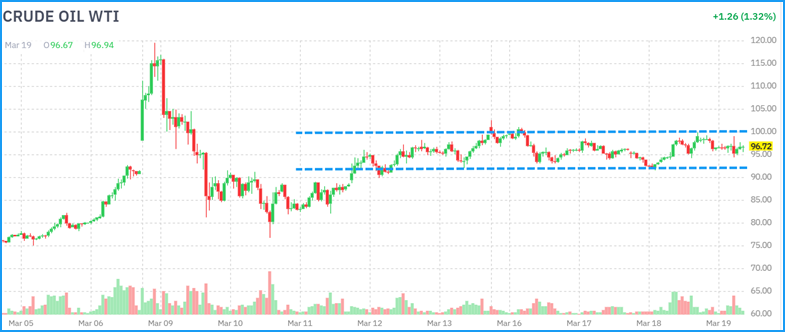
@chrismartenson Chris - can you explain how there appears to be no arbitrage in the oil markets to force WTI to reflect true prices and over come the paper slam?

I hate to be the bearer of bad news but if infrastructure like this 👇 gets blown up, as of this moment it will take at least a decade to recover from this war - and the truth is that the world's energy picture is probably changed forever. This single facility 👇produced roughly 20% of global LNG supply (aljazeera.com/news/2026/3/18…) and, as of 2011, had taken $70 billion to build (energyintel.com/0000017b-a7be-…). What makes this even worse is that Iran's strike on this was retaliation after Israel attacked their South Pars gas field which draws from the same natural gas reservoir, which is the world's largest by far (9,700 km² - about the size of Qatar itself). Heck, on the list of the 25 largest natural gas fields (en.wikipedia.org/wiki/List_of_n…) this single reservoir holds roughly 40% of their combined recoverable reserves - and is nearly 6 times bigger than the 2nd biggest field in the world. And, unlike many of the others on the list, it's only at 10% depletion (meaning 90% of the gas is still there). Which means that, probably for many years, a huge share of the gas from the world's largest reservoir simply won't be extractable, as infrastructure on both sides - Qatar's and Iran's - has now been blown up. From a global energy supply perspective, we're deep into worst-case scenario territory.


The big mistake Iran made was that they could have had Article 5 protection afforded by Russia. If that was in place, Israel and the US would never have launched a single missile strike on Iranian territory. If Russia has made it clear that in the event of either the US or Israel attacking Iran, that would have resulted in Moscow declaring war on those aggressors, do you imagine that what we have witnessed since 28th February would ever have happened. The answer is emphatically no.