@FeelsGuy2003 The same can be said for you when you make your asinine comments about Fr Cekada.
English
APG
6K posts
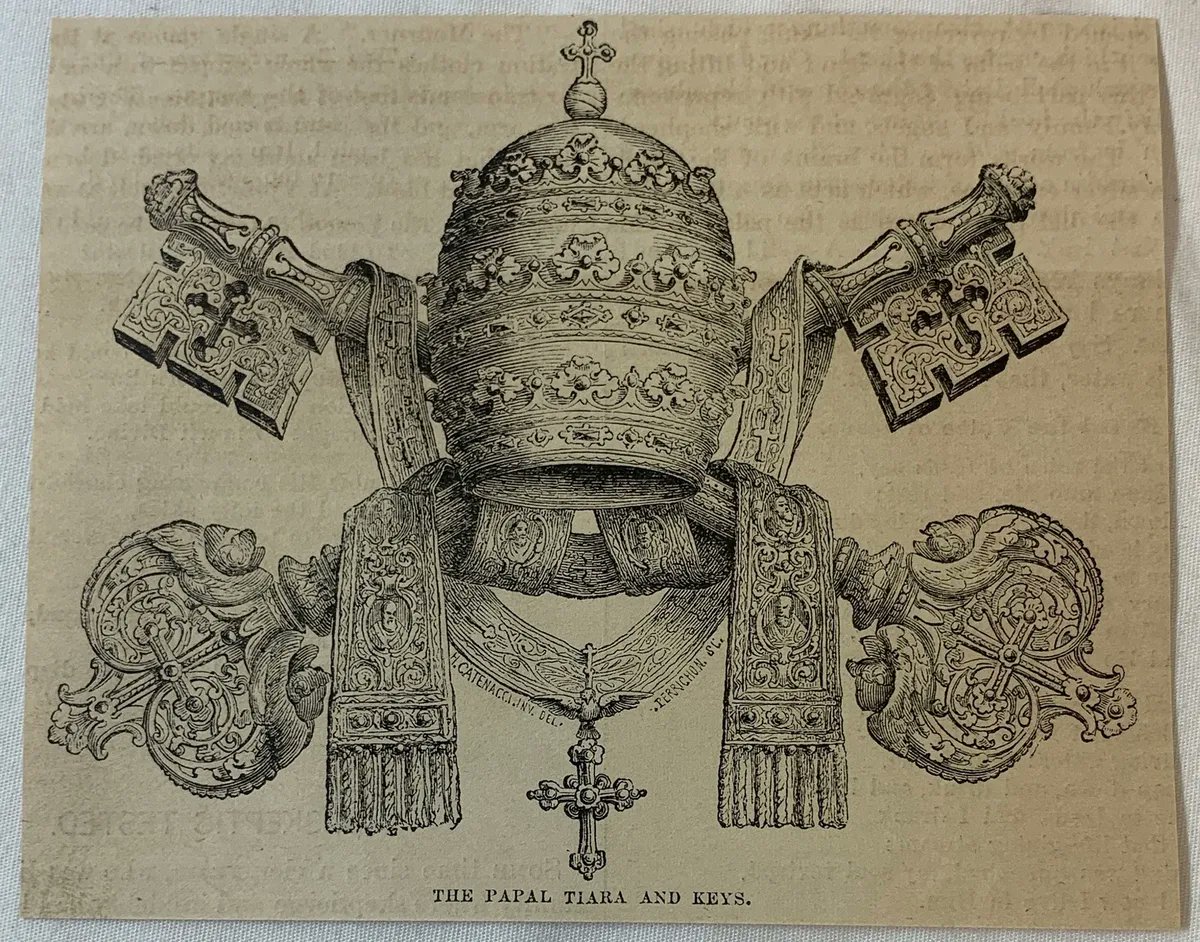

Vatican II tried to revise & restrict the Latin mass to make it more inclusive and progressive. The 1962 Tridentine Missal was almost completely extinguished in that time— but it survived. Today, hundreds of parishes perform the traditional Tridentine Mass. It’s quite beautiful.

I was devastated when he died. My biggest regret in life was never getting the chance to tell him I was sorry for the horrible things I said about him, and that I loved him with all of my heart.
Kosher Catholicism is not going to make it through the coming times.


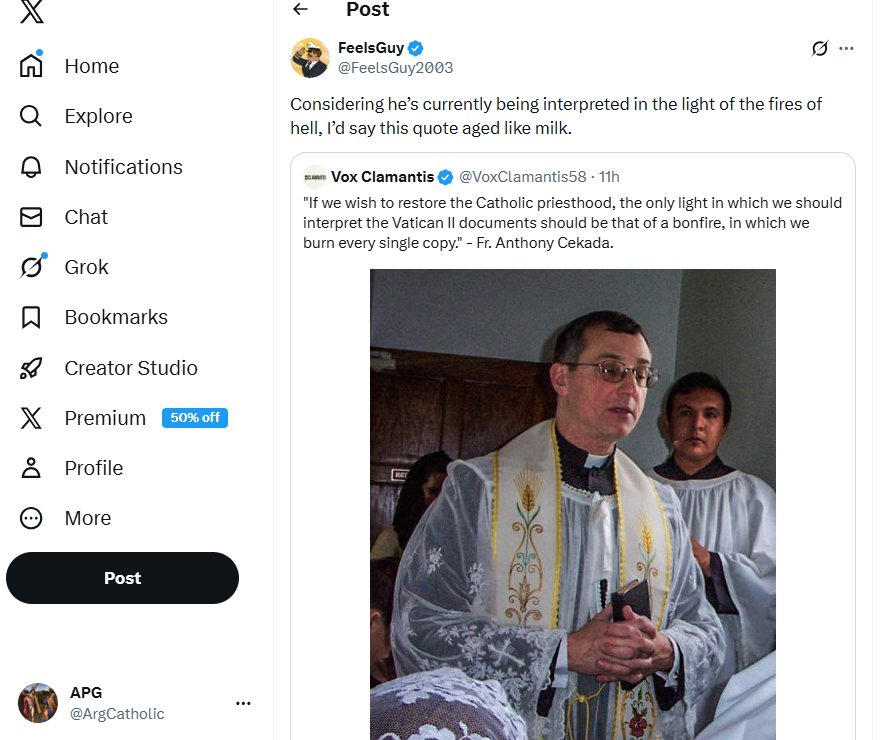
"If we wish to restore the Catholic priesthood, the only light in which we should interpret the Vatican II documents should be that of a bonfire, in which we burn every single copy." - Fr. Anthony Cekada.

@Catholicizm1 Your sect follows Nostra Aetate, it’s a Jewish religion.

Cruz's real issue is with Catholicism itself. He and many like him despise the Church's long-standing teachings on Church-State relations and the Kingship of Christ. Vatican II bent the knee to his ilk but Traditionalists will not. Not now not ever.⚔️
If sedevacantism is such a rational position why does it attract the most irrational group of retards on earth?
You mean the spurious “quote” that is actually a fabrication? (If I’m wrong, by all means, prove it.) Speaking of numbers, the Church’s mark of catholicity includes what Msgr. Van Noort calls “moral catholicity,” meaning that “the Church should always include in its membership a vast number of men from many different nations. … To satisfy the requirements of moral catholicity in fact — a quality belonging to Christ’s Church perpetually and necessarily — we stated there was required: ‘a great number of men from many different nations.’” Christ’s Church, p. 146 aroucapress.com/christs-church As for Pope Leo XIV, I recognize him as the legitimate successor of St. Peter with real authority to teach, govern, and sanctify. Like all Catholics, however, he is bound to the remote rule of faith (Scripture and Tradition) and “the ecclesiastical monuments” (Cardinal Franzelin, On Divine Tradition, Thesis XIII), such as formal creeds of the Church and infallible definitions of past popes and councils. (He is not a divine oracle whose every word is infallible.) From the moment his election was peacefully and universally accepted by the Church, Leo XIV’s pontificate was established as a dogmatic fact. To quote Fr. Berry, “since the Church is infallible in believing as well as in teaching, it follows that the practically unanimous consent of the bishops and faithful in accepting a council as ecumenical, or a Roman Pontiff as legitimately elected, gives absolute and infallible certainty of the fact.” The Church of Christ, p. 507 archive.org/details/church… In the words of Van Noort, “It is certainly not a backbreaking job to find the legitimate successor of Peter. First, it is a fact beyond question that Christ’s Church can never fail to have a successor to Peter [cf. Vatican I, Pastor Aeternus, Ch. 2; DH 3058: “perpetual successors”]; secondly, no one ever seriously claims to hold Peter’s office except the Roman pontiffs.” Christ’s Church, p. 153
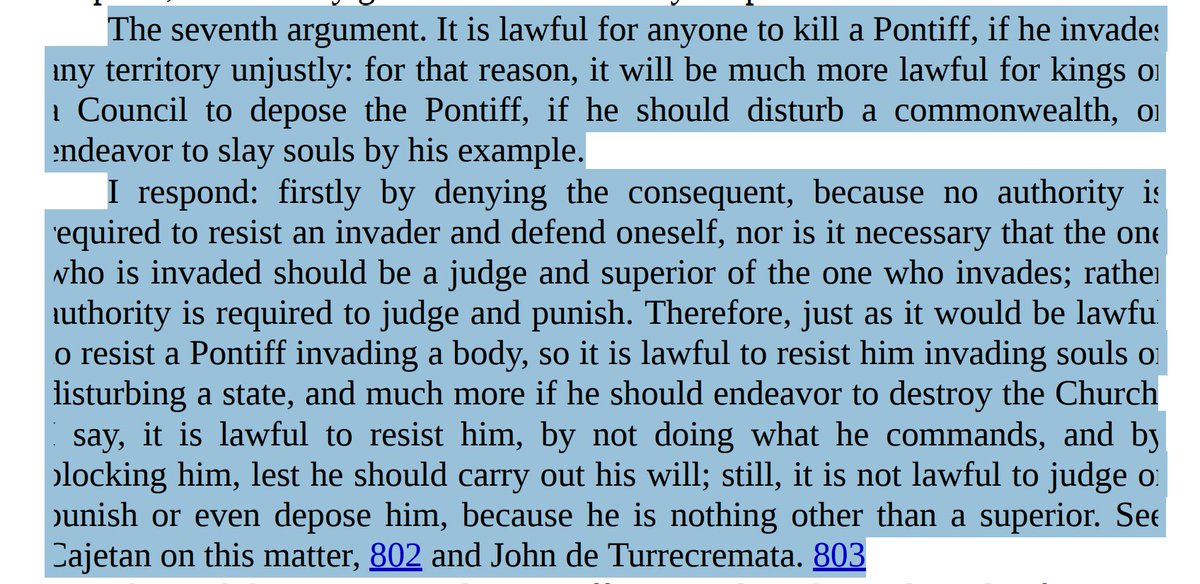

@MattGaspers It's funny how you make such a fuss about legitimate successors when you don't even follow those who you believe are legitimate successors. Why make such a fuss if we don't need to obey them?
FORMAL VISIBILITY AND APOSTOLICITY OF GOVERNMENT When it comes to the Church’s mark of apostolicity, sedevacantists generally seem to be hyper-focused on apostolicity of doctrine (i.e., the necessity of doctrinal continuity), yet they almost always neglect apostolicity of government (i.e., the necessity of formal or legitimate succession) entirely. A case in point is Mr. Wright’s latest article for @TheWMReview, in which he quotes Msgr. Van Noort (d. 1946) on the former but ignores the theologian’s teaching on the latter. The reason for this, I would imagine, is that there is simply no way to reconcile the sedevacantist thesis with apostolicity of government, which Van Noort says is “an essential part of that Church’s structure,” referring to the visible Church founded by Christ (Christ’s Church [The Newman Press, 1957], p. 152). aroucapress.com/christs-church Mr. Wright also quotes from The Church of Christ by Fr. E. Sylvester Berry (d. 1954), another stellar theologian, but he ignores Fr. Berry’s teaching on apostolicity of government, which is inseparably linked to the attribute of visibility and thus critically important to the discussion: “Apostolicity of origin and of doctrine are easily understood without further explanation, but some knowledge of succession is necessary for a proper conception of apostolicity of ministry. Succession, as used in this connection, is the following of one person after another in an official position, and may be either legitimate or illegitimate. Theologians call the one formal succession; the other, material. A material successor is one who assumes the official position of another contrary to the laws or constitution of the society in question. He may be called a successor in as much as he actually holds the position, but he has no authority, and his acts have no official value, even though he be ignorant of the illegal tenure of his office. A formal, or legitimate, successor not only succeeds to the place of his predecessor, but also receives due authority to exercise the functions of his office with binding force in the society. It is evident that authority can be transmitted only by legitimate succession; therefore, the Church must have a legitimate, or formal, succession of pastors to transmit apostolic authority from age to age. One who intrudes himself into the ministry against the laws of the Church receives no authority, and consequently can transmit none to his successors.” (The Church of Christ [Wipf and Stock Publishers, 2009], p. 78; emphasis in original) amazon.com/gp/product/160… Mr. Wright would also do well to read what Fr. Berry teaches regarding jurisdiction: “Jurisdiction is authority to govern and must be transmitted in the Church as in any other society; it can be conferred only by a lawful superior, according to the constitution and laws of the society, and may be revoked at any time. Consequently, jurisdiction in the Church can neither be obtained nor held against the will of her supreme authority; its transmission depends entirely upon legitimate succession. It is not sufficient, therefore, that a church have valid Orders; it must also have a legitimate succession of ministers, reaching back in an unbroken line to the Apostles, upon whom our Lord conferred all authority to rule His Church.” (ibid.) There is only one institution on earth that possesses both formal visibility and “a legitimate succession of ministers,” namely, the Church which sedevacantists pejoratively refer to as the “Vatican II sect” (while sedevacantists themselves have neither, by the way). As an aside, I find it quite ironic that Mr. Wright quotes from Berry and Van Noort when both theologians teach (and rightly so) that the universal and peaceful acceptance (UPA) by the Church of a pope establishes the pontificate of the man elected as a dogmatic fact (i.e., a secondary object of infallibility). See Berry, The Church of Christ, pp. 289-290; Van Noort, Christ’s Church, p. 112.