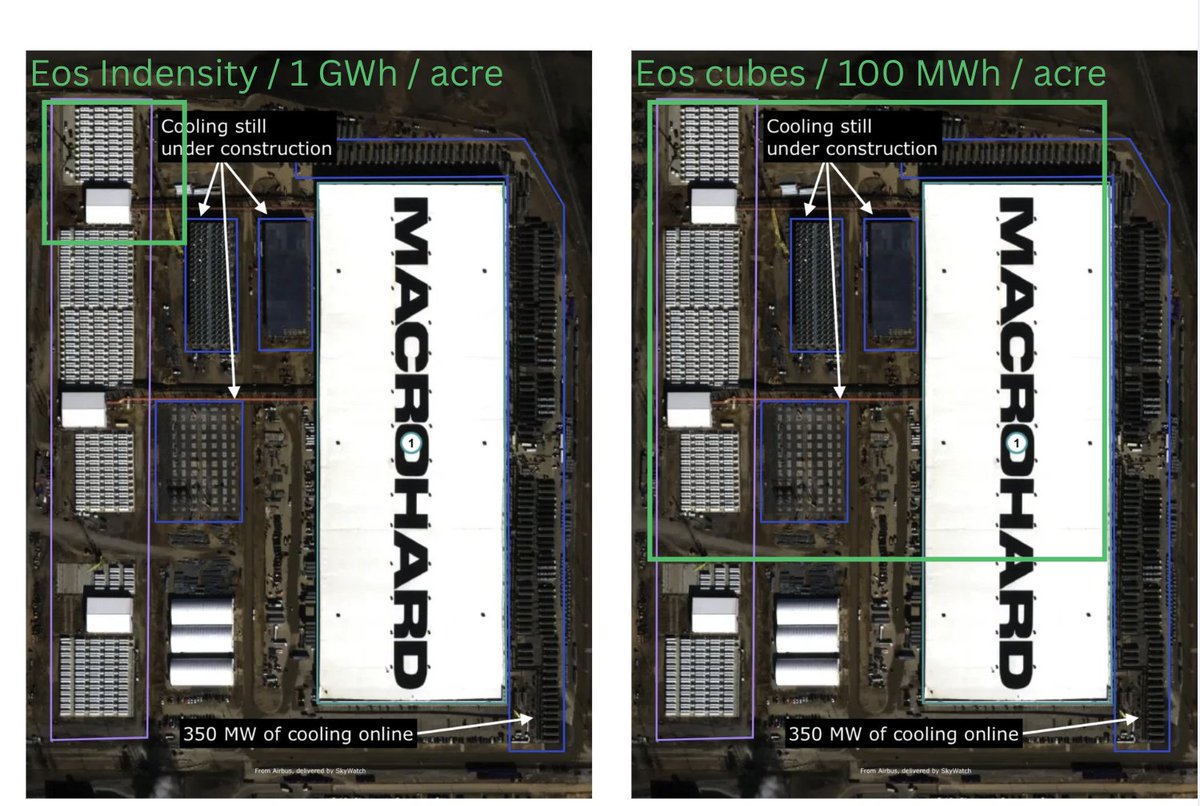
Very rough estimate of the land usage required to reach similar GWh stored if you used Eos Indensity at 1 GWh / acre instead of Tesla Megapack $EOSE (Green square)
🔋 Battery Buffett 🔋
1.9K posts

@BatteryBuffett
May you live in interesting times


Very rough estimate of the land usage required to reach similar GWh stored if you used Eos Indensity at 1 GWh / acre instead of Tesla Megapack $EOSE (Green square)


🚨 The AI ROI numbers are starting to look very ugly. Even under "best case" assumptions — assuming zero costs, just revenue against capex — the Financial Times calculated the implied return on hyperscaler AI investment from 2025 to 2030. Only one of them clears positive. Implied return on AI investment (FT / Panmure Liberum) – Microsoft: -9.2% – Alphabet: -15.7% – Amazon: +7.2% – Meta: -28.8% – Oracle: -35.6% And remember: that's assuming zero costs. In reality, GPUs depreciate, power bills run, salaries get paid. The real returns are worse. This is exactly why the dot-com comparison keeps coming up. Incredible technology does not automatically mean sustainable economics. The internet survived. Most internet companies didn't. Two anecdotes from this week alone Vivek Garipalli, Fortune 20 insider: a CEO asked for $1B in AI-driven opex savings this year. The team spent $200M on tokens chasing it. The results? Modest customer service savings and slightly less hiring in engineering. The CEO has now ordered token costs to be dramatically slashed because the ROI isn't there. Axios: an AI consultant reported a single client spent half a billion dollars in one month after forgetting to put usage limits on Claude licenses for employees. Right now hyperscalers are spending trillions hoping future demand catches up to present capex. That's not certainty. That's a leveraged bet. The technology is real. The infrastructure buildout is real. The eventual winners will be real. But "AI is transformative" and "every hyperscaler will earn its capex back" are two completely different statements. In 2000, the internet was real too. Cisco has recovered. After 26 years…


I’m increasingly convinced $EOSE can achieve a $300 share price. The market backdrop is the first part of it. Rystad and BNEF both have 2030 storage installs in the ~400–450 GWh a year range. Those numbers were set before the surge in AI and data centre demand, so even the official forecasts are probably on the low side. Then there’s how Eos scales. Their whole approach is based on modular manufacturing lines they can repeat quickly. They don’t need multi-year, multi-billion $ lithium-ion style gigafactory builds. Once a line is proven, they can add the next one much faster. In a market growing at this speed, that’s a huge advantage that is easily overlooked. They’ve also been talking more about shorter duration and multi-cycle use cases. Their chemistry can handle that without the usual degradation, which moves them from a niche “long duration only” story into a much bigger slice of the storage market. I don’t even think that’s fully necessary to achieve $300 as longer durations have an increasing slice of the market going forwards anyway. The new COO is a massive positive as well. This is exactly the stage where you need someone who’s scaled manufacturing before and can tighten operations, he’s hit the ground running in the 60 days he’s been with Eos and I’m very confident he will continue to bring costs down and help them scale rapidly. The numbers themselves are straightforward. At roughly $250/kWh ASP, ~30% margin, and with Eos qualifying for the full $45/kWh 45X credit, each 1 GWh of annual output comes out to about $120m of earnings power. Use a cautious future share count of around 600m and a normal growth multiple (25x), and you get roughly $5/share per GWh. If they eventually build out to ~60 GWh, you get about 60 × $5 = $300/share. To put that 60 GWh in context, it would only be around 13–15% of the 400–450 GWh market that Rystad/BNEF are forecasting for 2030, and probably an even smaller share if installs end up higher because of AI and data-centre demand. And that’s before you consider that fast-growing manufacturing stories often overshoot on multiples during the ramp. If that ever happens here, the share price could go higher than the basic maths suggests, or it could mean they undershoot 60 GWh but get a more favourable multiple on the way up. I’m not focusing on lines / factories anymore because that seems largely irrelevant at this point. They can scale supply fast enough now to match the demand as it comes in. They still need to execute, obviously. But the path to $300 seems increasingly possible.

$EOSE "Progress in Thornhill…debugging line #2. We’ve applied learnings from Line #1 that can be retrofitted … couldn’t be prouder of how this team is focused." - Mastrangelo