Tweet ghim
CeeCo
11.9K posts

CeeCo
@CeeCoDesign
Michigan designer, painter, and patriot! (I do not reply to DMs)

Michigan Tham gia Ocak 2014
544 Đang theo dõi317 Người theo dõi
CeeCo đã retweet

@Architectolder You might change your mind on those floors if you had to clean up after an aging large dog!
English

Met a lot of like-minded people on this post. Sorry I had to travel all day and could not respond
🏛Architectolder@Architectolder
Like this? we would probably get along pretty well

English
CeeCo đã retweet

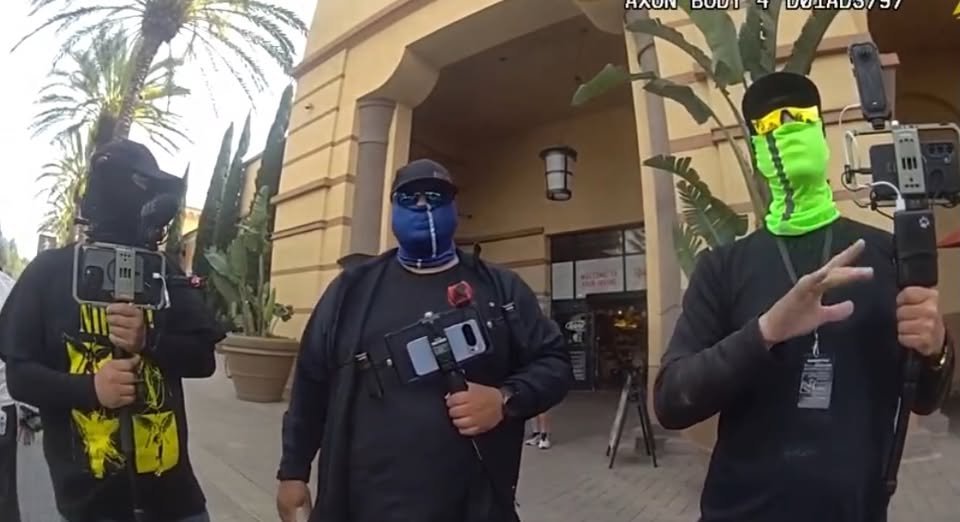
@TonySeruga They came to our small town in Michigan, harassed the local meat shop. Butcher came out, they pepper-sprayed him. He pressed charges.
English

🎥 GPS—What/Who “First Amendment Auditors” Actually Are
At the surface level, the police aren't wrong: these are individuals who film in public to assert constitutional rights. But that’s just the outer layer.
Underneath, it’s a mix of activism, monetized confrontation, and decentralized anti-authority culture—not a single coordinated movement.
🧠 The Core Playbook
Most auditors follow a pretty consistent script:
- Film in legally protected spaces (sidewalks, public buildings, lobbies)
- Refuse to explain themselves
- Provoke interaction without explicitly breaking the law
- Wait for overreach (detention, ID demands, trespass orders)
- Capture it all on video
- Upload for views, donations, and legal leverage
The goal isn’t random filming—it’s stress-testing authority figures and the public to see who violates rights under pressure.
💰 Follow the Money (This Matters)
This is where things get more real.
Many auditors are not just hobbyists—they’re running content businesses:
- YouTube monetization (ad revenue from viral confrontations)
- Donations / livestream tips
- Subscription platforms
- Civil lawsuit payouts (when police cross legal lines)
A single viral confrontation can generate tens of thousands of dollars across platforms.
So yes—there’s a financial incentive to create conflict.
Not all auditors admit this, but behavior lines up:
Calm, uneventful audits don’t pay. Confrontation does.
GPS tells us many of them are professional protesters and agitators. They go where they make the most money.
However, counterterrorist experts fully expect terrorists/bad actors to take advantage of the perceived anonymity to case certain public locations and venues.
🧩 Are They Organized?
This is where people expect a big centralized group. That’s mostly not what’s happening.
❌ Not a single organization
There’s no umbrella group controlling everything.
✅ But there are networks like Antifa:
- Informal alliances between creators
- Shared tactics and legal strategies
- Shoutouts and cross-promotion
- Copycat behavior driven by algorithm success
Think of it like:
A decentralized online subculture, similar to independent journalists or streamers—not a formal movement with a headquarters.
Some individuals brand themselves, but there’s no verified evidence of:
- A central funding body
- A unified command structure
- A single ideological doctrine
⚖️ The Legal Angle (Why Police Are Cautious)
Police departments know something most people don’t:
- Auditors often win lawsuits when officers mess up
- Settlements cost cities real money
- Even small violations (unlawful detention, retaliation) can trigger payouts
So departments now train officers to:
- Avoid escalation
- Respect filming rights
- Do not take the bait
Essentially:
“Don’t become the lawsuit.”
🎭 The Psychology of It
There are a few overlapping motivations:
1. Genuine civil liberties activism
Some auditors truly believe they’re:
- Holding the government accountable
- Educating the public on rights
- Documenting abuse
2. Anti-authority culture
A strong distrust of institutions:
- Police
- Government
- Corporate surveillance
This part isn’t irrational—people are reacting to a world already saturated with surveillance.
3. Performance + monetization
Others lean hard into:
- Provocation
- Costumes, masks
- Baiting emotional reactions
Because outrage = clicks = 💰
4. Hybrid types
Most fall somewhere in the middle:
Part protester, part activist, part entertainer, part opportunist.
🧨 What They’re Really Testing
It’s not just about “can I film here?”
They’re probing:
- Will authorities respect rights under pressure?
- Do citizens understand the law—or default to control?
- How quickly does someone escalate to aggression?
- Is there security on the premises?
And they’re doing it in a way that:
- Maximizes visibility
- Creates legal risk for others
- Rewards confrontation
🧭 The “End Game”
There isn’t one unified master plan—but there are clear individual endgames:
For some:
- Normalize public recording rights
- Deter government overreach
- Test security and boundaries
For others:
- Build a personal media brand
- Generate income from viral conflict
For a smaller subset:
- Force lawsuits to extract settlements
- Turn rights violations into revenue streams
- Expose vulnerable soft targets
So the real answer is:
The “end game” depends on the individual—but the system rewards conflict, not calm education.
⚠️ The Part People Miss
Public police press releases and posts hint at something important:
You’re already being recorded constantly—just by institutions and corporations.
Auditors flip that dynamic:
- Instead of top-down surveillance, it becomes bottom-up surveillance
That shift makes people uncomfortable—not because it’s illegal, but because:
The watcher is no longer anonymous or controlled.
🧩 Bottom Line
- No secret centralized organization pulling strings
- No single funding source
- But absolutely real financial incentives and coordinated behavior patterns
They’re best understood as:
Decentralized accountability activists mixed with internet-age provocateurs operating in an attention economy
And whether you see them as watchdogs or instigators depends on one question:
Do you think power behaves better when it knows it’s being watched—or worse when it’s being provoked?
Both are happening at the same time.
However, still, keep your head on a swivel and stay frosty.
If there is something they are recording or giving suspicious attention to, report it. Do not engage. Record yourself if you can safely do so. Be law enforcement's eyes and ears.
👉 Boost the algorithm, fight the throttling, and get more 👀: bookmark, share, reply, repost, like, and follow @TonySeruga

English

@HerbsandDirt I've seen posts saying that boxes of ticks are being air dropped in random rural areas. Is this true?
English
CeeCo đã retweet

Hungary did slash benefits for asylum seekers and refugees in 2016: April cuts ended pocket money and work rights; June eliminated integration aid, housing, and health extensions for recognized refugees.
Asylum apps: ~177k in 2015 → 29k in 2016 (83% drop) → 3.4k in 2017 (98% from 2015 peak).
The drop started with the 2015 border fence and 2016 push-backs (8-km rule), which blocked most entries. Welfare cuts added to the deterrent, but physical barriers were the bigger factor. Data from Eurostat, Hungarian Helsinki Committee, and IOM.
English

@Architectolder Too much wood! Elements should be balanced for calmness with the room (good feng shui/design elements)
English
CeeCo đã retweet

@Architectolder It's just missing the fake block galv panels that look like a foundation. Grandparents house was same, with panels, on piers. Had to put in a foundation.
English
CeeCo đã retweet

🚨BREAKING: 8 weeks of gratitude practice physically rebuilds the neural pathways between your memory and reward centers.
Your brain physically rewires itself every time you feel grateful.
Eight weeks of intentional gratitude practice creates measurable structural changes in the neural pathways connecting your hippocampus to your ventral tegmental area. The memory center starts talking to the reward center in a fundamentally different way. New synaptic connections form. Existing ones strengthen. The physical architecture of how you process positive experiences rebuilds itself.
Most people approach gratitude like a mood they can choose to feel. A psychological vitamin they remember to take when life gets difficult. The neuroscience reveals something far more profound.
Gratitude is a biological intervention that sculpts brain tissue.
Researchers tracked participants practicing gratitude exercises for two months using brain scans. They watched new neural highways construct themselves in real time. The anterior cingulate cortex developed stronger connections to the medial prefrontal cortex. The brain learned to route positive emotional experiences through higher order thinking centers instead of storing them as fleeting feelings.
Every positive experience you’ve ever had exists as a neural trace in your memory network. Most sit dormant, accessible only when something external triggers the specific sensory combination that originally encoded them. You smell coffee, suddenly remember a conversation from years ago. Random. Unreliable. Outside your control.
Gratitude practice systematically rewires that retrieval system.
After two months, participants could voluntarily access positive memories with increasing ease. Their brains had built stronger pathways between memory storage areas and emotional processing centers. They experienced deeper emotional resonance during memory retrieval. The quality of remembering itself had improved.
The participants also started noticing positive details in their present environment they had previously filtered out. Their attention systems recalibrated. The same neural pathways pulling positive memories forward were scanning current experiences more thoroughly for elements worth encoding as positive memories.
Their brains became biased toward collecting evidence that life contains meaningful moments.
Most cognitive interventions try to change how you interpret negative experiences. Gratitude practice changes how thoroughly you notice positive ones. It teaches your visual and emotional processing systems to detect opportunities and pleasures that were always present but neurologically invisible.
The timeline reveals something crucial about neural plasticity.
Weeks one through three showed minimal structural changes.
Participants felt slightly more positive, but brain scans looked identical to baseline. Weeks four through six showed the first measurable increases in gray matter density. Weeks seven and eight revealed entirely new neural network formation.
Two months. Your nervous system can physically restructure itself with consistent practice.
The method was almost embarrassingly simple. Participants wrote down three specific things they felt grateful for every evening, explaining why each mattered. No meditation apps. No guided visualizations. Just pen, paper, and the requirement to identify gratitude targets with enough detail that their brains had to actively search for positive elements.
Specificity drives the neural development.
General statements like “I’m grateful for my family” generate different brain activity than precise observations like “I’m grateful my daughter laughed at my terrible joke during dinner because it showed me she still finds me funny despite growing more independent.”
The brain needs detailed targets to practice connecting memory specifics to emotional rewards.
After eight weeks, participants developed a fundamentally different relationship with their attention and memory systems. Someone whose brain automatically scans for and emotionally amplifies aspects of experience that make existence feel worthwhile.
The neural pathways remain permanent after practice ends.
Gratitude carves lasting roads through consciousness.

Darshak Rana ⚡️@thedarshakrana
Gratitude rewires the brain. Gratitude rewires the brain. Gratitude rewires the brain. Gratitude rewires the brain. Gratitude rewires the brain. Gratitude rewires the brain. Gratitude rewires the brain. Gratitude rewires the brain. Gratitude rewires the brain.
English

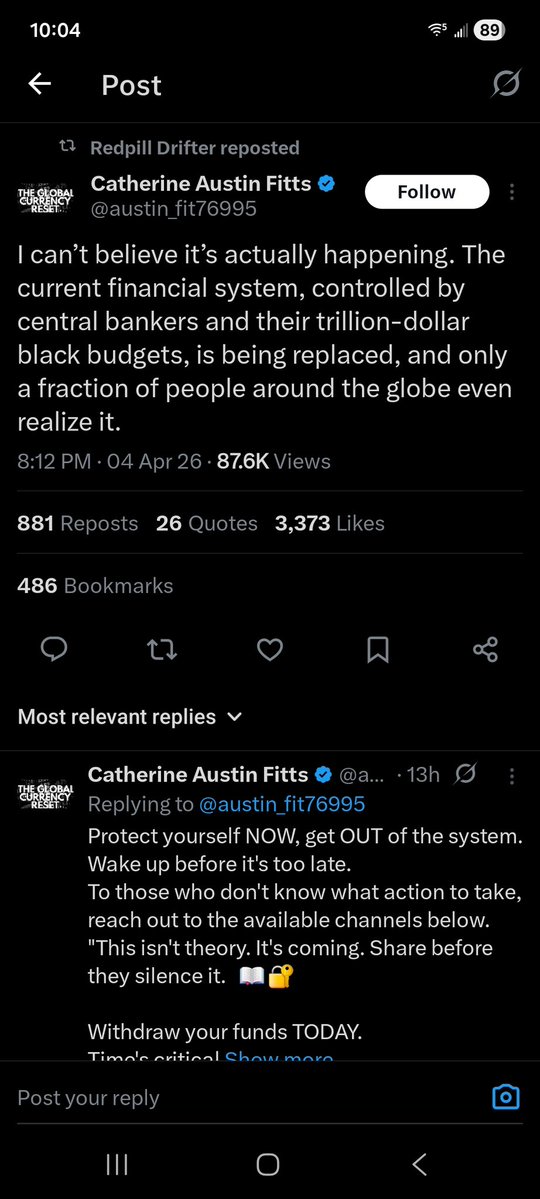
Beware Social Media Imposters and Scammers Pretending to Be Catherine or Solari
Last year, we published a warning about scammers creating fake accounts on Facebook pretending to be Solari or Catherine Austin Fitts. At the time, we reminded our followers that we are not on Facebook at all.
Solari is on X (@solari_the), and various entities have been impersonating Catherine there and on other social media platforms. In some cases, we have been able to get the fake accounts taken down, but in one case, we have been unsuccessful. The scammer in question is quite sophisticated and has been using Catherine’s name and photo and Solari’s branding and copyrighted materials without authorization to mislead the public and gain credibility.
Full Report: solari.com/beware-social-…
Subscribe to shop.solari.com

English
CeeCo đã retweet
CeeCo đã retweet
CeeCo đã retweet
CeeCo đã retweet

@sisalgirl @Architectolder Connected, maybe a long atrium room along the back. That would be fun. I have a LOT of art stuff and workshop.
English

@CeeCoDesign @Architectolder All connected or separate in a row?
English