Cryptic

210 posts

Cryptic banner
Cryptic

Cryptic

@CrypticTechApp

Privacy Is Power.

Tham gia Ağustos 2025
47 Đang theo dõi3.5K Người theo dõi
Tweet ghim
Cryptic
Cryptic@CrypticTechApp·
Why 2026 Is The Year Privacy Must Become Quantum Resistant 🧵1/8 Privacy Is Power. But today’s “private” tools won’t survive tomorrow’s quantum computers. Harvest now, decrypt later is real and accelerating. Cryptic is building post-quantum private communication and payments for the next decade. A short thread on the threat and why true digital sovereignty must be post quantum by design 👇
English
12
15
45
12.4K
Cryptic
Cryptic@CrypticTechApp·
@Unfilteredledgr There will be always availability of encrypted messaging, just choose your apps wisely.
English
0
0
0
1
Unfiltered Ledger
Unfiltered Ledger@Unfilteredledgr·
WhatsApp stays encrypted. Messenger too. Meta's spokesperson explicitly said users who want encryption should switch to WhatsApp. So Meta is keeping encryption where it already existed and scrapping it where they never bothered to launch it properly, then pointing to the low numbers as justification. Two weeks before Meta's announcement, TikTok said it won't implement E2EE for DMs, citing interference with safety investigations. Meta's move puts Instagram on TikTok's standard. (TikTok: helpnetsecurity.com/2026/03/16/ins…)
English
2
0
0
5
Unfiltered Ledger
Unfiltered Ledger@Unfilteredledgr·
Meta says it's killing Instagram DM encryption because almost nobody opted in. What they don't mention: they designed it that way. The opt-in feature was buried behind four taps in settings. It was never made the default. It was only available in "some areas" (Meta never specified which ones) on a platform with 3 billion monthly users. The author at Android Police who wrote about the removal still didn't have access to the feature when the announcement came out. So: Meta built a privacy feature, hid it from most users, never promoted it, never turned it on by default, and is now pointing to low adoption as the reason to scrap it entirely. The timing is the part that stops you. Encryption ends May 8. The Take It Down Act, which requires platforms to scan and remove intimate images from DMs within 48 hours, has its compliance deadline on May 19. Eleven days apart. Fortune identified the gap directly: if Instagram DMs are end-to-end encrypted, Meta cannot read message content, making it technically impossible to fulfill those removal requests. Meta hasn't said that publicly. But in 2022, Meta paid an independent firm called BSR to assess the human rights impact of expanding encryption across its platforms. The report concluded that E2EE "supports a range of fundamental human rights" including privacy, freedom from state surveillance, and freedom of expression. Meta committed to implementing 34 of 45 recommendations. Now it's reversing the expansion that report was written to justify. The internal picture is harder to look at. Unsealed documents from a New Mexico lawsuit showed a February 2019 internal briefing: if Messenger were encrypted, NCMEC child abuse reports to Meta would fall from 18.4 million to 6.4 million, a 65% drop. Meta's own head of content policy wrote internally that with encryption, "there is no way to find the terror attack planning or child exploitation." Those documents predate any regulatory pressure. The child safety concern is genuine, and it's been on Meta's books for seven years. What they get from unencrypted DMs: compliance with the May 19 deadline, the ability to fulfill content-level requests from the 81,884 US law enforcement inquiries Meta received in just the first half of 2024, and a commercially driven decision reframed as a user experience call. What users get: the platform Zuckerberg described in his 2019 privacy manifesto, minus the one part he most specifically promised.
English
1
0
0
1
Newsroom ZA
Newsroom ZA@NewsroomZA·
Meta has announced plans to remove end-to end encryption from direct messages on social media platform Instagram. The removal will be put in place on the 8th of March, 2026. Previously, users had to choose to manually enable encrypted chats. Now, those who have been making use of encryption are being urged to save any chats with encryption, as these encrypted chats will reportedly disappear from the app.
Newsroom ZA tweet mediaNewsroom ZA tweet media
English
1
0
1
21
Jasper W
Jasper W@Jasper_W90·
@EP_Justice @TheProgressives People are sick and tired of getting their #privacy breached while pushing for #DigitalID #AgeControl through government agencies. 'Voluntary' detection through scanning all images and messages? Presumed GUILTY? Protect the children but not at the expense off privacy for everyone
English
1
0
1
145
Cryptic
Cryptic@CrypticTechApp·
@MonstaDomains Privacy should be the standard, I love the approach!
English
0
1
8
39
Osama Chaudhry
Osama Chaudhry@chaudhry_osama·
Your phone apps are training AI models every day. 1. Photo apps scan every image you take 2. Keyboard apps log what you type 3. Location apps build real-time human movement maps The opt-out is buried. But it exists. Go check your settings. #AI #privacy
English
2
0
0
23
Cryptic
Cryptic@CrypticTechApp·
@wwhanlon Is it really getting this bad? Time to take privacy seriously.
English
0
0
3
33
Cryptic
Cryptic@CrypticTechApp·
Public doesn’t have to mean exposed. We’re merging strong encryption with speed. Public chats are coming, and soon, our community lives inside Cryptic.
Cryptic tweet media
English
4
5
15
346
Cryptic
Cryptic@CrypticTechApp·
@anonpgomes I believe privacy should be a right, actually it's available to everyone of us. People just need to understand how your data is being sold if you don't act cautious.
English
0
0
3
43
𝒫𝑒𝒹𝓇𝑜 𝒢𝑜𝓂𝑒𝓈 🇵🇹
Most #crypto projects chase narratives. ANyONe Protocol is building infrastructure. A decentralized #privacy network, where: • Users get real online anonymity • Node operators are incentivized • The network scales through participation As surveillance and data extraction keep growing, protocols that restore control to users will become critical infrastructure. That’s where @AnyoneFDN comes in, powering a network designed to make anonymous communication accessible to everyone. If decentralized privacy becomes a core pillar of #Web3, $ANYONE could become one of its key layers. Still early. Still building. #DePIN #ETH #VPN #AI #Tor
𝒫𝑒𝒹𝓇𝑜 𝒢𝑜𝓂𝑒𝓈 🇵🇹 tweet media
English
3
3
50
545
Cryptic
Cryptic@CrypticTechApp·
@TheNavThethi Privacy equals peace of mind, which leads to a happier life.
English
0
0
0
5
The Nav Thethi
The Nav Thethi@TheNavThethi·
1. The return of offline computing. #Privacy is king, and local processing is how we protect it.
The Nav Thethi tweet media
English
2
0
0
11
The Nav Thethi
The Nav Thethi@TheNavThethi·
I had an incredible discussion at #Austin during #SXSW yesterday. My big message: AI is a collaboration, not a competition. A few things we covered:
The Nav Thethi tweet mediaThe Nav Thethi tweet mediaThe Nav Thethi tweet media
English
1
0
1
43
Cryptic
Cryptic@CrypticTechApp·
Privacy shouldn't be shared without your explicit consent. We all know no one reads the user terms and just clicks "okay." That's where you agree to give away your data. Use apps that take your privacy seriously, use encryption wherever you can. Web3 is the (r)evolution of privacy.
English
1
1
5
89
𝒫𝑒𝒹𝓇𝑜 𝒢𝑜𝓂𝑒𝓈 🇵🇹
Privacy shouldn’t stop at the blockchain level 🛡️ Your #crypto transactions can be private on-chain, but network-level metadata still leaks: IP addresses, timing, and traffic patterns. That means your activity can still be traced. Real #privacy requires a full stack approach. ANyONe Protocol provides the network privacy layer for crypto and #Web3, hiding IPs and metadata through decentralized onion routing. Unlike centralized VPNs, trust isn’t placed in a single provider. It’s distributed across thousands of independent nodes 🌐🔐 Don’t just protect the ledger. Protect the connection. @AnyoneFDN $ANYONE #ETH #monero #zcash #VPN #Tor
English
3
3
20
732
Jupiter
Jupiter@JupiterExchange·
We’re building the future of finance!
English
188
155
776
75.5K
Cryptic
Cryptic@CrypticTechApp·
@PaulGStphens There are still applications that are firm at encrypting your private messages. Even if they wanted to spy, the right tools are available to evade being spied on.
English
0
0
1
20
Paul Stephens
Paul Stephens@PaulGStphens·
Stop thinking everything revolves around you. The push for digital IDs and passports is a way for people to be controlled. They want everything digital so they have access to you. #Privacy #DigitalID #Control
English
1
0
0
37
Cryptic
Cryptic@CrypticTechApp·
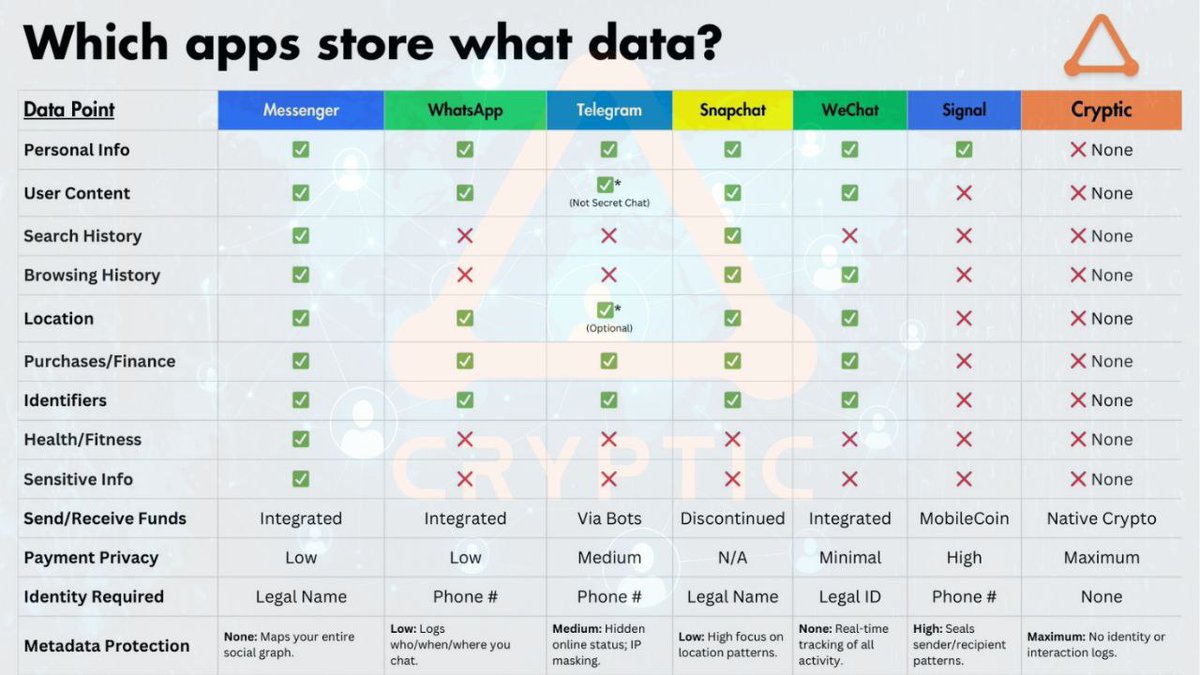
Telegram. WhatsApp. Signal. They built the foundation. Now we build the future. Wallets. Post-quantum encryption. Private conversations. Cryptic.
Cryptic tweet media
English
5
11
24
415
Cryptic
Cryptic@CrypticTechApp·
@TechNadu @WhatsApp As much as the intentions might be good in that specific case, it could open the doors for privacy breaches.
Cryptic tweet media
English
2
0
5
40
TechNadu
TechNadu@TechNadu·
Digital safety update. @WhatsApp is rolling out parent-managed accounts for pre-teens, allowing parents to control contacts, groups, and privacy settings. Messages remain end-to-end encrypted. Follow @TechNadu for cybersecurity and tech updates. #OnlineSafety #Privacy
TechNadu tweet media
English
1
0
0
84
Cryptic
Cryptic@CrypticTechApp·
@itguyakay Interesting! What kind of encryption is being used?
English
1
0
4
48
Cryptic
Cryptic@CrypticTechApp·
@LaneSystems Depending on what platforms/apps you use, privacy is nonexistent. Unless you use apps that are PQS encrypted.
English
0
0
1
43
Cryptic
Cryptic@CrypticTechApp·
@CyberNexoraNews Wouldn't it be a better world if no one collected your data?
English
1
0
1
32
Cryptic
Cryptic@CrypticTechApp·
@LuneExchange Sounds like some good advice. I would move to PQS encrypted messaging too.
English
0
0
0
29
Lune
Lune@LuneExchange·
Clarity Act uncertainty is shaking the centralized exchanges. Don't wait for any regulators to decide the fate of your funds. Move to a non-custodial engine and trade with total privacy. #DEX #Regulation #Privacy #Swap
English
1
0
1
282
Cryptic
Cryptic@CrypticTechApp·
@JMHBM01 @mullvadnet There are many tech companies that are using your data for financial gains. Scary to see. Your privacy belongs to yourself.
English
1
1
2
30
JMHBM
JMHBM@JMHBM01·
@mullvadnet This EU Chat Control saga screams tech-policy capture—authorities + big tech (looking at you, Google) eroding encryption/privacy. My OSINT dive exposes Google's DNS/CA funneling via ICANN ties, amplifying surveillance risks. Check it: x.com/JMHBM01/status… #Privacy #Antitrust #GoogleCapture #OSINT
JMHBM@JMHBM01

Introduction: The Myth of Passive Capture The investigation into the consolidation of the global internet frequently centers on the vulnerabilities of legacy infrastructure—specifically, how fragile protocols and unmanaged edge networks will inevitably fail under the weight of cryptographic upgrades like the 2026 Root Zone KSK Rollover. However, characterizing this transition merely as an accidental byproduct of systemic fragility fundamentally misrepresents the operational reality of the modern web. The core of this investigative seeks to answer a more profound and disturbing question: Is there empirical, quantifiable evidence proving that hyperscalers are not merely waiting for legacy systems to fail, but are actively and intentionally restructuring the architecture of the internet to funnel global Domain Name System (DNS) traffic directly into Google’s proprietary infrastructure? The answer is unequivocally yes. The evidence is robust, undeniable, and deeply embedded within the very protocols that govern how devices connect. This active capture spans across the configuration defaults of competing enterprise cloud environments, the symbiotic routing behaviors of the world’s largest Border Gateway Protocol (BGP) anycast networks, and the weaponized implementation of next-generation DNS discovery standards. What follows is a comprehensive, forensic autopsy of how the fundamental resolution plane of the internet is being deliberately routed away from sovereign, independent networks and fed directly into the hyperscale core. The DDR Centralization To understand the mechanics of the active DNS funnel, one must examine the evolution of encrypted DNS protocols and how the promise of user privacy has been inverted into a mechanism for ultimate centralization. Historically, DNS queries were transmitted in plaintext, allowing local Internet Service Providers (ISPs), network administrators, and on-path adversaries to monitor or intercept a user's browsing activity. To combat this, the Internet Engineering Task Force (IETF) standardized encrypted resolution protocols, primarily DNS-over-HTTPS (DoH) and DNS-over-TLS (DoT). While these protocols successfully encrypted the query, they introduced a new logistical problem: how does a client device (like a smartphone or laptop) automatically know if the local network it just joined supports these advanced encrypted standards? The solution, standardized under IETF RFC 9462 and RFC 9463, is a set of protocols known as Discovery of Designated Resolvers (DDR) and Discovery of Network-designated Resolvers (DNR). The Mechanics of the Trap The theoretical, publicly stated goal of DDR is noble: to seamlessly and automatically upgrade users from vulnerable unencrypted DNS to secure encrypted DNS without requiring the end-user to manually navigate complex network configuration menus. When a device joins a DDR-enabled network, it queries the local, unencrypted resolver provided by the router and essentially asks, "Do you have a secure, encrypted alternative I can use instead?" The local resolver then provides the "designated" encrypted target, and the operating system automatically upgrades the connection. However, a comprehensive and alarming 2025 network measurement study presented at the Privacy Enhancing Technologies Symposium (PETS) scanned 1.3 million open DNS resolvers to analyze the real-world deployment of the DDR protocol. The methodology was exhaustive, capturing a massive cross-section of the global routing table. The results of this study effectively dismantle the narrative of a decentralized, privacy-respecting internet, providing unequivocal proof of aggressive, protocol-driven traffic centralization. The PETS 2025 Data: An Autopsy of Decentralization The empirical data extracted from the 1.3 million scanned resolvers reveals a stark operational reality: Google's Absolute Dominance: The study found that an astonishing 79.3% of IPv4 and 82.54% of IPv6 DDR-enabled resolvers designated Google's encrypted DNS (dns.google / 8.8.8.8) as their absolute target. Cloudflare as the Regulated Secondary: Cloudflare (1.1.1.1) was identified as the second most designated provider, capturing 12.4% of the routing directives. The Eradication of Network Independence: Perhaps the most chilling metric in the entire study is the survival rate of localized networking. Only a statistically negligible 0.69% of IPv4 and 1.60% of IPv6 DDR-enabled resolvers delegated the encrypted connection to a server operating within their own Autonomous System (AS). The Operational Implication The implications of the PETS data cannot be overstated. When a user connects to a local, DDR-enabled network—whether in a coffee shop, a corporate office, or a sovereign government facility—their operating system queries the router for an upgrade path. In over 80% of cases globally, the router has been explicitly programmed by its firmware to respond, "Send your encrypted traffic directly to Google." This is not a passive fallback mechanism triggered by a network timeout or a cryptographic failure. It is an active, protocol-driven, silent redirection of global traffic. The local network administrators are effectively bypassed by the protocol itself. The traffic is lifted out of the edge network, encrypted so the local network cannot inspect it, and funneled directly into Google's hyperscale data lakes. The DDR protocol, cloaked in the language of privacy and seamless discovery, serves as the primary engine for the total eradication of decentralized DNS. AWS Route 53 and Azure DNS: The Surrender of the Enterprise Backend If Google is actively capturing endpoint telemetry via DDR, the next logical question is how its primary hyperscale competitors—Amazon Web Services (AWS) and Microsoft Azure—are responding. The assumption in a healthy free market is that these multi-trillion-dollar entities would fiercely protect their enterprise routing planes. The forensic reality, however, is that both AWS and Azure have become deeply architecturally reliant on Google's resolution infrastructure to maintain the illusion of hybrid-cloud continuity for their own enterprise clients. The AWS Route 53 Dependency In Amazon Web Services, massive enterprise architectures frequently utilize Route 53 Resolver endpoints to bridge the gap between their on-premises corporate networks and their isolated cloud environments, known as Virtual Private Clouds (VPCs). When an internal server needs to resolve public domain names or query external entities from within a private, split-horizon hosted zone, the AWS VPC Resolvers must perform complex recursive lookups. However, hybrid networking is notoriously fragile. When dealing with complex edge cases, unexpected network partition failures, or split-horizon DNS anomalies where internal and external records conflict, native cloud resolvers often struggle to maintain high-availability resolution. To compensate for these architectural weaknesses, AWS enterprise administrators have established a widespread, standardized practice: configuring Route 53 outbound forwarding rules that explicitly designate Google Public DNS (8.8.8.8) or Cloudflare (1.1.1.1) as the ultimate recursive backend. When the AWS routing logic fails or requires external validation, it simply hands the packet to Google. Microsoft Azure's Architectural Concession This pattern of structural surrender is identically mirrored in Microsoft Azure. Within Azure environments, private DNS zones that cannot natively resolve external queries rely heavily on DNS forwarding rules pointing to public recursive resolvers. This reliance is not merely a quirk of third-party administrators; it is hardcoded into official deployment guidance. A glaring example exists within the official documentation for configuring Kubernetes cert-manager deployments within the Azure Kubernetes Service (AKS). The cert-manager tool is critical for automatically provisioning TLS certificates (often via Let's Encrypt). However, Azure's native DNS infrastructure is prone to localized caching issues that can cause the required "DNS-01" cryptographic challenge to fail, preventing certificate issuance. To bypass Microsoft's own internal caching limitations, the documentation explicitly demonstrates configuring the DNS-01 challenge recursive nameservers to point directly to 8.8.8.8:53 and 1.1.1.1:53. The Telemetry Bleed This architectural reliance ensures a massive, systemic bleed of telemetry. As enterprise traffic scales exponentially within AWS and Azure, a proportional volume of recursive resolution data, internal timing metrics, and external API requests is actively shed from Amazon and Microsoft's networks directly into Google's anycast infrastructure. Google does not need to defeat AWS and Azure in the enterprise market; it simply provides the structural foundation that their enterprise networks require to remain operational. The Cloudflare Symbiosis and BGP Anycast Fluidity When analyzing this global consolidation, Cloudflare (operating 1.1.1.1) is frequently positioned in tech media and marketing materials as the direct, privacy-focused competitor to Google DNS. However, an analysis of their BGP routing behaviors and enterprise integrations reveals that their infrastructural relationship is not adversarial, but highly symbiotic. Both entities operate massive, highly optimized BGP anycast networks—Google operating under Autonomous System Number (ASN) 15169, and Cloudflare under AS13335. Together, they form a functional duopoly that captures nearly all orphaned or redirected internet traffic. Evidence of their deep architectural intertwining is abundant across modern enterprise deployments: Cloudflare Gateway Fallbacks: In modern enterprise "Zero Trust" deployments, corporations frequently route all employee traffic through Cloudflare Gateway for security filtering. However, certain legacy or heavily fortified applications contain hardcoded DNS instructions that completely bypass the operating system's routing table. Applications such as Android Studio (a Google product) or WhatsApp routinely bypass Cloudflare's localized filtering and attempt to dial 8.8.8.8 directly. Because this behavior is so ubiquitous, Cloudflare's official enterprise documentation explicitly instructs network administrators to create specific network policies designed to catch these hardcoded bypasses and either route or block the traffic attempting to reach Google. The competitor's documentation is dedicated to managing Google's hardcoded dominance. Google Cloud Integration: The symbiosis is mutual. Cloudflare provides specific, highly detailed technical documentation for integrating 1.1.1.1 as the designated alternate DNS server within Google Cloud VPC DNS Server Policies. By officially documenting and supporting each other's anycast addresses within their proprietary cloud backends, the two hyperscalers inextricably link their resolution paths at the highest levels of enterprise architecture. Secondary Configuration Norms and Micro-Latency: Across the global IT industry, the standard operating procedure for static, manual DNS configuration is virtually unanimous: deploy 1.1.1.1 as the primary resolver, and 8.8.8.8 as the secondary resolver (or vice versa). Because modern client operating systems frequently query primary and secondary resolvers in parallel to guarantee a response, or switch rapidly between them upon detecting micro-latency spikes as small as a few milliseconds, global traffic flows fluidly and constantly between the two entities. They do not compete for the user; they share the user. Surviving the 2026 AI Infrastructure Upgrades The preceding evidence establishes how the routing plane is being captured, but the underlying economic question remains: Why are competitive, trillion-dollar titans like AWS, Azure, and major global telecommunications operators willingly ceding the fundamental resolution plane of the internet to a direct competitor like Google? The answer is not found in routing protocols, but in the massive, unprecedented capital expenditures currently surrounding the development of Artificial Intelligence. According to the highly respected Forrester Predictions 2026: Cloud Computing report, the hyperscale cloud industry is undergoing a violent and rapid financial pivot. Hyperscalers are currently diverting hundreds of billions of dollars in capital investment away from legacy x86 and ARM server infrastructure in order to rapidly construct massive, GPU-centric data centers specifically optimized for training and running AI workloads. The Imminent Resource Starvation This rapid, zero-sum pivot is causing aging, traditional cloud infrastructure to falter under growing architectural complexity and deferred maintenance. You cannot starve legacy infrastructure of capital and engineering talent without consequences. Forrester explicitly predicts that these aggressive AI data center upgrades, and the resulting resource starvation applied to traditional networking stacks, will trigger at least two major, multi-day cloud outages across AWS and Azure in 2026. The Anycast Lifeboat Operating an unkillable, globally distributed, highly secure, and DNSSEC-validating recursive DNS resolver requires immense financial overhead and dedicated engineering resources. It is a high-risk, low-margin utility. If a cloud provider's DNS fails, their entire cloud appears offline to the world. Google Public DNS currently handles well over a trillion queries per day. Through decades of iteration, Google possesses arguably the most resilient, battle-tested BGP anycast architecture on the planet. As other hyperscalers cannibalize their legacy network stacks and routing infrastructure to fund the insatiable AI arms race, they are making a calculated economic decision: they are quietly offloading the fragile, dangerous burden of public recursive DNS to Google. They are willingly restructuring their enterprise architectures to funnel traffic to 8.8.8.8 because, as the Forrester data grimly implies, it is one of the only global infrastructures guaranteed to survive the cascading hardware failures and rolling outages anticipated during the impending 2026 AI infrastructure crunch. In the pursuit of artificial intelligence, the industry has surrendered the basic physics of connection.

English
1
0
1
91
Mullvad.net
Mullvad.net@mullvadnet·
Mass surveillance and censorship are escalating in many countries right now. There is a global attack on secure encrypted communication. Often, authorities, politicians, and tech companies work together to push for new laws. One example: when Ashton Kutcher (yes, the actor), through his tech company Thorn, tried to introduce total surveillance of all EU citizens through undemocratic and corrupt methods. First, Ashton Kutcher convinced the EU Commission that they could scan everything on an EU citizen’s phone or computer (messages, photos, emails, phone calls, all of it) for child sexual abuse material without, at the same time, looking at the content of other types of communication. And then? And then EU Commissioner Ylva Johansson presented the legislative proposal called Chat Control, which aimed to scan everything on all EU citizens' phones and computers (including conversations in end-to-end-encrypted messaging services). The message from the Commission was: we will only search for child sexual abuse material (CSAM). And then? And then experts from all over the world explained to her that the kind of scanning she was talking about (as Ylva described it: a drug-sniffing dog that can detect illegal content in a message without reading the message) simply cannot be done safely, and that Chat Control would mean the end of privacy and pose a security threat to all Europeans. Ylva responded with: “what about the children?” And then? And then it was revealed that Thorn, the organization founded by Ashton Kutcher and which had been lobbying for Chat Control from the beginning, was selling the kind of scanning technology that could be used for Chat Control – despite being registered as a charity organization in the EU’s lobbying registry. And then? And then it was revealed that Thorn, together with the EU Commission, had also started and funded “children’s rights organizations” that had supported the proposal. What appeared publicly to be charitable organizations were in fact lobby groups. And then? And then it was revealed that Europol wanted unlimited access and wanted to use the scanning for more than just child abuse crimes, saying that all data – also unfiltered and innocent material – should be stored because it “could at some point be useful to law enforcement”. And then? And then it was revealed that employees at Europol had joined Thorn, to lobby their old colleagues. And then? And then politicians in Brussels wanted to exempt themselves from the scanning. And then? And then the European Parliament, in an almost historic consensus, voted against the proposal and called Chat Control nothing but mass surveillance. As one of the members of the parliament said: “The Commission wasn’t focusing on protecting children but wanted mass surveillance.” And then? And then The Council of the EU (law proposals must go through both the Parliament and the Council), after three years of negotiation, finally reached a common position on Chat Control. The requirement for mandatory scanning (including end-to-end encrypted messaging services) was removed, which is a major victory, but several problematic elements remain in the Council's position. For instance, the Council wants to demand ID Control to use messaging services (including end-to-end encrypted). And then? And then, in 2026 the final negotiations began, between the European Commission, the European Parliament, and the Council of the EU. At the same time, the European Commission is working on a Plan B, through the initiative Going Dark/ProtectEU, where they once again try to force total surveillance (this time organized crime is the excuse) on the citizens of the EU. And then? youtube.com/watch?v=fPzvUW…

YouTube video
YouTube
English
62
642
2.1K
124.7K