Every 📧

6.3K posts

Every 📧 banner
Every 📧

Every 📧

@every

The only subscription you need to stay at the edge of AI. Ideas and apps: @TrySpiral @CoraComputer @SparkleApp @usemonologue

Tham gia Eylül 2012
77 Đang theo dõi47.2K Người theo dõi
Every 📧 đã retweet
Every 📧
Every 📧@every·
Every staff writer @kplikethebird used to toggle between 20 open windows. Calendar. Email. Research. Drafts. Each switch broke her focus. Her Plus One, Margot, brought it all into one surface. "It's a small thing, but it creates friction in your day—and the Plus One alleviates that in a way that's worth it over time."
English
4
3
8
4.6K
Every 📧 đã retweet
Dan Shipper 📧
Dan Shipper 📧@danshipper·
if you’re freaking out about Mythos, remember: Never make any major life decisions within 30 days of a meditation retreat, psychedelic trip, or first encounter with a frontier AI model.
English
79
231
3.9K
90.8K
Every 📧 đã retweet
Brandon Gell
Brandon Gell@bran_don_gell·
.@every is on the edge. We’re easily a top 3 agent native business in the world (even OpenAI employees have shared they want to work like we work). We went behind the scenes here to show what working alongside agents is like and share a bit about our upcoming launch: Plus One. If you want to work like us, sign up for the waitlist to get your 1-click, super-powered OpenClaw→every.to/plus-one
Dan Shipper 📧@danshipper

We use OpenClaws to do all of our work at @every. We have 25 full-time employees, so we’re one of the few companies in the world that has seen how work changes when everyone has their own personal agent in the company Slack. I chatted with @every COO Brandon (@bran_don_gell) and @every head of platform Willie (@bigwilliestyle) to share what we’ve learned. We get into: - Why agents become mirrors of their owners, and how that influences how other people on the team interact with them - How a parallel AI org chart forms on its own. People have stopped tagging me on Slack with questions about Proof, the document editor I vibe coded, because they knew my agent R2-C2 can step in - The etiquette for human-agent collaboration is being invented in real time. Brandon's rule is that if there's an established process or documented answer, always ask the agent, not their human - Why everyone is a manager now, and why even experienced managers carry limiting beliefs about what their agents can do - This is a must-watch for anyone trying to understand how AI workers change daily operations, not just in theory, but inside a company that’s half-agent Watch below! Timestamps Introduction: How Brandon built Zosia, an AI agent to run his household: Brandon’s “aha” moment: What happened when everyone on the team got their own agent: How agents take on their owners' personalities, and why that matters inside an org: Why it’s important for agents to work in public: What we’re still figuring out when it comes to agent behavior, including memory gaps, group chat etiquette, and the "ant death spiral" problem: How we built Plus One, our hosted OpenClaw product: The cultural shift required to make agents work at scale:

English
2
3
36
8.1K
Every 📧 đã retweet
Dan Shipper 📧
Dan Shipper 📧@danshipper·
We use OpenClaws to do all of our work at @every. We have 25 full-time employees, so we’re one of the few companies in the world that has seen how work changes when everyone has their own personal agent in the company Slack. I chatted with @every COO Brandon (@bran_don_gell) and @every head of platform Willie (@bigwilliestyle) to share what we’ve learned. We get into: - Why agents become mirrors of their owners, and how that influences how other people on the team interact with them - How a parallel AI org chart forms on its own. People have stopped tagging me on Slack with questions about Proof, the document editor I vibe coded, because they knew my agent R2-C2 can step in - The etiquette for human-agent collaboration is being invented in real time. Brandon's rule is that if there's an established process or documented answer, always ask the agent, not their human - Why everyone is a manager now, and why even experienced managers carry limiting beliefs about what their agents can do - This is a must-watch for anyone trying to understand how AI workers change daily operations, not just in theory, but inside a company that’s half-agent Watch below! Timestamps Introduction: How Brandon built Zosia, an AI agent to run his household: Brandon’s “aha” moment: What happened when everyone on the team got their own agent: How agents take on their owners' personalities, and why that matters inside an org: Why it’s important for agents to work in public: What we’re still figuring out when it comes to agent behavior, including memory gaps, group chat etiquette, and the "ant death spiral" problem: How we built Plus One, our hosted OpenClaw product: The cultural shift required to make agents work at scale:
English
10
14
184
24.2K
Every 📧
Every 📧@every·
How do you promote yourself with AI? At Every, it means becoming a model manager. A lot of the skills are familiar: Hire the right agents, give them clear goals, review the work, and give useful feedback.
English
2
2
4
1.1K
Every 📧
Every 📧@every·
Chat helped us learn what AI can do. But serious agent work needs a different kind of interface. @karrisaarinen says that unreliable AI products are a design problem: what the agent can see, how it acts, when it stops, and who owns the result. The future of agentic work is not a person approving every step. It’s a person designing the environment, setting the constraints, and delegating from there.
English
2
1
4
1.1K
Every 📧 đã retweet
Willie
Willie@bigwilliestyle·
Every is a weird place to work. It's a media company, sure. Also a product studio. Also an AI consulting practice. Also a place where every person on the team has a named agent they work with daily. The future is weird too - the edge is the edge for a reason. So it fits. And it's fun as hell. If weird fun futures sound good to you, you should join us!
English
2
2
23
2.6K
Every 📧 đã retweet
Dan Shipper 📧
Dan Shipper 📧@danshipper·
the idea that organizations don't need hierarchies anymore because of ai is silly for sure, there's an opportunity for fewer layers of middle management. but every experience i've had with agents leads me to believe that specialization and therefore hierarchy is extremely valuable
English
19
2
98
15.5K
Every 📧 đã retweet
Kate Lee
Kate Lee@katelaurielee·
1/ I’ve been at @every for more than 3.5 years, and this is the biggest growth moment we’ve seen. When I started, it was a newsletter. Now it’s a mix of media, product, and consulting.
English
3
4
62
10.1K
Every 📧 đã retweet
Austin Tedesco
Austin Tedesco@tedescau·
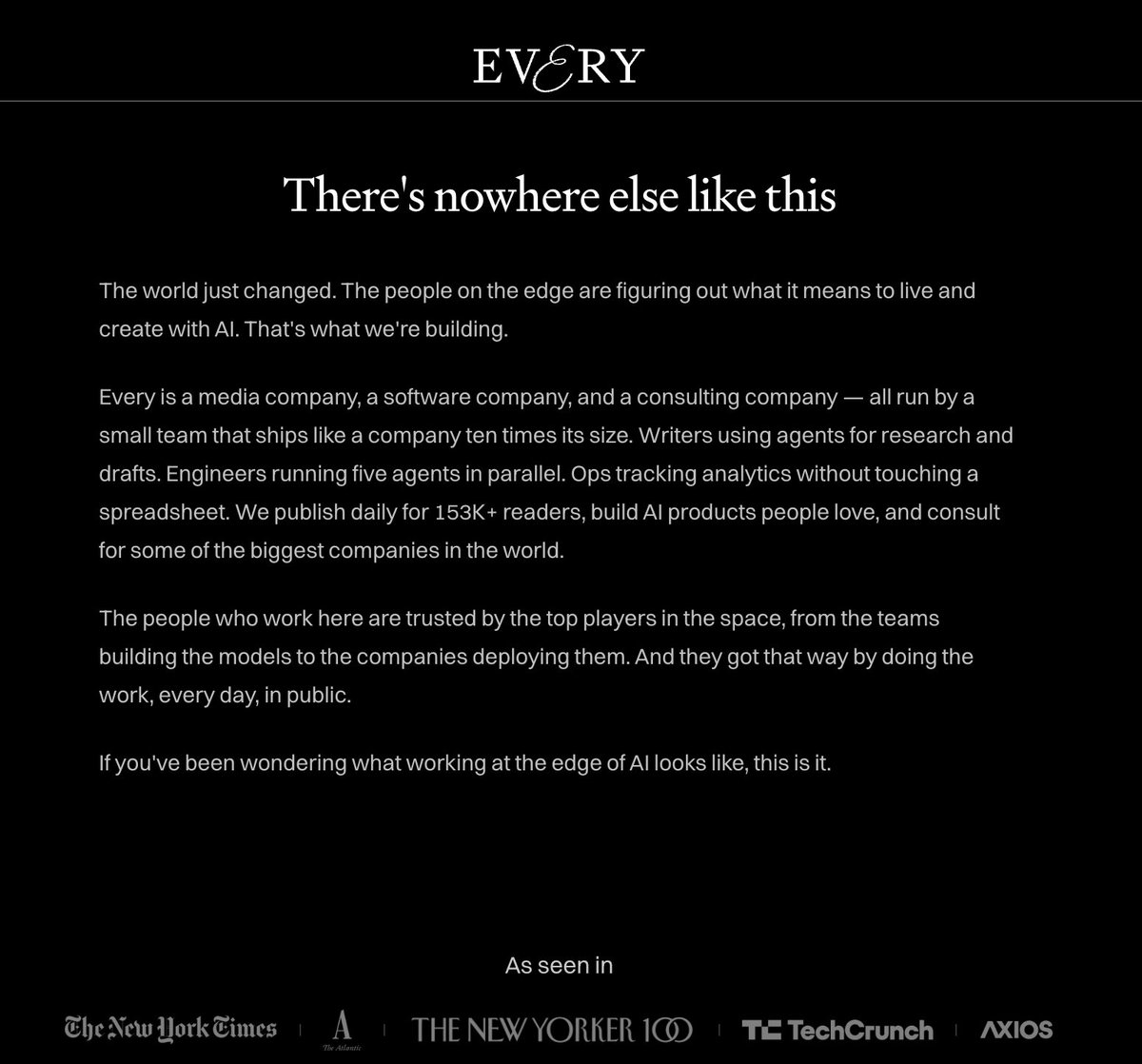
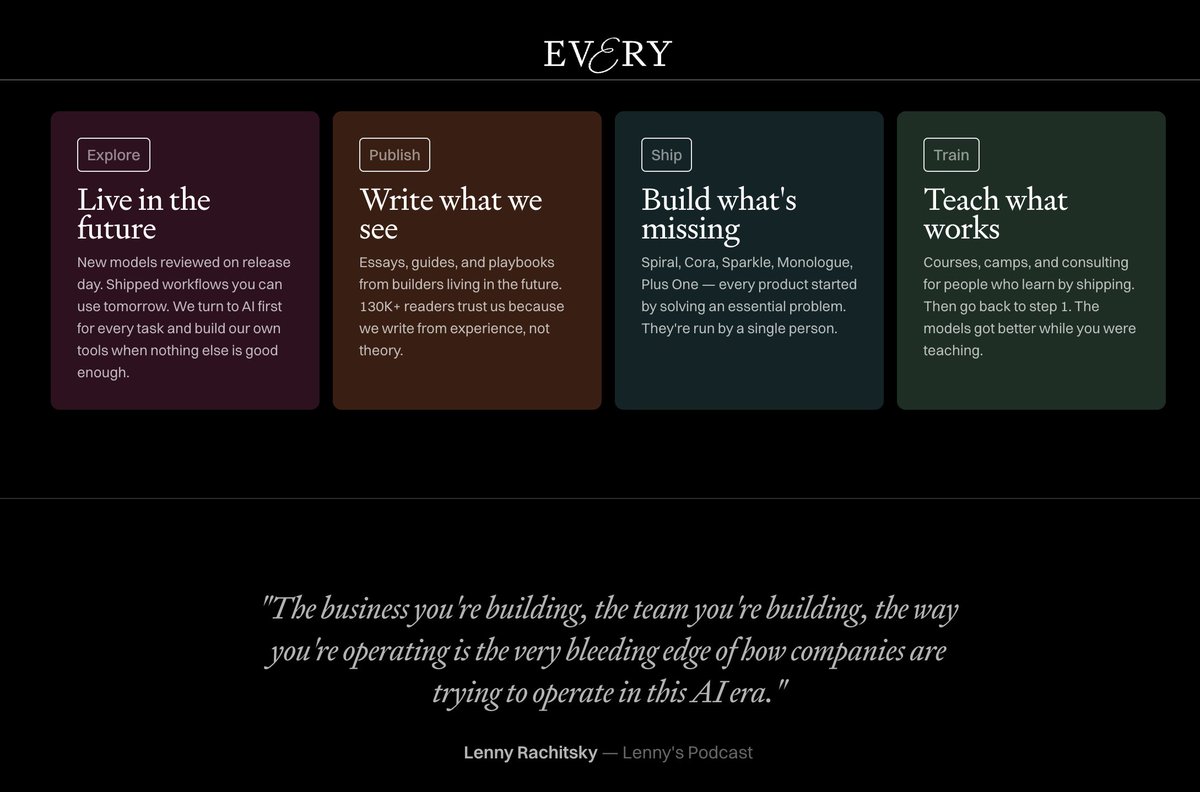
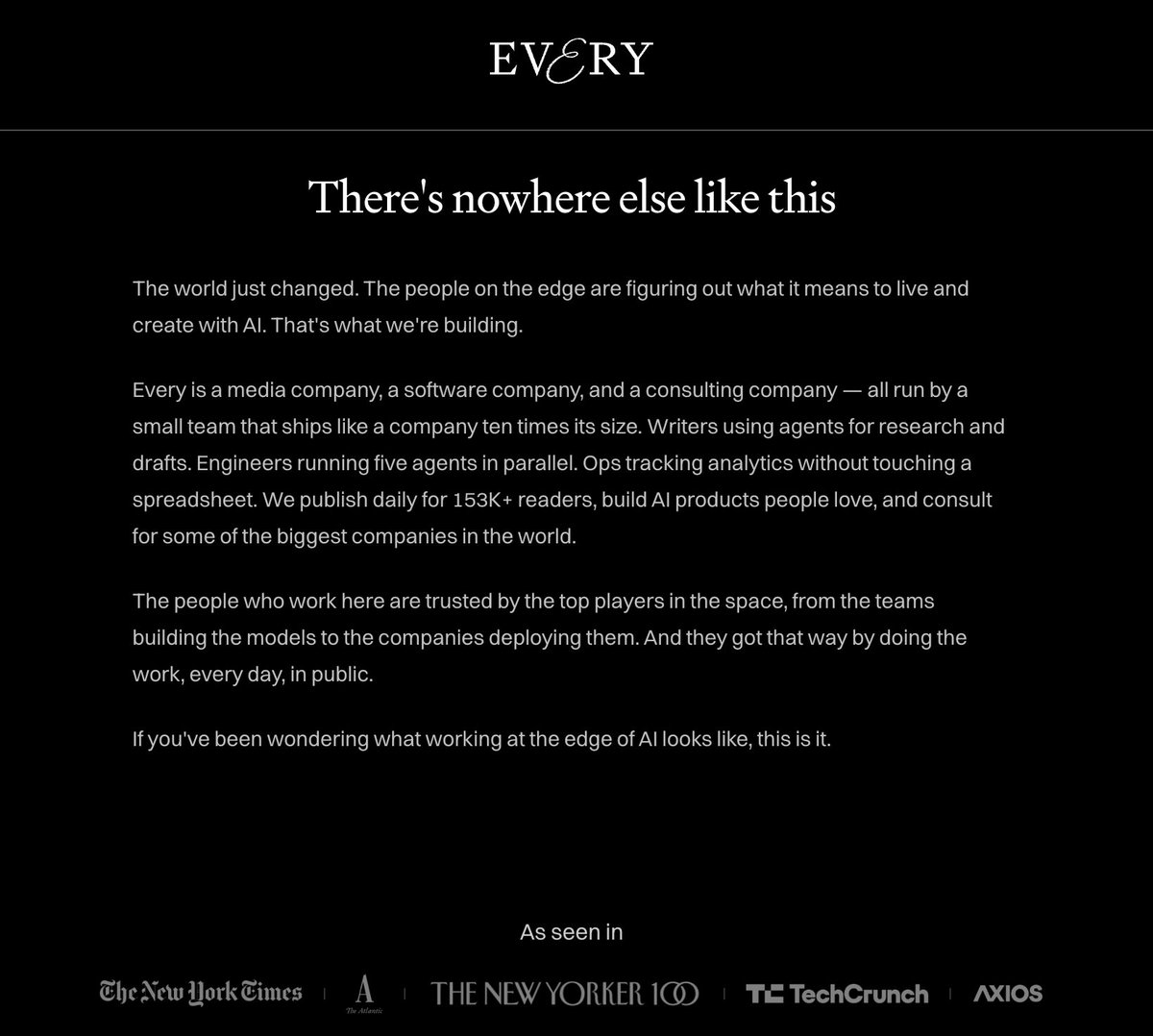
I've learned more from working at @every for the past five months than I did in the previous five years of my career. It's an incredible place to live at the bleeding edge of AI, and we're hiring for five new roles on the team. One small example of what's different here: At previous companies, a custom landing page like our new careers home would have taken 3-6 weeks to launch, requiring coordination across multiple teams and contractors. It was slow and frustrating. We built this in a day using Claude Code with the Figma and Notion MCPs, pulling copy and page architecture from our existing codebase, design system, and internal knowledge hubs. While an agent jammed on the page in the background, I kept pushing on bigger growth bets. We did a quick round of reviews and then shipped it in under 24 hours. A lot more companies will look like @every in the next couple years. Come join us and show people how to build better businesses and live better lives with AI.
Austin Tedesco tweet mediaAustin Tedesco tweet mediaAustin Tedesco tweet media
English
1
3
24
3.9K
Every 📧 đã retweet
Brandon Gell
Brandon Gell@bran_don_gell·
The future requires new ways of applying for jobs. If you're an engineer and love go-to-market too, apply to Every's GTM Engineer role here: github.com/EveryInc/apply… I think it'll probably be a top 3 most fun role at Every
English
3
4
43
6.1K
Every 📧 đã retweet
Brandon Gell
Brandon Gell@bran_don_gell·
We have 5 new roles open at Every. Probably a 6th soon. Every is an incredible place... it's a playground for builders. If you think you are one of the best at what you do (or could be), want to work in a truly agent native environment, be on the edge of AI, work alongside cool and caring people, and build more than you talk, you should work here → every.to/careers Open roles: - GTM engineer - Head of Finance Vertical, Consulting - Head of Learning and Development - Head of Product Marketing - Head of Social
Brandon Gell tweet media
Dan Shipper 📧@danshipper

we just opened up 5 new roles @every: - GTM engineer - Head of Finance Vertical, Consulting - Head of Learning and Development - Head of Product Marketing - Head of Social if you want to help discover and define how the world works with agents over the next 10 years—join us: every.to/careers

English
3
4
69
20.6K
Every 📧 đã retweet
Dan Shipper 📧
Dan Shipper 📧@danshipper·
we just opened up 5 new roles @every: - GTM engineer - Head of Finance Vertical, Consulting - Head of Learning and Development - Head of Product Marketing - Head of Social if you want to help discover and define how the world works with agents over the next 10 years—join us: every.to/careers
Dan Shipper 📧 tweet media
English
33
15
307
71.4K
Every 📧 đã retweet
Karri Saarinen
Karri Saarinen@karrisaarinen·
We experimented with AI internally, but took a deliberate approach in the product, understanding which workflows mattered and waited for the models to improve. That meant giving up being first, but it gave us a much clearer view of where AI can actually be useful for companies
Dan Shipper 📧@danshipper

SaaS isn’t dead, it just needs to become agent-native. Linear (@linear) is a great example of how: They pivoted the product to be used by both humans and agents, and that has made them one of the premier software tools in the agent-native era. I had Linear’s cofounder and CEO @karrisaarinen on @every's AI & I to talk about how a product management tool for human software developers became an agent-native tool—and how Linear’s trajectory reveals a bright future for SaaS businesses: - Speed means decisions matter more, not less. AI makes it easy to have an idea and build it without considering whether its existence is justified. When ChatGPT was released, SaaS companies were launching their own chatbots left, right, and center. Instead of jumping on the bandwagon, Linear stopped to consider whether the application was useful. (It wasn’t.) - Just because the technology has changed doesn’t mean your mission should. Karri attributes Linear’s success to never losing sight of what matters: helping teams develop great software. Instead of chasing trends, Linear focused on understanding how AI was impacting its customers’ workflows—and updating its product accordingly. - Agents are now first-class users. Linear never tried to change what it was or did well; it just expanded the user base. Companies can now kick off agents inside Linear, manage them, and track what they're working on alongside the humans on the team, which explains why Codex, Coinbase, and Brex all run their agents on Linear. This is a must watch for anyone interested in how an agent-native SaaS company operates. Watch below! Timestamps: Introduction and how Every first discovered Linear: 00:00:39 Why Linear waited to ship AI features instead of rushing to chatbots: 00:02:00 Linear's agent platform and becoming the system that guides AI agents: 00:05:06 Why "SaaS is dead" is a simplistic narrative: 00:07:42 How Linear adopted AI coding tools internally: 00:12:18 AI's impact on product building workflows—speed versus thoughtfulness: 00:17:45 The value of conceptual work and thinking before shipping: 00:22:18 How AI is reshaping Linear's product strategy: 00:29:30 Demo: Linear's agent skills, shared context, and code review workflow: 00:37:18 The future of product development and the enduring role of human judgment: 00:47:48

English
9
6
118
22.7K