Longevity Journal Club

3 posts

Longevity Journal Club

Longevity Journal Club

@LongevityJC

Physician (@ShawnXMa) interested in longevity For those looking to go beyond article abstracts and the podcaster/influencer one-liner "X paper shows..."

Tham gia Ekim 2022
7 Đang theo dõi14 Người theo dõi
Longevity Journal Club
Longevity Journal Club@LongevityJC·
Glossary: SD = standard deviation CV = cardiovascular CHD = coronary heart disease SCD = sudden cardiac death HTN = hypertension SBP = systolic blood pressure T2DM = type 2 diabetes mellitus BMI = body mass index LDL-c = cholesterol carried by low-density lipoprotein SES = socioeconomic status HR = hazard ratio Compares the chance of an event happening in a group (A) compared to a reference group (B) over time. HR of the reference group is defined as 1. If HR of group A is 1, there is an equal chance of the event compared to the reference group. If HR of group A is <1 (eg. 0.7), the event is less likely to occur in group A compared to reference group B (in fact, a 30% risk reduction). If HR of group A is >1 (eg. 1.3), the event is more likely to occur in group A compared to reference group B (a 30% risk increase) Bradford Hill Criteria = 9 principles that can be useful in epidemiology to establish a causal relationship between a presumed cause and an observed effect
English
0
0
0
105
Longevity Journal Club
Longevity Journal Club@LongevityJC·
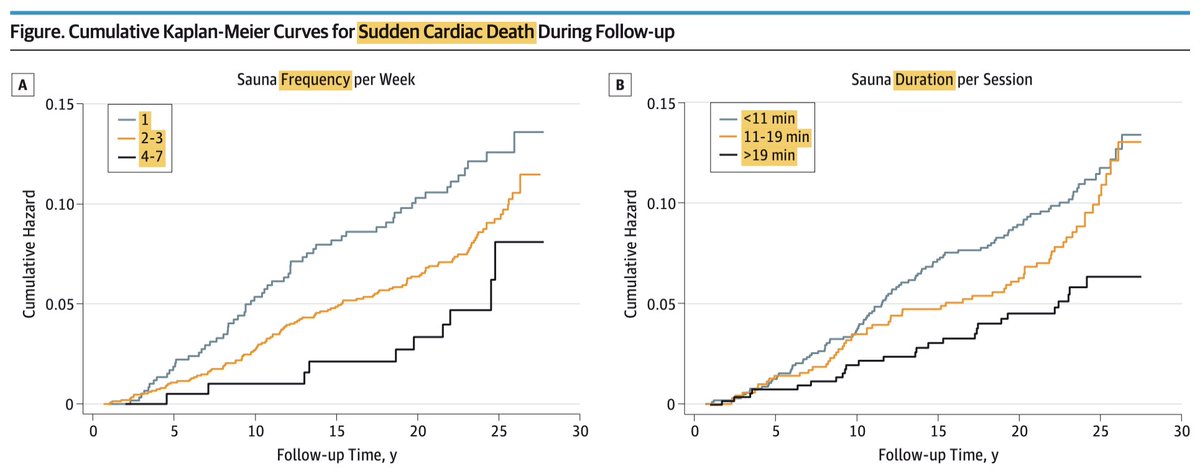
JAMA IM 2015: Association Between Sauna Bathing and Fatal Cardiovascular (CV) and All-Cause Mortality Events BOTTOM LINE - Strong dose-dependent association of dry sauna and lower CV + all-cause mortality - For optimal benefit, suggest sauna 4+/week for 19+ min at >171F Details CLINICAL QUESTION: Is frequency and duration of sauna associated with risk of sudden cardiac death (SCD), fatal coronary heart disease (CHD), fatal cardiovascular disease (CVD), and all-cause mortality? DESIGN: - Prospective, cohort (observational) study, population-based sample of 2315 men (42-60 yo) from Eastern Finland - 3434 invited → 2682 participated (78%) → 2315 sauna data available (68%) - Grouped by frequency (1, 2-3, 4-7 per week) and session duration (<11, 11-19, >19 min) - Baseline characteristics measured once at beginning of the study: -- Labs/vitals -- Chronic diseases assessed by internist -- Cardiorespiratory fitness measured by VO2 max cycle testing -- Physical activity by 12 month questionnaire - Self-reported sauna data by typical week; temperature measured by participant at head level - Outcomes/deaths by interview, hospital records, death certificates by 2 reviewers (blind to sauna data) Baseline, avg (sd): - Age 53 (5.1) - BMI 27 (3.5) - LDL-c 156 (39) - SBP 134 (16) - VO2 max 30 (8.0) mL/kg/min - Physical activity 372 (357) kcal/day - 30% smokers - 24% CHD - 34% HTN (21% on anti-HTN meds) - 5% T2DM Sauna: - 2.1 (1.1) sessions per week - 14.2 (7.5) min per session - 174 (17) degrees F RESULTS: - Avg follow-up time 19 years (no loss to follow-up) - Avg sauna session duration did NOT differ significantly by frequency - Avg temp of 4-7/week 171F vs. 1/week group 176F (p<0.001) Hazard ratios adjusted for age, BMI, SBP, LDL-c, smoking, alcohol, T2DM, CRF, physical activity, SES Subgroup analysis: Avg characteristics of 4-7/week group compared to 1/week: - 2 years younger - Slightly higher VO2 max - Slightly higher BMI - More HTN, T2DM - Less smokers - NO physical activity data provided More benefit in terms of CV mortality in less healthy population, aka patients with: - T2DM - Oldest third - Bottom third of VO2 max - BMI >25 - Trending toward benefit in middle/top third of VO2 max, not statistically significant (not powered for this analysis) - More benefit for non-smokers, likely due to overwhelming negative impact of smoking on CV health STRENGTHS: - Relatively generalizable sample - population-based group, no formal exclusion criteria -- Middle-aged -- Slightly overweight on average by BMI -- No exclusion based on co-morbidities -- VO2 max similar (30 vs. 33 for males 50-59 by FRIEND database - FRIEND excluded CAD/CHF likely explains slightly higher VO2 max) - Large sample size (2315) - Long follow-up duration (~19 years) - Use of 1 sauna session/week as control group, rather than no sauna -- Controls some confounding (all can tolerate sauna, all have access/time for at least some sauna) LIMITATIONS: - Homogenous population (male, not ethnically diverse) - Observational study, likely residual confounding - Regression dilution bias: one-time sauna reporting (sauna habits could change over long the follow-up period) - Duration should have been compared between frequency groups, or compared total weekly sauna time -- Once-a-week, 20 min session (20 min weekly total) is in >19 min group, but daily 10 min session (70 min weekly total) is in <11 min group → likely explains weaker associations with sauna duration - Biggest critique: Did not break out physical activity in the subgroup analysis of frequency groups -- Large variance in activity among participants (avg 372, st dev 357), can imagine a strong correlation with frequency of sauna -- Although HR was adjusted for physical activity, likely still residual confounding related to exercise OTHER DISCUSSION: - 4-7/week group was slightly healthier than 1/week group at study enrollment (age 52 vs. 54, VO2 max 32 vs. 29, less T2DM, less HTN) - However, may be in part due to existing sauna habit prior to study enrollment - Authors attempted to adjust for these with adjusted HR which included age, smoking, HTN, T2DM, cardiorespiratory fitness Potential rebuttal: “Those who can tolerate more frequent sauna are healthier” - Avg temp of 1/week is higher than 4-7/week - Higher temp is more taxing, 1/week can regularly tolerate this higher physiological stress Potential rebuttal: “one-time sauna reporting is too limiting” - Agree, more sampling of sauna data would be useful (though practically difficult) - Per article: “Practically, Finnish people are accustomed to have a sauna bath regularly at least once per week.” - Assuming this is directionally true, the biggest possible regression would be in the 4-7/week group, which would decrease the effect size, not increase it Applicable Bradford Hill criteria: - Strength (effect size) - Biological gradient (dose-response) In the context of other literature (to be covered): - Consistency (reproducibility) - Temporality - Plausibility - Coherence - Experiment CONCLUSION: - In this population of middle-aged men, there is a large beneficial association of sauna with CV death (adjusted HR 0.6) and all-cause mortality (adjusted HR 0.5) for 4-7 sauna sessions/week compared to 1 sauna session/week, in a dose-dependent relationship across frequency and duration - Stated magnitude of effect probably overestimated due to residual confounding even after adjusting hazard ratio, most likely due to correlation of sauna frequency with physical activity - Trending toward a causal relationship given most Bradford Hill criteria met for this study in the context of the broader literature - Subgroup analysis shows increased magnitude of benefit for more unhealthy population, but trending toward benefit in healthier populations as well (not sufficiently powered for this analysis) - This study suggests that sauna 4+ sessions/week for 19+ min/session at a temperature >171F (avg temp of 4-7/week group) may be optimal for mortality benefit Link: jamanetwork.com/journals/jamai…
Longevity Journal Club tweet mediaLongevity Journal Club tweet media
English
1
1
3
242