@nano_arun@narendramodi@PMOIndia When big step is made by big players like US, EU, Japan, Taiwan...Chips acts, Intel and TSMC are expanding its manufacturing for advanced nodes, TSMC and UMC are expanding 28nm fabs around the world, better to take wise steps with right partner(2/2).
@nano_arun@narendramodi@PMOIndia It is not about investing money, it is a game of sustaining in the business. So better not to compare with US, Europe and Japan. Instead, monitoring and understanding the trend is key. (1/2)
Dear @narendramodi@PMOIndia , one of your Ministers seems to be more sure of whether #TSMC will get to 1nm and 1 Trillion transistors in his lifetime than whether India will have an HVM commercial Si fab in production within that time 😏
Here you go:
A top government body is examining “a significant number" of applications to set up semiconductor fabrication units and testing facilities in India, said Rajeev Chandrasekhar, Union minister of state (MoS) for electronics and information technology (IT). In an interview, Chandrasekhar spoke about domestic electronics manufacturing, likely production-linked incentives, artificial intelligence (AI) technologies and cybersecurity. Edited excerpts:
A top government body is examining “a significant number" of applications to set up semiconductor fabrication units and testing facilities in India, said Rajeev Chandrasekhar, Union minister of state (MoS) for electronics and information technology (IT). In an interview, Chandrasekhar spoke about domestic electronics manufacturing, likely production-linked incentives, artificial intelligence (AI) technologies and cybersecurity.
Edited excerpts:
State governments say the India Semiconductor Mission (ISM) isn’t giving approvals to chip projects in their states. Is that true?
Our government’s mission is to create semiconductor capability—it isn’t about creating it here but not there. Electronics factories, for instance, are in Tamil Nadu, Karnataka, Uttar Pradesh and other places, too. Apple’s largest production plants, for instance, are in Tamil Nadu.
For semiconductors, there is a lot of public money involved. Hence, there’s a ‘technology financial advisory group’ (TFAG) which identifies fake proposals from good ones. In the first three proposals that we received, despite a lot of public pressure, the TFAG identified certain parties that did not have capable credentials, and said no.
How many proposals have we received so far?
We have a significant number of proposals that are all being evaluated today. They span compound fabs, compound OSATs (outsourced semiconductor assembly and test), silicon OSATs and silicon fabs. We’ve also recently floated an expression of interest (EoI) for modernizing the Semi-Conductor Laboratory (SCL), Mohali. That has also received significant interest. All of these proposals and expressions of interest are with the ISM TFAG.
With SCL, there were two options at hand for the modernization process. Has there been a decision about it?
Given the size and scale of SCL, its future should lie in being a commercial-grade, limited-volume production hub, as well as an R&D (research and development) hub—as opposed to becoming a full-scale, mass-volume fab. SCL also has a new director-general, and our thought is to not involve SCL in building chips for mass-market devices. That means SCL will create more complex chips and devices, and also be part of the R&D ecosystem for semiconductors that we are developing around the India Semiconductor Research Centre (ISRC).
Would they need a big quantum of funds to be allocated?
Of course. SCL’s capability is at 180nm today, and you can’t be a commercial R&D hub at 180nm. You can cater to a large number of products, but it’ll need to create a much more cutting-edge node going forward. We’ve already allocated ₹10,000 crore—more than $1 billion (about ₹8,300 crore) —and I don’t think we’ll need to take that figure up further.
Will local electronics manufacturing in India need concerted efforts to create a component supply chain now, given that we’re assembling a sizeable amount?
Even China, which controls 70-72% of the global value chains (GVCs), makes a value addition that is in the low two-digits. Even they, for exports exceeding $1 trillion, import $650-700 billion in components.
To be in the GVC of electronics is a low-margin, high-volume game—unless you’re in the strategic electronics space, where it is low-volume and high-margin. But consumer technology, which includes mobile phones, laptops, tablets, etc., is effectively characterized by low margins—not as low as 1%—but very high volumes. That scale, when you reach, allows you to develop an ecosystem of suppliers and supply chain for electronics.
When will we get components made in India to supply?
We’re now reaching the tipping point of scale, size and volume. Now, we’re seeing suppliers wanting to come in and set up shop here.
Will we have any dedicated PLIs for suppliers and component makers?
We’ll consider it at the right time, because we certainly don’t want to offer double the subsidy for the same product. One important thing to understand is that we’re building this industry for exports as well as domestic supplies. Unlike automotive, which only exports 3-4% of what is made locally, or even white goods, for electronics we’re designing local manufacturing to be competitive in exports.
Our target for electronics manufacturing is $300 billion by 2026, of which nearly $120 billion, or 40%, will be in exports. Hence, the electronics manufacturing sector must grow faster than the growth of the domestic market.
What figure will we achieve in electronics manufacturing by 2024?
We’re close to around $90 billion by end-2023. Now, there are a couple of imponderables in between, such as the global economy. The wars in Europe haven’t helped global consumer sentiment. There’s also the factor of whether the US economy is still anticipating a recession or not, and if China, one of the largest global markets, will buy as many phones as previously projected.
These things have to be looked into. But our endpoint remains at $300 billion, as that will represent a significant critical mass on the $1.5 trillion GVCs. We want to at least be in the range of contributing 12% of GVCs. We may want the flexibility of one additional year to get there, given the global factors. I wouldn’t want to hazard a guess on where this figure will be by the end of this year.
Is the plan to build indigenous AI chips a near-term plan?
Our strategy is twofold. One, we’re creating AI compute capacity in the public sector, where C-DAC (Centre for Development of Advanced Computing) is building an indigenous AI compute service—Param Rudra.
For the private sector, we’ve submitted a proposal to the government—and it’ll need funding. The idea is to create a significant amount of GPU capacity in the private sector, with the government as a partner. This’ll be like a PPP (public–private partnership). The latter will give AI compute as-a-service for startups, researchers and for anyone who has a model that needs to be trained.
Are countries prioritizing AI regulation?
The GPAI (Global Partnership on Artificial Intelligence) Delhi event saw agreement from most nations on not demonizing AI, and to also take a collaborative approach instead of a sovereign AI. We must all agree on what are safe and trust today, and India is taking the lead in this.
In February, at the Global Forum on the Ethics of Artificial Intelligence 2024 event in Slovenia organized by Unesco, India will present an initial framework of safety and trust in AI. The idea is to host a mid-year GPAI here post-elections, sometime in May, where we may have a tentative agreement on the regulatory framework, before we head to the AI Safety Summit, Seoul in South Korea later in the year.
The Digital India Act is expected to offer our legislatorial take on regulating AI. Would the act require a fresh round of consultations?
We did a year of preconsultations for it, and built expectations for its framework. But Parliament has to legislate it, and there’s no time left for it now; so, it will have to be the next government that does it.
Is there a concern around the lack of dedicated legislation on cybersecurity, and following diligence with Cert-In (Indian Computer Emergency Response Team)?
That’s wrong to think so. There is a law—the IT Act—as well as cybersecurity directions. But law and order is a state subject. A part of the problem on cybersecurity not being addressed adequately is because usually most cybercrimes—nearly 85% of it—are multi-jurisdictional. The victim is in one jurisdiction, and the perpetrator in another. In our system, two police forces have to both want to investigate a cybercrime, and also do it cooperatively. This is a fundamental problem.
Many state governments today keep cybercrime at a much lower pedestal than violent crime, terrorism, robbery and so on. For them, a cybercrime is an elitist crime, and hence they do not respond to it. When there are state governments that respond to it, they find that the second leg of the crime is in another jurisdiction, where another police force has to coordinate. This is a structural problem, because of law and order being a state subject.
How do we solve that, and is there a better way?
Given that a billion Indians are going to use the internet by 2026, and as we harness tech for good so there’ll always be harms, cybercrimes are one aspect of the harm that we’ve to figure out a way for allowing state governments to be able to collaborate and respond faster.
But this is beyond the Centre’s ambit, and we cannot legislate a state subject. There is an issue, indeed. We’ll have to look to raise more awareness, and build more capabilities within state police departments to investigate and prosecute multi-jurisdictionally.
Could skill development play a role in such capacity building?
It’s not about that. There are many state police forces who don’t think cybercrime is an important issue to be worried about. Hence, cybersecurity is very low on their priority, and these state governments are also pressed for people and resources. Hence, a ₹1 lakh cybercrime will certainly not run pari-passu with a murder or a terrorism threat. There is a natural problem here.
Should Cert-In be given more powers?
It’s not about powers. As of 2023, we have dramatically expanded our capabilities, compared to the past five years. The capability that we have to identify and detect cross-border weaponization and threats is significant today. We’ll continue to grow this dramatically, along with an ecosystem of cybersecurity startups.
On the capability front, we’re in the right direction. On 16 January at Startup Day, a full session will be dedicated to showcasing such capabilities. But when you say legislating more powers for Cert-In, we go back to law and order’s state jurisdictions. Cert-In is a central body that can detect and give directions to corporates and states in the event of a breach. But it doesn’t and cannot investigate and prosecute a crime.
“The Israeli people are the most resilient people on earth.” - @intel CEO @PGelsinger
Throughout one of our most difficult periods, Israelis have shown up and proven just how resilient our country is.
To the millions of Israelis who keep persevering, thank you.
Watch:
Gender equality doesn't just happen. It requires constant work and attention.
Initiatives like Global Board Ready Women prove there are plenty of qualified women for top jobs.
In the same time, the EU's new directive creates conditions for more talented women on boards.
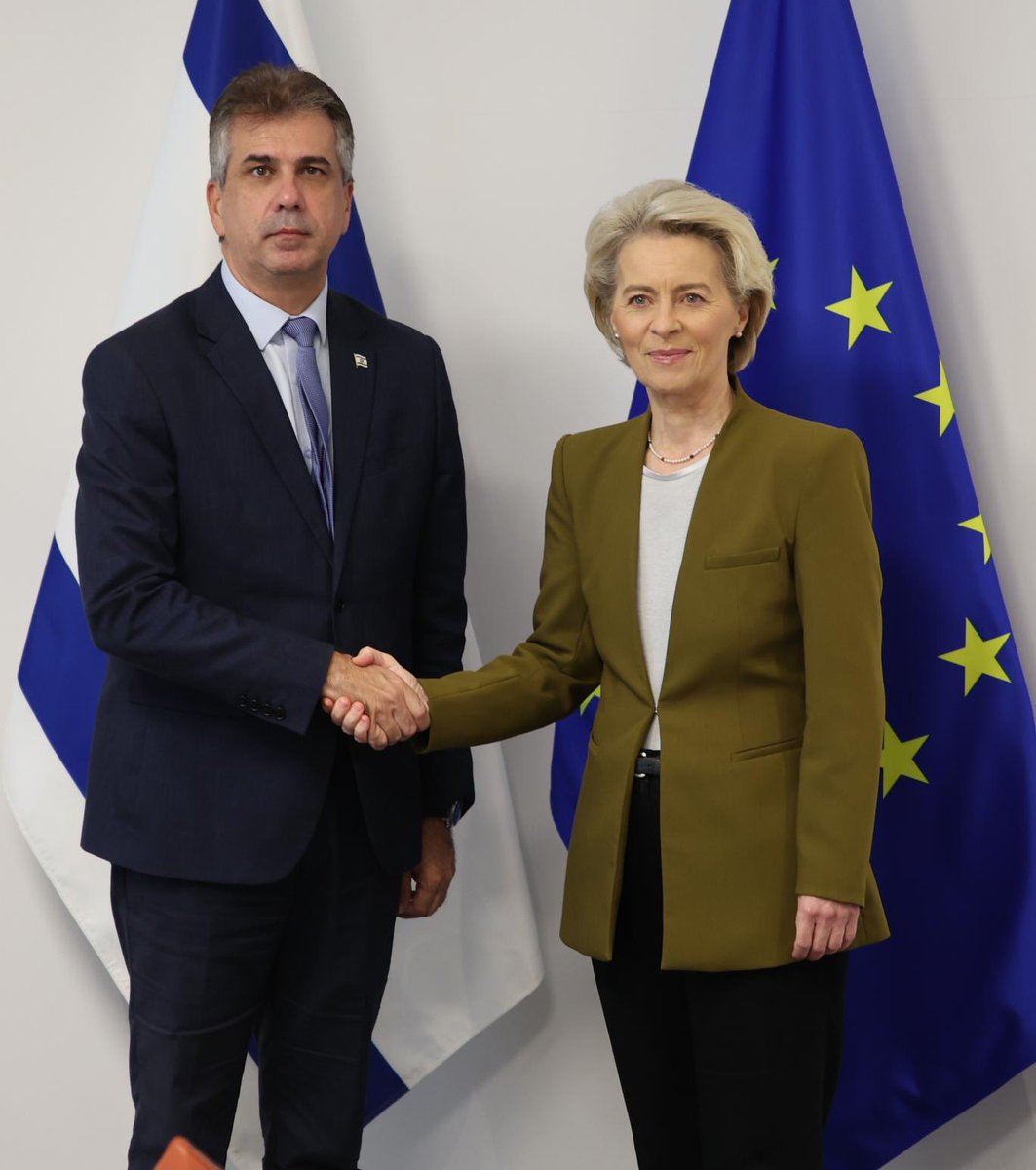
Assured Israeli foreign minister @elicoh1 of our full solidarity in the wake of Hamas’ terror attack of 7/10.
I reiterated my call for the immediate release of all hostages held in Gaza.
We also remain focused on improving the delivery of humanitarian assistance to Gaza.
Josie (6 years old), Bertha (6 years old) and Sophie (10 years old) worked regularly at the Maggioni Canning Company.
Work began at 4 AM, and the three would make from $9 to $15 a week.
Sophie would do six pots of oyster a day, and her mother, who also worked with her, said, "She don't go to school. Works all the time."
Through such photos, Lewis Hine documented the harsh working conditions borne by thousands of children, who were sent to work soon after they could walk and were paid based on how many buckets of oysters they shucked daily.
Mr Hines wrote of one photograph: ‘All but the very smallest babies work. Begin work at 3:30am and expected to work until 5pm.’ He covered around 50,000 miles a year, photographing children from Chicago to Florida working in coal mines and factories.
These photos helped to raise an outcry against child labor and made the American public widely aware of the scope of the problem.
@Harpree12105870@nano_arun Node nrs r to follow the conventional scaling trend not linked to Lg. After FinFET, nr. of fins and tracks scaling helps for PPAC. This also varies from foundry to foundry.
"In theory", Samsung's early learning from commercial HVM of GAAFETs at 3nm (albeit with limited customers) should give it confidence & edge at 2nm, but w/ T$MC.. you never know
sammobile.com/news/samsung-f…
ChatGPT’s grandmother?
Siemens is one of the early pioneers of AI; its Central Research department was already working on the topic in 1970s. In 1974, "interactive, automatic, natural language question and answer system" was to be researched.
linkedin.com/pulse/tracing-…
The idea of the CFET, where n- and p- type transistors are stacked vertically and monolithically, was proposed by the IMEC research institute back in IEDM 2018.
In this year IEDM 2023, Intel, TSMC both set to report on stacked CFETs.
eenewseurope.com/en/intel-tsmc-…
Thanks to eeNews.
Electric truck maker Volta Trucks, Hqr-ed in Sweden said this week that, it has decided to file for bankruptcy proceedings in Sweden, It was hard for the startup to raise funds.
reuters.com/markets/deals/…
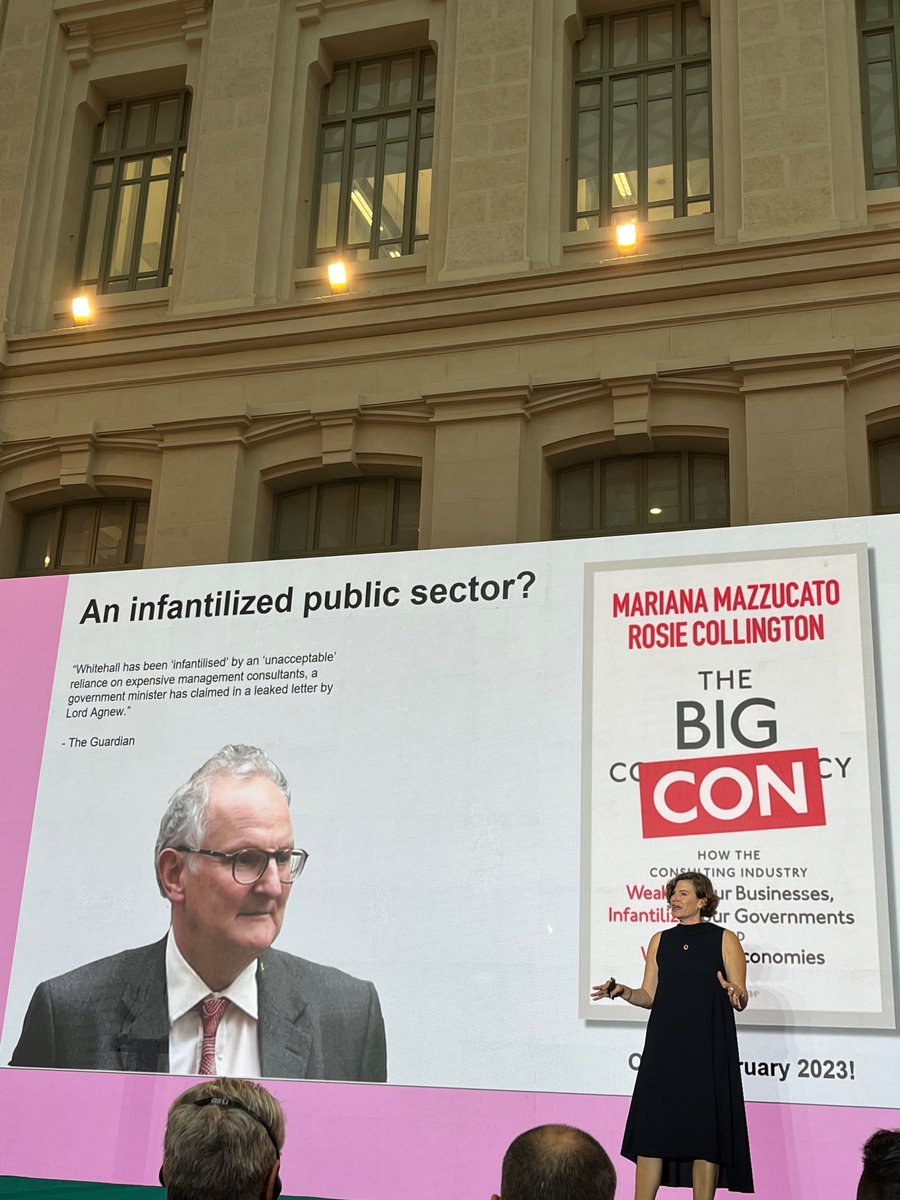
“Why have govs stopped investing in their brain? We shouldn’t let our govs become stupid by outsourcing their know-how. If that happens, we will end up with bad contracts, contracts that socialise risks & privatise profits” @MazzucatoM at the @Mutualidad_es congress #ESIPFamily
There's some confusion about how the updated Biden Administration chip export controls work. Below is my graphic guide to understanding the recently updated controls.
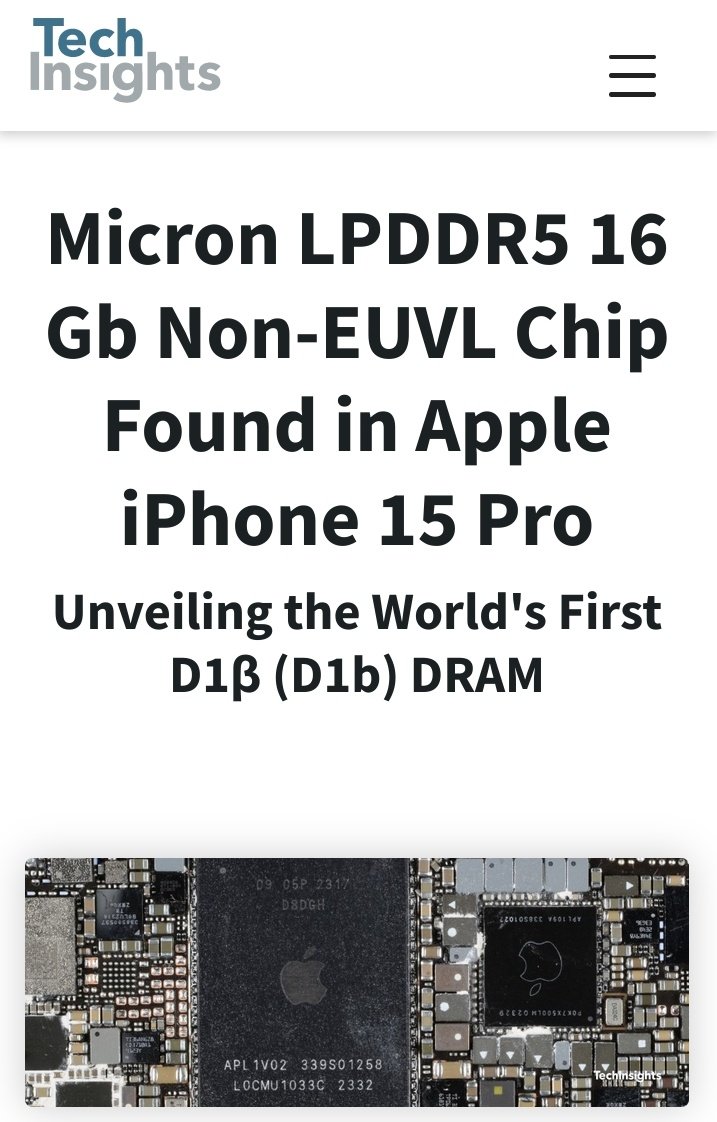
The most advanced DRAM D1β LPDDR5 from Micron was made without EUV. No cost advantage with EUV when multipatterning is required. So DUV wins the game in selective nodes and applications.
#micron#LPDDR5#EUV#ASML#DUVtechinsights.com/blog/micron-lp…
Revolute Robotics has presented its autonomous Hybrid Mobility Robot (HMR), a whirling, spherical cage that can fly like a multicopter, or roll in any direction using two gyroscopic gimbal rings.
Video source: Revolute Robotics
#robots#robotics#tech#engineering#gyroscopic
Hamas terror is now bringing immense suffering to the Palestinian people.
There is no contradiction in standing in solidarity with Israel and acting for the humanitarian needs of the Palestinians ↓
twitter.com/i/broadcasts/1…