SpaceComputer - 天机

844 posts

SpaceComputer - 天机 banner
SpaceComputer - 天机

SpaceComputer - 天机

@SpaceComputerIO

The distributed compute network for security services in low earth orbit https://t.co/OuYPKv4dik

https in orbit Tham gia Mayıs 2024
88 Đang theo dõi4.6K Người theo dõi
Avin
Avin@tranaiht·
@SpaceComputerIO With a satellite constellation this dense, it's no different from a protective shield surrounding the Earth.
English
1
0
0
12
SpaceComputer - 天机
SpaceComputer - 天机@SpaceComputerIO·
51,600 + 88,000 + 1,000,000 = 1,139,600 Satellites Kessler's syndrome looking good here.
SpaceComputer - 天机 tweet media
Sawyer Merritt@SawyerMerritt

NEWS: Jeff Bezos' rocket company Blue Origin has filed an official request with the FCC to launch and operate a constellation of 51,600 AI satellites (orbital datacenters), just two weeks after Amazon filed a formal petition calling on the FCC to deny @SpaceX’s 1 million-satellite proposal for orbiting datacenters, going as far to claim the project would take “centuries” to deploy. Blue Origin's project, called “Project Sunrise,” would include up to 51,600 satellites in low Earth orbit, designed to run AI and cloud computing workloads using constant solar power. The system would primarily use laser (optical) links between satellites. Blue Origin says "space-based data centers could relieve pressure on Earth’s power grids and water usage."

English
2
1
9
269
B=MananzeZA
B=MananzeZA@Thormichaey·
Here’s why extremely bullish on public pseudo-randomness beacons 👀 Because randomness is one of the most underestimated primitives in all of crypto and AI infrastructure. Most systems today still rely on: •Local entropy •Validator-controlled randomness •Opaque generation methods Which creates a hidden problem: if randomness can be influenced, everything built on top of it can be gamed. Why public randomness beacons matter A public pseudo-randomness beacon gives you: Unbiasable outputs no single party can manipulate outcomes Verifiability anyone can independently check the randomness Liveness guarantees continuous, predictable generation Global availability same source of truth for everyone This turns randomness into shared infrastructure, not a hidden assumption. What this unlocks 1. Fairness in onchain systems •Gaming, lotteries, NFT mints, leader elections •No more validator advantage or timing exploits 2. Secure cryptographic coordination •Key generation •MPC / threshold systems •Distributed consensus 3. Trustworthy AI workflows •Sampling •Model randomness •Agent coordination If randomness is compromised, AI outputs can be subtly steered. That’s a massive attack surface most people ignore. Why now We’re moving into a world of: •Autonomous agents •High-value onchain systems •Cross-chain coordination All of these depend on unpredictability + verifiability at scale. Public randomness beacons become the clock + entropy layer for this new internet. Only made possible by @SpaceComputerIO
English
1
0
3
37
alin.apt
alin.apt@alinush·
Actually, I do enjoy talking about this: “Real randomness” is a sham… there’s no way to really (cryptographically) prove it’s “real.” You may say “signature from my space computer is enough” but it’s not easy to bootstrap meaningful trust in such systems (TEEs, etc.)
SpaceComputer - 天机@SpaceComputerIO

The entire crypto industry decided that algorithmic randomness with a proof attached was good enough and just stopped asking questions. Nobody wanted to have the conversation about whether the randomness itself is actually real. So let's have it now 👇

English
5
1
11
604
SpaceComputer - 天机
SpaceComputer - 天机@SpaceComputerIO·
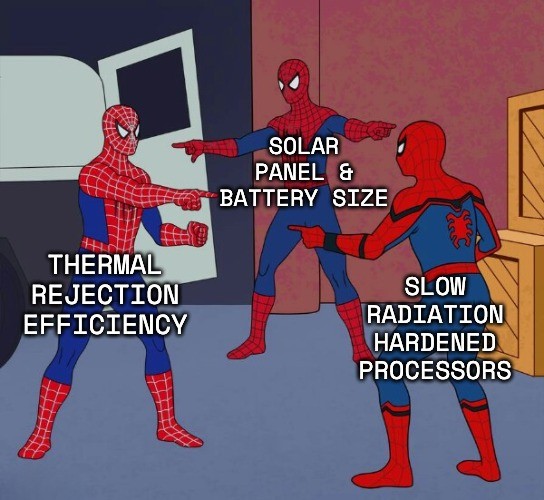
These constraints form a closed loop. More compute = more power = produces more heat = more mass ∴ higher launch costs Conversely: improve one link, improve the whole system. We can't change the laws of physics, but we can improve the technology. That's the biggest opportunity for space computing.
SpaceComputer - 天机 tweet media
English
0
0
2
85
SpaceComputer - 天机
SpaceComputer - 天机@SpaceComputerIO·
3. Radiation-hardened processors survive space but perform 1,000 to 10,000x slower than commercial hardware. That inefficiency means more waste heat per computation, which loops right back into the thermal and power constraints.
English
1
0
3
87
SpaceComputer - 天机
SpaceComputer - 天机@SpaceComputerIO·
Space is -270°C and cooling is still the hardest engineering problem in orbital computing. Everyone's bullish computing in orbit. But they don't say what makes it so hard. What nobody tells you is orbital computing constraints are a chain reaction problem 🧵
SpaceComputer - 天机 tweet media
English
4
4
16
394
SpaceComputer - 天机 đã retweet
frezabek
frezabek@rezabfil·
Prague is calling and this time, we're bringing space with us 🛰️ What if your next secure data center wasn't on Earth? At ETHPrague, I'll dive into Confidential Computing in Space, leveraging satellite-level isolation + SW/HW co-design to rethink TEEs. Talk: Space Fabric: Reinventing Hardware Architecture for Orbital Infrastructure If you're there, let's connect 👇
ETHPrague@EthPrague

Our local tech brewer @rezabfil is the newest addition to our speaker lineup! Co-founder with a great experience working with our friends at @SpaceComputerIO and many others, this is a talk you definitely shouldn’t miss! This May at ETHPrague ☀️ 🎟️ Get tickets in bio


English
1
5
15
546
SpaceComputer - 天机
SpaceComputer - 天机@SpaceComputerIO·
@0xMaskedMiner It is cold in orbit! But because space is a vacuum, the classic cooling of releasing the heat into orbit doesn't work. That's why radiative cooling and other mechanisms are super important. Otherwise the satellite overheats with nowhere for the heat to go, and stops functioning
English
1
0
1
5
SpaceComputer - 天机
SpaceComputer - 天机@SpaceComputerIO·
Other than energy, cooling is the biggest constraint for orbital computing and orbital data centers. Biggest constraints for cooling in orbit: 🛰️ cooling unit size 🛰️ rate of heat transfer 🛰️ cooling mechanism position on the satellite We analyzed the landscape for cooling orbital compute. Learn about the different cooling mechanisms of orbital compute companies👇
SpaceComputer - 天机@SpaceComputerIO

x.com/i/article/2021…

English
5
2
13
527
SpaceComputer - 天机
SpaceComputer - 天机@SpaceComputerIO·
@tranaiht so true! luckily if you position the radiator away and keep the solar panels facing the sun (in sync with the sun in orbit)! Though for ultraviolet radiation, hardware has to withstand radiation for many years, so the hardware remains functional and intact! 🫡
English
0
0
1
9
Avin
Avin@tranaiht·
@SpaceComputerIO That's the real challenge for satellites enduring constant ultraviolet radiation.
English
1
0
1
16
B=MananzeZA
B=MananzeZA@Thormichaey·
Every cryptographic key begins with a random number Better randomness stronger security @SpaceComputerIO
English
1
0
2
45