John Lilburne

3K posts

John Lilburne

John Lilburne

@ef50

Catechist, cantor – Catholic, Carmelite catechised. Calculator, cataloguer. Carry Canon camera, camcorder. Cares: camaraderie, canticles, cafes, caps, canines.

Melbourne/Australia Tham gia Ağustos 2009
80 Đang theo dõi51 Người theo dõi
John Lilburne
John Lilburne@ef50·
Roman Missal, GIRM 42: "A common bodily posture, to be observed by all those taking part, is a sign of the unity of the members of the Christian community gathered together for the Sacred Liturgy, for it expresses the intentions and spiritual attitude of the participants and also fosters them." The person distributing Holy Communion is standing. The person providing a communion-plate to the communicant is standing. Those in procession are standing. The Priest, when receiving Communion is standing. Hence understandable that Conferences of Bishops have often chosen standing.
English
0
0
0
7
Matt Kennedy
Matt Kennedy@lambeth981·
Genuine question for a Roman Catholic. Can you explain to me why a Roman Catholic bishop wouldn't want people kneeling at the altar rail to recieve communion? Given Roman teaching about the eucharist, you'd think nobody should ever stand at all ever after the institution.
English
85
5
82
14.6K
John Lilburne
John Lilburne@ef50·
Roman Missal, from GIRM 160: “The faithful communicate either kneeling or standing, as has been determined by the norms of the Conference of Bishops.” (Catholic Truth Society edition, page 69; a translation of the original Latin, without modification by a Conference of Bishops). 2004 Instruction Redemptionis Sacramentum, n. 91: “Therefore, it is not licit to deny Holy Communion to any of Christ’s faithful solely on the grounds, for example, that the person wishes to receive the Eucharist kneeling or standing.” I think a bishop has a right and duty to encourage people to receive in the manner determined by the Conference of Bishops. Providing kneelers or using communion rails, where the decision is standing, does the opposite: it encourages kneeling. GIRM “160. The Priest then takes the paten or ciborium and approaches the communicants, who usually come up in procession.” It is unreasonable to require the Priest to give communion to someone who is uncooperative, refusing to come up in procession. To someone wanting to receive Communion in a special location, which his bishop has decided is not appropriate: “The use of altar rails, kneelers, and prie-dieus are not to be utilized for the reception of Communion in public celebrations by January 16, 2026.” From the bishop letter: charlottediocese.org/communications…
English
1
0
0
182
Christine Niles
Christine Niles@ChristineNiles1·
A North Carolina priest is denying charges that he refused Holy Communion to a family kneeling at the altar rail. CATHOLIC NEWS ROUNDUP: youtube.com/watch?v=Kk-tXa…
YouTube video
YouTube
English
24
10
48
20.5K
John Lilburne
John Lilburne@ef50·
Roman Missal, from GIRM 160: “The faithful communicate either kneeling or standing, as has been determined by the norms of the Conference of Bishops.” (Catholic Truth Society edition, page 69; a translation of the original Latin, without modification by a Conference of Bishops). 2004 Instruction Redemptionis Sacramentum, n. 91: “Therefore, it is not licit to deny Holy Communion to any of Christ’s faithful solely on the grounds, for example, that the person wishes to receive the Eucharist kneeling or standing.” It appears to me the grounds were not about posture, they were about location. I think a bishop has a right and duty to encourage people to receive in the manner determined by the Conference of Bishops. Providing kneelers or using communion rails, where the decision is standing, does the opposite: it encourages kneeling. GIRM “160. The Priest then takes the paten or ciborium and approaches the communicants, who usually come up in procession.” It is unreasonable to require the Priest to give communion to someone who is uncooperative, refusing to come up in procession. To someone wanting to receive Communion in a special location, which his bishop has decided is not appropriate: “The use of altar rails, kneelers, and prie-dieus are not to be utilized for the reception of Communion in public celebrations by January 16, 2026.” charlottediocese.org/communications…
English
2
0
1
941
John Lilburne
John Lilburne@ef50·
@BasedBrawLad @UcheMaryOkoli 1984 Ceremonial of Bishops: "1103 Genuflection in the presence of the blessed sacrament exposed for public adoration is on one knee." A footnote refers to Holy Communion and the Worship of the Eucharist Outside of Mass, n. 84.
English
0
0
0
21
The New Man
The New Man@BasedBrawLad·
@UcheMaryOkoli Genuflect with the right knee down for the the Tabernacle (The Crucifix during Holy Triduum). Both knees for the monstrance. And the left knee down if you ever meet a Bishop.
English
1
0
1
115
Uche is a girl
Uche is a girl@UcheMaryOkoli·
I didn't know that kneeling was for Jesus in the Blessed Sacrament and the Crucifix. And then we bow when we stand before the statues of the saints. I usually just kneel for all. Did you know this?? 📹 frmaxhermanmsc
English
28
41
318
25.1K
John Lilburne
John Lilburne@ef50·
@ColoursJnr @UcheMaryOkoli 1984 Ceremonial of Bishops: "1103 Genuflection in the presence of the blessed sacrament exposed for public adoration is on one knee." A footnote refers to Holy Communion and the Worship of the Eucharist Outside of Mass, n. 84.
English
0
0
0
19
Fech
Fech@ColoursJnr·
@UcheMaryOkoli Yes. But the Fr in the video made a mistake. I hope someone in his comments corrected him. We only genuflect (kneel) to Our Lord in the Blessed Sacrament in the tabernacle (right knee) or monstrance (both knees). The only day when we genuflect to the cross is on Good Friday.
English
1
0
1
49
John Lilburne
John Lilburne@ef50·
From the pastor, Father Coleman, posted 1 May 2026: “Dear Our Lady of Grace community, I want to address false posts on social media suggesting the denial of Holy Communion to a family kneeling at our altar rail during a Confirmation Mass on Tuesday. The assertion that Bishop Martin refused them Communion is fabricated, as the bishop did not even participate in the distribution of Holy Communion. In fact, Bishop Martin was gracious enough to join us to celebrate and confirm 34 young people in their faith. I (as pastor) and three other priests handled the distribution of Communion to more than 300 people who attended, some of whom knelt at any one of our Communion stations. None were denied. One family walked past our Communion stations and knelt at the altar rail. We do not distribute Communion at the altar rail. Sadly, certain agenda-driven bloggers posted about this matter without checking the facts. I encourage our parishioners and anybody visiting our church to be unified at this special moment of Communion and to follow the norms of the Church. God bless. Father Coleman Pastor” From facebook.com/ourladyofgrace… accessed 3 May 2026.
English
0
0
1
44
Uche is a girl
Uche is a girl@UcheMaryOkoli·
"Those who removed the kneeler have done damage to the Catholic community." - Cardinal Arinze 🔥 The only reason to excuse why people shouldn't kneel during consecration according to Roman Missal is if the church where the Mass is happening is open air and the ground is muddy, if the person has arthritis or the person is too old or holding a baby. And I ask this with every humility: Why were the altar rails removed?? I was shocked to see a bishop deny a family the Eucharist in the 🇺🇸 US who knelt down to receive Jesus in the Eucharist. Does this mean that if I find myself in the US someday and I go to Mass and during Communion, if I kneel to receive Jesus who is fully present in the Eucharist, the priest can deny me the Eucharist even if I'm in the state of grace???
English
28
93
317
11K
John Lilburne
John Lilburne@ef50·
Roman Missal, GIRM 244: "The concelebrants do likewise, giving themselves Communion. After them the Deacon receives the Body and Blood of the Lord from the principal celebrant." But after Communion: "247. The Deacon reverently drinks at the altar all of the Blood of Christ that remains, ...".
English
0
0
1
15
John Lilburne
John Lilburne@ef50·
Roman Missal, GIRM: "245. The Blood of the Lord may be consumed either by drinking from the chalice directly, or by intinction, or by means of a tube or a spoon." 2004 Instruction Redemptionis Sacramentum, n. 103 has: “As regards the administering of Communion to lay members of Christ’s faithful, the Bishops may exclude Communion with the tube or the spoon where this is not the local custom, though the option of administering Communion by intinction always remains.”
English
0
0
0
8
Veritas Cath
Veritas Cath@VeritasCath0lic·
It’s not just a cup. It’s a chalice. When we receive the Eucharist, we receive the Body and Blood of Jesus already. The Byzantine rite does intinction, which I also like, but we shouldn’t be holding the chalice or drinking out of it like this. Things have become so non-chalant. Many liturgical abuses.
English
8
0
19
1.6K
John Lilburne
John Lilburne@ef50·
Roman Missal, GIRM: "245. The Blood of the Lord may be consumed either by drinking from the chalice directly, or by intinction, or by means of a tube or a spoon." 2004 Instruction Redemptionis Sacramentum, n. 103 has: “As regards the administering of Communion to lay members of Christ’s faithful, the Bishops may exclude Communion with the tube or the spoon where this is not the local custom, though the option of administering Communion by intinction always remains.” GIRM: "287. If Communion from the chalice is carried out by intinction, each communicant, holding a communion-plate under the mouth, approaches the Priest ...".
English
1
0
0
11
Mark L
Mark L@markd5959·
@oublinkerbro @CCamosy Intinction opens up far too many opportunities for the Precious Bloood to be spilled or dripped.
English
2
0
0
35
John Lilburne
John Lilburne@ef50·
2004 Instruction Redemptionis Sacramentum, n. 103 has: “As regards the administering of Communion to lay members of Christ’s faithful, the Bishops may exclude Communion with the tube or the spoon where this is not the local custom, though the option of administering Communion by intinction always remains.” Roman Missal, GIRM: "287. If Communion from the chalice is carried out by intinction, each communicant, holding a communion-plate under the mouth, approaches the Priest ...".
English
0
0
0
10
Mark L
Mark L@markd5959·
@PlzClap4me @_FrSmith @CCamosy Intinction too often allows for dripping of the Precious Blood onto the floor as the host is transferred into the mouth.
English
2
0
0
31
John Lilburne
John Lilburne@ef50·
2004 Instruction Redemptionis Sacramentum, n. 103 has: “As regards the administering of Communion to lay members of Christ’s faithful, the Bishops may exclude Communion with the tube or the spoon where this is not the local custom, though the option of administering Communion by intinction always remains.” Roman Missal, from GIRM 283: “The Diocesan Bishop may establish norms for Communion under both kinds for his own diocese, which are also to be observed in churches of religious and at celebrations with small groups. The Diocesan Bishop is also given the faculty to permit Communion under both kinds whenever it may seem appropriate to the Priest to whom a community has been entrusted as its own shepherd, provided that the faithful have been well instructed and that there is no danger of profanation of the Sacrament or of the rite’s becoming difficult because of the large number of participants or for some other cause. As to the manner of distributing Holy Communion under both kinds to the faithful and the extent of the faculty for doing so, the Conferences of Bishops may publish norms, once their decisions have received the recognitio of the Apostolic See.”
English
0
0
0
5
Garrett Ham
Garrett Ham@garrettham_esq·
Justin Martyr, writing to a pagan emperor around 155 AD, described what Christians did on Sunday. Walk into a Catholic Mass tomorrow and tell me what's changed.
Garrett Ham tweet media
English
86
262
1.9K
64.3K
John Lilburne
John Lilburne@ef50·
1984 Ceremonial of Bishops has a section with the heading "Sacristan". In 37: "He or she should ensure the observance of silence and quiet in the sacristy and vesting room." (1989, Liturgical Press, page 27). Roman Missal, GIRM 45: "Even before the celebration itself, it is a praiseworthy practice for silence to be observed in the church, in the sacristy, in the vesting room, and in adjacent areas, so that all may dispose themselves to carry out the sacred celebration in a devout and fitting manner."
English
0
0
0
12
Uche is a girl
Uche is a girl@UcheMaryOkoli·
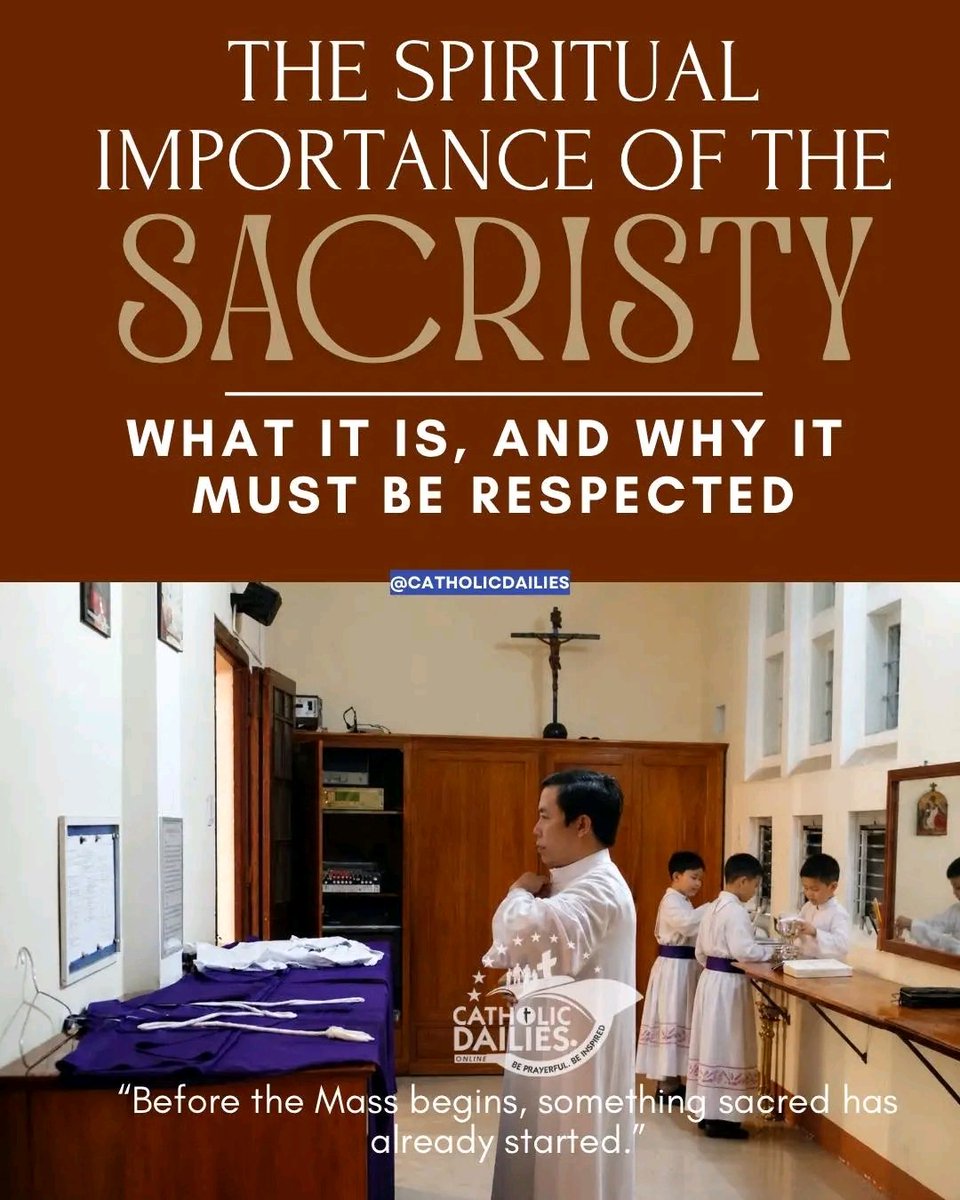
THE SPIRITUAL IMPORTANCE OF THE SACRISTY WHAT IT IS, AND WHY IT MUST BE RESPECTED “Before the Mass begins, something sacred has already started.” Many Catholics focus on the altar, the readings, the Eucharist, But very few think about the place where everything is first prepared: The Sacristy. What happens there may be hidden from the congregation, but it is deeply spiritual and essential to the life of the Church. And this is where many people miss it. 1. WHAT IS THE SACRISTY? The Sacristy is not just a storage room, It is a sacred preparation space where priests, servers, and ministers get ready before entering the altar. It is where vestments are kept, sacred vessels are arranged, and everything needed for the Mass is carefully prepared. In many ways, the Sacristy is like a “backstage of heaven’s liturgy”, but with reverence, not casualness. Because what happens there prepares what will happen on the altar. 2. WHY THE SACRISTY IS SPIRITUALLY IMPORTANT The Sacristy is a place of silence, focus, and interior preparation. Before stepping into the sanctuary, the priest recollects himself. He prepares not just physically, but spiritually, for the sacred duty ahead. It reminds us that the Mass is not something we rush into, It is something we prepare our souls for Reverence begins before the first sign of the Cross. 3. WHAT HAPPENS IN THE SACRISTY Everything used at the altar passes through the Sacristy. Vestments are worn with intention. Chalices and sacred vessels are arranged with care. Liturgical books are prepared in order. There are also traditional prayers said by priests before Mass, quiet moments where they entrust themselves to God. Nothing there is random, Everything is ordered toward worship 4. WHY THE SACRISTY MUST BE RESPECTED This is where a serious problem exists today. Some people treat the Sacristy like: * A meeting point * A discussion area * A casual passageway But the Church expects something very different. The Sacristy should be treated with: * Silence * Respect * Reverence Because it is connected directly to the sacred action of the Mass. If we lose reverence in preparation, we weaken reverence in worship. 5. WHAT THE CHURCH EXPECTS While the General Instruction of the Roman Missal emphasizes order and proper preparation for the liturgy, the spirit behind it is clear: Everything that leads to the Mass must reflect dignity and sacredness This includes how we behave in and around the Sacristy. It is not about rules alone, It is about understanding what we are approaching IN SUMMARY: A SACRED PLACE BEFORE A SACRED ACTION The Sacristy may not be seen, But it is deeply connected to what we experience at Mass. It is a place of: Silence Preparation Reverence And it teaches us something powerful: If we prepare well, we worship well Today, reflect: “Do I approach the things of God with preparation or with haste?” “The way you prepare for God, reveals how much you value Him.” If this opened your eyes, share it with someone who serves in the Church and tell us -have you ever been inside the Sacristy? SOURCE: * Sacred Scripture * Catechism of the Catholic Church (CCC) * General Instruction of the Roman Missal (GIRM) Be Prayerful. Be Inspired ©- Catholic Dailies
Uche is a girl tweet media
English
2
8
11
484
John Lilburne
John Lilburne@ef50·
@ebooksproject @DrFrancisYoung 2008 Roman Missal, GIRM 303: “In already existing churches, however, when the old altar is so positioned that it makes the people’s participation difficult ...".
John Lilburne tweet media
English
0
0
0
11
Dr Francis Young
Dr Francis Young@DrFrancisYoung·
It must be very lonely if you’re someone who wants the 1962 missal, but celebrated in Modernist vestments in Brutalist churches. Even more lonely than being someone who wants the Novus Ordo, but celebrated ad orientem and in Latin in beautiful churches
倪神父@StMichael71

It is often alleged (even when followed) the 'options' of the 1970 Missal produce radically different-looking Masses with the same rubrics. But, actually, you can celebrate the 1962 in a very modern way. E.g., with Matisse's vestments & versus populum (permitted in R.S. V.3)

English
18
8
137
11.2K
John Lilburne
John Lilburne@ef50·
@weeklyadvent @DrFrancisYoung 2008 Roman Missal, GIRM 303: “In already existing churches, however, when the old altar is so positioned that it makes the people’s participation difficult ...".
John Lilburne tweet media
English
0
0
0
12
John Lilburne
John Lilburne@ef50·
@TheModernist_CA 2008 Roman Missal, GIRM 303: “In already existing churches, however, when the old altar is so positioned that it makes the people’s participation difficult ...".
John Lilburne tweet media
English
0
0
0
15
Brian Murphy
Brian Murphy@MoxyMurphy·
@FrDaveNix @pontificatormax I think it’s not possible to “get the faith down” w/o correcting the liturgy. One begets the other. The Vetus Ordo is truly transformative. Celebrating the Novus Ordo ad orientem? The jury is out.
English
1
0
4
1.3K
Fr. Dave Nix
Fr. Dave Nix@FrDaveNix·
Here's Fr. James Martin SJ offering "Mass ad orientem" at a traditional chapel in St. Mary Major in Rome. Do you see why I keep saying we need to get the faith down before the liturgy?
James Martin, SJ@JamesMartinSJ

Happy 5th anniversary to @OutrchCatholic, the LGBTQ Catholic ministry of @americamag, of which I'm happy to be a part. One highlight was our Sept. pilgrimage to Rome for the Jubilee, including a very warm Mass at a chapel in Santa Maria Maggiore, and my first Mass "ad orientum."

English
61
47
388
55.9K
John Lilburne
John Lilburne@ef50·
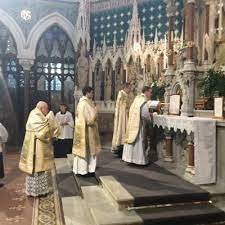
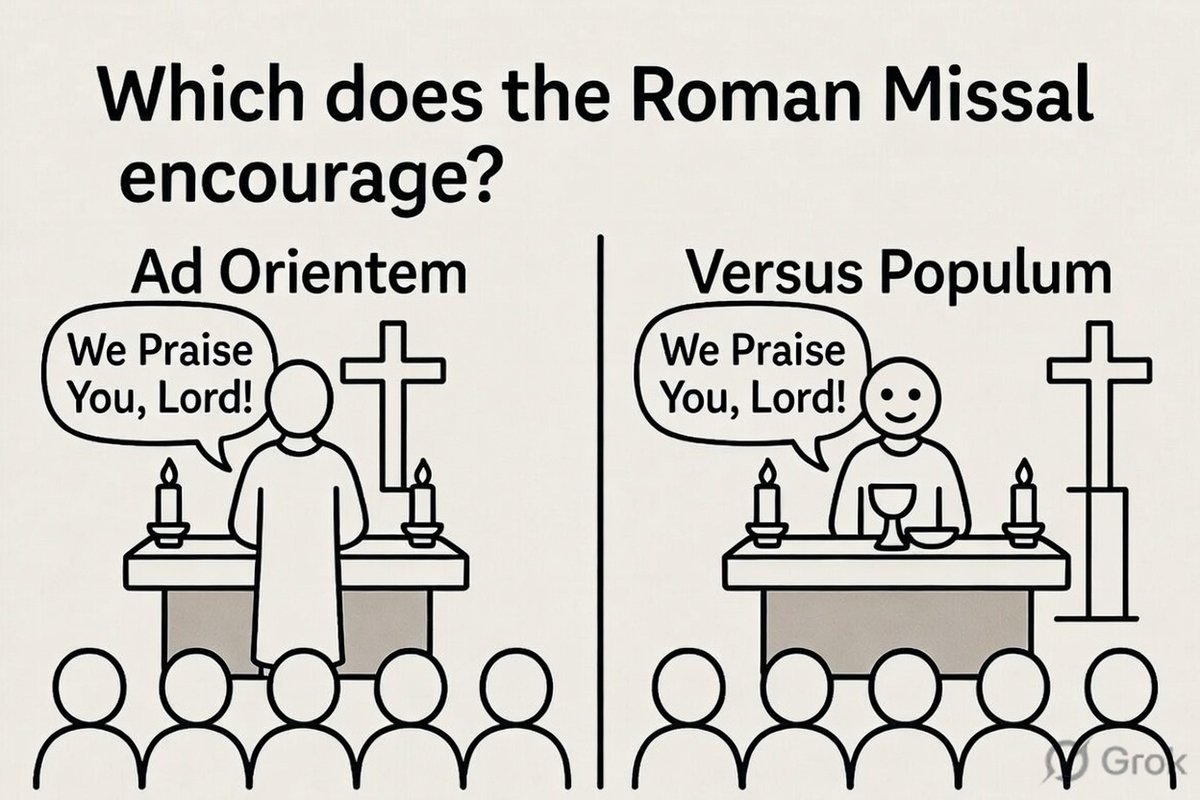
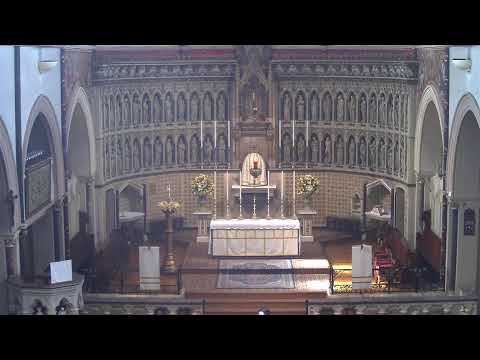
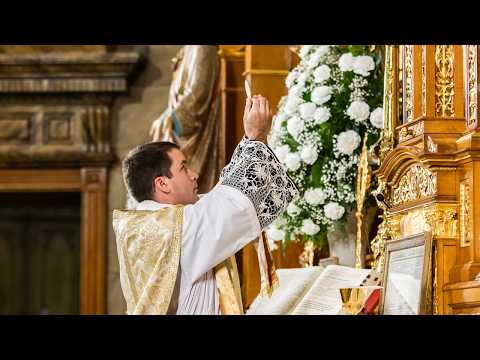
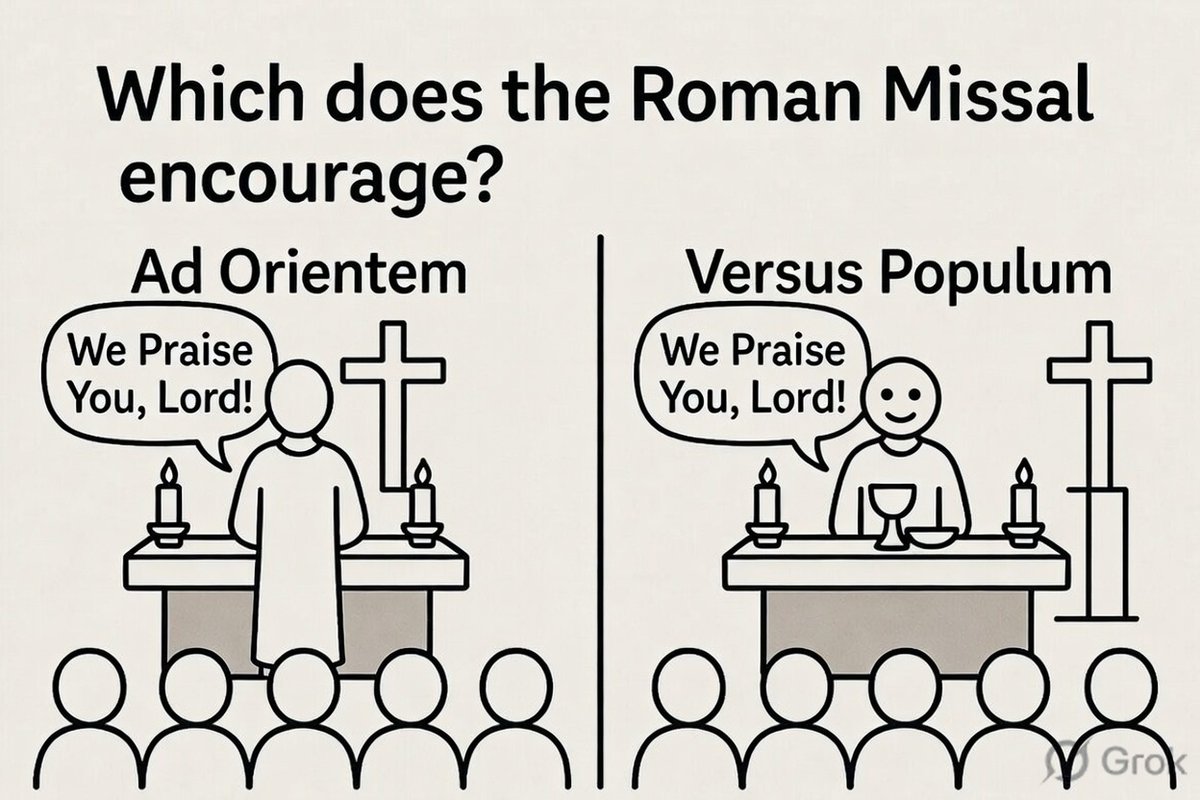
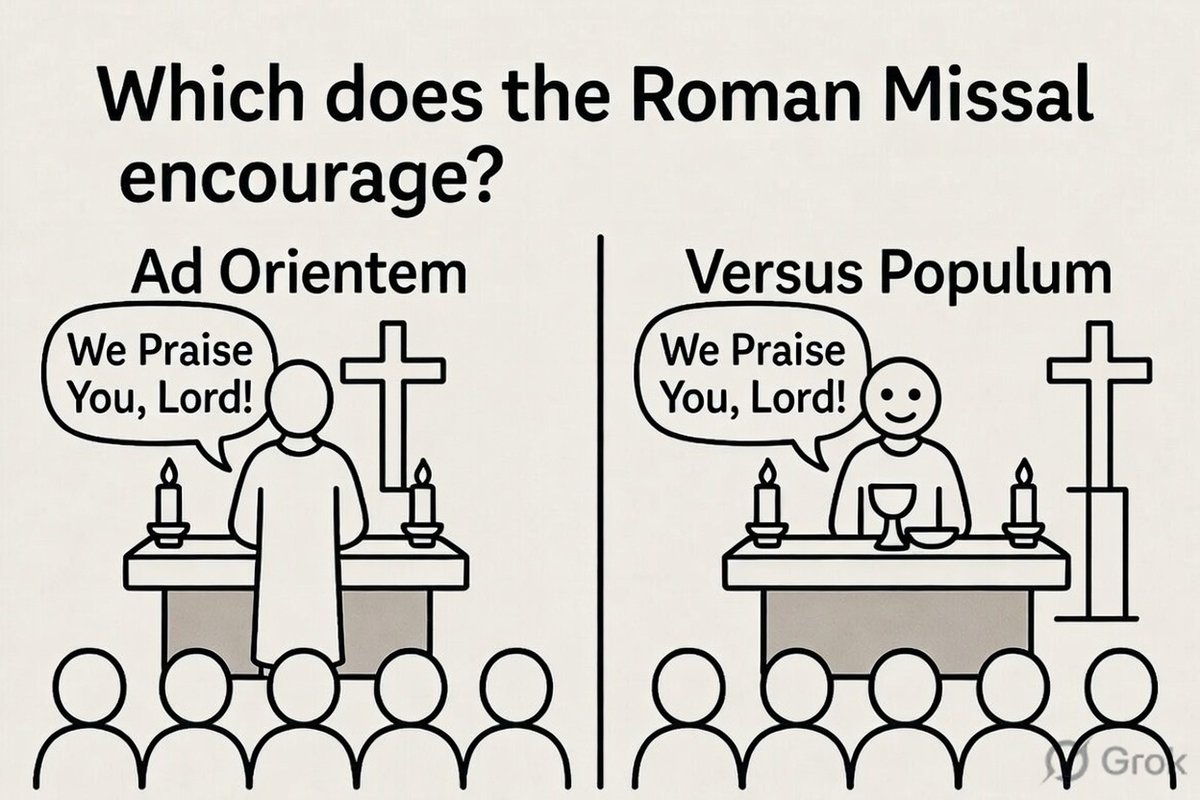
The 2008 Roman Missal discourages ad orientem, facing east, Priest facing away from the people. It has a preference that the view of the people not be obstructed by the Priest. For example: GIRM 215: “After the Prayer over the Offerings has been said by the principal celebrant, the concelebrants approach the altar and stand around it, but in such a way that they do not obstruct the execution of the rites and that the sacred action may be seen clearly by the faithful.” GIRM 299: “The altar should be built separate from the wall, in such a way that it is possible to walk around it easily and that Mass can be celebrated at it facing the people, which is desirable wherever possible.” GIRM 303: “In already existing churches, however, when the old altar is so positioned that it makes the people’s participation difficult but cannot be moved without damage to artistic value, another fixed altar, skilfully made and properly dedicated, should be erected and the sacred rites celebrated on it alone.” GIRM 307, about candlesticks: “the faithful may not be impeded from a clear view of what takes place at the altar or what is placed upon it.” GIRM 277: “if the altar is not freestanding, the Priest incenses it while walking first to the right hand side, then to the left.” It permits ad orientem, in certain circumstances, but discourages it.
John Lilburne tweet media
English
0
0
0
8
Peter Kwasniewski
Peter Kwasniewski@DrKwasniewski·
Question: Why does the direction of the priest matter at Mass? In this reflection, Conor Gallagher explores ad orientem, the ancient practice of priest and people facing east together, and why this single outward gesture reveals the true nature of the Holy Sacrifice of the Mass. The Mass is not first a communal meal or a performance for the congregation. It is the offering of the Lamb of God to the Father for the remission of sins. When worship turns inward, something subtle but devastating shifts in the soul of the liturgy and in the soul of man. Ad orientem restores the original axis of worship. It reorients the heart away from what is convenient, comfortable, or entertaining, and back toward what is worthy, beautiful, and true. Facing east teaches us to ask the right question, not “what am I getting out of the Mass,” but “what is the Father receiving from this offering?” This orientation protects the priest from becoming a performer, forms the faithful in reverence, and quietly shapes our eschatology. Every Mass becomes an act of waiting. Every elevation becomes preparation for the Second Coming. Priest and people together proclaim, without words, He is coming. This video is part of TAN Books’ Year of the Latin Mass, a year-long initiative to restore reverence, clarity, and continuity in Catholic worship. For more resources and insights on this cornerstone of Catholic worship, please visit: tanbooks.com/year-of-the-la… youtube.com/watch?v=fFLeCC…
YouTube video
YouTube
English
9
24
91
3.9K
John Lilburne
John Lilburne@ef50·
The 2008 Roman Missal discourages ad orientem, facing east, Priest facing away from the people. It has a preference that the view of the people not be obstructed by the Priest. For example: GIRM 215: “After the Prayer over the Offerings has been said by the principal celebrant, the concelebrants approach the altar and stand around it, but in such a way that they do not obstruct the execution of the rites and that the sacred action may be seen clearly by the faithful.” GIRM 299: “The altar should be built separate from the wall, in such a way that it is possible to walk around it easily and that Mass can be celebrated at it facing the people, which is desirable wherever possible.” GIRM 303: “In already existing churches, however, when the old altar is so positioned that it makes the people’s participation difficult but cannot be moved without damage to artistic value, another fixed altar, skilfully made and properly dedicated, should be erected and the sacred rites celebrated on it alone.” GIRM 307, about candlesticks: “the faithful may not be impeded from a clear view of what takes place at the altar or what is placed upon it.” GIRM 277: “if the altar is not freestanding, the Priest incenses it while walking first to the right hand side, then to the left.” It permits ad orientem, in certain circumstances, but discourages it.
English
0
0
1
152
James Martin, SJ
James Martin, SJ@JamesMartinSJ·
Happy 5th anniversary to @OutrchCatholic, the LGBTQ Catholic ministry of @americamag, of which I'm happy to be a part. One highlight was our Sept. pilgrimage to Rome for the Jubilee, including a very warm Mass at a chapel in Santa Maria Maggiore, and my first Mass "ad orientum."
English
51
42
355
81.5K
John Lilburne
John Lilburne@ef50·
@UcheMaryOkoli Do you support requiring the Priest to give people Communion next to the baptismal font, if that is their preference?
English
0
0
0
40