
exitwise

124 posts

exitwise banner
exitwise

exitwise

@exitwise

Exitwise is the leading platform to assemble the world's best team of M&A experts to help ensure business owners create the exits they deserve.


Birmingham, MI Tham gia Temmuz 2022
56 Đang theo dõi25 Người theo dõi
exitwise
exitwise@exitwise·
ADVANTAGES - Long-standing partnerships, Low CAC. Very High Retention. HIGHLIGHTS - Profitable with stable earnings. Expanding footprint & strong growth potential. Interested in seeing the teaser? DM or contact us at: hello@exitwise.com
English
0
0
1
18
exitwise
exitwise@exitwise·
Acquisition Opportunity: Mental Health & Behavioral Health Services FINANCIALS - 2024: $1M AEBITDA, $3M Revenue, 33.53% EBITDA Margin, $4m+ Projected Revenue in 2025.
exitwise tweet media
English
1
0
1
54
exitwise đã retweet
Brian Dukes
Brian Dukes@bdukes32·
Business Onwers... Ever heard of a Sellability Score? It could be the secret weapon you didn't know your business needed. Think of it as a report card. It measures how attractive your business is to potential buyers on a scale of 1 to 100. Why does it matter? Because it: → Highlights where to improve. → Keeps you exit-ready at all times. → Helps you understand your net worth. → Sets realistic expectations for negotiations. The secret? You don't have to wait until you're ready to sell to care about your score. In our latest issue of The Wise Exit newsletter, we dive deep into the Sellability Score. We break down its: → Components. → Explain why it matters. → And share strategies to boost your score. Subscribe for free to get access to content like this every Wednesday direct to your inbox: newsletter.exitwise.com/subscribe Don't miss out. P.S. Follow me for more content like this.
English
0
1
1
56
exitwise
exitwise@exitwise·
@bdukes32 When it comes time to exit your business, make sure you're working with the right partner.
English
0
0
0
10
Brian Dukes
Brian Dukes@bdukes32·
I once had to fire an investment banker mid-deal, so I know from personal experience that not all investment bankers are created equal. (here’s my advice for how to choose the right one) Here are 5 questions to ask your investment banker BEFORE signing an engagement letter: 1) What's your track record in my industry? Past performance matters, so ensure they know your space inside out. Ask for specific deal examples. What multiples did they achieve? What are the relevant buyers that they have relationships with? How long did the deals take? What challenges did they face? A banker with deep industry knowledge can spot unique value drivers and connect you with the right buyers. 2) Who'll be working on my deal day-to-day? Don't get bait-and-switched. Ensure you're getting the A-team, not just the pitch team. Ask to meet the entire deal team. Understand their roles and experience levels. You want seasoned pros handling your transaction, not junior associates learning on the job. Chemistry matters too. Because you'll be working closely with these folks for months. 3) Are you sell-side only? Some banks play both sides. That’s why you need to understand their approach upfront. Do they represent buyers too? How do they manage confidentiality? What's their policy on representing competitors? Clear boundaries protect your interests and ensure your banker fully aligns with your goals. 4) What's your process for preparing my business for sale? A solid game plan is crucial. That’s why you need to get specifics on their approach. How do they conduct due diligence? What materials will they prepare? How do they uniquely position companies to various buyers? The best bankers have a proven playbook for maximizing value and streamlining the sale process. 5) How do you define a successful outcome? Align your goals early because it'll save a ton of headaches later. Is it just about price? What about deal structure? Post-sale integration? A great banker understands that success means different things to different founders. Remember: The right banker can make or break your deal. Choose wisely. Take your time vetting options. And don't be afraid to ask tough questions. Because your life's work deserves nothing less than the best representation. DM me if you'd like help in selecting the perfect banker for an upcoming M&A process.
English
1
0
1
97
exitwise
exitwise@exitwise·
Employees are your lifeblood. Make sure to invest appropriately.
Brian Dukes@bdukes32

"Employees are your greatest asset" ... Or are they? Here's my take: Good employees are vital. But are they truly invested in your company's success? If not, try this: Transform employees into stakeholders by getting them to think and act like owners. Here's how: Communicate the vision. - Share your company's purpose, goals, and values early and often. - Help employees see how their work contributes to the bigger picture. Offer meaningful ownership. - Consider offering stock options, profit-sharing, or other forms of equity. - Give employees a tangible stake in the company's success. Empower decision-making. - Give employees autonomy to make decisions in their areas of expertise. - Trust them to act in the best interests of the company. Celebrate successes. - Recognize and reward employees for their contributions to company goals. - Make them feel valued and appreciated for their efforts. Encourage transparency. - Share financial and performance metrics with the team. - Encourage open communication and ideas at all levels. Remember: Transforming employees into stakeholders will take time. It requires consistent effort and genuine commitment from the leadership team. But get it right? You'll unlock a powerful force for growth. And create a team that is genuinely invested in the company's future. I'm curious: How do you encourage your employees to become invested stakeholders in your business? Share your thoughts below. Get some value? Please follow, and check out my weekly newsletter for even better founder content: newsletter.exitwise.com

English
0
0
0
54
exitwise đã retweet
Brian Dukes
Brian Dukes@bdukes32·
Ever wondered why some companies thrive while others stagnate? It comes down to one key ingredient: Transparency. Here’s how being open with your team can drive growth: 1. Builds Trust. When leaders share information openly, it encourages a culture of trust. Teams feel valued and engaged. The result? Higher morale. Increased productivity. Regularly share company updates (good and bad) to keep everyone in the loop. 2. Enhances Collaboration. Transparency breaks down silos and encourages cross-departmental collaboration. It helps everyone: Understand the big picture. Work together more effectively. Try holding regular inter-departmental meetings to discuss goals and challenges. 3. Improves Decision-Making. Open communication ensures all team members have the information they need to make informed decisions. Resulting in better: Strategies. Outcomes. Consider creating an open forum for feedback from all levels of your company. That's it. Transparency is a simple yet powerful way to unlock your team’s potential and drive growth. Is your business transparent enough? YES or NO. Let me know below.
English
0
1
1
42
exitwise đã retweet
Brian Dukes
Brian Dukes@bdukes32·
Want to know the secret to securing the future of your business? Start planning your exit now. (seriously) Succession planning is one of the most critical yet often overlooked aspects of running a business. (don't leave it to the last minute) Give yourself time to prepare for the transfer of ownership to the next generation. Because without a solid succession plan, you risk: Diminishing the value of your business. Losing key employees and institutional knowledge. Disrupting operations and damaging relationships with clients and vendors. But with careful planning and execution, you can: → Ensure a smooth transition and continuity of leadership. → Retain top talent and maintain the confidence of stakeholders. → Maximize the value of your business and secure your financial future. (the latter sounds much better) Succession planning is an ongoing process. It requires: Open communication. Strategic thinking. And a willingness to groom the next generation of leaders. The earlier you start, the better prepared you'll be. If you haven't considered your exit strategy, now is the time. Your legacy. Your business. Your employees. They all depend on it. Need help? Exitwise can connect you with experts to help you get started. Drop me a DM. And let's start planning.
English
0
1
1
29
exitwise
exitwise@exitwise·
Two years in, and we're just getting started!
Brian Dukes@bdukes32

It's been two years ... (time flies when you live and breathe M&A) As @exitwise hits its second anniversary, we reflect on helping our fellow founders achieve life-changing exits. Here are 5 key lessons we've learned along our journey: 1. Industry Expertise Is Non-Negotiable. Sellers need advisors who understand their industry's unique challenges. Generic advice doesn't cut it. Industry-specific M&A advisors will secure you a better deal every time. Guaranteed. 2. Valuation Is Both An Art And A Science. Accurate valuations need a balance of financial analysis and strategic positioning. It's not just about the numbers. It's about crafting a compelling narrative that demonstrates the business's upside. 3. Preparation Is Everything. The most successful exits result from months (or even years) of careful planning. Tidying up financials. Streamlining operations. Founders who lay the groundwork early are best positioned to maximize their sale price. 4. Fit Is Just As Important As Financials. The highest bidder isn't always the best buyer. Founders want a buyer who aligns with their: Values. Their vision. And their culture. The right fit ensures a smooth transition and sets the stage for the company's continued success. 5. You'll Need Emotional Support. Selling a business is personal. Yes, founders need advisors who provide strategic guidance. But that's not enough. Advisors must also offer emotional support and empathy throughout the process. At Exitwise, we live and breathe M&A. If you're considering selling your business, we'd love to put these lessons to work for you. Drop me a DM. And let's discuss how Exitwise can help you get the exit you deserve.
English
0
0
1
56
exitwise
exitwise@exitwise·
It's been too hard a journey building an incredible business to fumble the EXIT on the goal line... M&A knowledge bombs below 👇
Brian Dukes@bdukes32

Most founders think they're ready to sell their business. Unfortunately, many are not. Here’s why. Selling a business is a complex process. If you take on an M&A process unprepared, you'll likely leave money on the table, or worse ... Tank the deal altogether. Don’t worry, you’re not alone. Every successful entrepreneur has had to go through an exit process for the FIRST TIME. So, before you sell, let’s level up what you know about M&A. How? That's easy. Follow my simple 5-step checklist: Know Your Numbers. Understand your financials, including revenue, profit, and growth projections. Buyers will scrutinize your numbers. So, ensure they're accurate (or you'll raise more questions than you answer). Tidy Up Your Operations. Streamline your processes, document your procedures, and ensure you have strong leadership overseeing key areas of the business. Why? Because many buyers want a business that's primed for a smooth transition. Identify Your USP (unique selling proposition). What makes your key products or services unique compared to your competition? Articulate your strengths. And reveal the opportunities for growth under new ownership. Assemble a Team of M&A Advisors. Surround yourself with industry-specific M&A experts (accountants, lawyers, bankers, etc.). They'll help you: Avoid pitfalls. Identify real buyers Negotiate a deal that matches your expectations. Prepare for Due Diligence. Get all your documents in order, and be ready to answer tough questions. Want to get the deal done? Transparency is vital, as it builds trust and gets you close to the finish line. That's it. Well, not really, but those are the big 5. At Exitwise, we help founders level up their M&A knowledge to achieve life-changing exits. Don't leave your exit to chance. Need help? Drop me a DM, and let's chat about how Exitwise can help you become M&A-ready.

English
0
0
0
27
exitwise đã retweet
Brian Dukes
Brian Dukes@bdukes32·
Growing a startup that's missing this ONE critical element isn't for the faint-hearted: … a clear valuation. Let me explain: Some businesses have clear valuations. Buyers can determine a company's worth based on tangible assets recurring revenue, or profitability (EBITDA). For example: A medical device company doing $2,00,000 in monthly revenue with a 35% gross margin tells you what you need to know. But what about startups like Facebook in 2006 that had almost 8 million users, but limited revenue. Or a company with incredible IP and brand, but with limited sales momentum? Valuing those businesses can be much harder. And it takes a special kind of CEO to run those companies. Because every step is challenging when you can’t determine a clear value on the business. The CEO must be able to: 1. Raise funds without clear growth guarantees, selling a distant dream to skeptical investors. 2. Recruit top talent based on belief and a vision. 3. Know which shiny toy (aka product) is the one that will drive revenue. It's a high-stakes game that not everyone can stomach. But for those with the conviction and grit to tackle these challenges head-on, the potential payoff is massive. Could you be the kind of CEO to lead a startup through this journey? Let me know below.
English
0
1
1
52
exitwise đã retweet
Brian Dukes
Brian Dukes@bdukes32·
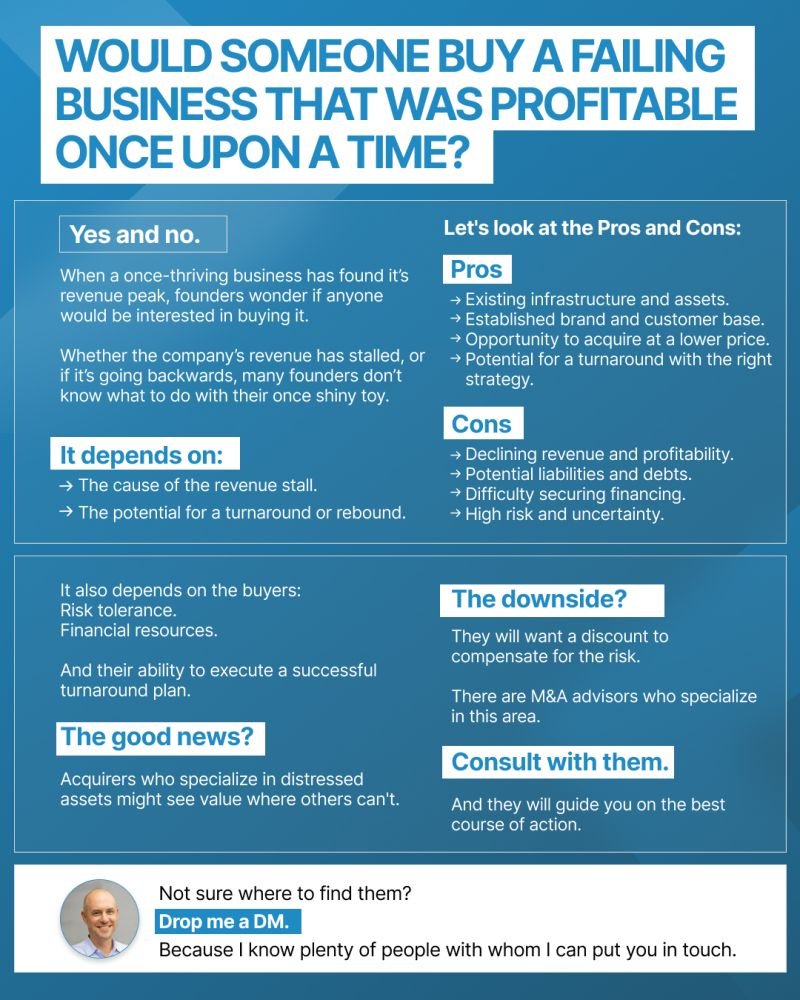
Would someone buy a failing business that was profitable once upon a time? Yes and no. Let me explain ... When a once-thriving business has found its revenue peak, founders wonder if anyone would be interested in buying it. Whether the company’s revenue has stalled, or if it’s going backwards, many founders don’t know what to do with their once-shiny toy. It depends on: The cause of the revenue stall. The potential for a turnaround or rebound. Let's look at the Pros and Cons: Pros: - Existing infrastructure and assets. - Established brand and customer base. - Opportunity to acquire at a lower price. - Potential for a turnaround with the right strategy. Cons: - Declining revenue and profitability. - Potential liabilities and debts. - Difficulty securing financing. - High risk and uncertainty. It also depends on the buyers: Risk tolerance. Financial resources. And their ability to execute a successful turnaround plan. The good news? Acquirers who specialize in distressed assets might see value where others can't. The downside? They will want a discount to compensate for the risk. There are M&A advisors who specialize in this area. Consult with them. And they will guide you on the best course of action. Not sure where to find them? Drop me a DM. Because I know plenty of people with whom I can put you in touch. P.S. - Get some value? Please reshare this.
Brian Dukes tweet media
English
0
1
1
42
exitwise đã retweet
Brian Dukes
Brian Dukes@bdukes32·
Is your business a one-hit wonder? Or a success story that will last for generations? The difference lies in one key attribute: Replicability of results. In other words, could a new owner step in and replicate your success? Or is your business dependent on your personal efforts and unique skills? If you want to build a sellable business, you need to create systems and processes so it can thrive without you. This means: - Building a strong management team. - Documenting your standard operating procedures. - Ensuring your business can run like a well-oiled machine. Why go to this effort? Simple. Replicable businesses are infinitely more attractive to potential buyers. Want to learn more? In the latest edition of The Wise Exit newsletter, I discuss the three attributes of a sellable business. It's a must-read. Read the full issue here: newsletter.exitwise.com/p/three-essent… Don't miss out. P.S. - Get some value? Please reshare this.
English
0
1
1
47
exitwise
exitwise@exitwise·
New edition of The Wise Exit newsletter out this week. Check it out for weekly M&A-insights and stories and experiences shared by exited founders and entrepreneurs: newsletter.exitwise.com
Brian Dukes@bdukes32

I know several founders who struggle with this (and it can be crippling) ... Imposter syndrome. It's that nagging voice in your head that whispers: "You're not close to good enough." "Are you kidding? You don't belong here." "You're just pretending to know what you're doing." Sound familiar? You're not alone. Even the most successful entrepreneurs grapple with feelings of inadequacy and self-doubt. But here's the thing: Imposter syndrome isn't a sign of weakness. It's a sign that you're growing, pushing boundaries, and taking on new challenges. The key is learning to embrace and use it to your advantage. In the latest edition of my newsletter, The Wise Exit, I dive deep into the surprising truth about imposter syndrome and share practical strategies for overcoming it. Don't let self-doubt hold you back from reaching your full potential. Read the whole issue here: newsletter.exitwise.com/p/surprising-t… And take the first step towards conquering imposter syndrome today. Don't miss out. P.S. If you like this content, here are 4 more resources you need to check out: 1. Subscribe to The Wise Exit podcast for weekly interviews with fellow founders, entrepreneurs, experts, and M&A advisors:  newsletter.exitwise.com 2. Read my guide to selling your business, M&A 101 for Business Owners, here:  exitwise.com/blog/mergers-a… 3. Follow me on LinkedIn for daily M&A-related content:  linkedin.com/in/brdukes/ P.S. - Get some value? Follow me for daily posts.

English
0
0
1
21
exitwise
exitwise@exitwise·
Would you have the conviction to keep building...? Having the right advisors around you can certainly help arming you with the best information...
Brian Dukes@bdukes32

He turned down a $1 BILLION offer. Would you? Back in 2006, Mark Zuckerberg faced a dilemma. Yahoo! had offered to buy Facebook for a staggering $1 billion. At the time, Facebook was only 2 years old, and the valuation was astronomical for such a young startup. Zuckerberg shocked Silicon Valley when he said no. (turning down life-changing money seemed crazy) But he had a vision. Zuckerberg believed Facebook could connect the entire world. And he knew he needed to maintain control to execute that vision. A year later, Microsoft validated his instincts. They invested $240 million for a mere 1.6% stake in Facebook. This deal valued the company at $15 billion - over 15X Yahoo's offer. By following his convictions and playing the long game, Zuckerberg grew Facebook into the tech titan it is today. It's now worth over $500 billion. The Lesson? For founders, your company is more than a financial asset. It's the embodiment of your vision. Selling for a quick payday can be tempting. But if you have an unwavering belief in your startup's potential, you may create far more value by staying the course. Zuckerberg's story is an extreme example. But it illustrates the importance of having a clear mission and the guts to see it through. As you weigh acquisition offers, reflect on whether the deal aligns with your endgame aspirations. Not the dollar amount. What would you have done in Zuckerberg's shoes? Let me know below.

English
0
0
0
18
exitwise đã retweet
Brian Dukes
Brian Dukes@bdukes32·
Building a business with a remote workforce? Here's what you need to know: More and more companies are embracing remote work. And for good reason. Remote workforces offer: Flexibility. Potential cost savings. Access to a wider pool of talent. But what happens when it's time to sell your business? Will buyers see your remote team as an asset? Or a liability? The key is in the systems and processes you have in place. When you have: Clear communication channels. A strong company culture. Well-documented SOPs. ... your remote workforce becomes a valuable asset. It demonstrates your ability to scale efficiently and adapt to changing circumstances. In this week's issue of The Wise Exit, I dive deep into this topic with @NathanHirsch99 , co-founder of FreeUp. Nathan built a $12 million business with a team of 30 employees, all based in the Philippines. And when it came time to sell, his remote workforce was a key factor in the successful exit. Discover the strategies Nathan used to build a valuable business with remote talent and how he navigated the challenges of selling it. Read the full issue here: newsletter.exitwise.com/subscribe Don't miss out. P.S. Here are 4 resources you need to check out: 1. Subscribe to The Wise Exit podcast for weekly interviews with fellow founders, entrepreneurs, experts, and M&A advisors: podcast.exitwise.com 2. Read my guide to selling your business, the definitive "M&A 101 for Business Owners" here: exitwise.com/blog/mergers-a… 3. Check out all past newsletter issues here: newsletter.exitwise.com 4. Follow me on Twitter (X) for daily insights and M&A adventures and LinkedIn: linkedin.com/in/brdukes/ for daily M&A-related content.
English
1
2
2
51
exitwise
exitwise@exitwise·
Exited founders bring an encyclopedia of insights and education to the next business(es) they build, and @NathanHirsch99 is no exception. On last week's episode of The Wise Exit podcast, we got a chance to ask him for advice for founders building a company towards a future exit.
English
1
0
2
30