

@Tiza4ThePeople still think theres a lot of money to be made, less so in pure yield farming but asymmetric opportunites are ever present
i miss the days of looping pt-usde for 60%+ apy though
English
wumpy crypto
597 posts

@wumpycrypto
head of defi @3janexyz

i dont understand why more people dont talk about DeFi on tokenized stocks 500m people already own stocks thats 500m people who could get: - loans against them - yield on them isnt it like an obvious massive market or im i retarded?
Private credit is in a strange place today. The economy is tied to the cost of money. Low interest rates mean cheap borrowing, which in theory should lead to higher utilization of credit facilities. Conversely, high interest rates mean less affordable borrowing and, in theory, reduced demand for credit. We've been living through a high-interest-rate environment since the Federal Reserve began its aggressive tightening cycle in March 2022, raising rates from near zero to over 5% by mid-2023, the fastest hiking cycle in four decades. Rates have remained elevated through early 2026, with only modest cuts. For many consumers and businesses that initiated borrowing during the low- or mid-rate era, and whose obligations remain outstanding, this translates into a significantly higher cost of capital, a burden that compounds over time. This all sounds normal. Finance is part of almost every phase of a company's lifecycle, from growth to maturity. The problem arises when the cost of capital stays elevated for too long, creating unmanageable expenses for borrowers. Businesses typically borrow from financial institutions like banks, or from asset managers in the form of private credit. How do private credit funds work? Private credit funds are typically either closed-end or semi-liquid vehicles managed by asset managers. This structure makes sense: the funds need to deploy capital into lending opportunities to generate returns. Investors in private credit range from pension funds, insurance companies, and family offices to, increasingly, retail investors. Closed-end funds don't allow redemptions until maturity, usually 7 to 10 years. Semi-liquid funds offer quarterly redemption windows with limits. BDCs (Business Development Companies), which are publicly traded, provide liquidity via daily trading on exchanges. In essence, private credit funds function as private banks: they lend capital to businesses and collect interest. What does private credit fund? Typically, private credit finances leveraged buyouts for private equity, middle-market corporate loans for companies that lack access to public bond markets, certain asset-backed lending (such as aircraft, shipping, and consumer loans), and real estate credit. Private credit funds generally fill the funding gap that banks have vacated. This shift has been driven primarily by post-2008 regulation, particularly Basel III, which pushed banks out of riskier corporate lending. Today, private credit finances an estimated 80 to 90% of leveraged buyouts in the U.S. middle market. Who are the players? Apollo ~$460B AUM Blackstone ~$330B AUM Ares ~$280B AUM KKR ~$220B AUM Carlyle ~$190B AUM Blue Owl ~$170B AUM What's going on? Recently, distress has emerged across private credit. The persistent cost of capital driven by high interest rates remains a reality, and AI is reshaping perceptions of many software companies that private credit has funded, creating uncertainty about these borrowers' futures. The market has already begun repricing private credit: VanEck BDC Income ETF: ~15% decline over the past year Blue Owl Capital: ~50% decline over the past year, with ~30% of that during 2026 Apollo, Blackstone, Ares, KKR: shares down ~20% on private credit concerns The average BDC now trades at roughly a 20% discount to NAV while offering 10 to 11% yields, signaling that loan portfolios may be overvalued, defaults could rise, or liquidity risk is building. What makes this even more concerning is that historically, these funds traded at a premium. Some funds' monitored loan default metrics have risen to as high as 9%. Blackstone's flagship private credit fund, BCRED, is a notable example. BCRED recently limited its redemptions. The fund manages roughly $82B, and during Q1 2026, redemption requests reached $3.7B, approximately 8% of NAV. Blackstone injected $400M of its own capital to support liquidity. Technically, the fund was not gated, but it came very close. Meanwhile, BlackRock's HPS Corporate Lending Fund (HLEND), a $26B fund, received $1.2B in redemption requests, reaching the point where gating was necessary. Roughly $580M in requests could not be honored. Blue Owl's retail private credit vehicle experienced $2.9B in redemptions during Q4 2025, with redemption requests reaching 15% of NAV, largely driven by exposure to software lending. Can the market handle a private credit fund default? While total redemptions have been around $7B+ (5 to 10% of NAV) and public alternative managers are down 20 to 30%, the overall private credit market is still $1.8 to 2T in size. Even the largest funds top out at $20 to 80B, compared to the global bond market at $130T or banking assets at $180T. A single fund default would most likely not collapse the broader market or trigger the kind of contagion that amplifies crises. Large funds also hold diversified portfolios of hundreds of loans, and the semi-liquid or closed-end structure naturally forces investor lock-up, acting as a buffer against bank-run dynamics. I've mapped out three scenarios of increasing severity: Scenario A: One large fund defaults (~$50B)Investors lose capital, some companies lose financing, and credit spreads widen. The system likely absorbs the shock. Scenario B: Several funds fail simultaneouslyCredit markets freeze, leveraged companies cannot refinance, and defaults cascade. This could trigger a credit-cycle downturn. Scenario C: Private credit + leveraged loans collapseA broader corporate credit crisis unfolds: private equity deals fail and banks become exposed. This would be genuinely systemic. Fortunately, private credit funds remain relatively small in the broader picture and are unlikely on their own to pose systemic risk. However, the most worrisome scenario is one where loss of confidence begins in private credit markets, particularly around lending to businesses vulnerable to AI disruption, and then bleeds into public bond markets. This contagion path is plausible because the larger corporates in bond markets are arguably more exposed to automation and AI disruption than the leaner, high-growth businesses that private credit typically funds. How does this affect RWAs and DeFi? The most immediate impact of private credit distress falls on capital allocators. Many private credit funds have been distributed to retail investors via publicly traded BDCs, private credit ETFs, or semi-liquid funds like Blackstone's BCRED, Apollo's Debt Solutions BDC, and BlackRock's HPS Corporate Lending Fund. These funds share common characteristics: quarterly (or monthly) redemption windows, redemption limits typically capped at 5% of NAV per quarter, and target returns of 8 to 11%. Recently, some funds have also begun gating redemptions. From a DeFi capital allocator's perspective, the biggest risk I see is structural: private credit is packaged in DeFi in ways that many retail-oriented users don't fully understand before committing capital. We've seen countless examples of DeFi users eagerly supplying funds into high-yielding RWA strategies, only to discover later that the underlying exposure carries significant duration risk. I believe RWAs represent the biggest opportunity for DeFi in the near term. However, my greatest fear is that institutional opportunists could view DeFi as a channel to offload illiquid and distressed products that Wall Street has already soured on, effectively using DeFi participants as exit liquidity. This risk is amplified by the fact that assessing RWA allocation opportunities is inherently harder: they don't carry the same transparency or onchain verifiability that native DeFi opportunities provide. That said, private credit done well onchain offers something traditional finance fundamentally cannot: smart contract-enforced guarantees. Redemption windows, withdrawal limits, collateral ratios, and distribution rules can be encoded immutably, meaning fund managers cannot arbitrarily change the terms after capital has been committed. In traditional private credit, investors discovered the hard way with BCRED and HLEND that redemption policies can be tightened or gated at the discretion of the manager when conditions deteriorate. Onchain, those rules are transparent from day one and enforced by code, not by a fund administrator under pressure. This is precisely where RWAs and DeFi can outperform the traditional model for this asset category. For RWAs to succeed in DeFi, and for DeFi to scale meaningfully through real-world assets, the industry needs deliberate and careful structuring of opportunities that bridge TradFi and onchain markets. That means robust transparency standards, proper risk disclosure, independent verification of underlying collateral, and governance frameworks that protect onchain participants from asymmetric information disadvantages. Without these safeguards, the convergence of TradFi and DeFi risks becoming extractive rather than additive. DeFi should not become Wall Street's exit liquidity.
why has no lending market explored the idea of making the calculation of interest charged be dependent on the LTV of a loan the riskier a loan, the higher the interest the borrower pays afaik only protocol that has smth along these lines is Maker with ETH-A, ETH-B...
🚨New Decision Market🚨 A group of RNGR tokenholders allege that the @ranger_finance team made material misrepresentations about their business before the fundraise and are proposing liquidation. Read and trade the proposal below⏬
1/ 3Jane's unsecured credit book remains healthy, with a debt-weighted LTV at 14.6% with 96.6% of debt below 25% LTV. Sharing a deeper report on how our risk model performed through the recent sell-off.




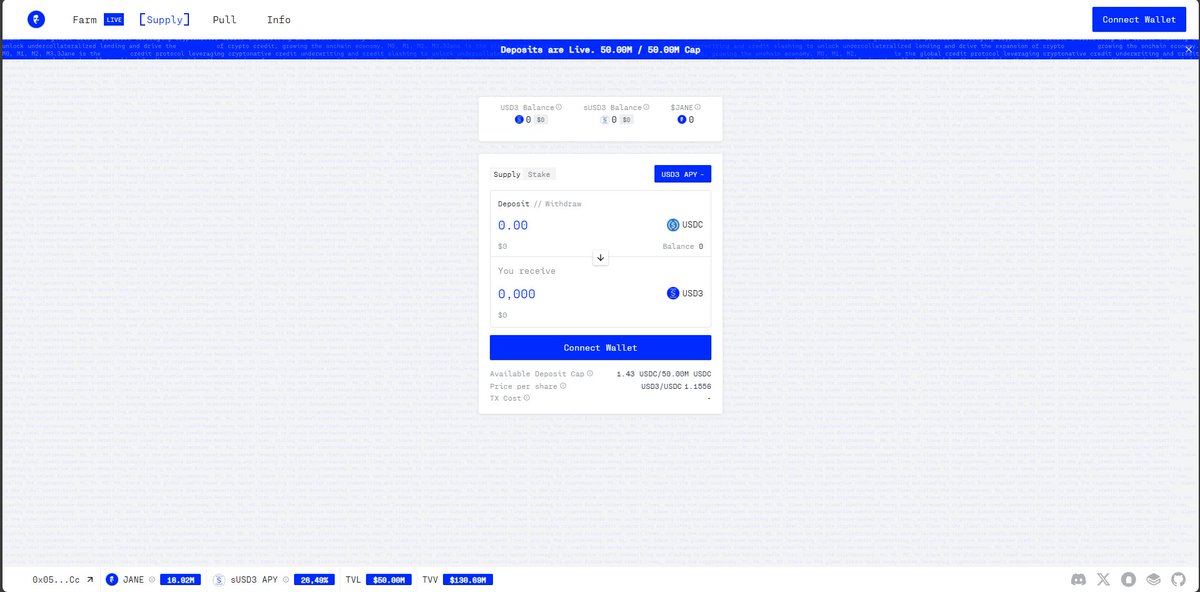

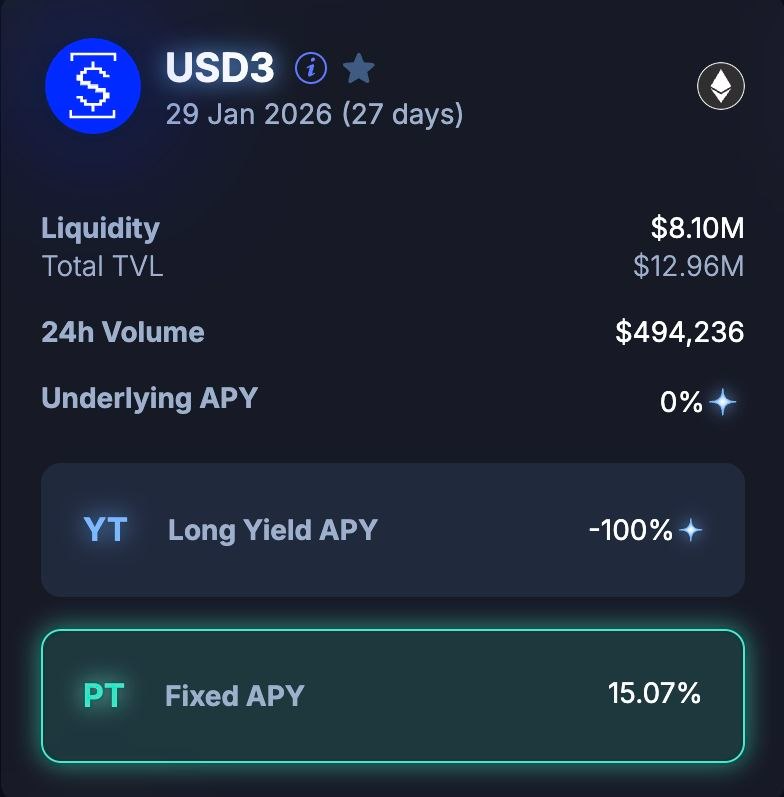



Also, obviously, @pendle_fi. It's actually crazy that you can still get >15% fixed rate/date on Pendle even in these market conditions. GRANTED, all PTs are not equal. Some assets are way more risky / illiquid than others. So here's what I like (NFA, DYOR, GLHF): ➢ @3janexyz USD3: 19% IY Why? Senior tranche, fairly liquid, 51 days of yield. ➢ @Neutrl sNUSD: 18% IY Why? Accountable solvency proofs, great underlying APR, 86 Days ➢ @USDai_Official sUSDai: 16% IY Why? 600M TVL protocol, 99% TBILL backing, 100 days I also like @re's reUSD since it's a basis+tbill asset, as well as syzUSD because it's by @OuroborosCap8 and has a solvency dashboard. If I didn't mention one in the top 10, feel free to ask why.
