wumpy crypto

684 posts

wumpy crypto banner
wumpy crypto

wumpy crypto

@wumpycrypto

head of defi @3janexyz @yieldsandmore @cozy_fnf

Katılım Mart 2023
483 Takip Edilen726 Takipçiler
wumpy crypto
wumpy crypto@wumpycrypto·
tvl as a metric penalizes the capital efficiency of unsecured lending protocols 3jane is able to drive higher credit spreads through extending unsecured lines of credit - yet tvl may appear 2-3x lower than an overcollat. lending protocol despite being able to support greater economic productivity from current data: 3jane tvl: $600k outstanding credit: $18.8m (incl. asset-backed finance staging & cryptonative unsecured) curvance tvl: $64.5m outstanding credit: $23.5m despite similar amounts of outstanding credit, curvance looks like 100x bigger protocol than 3jane when using tvl as the metric for measurement. as paper states, total assets is a better measurement than tvl when evaluating lending protocols. i think a better measurement would be fees per $ in total deposits - in essence, how much $$$ is a lending protocol able to drive from a users deposit? protocols with high fees per $ in total deposits means borrowers are willing to pay a higher borrow rate (likely due to being able to borrow against novel asset classes) & lenders feel they are being properly compensated for their credit exposure. rerunning the numbers: 3jane fees: $1.8m (assuming ~ 10% on-credit apy) total deposits: $19.6m fees / deposit: $0.09 curvance fees: $2m total deposits: $64.5m fees / deposit: $0.03 this flips the tvl metric upside down, showing how showcasing the capital efficiency of each lending protocol. the main thing its missing is accounting for scalability of a lending model imo. p.s. i just took curvance as an example b/c its a pretty good, generic overcollateralized lending protocol
PaperImperium@ImperiumPaper

I’ll go further and say TVL has always been a poorly defined metric, and is mostly a technical measurement vs a financial measurement, since it just measures tokens in a location. Let’s imagine three lending protocols. Both receive 100 USDC in deposits. Protocol A lends 50 USDC out unsecured. TVL is now 50 (100 deposits - 50 lent USDC). Protocol B lends 50 USDC out against $100 in ETH. TVL is now 150 (100 deposits + 100 collateral - 50 lent USDC). Protocol C fails to originate any debt at all. TVL is 100 (100 deposits). What useful information is TVL giving us here? Not much. All three protocols were equally successful in attracting 100 USDC in deposits, but the TVL doesn’t tell that story, and standard practice is to count it as three completely different values. For lending protocols, this mostly comes from TVL being a poor substitute for proper accounting. If these protocols were lending companies, they would probably be measured by total assets instead of TVL: Protocol A lends 50 USDC out unsecured. Total Assets is now 100 (100 deposits - 50 lent USDC + 50 loan). Protocol B lends 50 USDC out against $100 in ETH. Total Assets is now 100 (100 deposits - 50 lent USDC + 50 loan). Protocol C fails to originate any debt at all. Total Assets is 100 (100 deposits). What’s different? Well, the collateral is not the property of Protocol B, so you don’t count that. Also, both Protocols A and B made a 50 USDC loan. That lowers their assets by 50. HOWEVER, they have less USDC because they made a loan. That loan is an asset, and would typically be carried at the value of the amount lent. Total assets is useful here because it accurately reflects that the assets inside each protocol sums up to $100. Alternatively, the next most common method is to measure total deposits. This is a simple measure of how much money customers deposited, and does not account for loans or other assets. For our example, it would also show 100 for all protocols. To the extent that a protocol primarily finances all lending from deposits, the total deposits method would generally follow the total assets method, with the main difference being the exclusion of any protocol equity. One could also use net income. In an onchain environment where things like emissions and revenue collection can be scattered across a sprawling set of smart contracts, this is probably quite hard to collect without standardized disclosure and reporting practices. In general, TVL is more of a technical metric than a financial one - it measures tokens within an affiliated set of smart contracts. It only loosely reflects actual financial value, and I think its persistence as a key metric has more to do with DeFi participants being naive of standard accounting practices than anything else.

English
3
0
8
1.4K
wumpy crypto
wumpy crypto@wumpycrypto·
@3janexyz - fintech credit conduit
Harry Tran@HarryTran_RWA

I found early RWA projects weekly so you don’t have to PT.17 @Credit_Markets - Tokenized LATAM Private Credit @higrowfi - Tokenized Agricultural @fractionaxapp - Tokenized Real Estate @officialpanora - Tokenized Agricultural @you_canton - RWA Perps on Canton Network @ChainBNBapp - Tokenized Real Estate @ammomarkets - Tokenized Ammunition @TravessiaCredit - Tokenized Commodities @satscapital_ - RWA Infrastructure @GENPowered - Tokenized Green Energy @deadstock_app - Tokenized TCG @OnchainEstate - Tokenized Real Estate [ Bookmark for later read🔖 ]

Nederlands
1
0
4
166
wumpy crypto
wumpy crypto@wumpycrypto·
people are starting to wake up to money market lending just being a senior tranche wrapped under the guise of risk curation. people get paid some benchmark rate set by a utilization curve, borrowers are the junior tranche which keep residual. imo, these money markets are one of the key features in defi. lots of curators end up catching heat following lots of recent exploits, but they do serve a crucial role in serving as an unbiased (hopefully) third-party to underwrite risk. they allow each holder of an asset to choose their specific leverage through money markets, creating a continuous spectrum of synthetic mezz/junior tranches. however, there are several issues: - lenders lending to assets with lots of on-chain dependencies end up taking tail risk, which is near impossible to underwrite (or at least for right now, while DPRK goes crazy). lots of these tail risk events can result in assets being marked down to near zero (look at stream, resolv rlp, etc.), in which case it would actually be +ev to leverage on the underlying asset, since a loss would likely result in being zero'd in junior/senior. - senior tranche is not correctly paid for lower coverage ratio. a position sitting 0.5% away from LLTV is inherently more risky then a position with a 10% buffer. the residual rate earned by the junior is decreased, yet the senior tranche remains at a constant rate set by the utilization curve. $1 borrowed is indifferent to the coverage ratio. at 3jane, we're looking to solve this issue on several fronts: - unsecured lines of credit are priced dynamically by LTV; higher LTVs = higher APY to lenders - tranching at the protocol level creates a clearly defined capital waterfall while minimizing third-party dependencies - unsecured lines of credit & asset-backed financing allows for risk curators & 3jane depositors to better underwrite risk as risk becomes dominated by credit exposure, not on-chain tail events
0scar@0scaronchain

x.com/i/article/2054…

English
0
1
9
2.7K
yieldfarming
yieldfarming@delucinator·
rwa looping is great but markets are fragile so you need fixed rate lending but isnt fixed rate lending to rwas just senior tranche and the looper is junior tranche
English
1
0
12
1.5K
wumpy crypto
wumpy crypto@wumpycrypto·
at 3jane, we're tapping into a new asset class previously unavailable to defi: offchain creditworthiness & future productivity with our unsecured cryptonative lines, we showed our underwriting system can extend unsecured credit lines at scale to cryptonative borrowers now, we're leveraging fintech lenders to originate loans to hundreds/thousands of businesses utilizing bnpl in their workflow to free capital.
3Jane@3janexyz

$AFRM originated ~$36B of BNPL purchases in 2025. Every consumer purchase is funded by a web of bank warehouse lines, forward flows, and securitizations under the hood. 3Jane x BNPL yield, coming soon ✨

English
2
1
11
1.8K
wumpy crypto
wumpy crypto@wumpycrypto·
@3janexyz -> tranches asset-backed financing and unsecured cryptonative borrowing into a junior & senior tranche unsecured loans have variable rate based on LTV (what @LotusFi_ does)
0xyanshu (d/acc)@0xyanshu

Tranching is actually a more adjacent primitive to fixed-rate in this thesis than most think. Both solve the same institutional problem from different axes; flat pool defi is unallocatable on a risk committee because there's no defined position in the capital stack. 1) Fixed-rate solves it on the rate axis (know what you earn, over what duration). 2) Tranching solves it on the loss axis (know where you sit in the waterfall if losses occur). Together they reproduce tradfi level structured credit toolkit for onchian capital markets. What's interesting is the wave is on its third real attempt, and the timing finally fits: 1 (2020–22): @BarnBridgeDAO shipped SMART Yield in 2020 = Senior bonds + Junior tokens tranched from Aave/Compound yield. @idlefinance followed with Perpetual Yield Tranches (epoch-free, novel design). Both hit ~$80M TVL peaks, both effectively dead now. Right idea, four years early. 2 (2023–24): @StructFinance ported the model to @avax on GLP yield. Idle then pivoted into @paretocredit, recognizing tranching alone doesn't capture value, but tranching inside an institutional credit product (@RockawayX + @FalconXGlobal + @Maven11Capital) does. Now upwards of $50M+ in structured credit facilities. 3 (2025–26): purpose-built for the moment (and honestly the most interesting one) @roycoprotocol dawn -> universal yield-source tranching, continuously-priced Senior/Junior split, observation period before Junior absorbs losses. Dialectic curating. @0xKnoxFi -> 3-tranche model (Senior / Spectrum / Junior) with Surplus Participation. The Spectrum tranche is the under-appreciated bit — DeFi's first real mezzanine layer. In TradFi, mezzanine is where most institutional allocators actually sit. Two-tranche models reproduce only Senior + Equity; three-tranche unlocks the middle. @LotusFi_ -> tranching within a lending market via LLTV tiers. Different surface, same idea. @mezzanine_fi -> tranching applied to peg arbitrage + crosschain stables. Why i think this wave works (and will be bigger than ever) when the previous ones didn't: 1) mature variable-rate base layer (30+ @Morpho curators, @pendle_fi PTs, sUSDe, syrupUSDC) 2) the substrate is finally rich enough to tranche meaningfully 3) institutional buyer is actually here (Pareto's pivot is the proof that risk committees can't allocate to flat pools) 4) curator/structurer role separation now exists for structured products, not just lending 5) fixed-rate origination is shipping alongside, so the full toolkit closes Defined positions in the capital stack by rate and by loss. But i believe ideally both is what unlocks the next wave of institutional DeFi. This will be the next thing i dive deeper into after fixed-rates. Builders in this lane, would love to trade notes.

English
1
0
1
104
wumpy crypto
wumpy crypto@wumpycrypto·
@3f_xyz bridging time gaps is a great example of how cryptonative rails can revolutionize RWAs - programmatic, transparent prime broker auctions ensure the best rates for borrowers - lenders can view real-time loan health - borrowers are no longer bound by T+X RWA cycles - each borrower can specifically choose their preferred leverage instead of a blanketly applied fund level leverage
Sonya Kim@sonyasunkim

From last week's deposits for @3f_xyz private beta: ⬛️ $7.1 million of total exposure in @centrifuge $JAAA from LPs who are earning yields from leveraging the real world! 🟧 10x leverage on JAAA = ~39.4% APY 🟦 Bridge Facilitator overnight liquidity = 9.1% APR 🟩 wJAAA Morpho lender = 3.7% APY

English
0
2
14
2.1K
wumpy crypto retweetledi
DCF GOD
DCF GOD@dcfgod·
Few realize there's a $15M @AerodromeFi fuelled heist going on in the form of @overnight_fi ... if you farmed aero in the early days I'm sure you've seen them. - They raised $850k in pre seed from some good funds - The product was basically a PoL aero farm. They put up liquidity and bribed their pool, extracted more than their bribes, repeat. - They were early to this and it worked well, earning them millions and filling up a fat treasury to $15M including their veNFT - To entice buyers they always said OVN was backed and the treasury would buyback whenever it fell below treasury value... and it should be valued for its PoL and the business itself - That day came as OVN sold off... but the founders promises didn't come to fruition. OVN has traded down only for a long time. - In response, the holders put up a vote to distribute the treasury assets back to them - 1 day later... he's attempting to take the entire treasury for himself and disguising it as a 'token migration'. Every holder will be diluted 1:1000 and get locked tokens - On top of this he tries to claim protocol owned wallets are suddenly his own... Trying to comingle and mix funds to hide the treasury. - It's such nasty work, even their lead VCs have started selling at cents on the dollar despite holding until now Guess the only thing that was overnight about this was how fast the treasury disappeared note: dcf cap holds OVN (from a long time ago). Thankfully a small bag, but enough to pay attention.
DCF GOD tweet mediaDCF GOD tweet mediaDCF GOD tweet mediaDCF GOD tweet media
English
30
16
229
50.5K
wumpy crypto retweetledi
ya3kov
ya3kov@_yakovsky·
1/ Since the 2010s, fintechs made origination software-native. Crypto's one redeeming quality is that it has the capacity to turn capital markets into software when nobody else can. Both worlds are converging. To accelerate that vision we're introducing fintech credit conduits.
3Jane@3janexyz

3Jane began as a credit-based money market extending lines of credit to cryptonatives. Today we're evolving into programmable credit facilities via warehouse loans & forward-flows to power the next generation of fintech originators across a $100B opportunity. Full post below.

English
4
5
49
5K
wumpy crypto
wumpy crypto@wumpycrypto·
tranching is one of the main edges defi has in tradfi, tranching carries lots of overhead (legal fees, accounting fees, etc.) in defi, tranching is programmatic and can occur instantaneously, eliminating overhead and providing better risk profiles for investors
RWA Foundation@RWAFoundation_

x.com/i/article/2050…

English
1
0
8
252
wumpy crypto
wumpy crypto@wumpycrypto·
@KeyringNetwork Borrowers need confidence that collateral can be liquidated efficiently. Lenders need confidence that they can exit without waiting for off-chain settlement cycles. should be flipped?
English
0
0
1
78
wumpy crypto retweetledi
monetsupply.eth
monetsupply.eth@MonetSupply·
with stablecoin markets beginning to become illiquid, the situation is now entering a more dangerous stage imo to break down the driving factors: the ETH market is ~16.5% backed by rsETH, and rsETH backed loans could see up to 10-15% haircut in emode if losses are socialized equally on mainnet & external chains, leaving 2-3% residual haircut for ETH suppliers after wiping out umbrella ETH suppliers are naturally incentivized to get out ASAP to avoid this, so utilization is pinned at 100%, and borrow rates are not high enough to incentivized repayment of unrelated LST loops (wstETH, weETH) to free up liquidity because it is impossible to withdraw ETH, users borrowing stables like USDT against ETH collateral cant unwind their position even when the rates for stablecoin borrowing start to spike, which severs the typical incentives scheme keeping these markets healthy now we have 2 unhealthy incentives based on the markets becoming locked at 100% utilization 1) ETH holders cannot unwind their positions to maintain healthy LTVs, and liquidators cant withdraw/sell collateral to close positions atomically, meaning that ETHUSD price drop could potentially cause bad debt 2) users supplying USDT have a perverse incentive to max-borrow other stablecoins as a way of exiting, the position has positive carry (for now) so the optionality has low cost, while if conditions worsen they can get at least 75% of their position value out of the market bottom line is, for these pooled/rehypothecated lending markets to function properly, liquidity must be preserved AT ALL COSTS. recent slope2 changes nerfing Aave's max borrow rates are having a negative effect and significantly increasing the risk of cascading market failure
monetsupply.eth tweet media
English
52
121
827
307.1K
wumpy crypto
wumpy crypto@wumpycrypto·
@jacq_capital interested to see your breakdown of recent strc products also then you're basically proposing just using roi instead of apy?
English
0
0
0
43
jacq (宁思)
jacq (宁思)@jacq_capital·
I'd view it with a risk reward framing because yield farming is a TRADE (A) Upside : 1 : Thinking in terms of ROI and never APY because : - APY extrapolates over a year whereas you usually hold farming for a month, on average your ROI is APY/12, it then become useful to compare with any kind of other investment (example : what was your opportunity cost to play that APY/12 vs Gold started a 10% rally in that same period of time) - APY fluctuates and is based on past events, it can also be manipulated by team (controlled yield distribution to a vault to smooth the yield over time). - Calculating (anticipated) ROI will force you to dig how the protocols generate yield and understand the underlying assets rather than trust a naive on-chain function based on stale data. - Most important point : ROI framing forces you to integrate all the friction costs (slippage, fees, depeg max drawdown if you buy in the high range...). You'll find a lot of surprises and your breakeven point (how long I must hold at least). 2 : Always compare with risk-free such as T-Bills, if yield is around 5% to 6%, why would I bother taking the premium ? 3 : Predictive markets offer great information about project's valuation on which often depends the ROI (B) Downside : "Qualitative criteria and some principles" 1 : Anything way higher than the mean of the market is suspicious 2 : Anything tied to off-chain liquidity should provide transparency and guarantees (if RWA, how big are the third parties comparing to on-chain TVL etc) 3 : Smart contracts audits are worthless but always interesting to read for finding the real weak points and how team handles audited bugs (spoiler : they often ship partially unpatched smart contracts despite the audit warnings) 4 : Yield is a zero sum game, it must be clear to you HOW and WHO is losing (ex : PT/YT, bulls pay bears' yield) 5 : Always favor organic yield and ideally not TOO tied to season, cycle, market conditions (ex : funding rates). "Quantitative and measurable risks" > I don't agree with their safety scores and risk adjusted yields but @PharosWatch are doing a great job in providing on-chain unbiased and clear metrics about peg stress, liquidity and dependency risks 1 : Liquidity is KING, are secondary markets available and liquid to swap yield bearing assets ? Is pendle liquidity good enough ? Is there a cooldown for swapping ? 2 : Over leveraged TVL and looped yield is quite a threat in case of tail risk events (i'd rather keep a watch/depeg alerts as a buying opportunity if the rest is solid) 3 : Predictive markets will become a great proxies to get probabilities about tail risk (hack etc) I can provide a full case study on recent STRC yield farming projects if interested.
wumpy crypto@wumpycrypto

how else would you recommend viewing yield farms from a risk adjusted pov? and also i agree, smart contract tail risks are hard to underwrite. but using insurance cover can serve as a good proxy and SHOULD typically be overpriced since the insurance company must take a split somewhere

English
1
1
5
580
Rami
Rami@rami_poker·
Been doing some math on hourly/rate for my current portfolio under current conditions (assuming 6h a day) and the rate is way less than what I made playing poker in 2020 lmaooo I don’t quit poker to compound my portfolio and 5 years later after being successful at that making less than what I made playing poker which btw was far more creative and competitive and enjoyable than fucking yield farming 6 hours a day is a lot, and is probably what I dedicated in 2024-2025. We gotta account for all the time in discord, twitter, research, wallet stalking, chart watching, etc. I don’t think in 2026 I’ve dedicated 6 hours on average, probably half that, but even then, the difference in hourly rate vs 2025 is abysmal. In 2024 I 3xed portfolio iirc but my portfolio starting point was small compared to 2025 and 2026. But even then, the hourly was far bigger than now (after accounting for risk which erodes a part of your Apr). In 2025 I only 1.25xed portfolio but my starting point in sheer size was bigger therefore reached the sweet spot (it was by far my greatest year in $ terms). In 2026 portfolio starting point is highest ever of course, but yields are so terrible that hourly is 5-10x lower than previous years (assuming 6h/day). The only possible answer is set: -long term farms that won’t need to touch in weeks/months (think about how likely it is someone will fuck your farm or the farm conditions will change) -good EV (this is basic otherwise wtf are you even doing) -diversified enough (won’t enter in this topic today but I feel it’s even more important to diversify and reduce volatility of a portfolio in shit times than in good times) -and be happy with mediocre yield and stop hustling for literal crumbs. In other words, the only possible answer, as a yield farmer in 2026, is Pareto maxxing. Just explained why, but there is more explanation in case it’s necessary: a) Either you are broke and yield farming offers you a ridiculous hourly rate therefore you should do something different in your life b) or you have enough portfolio to keep yield farming. But in that case, are you really in a position financially or in your life overall in which it makes sense to peak perform for such shit hourly rate while you’re looking at a 7+ figure portfolio? The answer is Pareto again. Reduce your peak performing, stick to long term stuff, reduce volatility in your portfolio as much as possible by diversifying risks, reduce your hours spent in crypto, and then be happy with 50-70% of what you would have made had you peak performed, but having cut your hours by let’s say 70-80%, your hourly (at least until conditions change) will still be something that won’t make your 5 year younger self embarrassed. As always, this is a message to my subconscious. Seeing my projected hourly rate for 2026 really was a breakthrough and made me feel retarded for having spent so much time in crypto in these last 3.5 months of 2026 (even though it was half or less than previous couple years) I’ve also given some thought to doing something different than yield farming. I was trading relatively successfully in 2021-2023 and it was more interesting than yield farming. Yield farming has the attractiveness of “passive income”, but what the hell is ‘passive’ in 6 hours a day lmao TLDR: hourly in 2026 is shot. Either you’re poor and yield farming doesn’t make sense economically, or you’re rich and yield farming (peak performing) doesn’t make sense from a life enjoying perspective. In that case, look for long term stuff, don’t worry about getting the extra % yield, and enjoy life or pursue other interests or money-making venues! I’ve personally finally decided to start rehabilitating as a yield farmer addict. Hope this is helpful for some of you!
Rami@rami_poker

Been away for a while. 6 days only, not much. My cat turned out to very likely have asthma, so that sucks and been taking care of her and doing some changes in the house. Stuff like this helps put things into perspective, and realizing how meaningless and stupid crypto is. I'm still doing soul searching. Anyway, last tweet I wrote was one of my best tweets and I've been building a little bit on it. I've been discovering the markets on my own since late 2020, and at every step of the way I got surprised by how much every dinamic in trading and in the markets was extremely similar to poker. Several breakthroughs throughout the years, and this one framing yield farming in EV terms, same as we framed every action at the poker table in such terms, was quite impactful. I learned to think in EV terms also in my farms. This is even more important now that all EV's are giga compressed vs 2024-2025. Let's do a small recap on current state of portfolio: My farming portfolio is averaging 21-22% APR, and a weighted-EV of 2.69. This number means for every 1$ at risk for the whole year, I'd expect to make 1.69$ in profit. That sounds great at first, but it really means I'm gonna make on average only net 62% (1.69/2.69) out of 22% apr, so after accounting for risk, that's a net of 13.2% of my farming portfolio. Which is still a good number in dollar terms, but let's be honest, That's shit. 13.2% net. And that's before accounting for the extreme volatility of a "long term" realized EV that might be achieved in perhaps 20-30 years. It means nothing bad could happen in this 2026 sample, no exploit or black swan, and i would make 22% on portfolio; but could also mean a 10% is wiped out if a farm with that exposure gets turkey'd (yield farming is the life of a turkey) and i make 12%, or 30% is wiped out if a big position allegedly very low risk (think aave or very very low risk stuff) and i make -8% on the year. That's really not great. It's still profitable if you know what you're doing, but it's far from great. Just to put it into context, here are some farms from the 2024-2025 era in terms of EV: -Aave weeth/weeth loops in etherfi season 2. risk: aave 2% lets say, ethfi 2% let's say at the time (im being generous on both). Total risk: 4% Reward apr: 250% EV: 62.5 (LOL) So we're talking 25x more profitable than my current farms. There have been a lot of similar farms (a handful as great or even better, the majority of those in early 2024), and a lot more of perhaps not that great but let's say half as good. Even those half as good farms easily offered 5-6x the risk/reward of our current environment. 2024-2025 had a few absurd risk/reward farms, which were mostly taken by peak performers, and a lot more still pretty good stuff, that the kinda smart motivated farmer could still easily take advantage of (and again, offered him 5-6x higher evs than current farms). And let's say slightly winnning or break even for the mediocre farmer (or the better known as "retard"). 2026 has mediocre (still positive) EV for the peak performer, probably slightly losing for the mid farmer (not to mention the extreme volatility), and clearly very negative EV (we're seeing so many exploits also lol) for the casual yield farmer (again, the retard). Where am I going with all this doomer shit? I think my EV estimates are pretty accurate. This means yield farming in the current state of affairs is kinda dead (things could still get worse btw and EVs of the best farms even more compressed towards 1), and for me it means a lot of peace of mind in understanding and putting into numbers that if I don't peak perform in these times and don't APR max, its totally fine. My focus now is on farms that can last for a while, low risk overall, highest possible EV (which as mentioned are super low compared to 2024-2025), and try to dedicate as least time as possible in defi. In poker, hourly rate is very important, and it's undeniable my hourly rate in yield farming is not that great in 2026 even though my portfolio has grown. Which is a reason to keep grinding tbh, since your portfolio growing means even if EVs are compressed u can still kinda compensate that fact by the sheer size of your portfolio. And finally, and more importantly, it also means it's time to look for a different game. It was yield farming of NFTs, ETF and BTC season, memecoins, retarded weeth/weeth loops for 250% APR, pendle PT loops when no one was looking, predeposits season, presales season (lol), Ethena season, then perp season (this farmer told u to fade that shit after lighter dropped), and now the hot potato seems to be Polymarket. I expect Polymarket to be very decent at least until more smart farmers get there and figure out that game as well. In the meantime, it's time to move on from larping as a yield farmer quant, to larping as a geopolitical macro quant. 🫡 TLDR: evs low, yield farming kinda dead, if ur reading this u should prob stop lending me money, polymarket good, braindead people betting on geopolitics are the new yield polymarket.com/?r=RAMIPOKER

English
7
4
61
4.7K
wumpy crypto
wumpy crypto@wumpycrypto·
how else would you recommend viewing yield farms from a risk adjusted pov? and also i agree, smart contract tail risks are hard to underwrite. but using insurance cover can serve as a good proxy and SHOULD typically be overpriced since the insurance company must take a split somewhere
English
0
0
0
355
jacq (宁思)
jacq (宁思)@jacq_capital·
@wumpycrypto @re @rami_poker EV for yield farming is meaningless because : - Variance is huge (you only farm 10 to 15 yields per year) - Probabilizing risks such as hack (100% downside) is very complex (need to use proxies such as polymarket and lot of maths)
English
2
0
1
97
wumpy crypto
wumpy crypto@wumpycrypto·
estimating the expected value of farming @re using a PT/YT-reUSDe loop @rami_poker recently outlined a way of viewing yield farming through a lens of expected value i will be applying this framework to go over one of my favorite farms at the moment
Rami@rami_poker

One of the biggest breakthroughs I have had lately regarding farming is the FRAME of my risk and reward vs APR. Instead of thining in APR terms, framing my farms in EV terms. The only thing that matters is your return:risk ratio. I think it's best understood with an example: Think of syrupUSDT looped on Fluid. What are my risks? 1-Sryup has exposure to mainly 3 things: a) Sky (syrup deposits a bunch on sky) b) Aave (sky deposits itself on aave) and c) overcollateralized (mostly) BTC/XRP loans 2-Fluid tech Now comes the tricky part, where u have to be honest with yourself. It's impossible to ascertain risk, but u need to give a good honest, conservative assessment (if u have an error in estimating risk and reward, it should always be on the side of caution). You can look into places like opencover, where they sell you insurance, as a base framework to help you understand and estimate risk; but i think they have tons of mispriced covers. I will not help them do their job better by all means, so won't mention any particular risk, but most risk overall are overpriced (i mean they have to make money i guess), and a few (that i have purchased in the past) clearly underpriced by magnitudes. One of my favorites was earning 200-250% net APR on extra finance while purchasing smart contract risk insurance for 5% lol At that time Extra finance was relatively novel and untested, so 5% was very crazy price (esp when u were getting 40-50 times that). But lets go back to the syrup fluid position and my guesstimates of risk: Aave risk: 1.25% Sky: 1.75% Overcollateralized loans: 2.5% (afaik those are not onchain liquidations but more like loans to institutions which take some time to settle and therefore the higher risk. could be wrong) This leaves us a 5.5% risk (0,9875×0,9825×0,975) that something goes wrong and we lose a chunk of our money. syrupUSDT pays 3.8% currently, so the bet has negative EV if we were to lose all our money. we wouldn't, but holding syrupUSDT overall doesnt have a great expected value. We can loop it on fluid, though, adding another layer of risk. Fluid risk: 3.5% (source: i made that up) Now we go from 5.5% risk to 9% risk (0,945×0,965). The payout of this play? 18-23% It's not that insane (the ratio of reward:risk is still only just above 2), but definitely better than holding naked syrupUSDT. The single most important factor for a farmer's portfolio is the weighted-EV (or reward:risk ratio) of his positions. Now, you obviously need it to be above 1 to make money. Many people are so bad that their positions barely have a number above 1. Add execution price, retarded prices at which they buy their stablecoins, in/out costs, etc. and they're clearly losing money over the long term. But if it's close to 1, you're basically making a tiny profit for exposing yourself to huge variance. So you need to reduce it by increasing the number of positions. But if you increase the number of positions too much you're going to hurt your EV (not to mention the time and energy required to handle them). So there is always a tradeoff between diversification and EV. Now, I wrote a few days ago about WHEN to play in poker. It mattered as much as WHERE to play. And got to the conclusion that my hourly rate as a professional poker player could vary between 2-3x and even 5-10x from playing at the best possible times of the week/year vs the worst. And I was analyzing my portfolio in peak bullmarket (early-mid 2024) vs good bull market (late 2024-late 2025) vs shit market (right now), and it's curious that my APR from peak bullmarket to shitmarket was up to 10x what is now, and from bullmarket to now is around 3-4x. Which more or less coincides with the ratios from peak times in poker: Christmas, or a nice saturday night at 1am when all u have is drunk people as competition would be early 2024 Normal weekend midday would be 2025, when things are still very good And morning-midday on a normal weekday would be the equivalent of now: more regs, less fish, so hourly rates is even 1/10th of peak time. (Just to put some stupid example, if we take something as retarded as Openeden $EDEN, the risk of farming it (exposure to tbill issuing, pendle and morpho) were probably under 10%, so even one of the most retarded farms from 2025 offered a 6-7:1 ratio. whereas the best farms we have rn in defi dont get close to that) I also think this change of frame in analyzing yields is the best you can do for yourself. Stop worrying about APR so much, stop worrying if your portfolio doens't make X APR, and start thinking more in terms of EV: a 12% APR but extremely safe farm is much better than a 50% APR but super risky one. This also allows to frame polymarket bets (polymarket.com/?r=RAMIPOKER thank you) in the same way as any yield farm. I was mentioning the BIBI BOND recently on twitter, in which you could get 48% APR (4% for the whole month) betting that the Polish president of satan's chosen people (oops did i just say that) would remain in the presidency until the end of April. the most likely cause for him not to be president would be: +death. he was already confirmed alive by independent foreign press, and the odds of him dying from health issues are probably under 1% for the month, more like 0.5%. iran's odds of getting him are non-zero but very close to 0 imo +political death. almost 0 in times of 'war', and elections won't come for a while So this farm offered a lot better risk reward than the fluid syrup one (but still worse than the openeden one from 2025): if we estimate the odds of bibi the genocidooor not making it at around 1%, we have an incredible 4:1 ratio, almost twice as better as the 2:1 ratio of the syrup venus farm. Overall, as side note, i think there is a ton of alpha in polymarkets right now. There are way more retards per $ of TVL there than in any other defi protocol. This won't happen forever, but probably until $POLY airdrop things will remain very good. And also, as another side note, we also gotta price the inherent risks of crypto. There are risks, like idk blackswan for Ethereum network, USDT going down, some that we havent even thought about.... you name it. You could phrase it by saying that there is a hidden, fixed cost of having your money exposed to crypto, think of it as a negative 1-2% tax on your money lol Which means two things: 1-if EVs are more or less similar between two farms, we should probably go for the highest APR farm cause the hidden tax of crypto affects the highest APR farm less instenively. It offsets the hidden tax of being a crypto participant better 2-If a farm has very shit apr, let's say sky at 3,75%, even if i estimate its risk on 1.75% (so EV above 2$ return for every 1$ risked), you should probably stay away from them and at that point offramp if you can. So i guess the conclusion is thast very low apr farms (think below 4%) are shit and we should avoid them like the plague and just look to take our money to tradfi And TLDR just to sum it up: weighted-EV or risk adjusted returns of your portfolio is the single most important metric as a crypto participant and how you should frame your farming. Volatility and risk of ruin are still important metrics and you should aim to minimize both without sacrificing sa too much EV (and time). portfolio APR is not a very important metric, at least compared to EV. there is a cost, a hidden tax of doing business in crypto. Hope this is helpful!

English
2
0
12
1K
wumpy crypto
wumpy crypto@wumpycrypto·
ps i didnt mention oracle failures, possible pt price squeezing, etc. i consider those to be basically negligible
English
0
0
1
98
wumpy crypto
wumpy crypto@wumpycrypto·
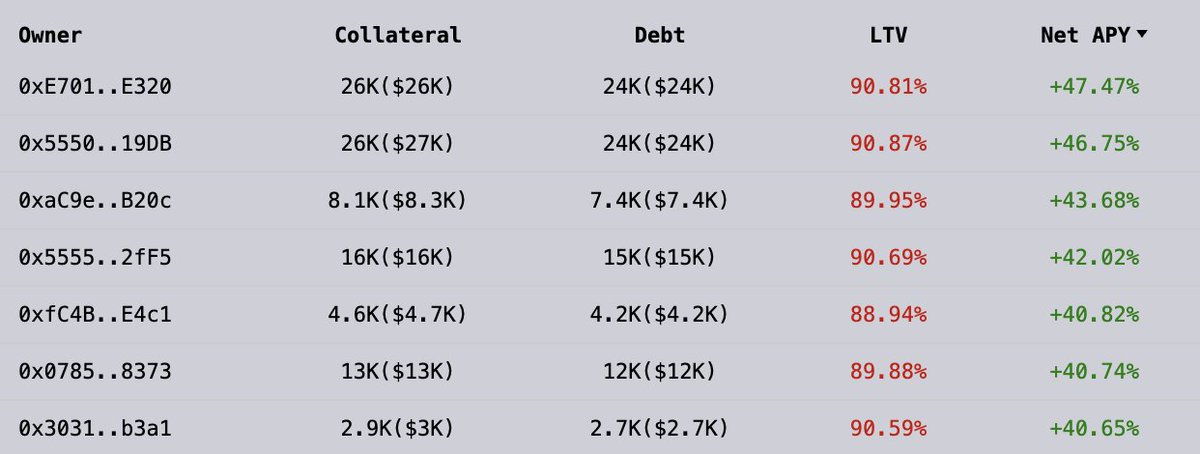
after computing total reward, total risk and expected value, we end up at a risk weighted APY of 123%. of course there are LOTS of assumptions made here but it mainly boils down to a) what discount to NAV can you exit at b) will borrow rates spike
wumpy crypto tweet media
English
1
0
1
119