置顶推文
1914 Reader
181 posts

1914 Reader
@1914Reader
Updates on the latest essays and episodes from 1914 Reader and Frontier Matters podcast.
加入时间 Ekim 2025
31 关注237 粉丝

1914 Reader 已转推

This is such a high value tweet. Writing a book at the moment (details in next tweet) and I've amassed a tonne of PDFs and books for research. Each chapter in the book is a standalone story so I previously organised the PDFs in one folder per chapter.
Dumped everything in one folder and handed it - along with this tweet - to Claude Cowork with which it built a wiki. And oh my....magic has once again happened.
Andrej Karpathy@karpathy
LLM Knowledge Bases Something I'm finding very useful recently: using LLMs to build personal knowledge bases for various topics of research interest. In this way, a large fraction of my recent token throughput is going less into manipulating code, and more into manipulating knowledge (stored as markdown and images). The latest LLMs are quite good at it. So: Data ingest: I index source documents (articles, papers, repos, datasets, images, etc.) into a raw/ directory, then I use an LLM to incrementally "compile" a wiki, which is just a collection of .md files in a directory structure. The wiki includes summaries of all the data in raw/, backlinks, and then it categorizes data into concepts, writes articles for them, and links them all. To convert web articles into .md files I like to use the Obsidian Web Clipper extension, and then I also use a hotkey to download all the related images to local so that my LLM can easily reference them. IDE: I use Obsidian as the IDE "frontend" where I can view the raw data, the the compiled wiki, and the derived visualizations. Important to note that the LLM writes and maintains all of the data of the wiki, I rarely touch it directly. I've played with a few Obsidian plugins to render and view data in other ways (e.g. Marp for slides). Q&A: Where things get interesting is that once your wiki is big enough (e.g. mine on some recent research is ~100 articles and ~400K words), you can ask your LLM agent all kinds of complex questions against the wiki, and it will go off, research the answers, etc. I thought I had to reach for fancy RAG, but the LLM has been pretty good about auto-maintaining index files and brief summaries of all the documents and it reads all the important related data fairly easily at this ~small scale. Output: Instead of getting answers in text/terminal, I like to have it render markdown files for me, or slide shows (Marp format), or matplotlib images, all of which I then view again in Obsidian. You can imagine many other visual output formats depending on the query. Often, I end up "filing" the outputs back into the wiki to enhance it for further queries. So my own explorations and queries always "add up" in the knowledge base. Linting: I've run some LLM "health checks" over the wiki to e.g. find inconsistent data, impute missing data (with web searchers), find interesting connections for new article candidates, etc., to incrementally clean up the wiki and enhance its overall data integrity. The LLMs are quite good at suggesting further questions to ask and look into. Extra tools: I find myself developing additional tools to process the data, e.g. I vibe coded a small and naive search engine over the wiki, which I both use directly (in a web ui), but more often I want to hand it off to an LLM via CLI as a tool for larger queries. Further explorations: As the repo grows, the natural desire is to also think about synthetic data generation + finetuning to have your LLM "know" the data in its weights instead of just context windows. TLDR: raw data from a given number of sources is collected, then compiled by an LLM into a .md wiki, then operated on by various CLIs by the LLM to do Q&A and to incrementally enhance the wiki, and all of it viewable in Obsidian. You rarely ever write or edit the wiki manually, it's the domain of the LLM. I think there is room here for an incredible new product instead of a hacky collection of scripts.
English
1914 Reader 已转推

When everything doesn’t work in a superior currency, then it’s not an indictment on the funding models.
Even when you raise in local currency, the value destruction is clear.
I think it’s better to separate solvency (or exits) from value creation.
GIANT@tomiwalker_
VC doesn’t work, private equity doesn’t work, dollar denominated debt doesn’t work Why? Because the African market is small and returns are battling poor revenues/profits, inflation, devaluation Answer? Raise local. Build local Raise global. Build for export
English
1914 Reader 已转推
A line that stood out to me from this terrific piece by @PatrickMcGee_ giftarticle.ft.com/giftarticle/ac…
English
1914 Reader 已转推

@adam_tooze's post about Nigeria sparked some curiosity—had Claude scatter regional income dispersion vs GDP per capita.
Poor countries tend to have more income inequality between regions, though the negative relationship isn't super strong. Nigeria is also far from the worst!
Data from Gennaioli et al 2013.

Adam Tooze@adam_tooze
Nigeria is a country of truly extreme regional inequality. The ratio between per capita income in Lagos State and Kano is ten to one, however your measure it. More on today's Chartbook Top Links:
English
1914 Reader 已转推

“Across 23 African countries, annual US health assistance has declined from approximately $16 billion under previous programmes to just under $3 billion under the new health arrangements, a reduction of roughly 82 percent.”
Development Reimagined™@DevReimagined
U.S.–Africa health partnerships are changing. Beyond the headline figures, there’s a shift from aid to more conditional, transactional agreements with greater expectations on African countries. What does this mean for long-term health systems? More here: developmentreimagined.com/headline-figur…
English
1914 Reader 已转推
1. I have taken to a term: "low-info elitism", to describe what I see often in Ghana.
2. I am not being disrespectful. Just factual. The burden of having a middle class education is to go beyond the surface in national/international debates. Using bigger English alone is not enough.
3. So many middle class folks talking about UN General Assembly votes on slavery & reparations as if some new controversy has broken out.
4. Yet the 1st UN resolution on slavery dates to 1949 (the so-called "problem of slavery" text). And since the Durban declaration (2001), we have had ~10 on reparations.
5. Every year or so, we have a follow up resolution on the "Durban framework" regarding slavery, and sometimes reparations, more or less repeating the same stuff with different wording.
6. Over the last 2.5 decades, consensus has fallen, positions have hardened between the so-called Global "South" & "North" (or "West"), and no new ideas have emerged on how to close the gap.
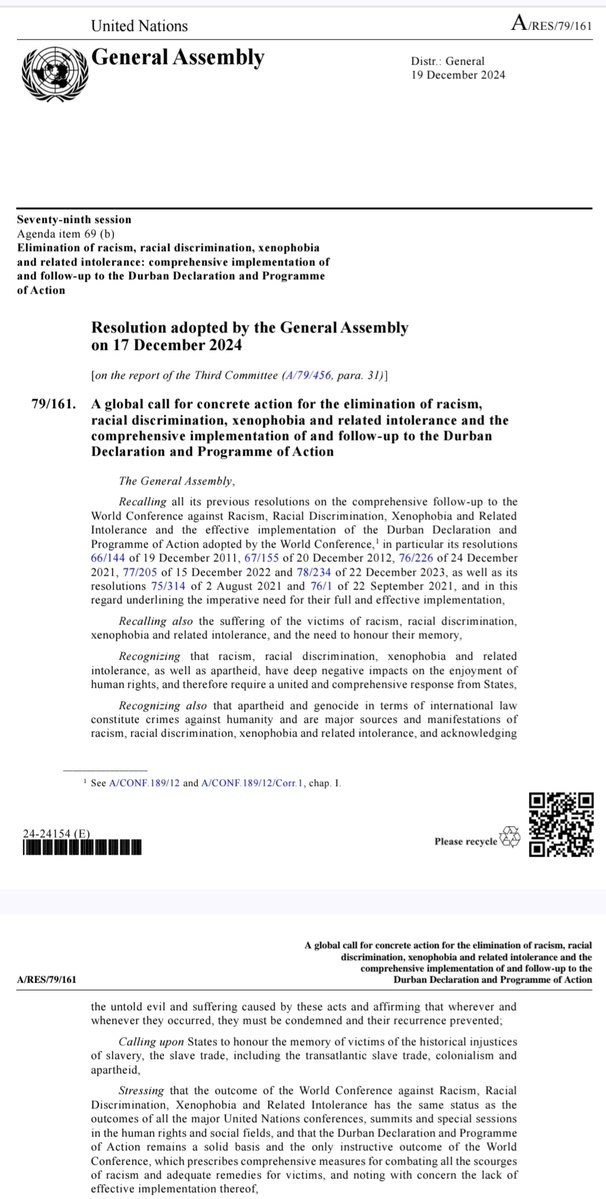
7. Here is a sampling of such resolutions: 71/181, 72/157, 73/262, 74/137, 76/226, 77/205, 78/234, 79/161, & 75/237.
8. Attached is a chart of the trend of voting, which shows the widening Gulf. As well as extracts from two seminal resolutions.
9. In a debate over such an issue, you would expect some awareness of this beaten path and some fresh ideas about how leverage can be built for any serious activism.
10. No such luck. Just grammar vs grammar. I am not even sure, scanning my feed, that folks who should know such stuff are aware of the Durban process and the annual votes. 🤔


English
1914 Reader 已转推
One of the saddest things for me is seeing people say this kind of thing in a country that has produced two cement dollar billionaires.
Cement is humanity’s greatest invention that has made a habitable civilisation possible. It allows us ward off hostile elements and survive inhospitable environments. It is endlessly malleable and works in every type of weather. There is nothing special about Nigerian weather or heat that is beyond cement as a solution.
The only thing that can make someone think this is a good idea is if they have been denied its benefits (due to all of it being captured at source by the “manufacturers”)
A Chinese person who has grown up in the last 40yrs seeing cement transform their environment and make it so much more liveable will not say stuff like this.
Please don’t internalise it
Typical African@Joe__Bassey
A Nigerian lady urges Africans to continue and start using mud or clay in building houses and infrastructure, as it has more advantages in Africa than cement and concrete.
English
Enjoy this week's selection of stories about Nigeria and Nigerians everywhere 1914reader.com/p/below-the-he…
English
1914 Reader 已转推
Nigerians believe any thing of value you offer, regardless of the cost, is a net positive.
It's such a stupid way to view things. Sadly, it's pervasive.
We are stuck with billionaires extracting more value than they create.
Le Penseur@LRNZH
Never speak in absolutes when it comes to economics. Dangote can be a net negative to the welfare of Nigerians if he draws rent above the economic value he provides inclusive (very important) of sufficiency guarantees which cannot have infinite value.
English
1914 Reader 已转推

As @DoubleEph says "A complete lack of technological learning, upgrading or mastery after 20yrs of govt protection" is pretty much par for the course in every single conglomerate in Asia and Africa (excl the E. Asians).
These are Studwell's 'Godfathers' - they are not manufacturers; they’re 'political entrepreneurs.' Although they covet the title of, and play-act the 'industrialist' role.
But Tony Stark or Howard Hughes or James Dyson or Elon they are not.
The returns and size and wealth of these tycoons - the India 'double-A' Adani & Ambani's, the Dangotes etc - are not from industrial innovation, but from the state-granted 'franchise' or monopoly that ensures no one else can compete in that space.
All you see across Asia and Africa are these gargantuan business's - its all car agencies, banks, SKD (semi-knockdown assembly of Chinese stuff), or marketing of chinese OEM stuff. Its the colonial industrial version of Victiorian 'piece working'.
Weak states are bullied by every wealthier and powerful oligarchs into licenses and protection. And the wealth allows global reputation laundering at The Economist and Davos.
The real test - is export discipline. Can any of then sell a product which competes on world markets. Samsung and LG and TSMC have.
Which oligarchic products from India, Pakistan, SL, B'Desh, Nigeria etc have done that?
But yet they are billionaires and fêted like entrepreneurs by The Economist.
English
New Frontier Matters episode: Don Robotham on Bridging The Atlantic Divide 1914reader.com/p/don-robotham…. You can also listen on Spotify open.spotify.com/episode/1DA5Pc…
English
1914 Reader 已转推
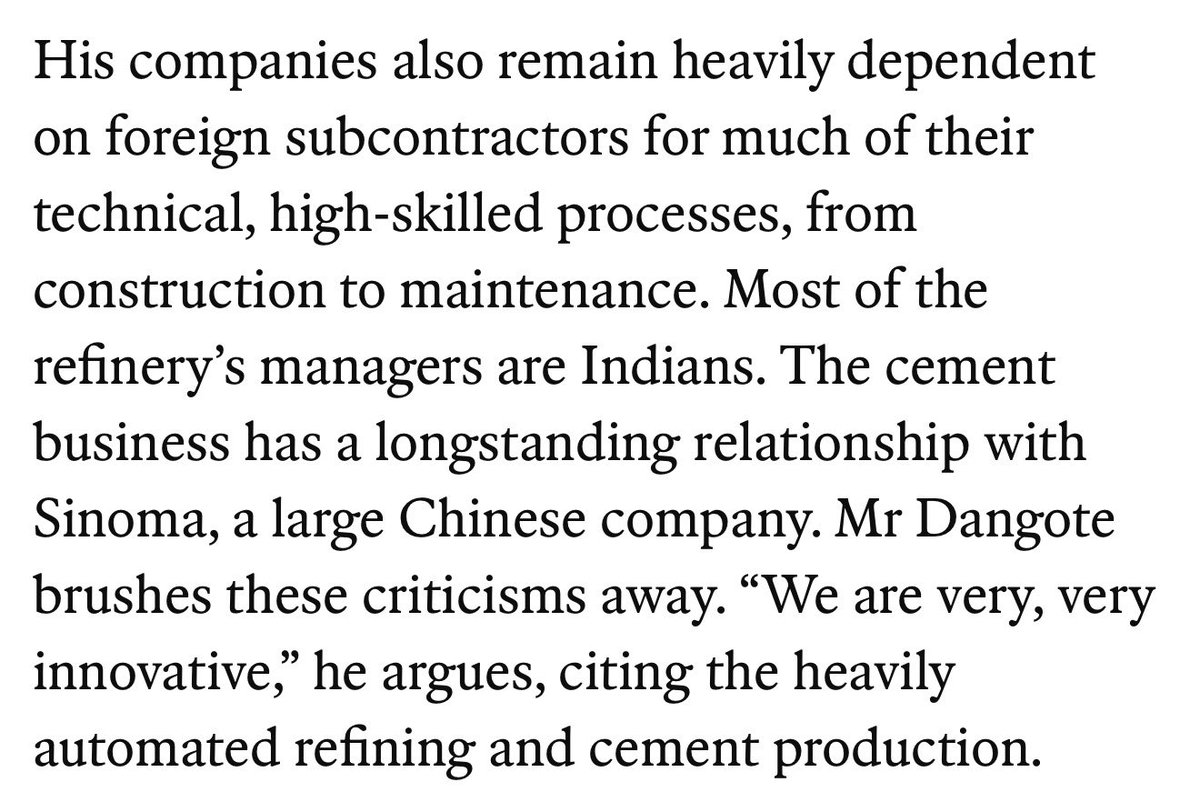
This - from The Economist - is the first time this specific topic has been brought up in any major media in relation to Dangote. A complete lack of technological learning, upgrading or mastery after 20yrs of govt protection.
Every other criticism I make of Dangote you can hang it on this one. It is utterly utterly shameful.
English
1914 Reader 已转推

1914 Reader 已转推
1914 Reader 已转推

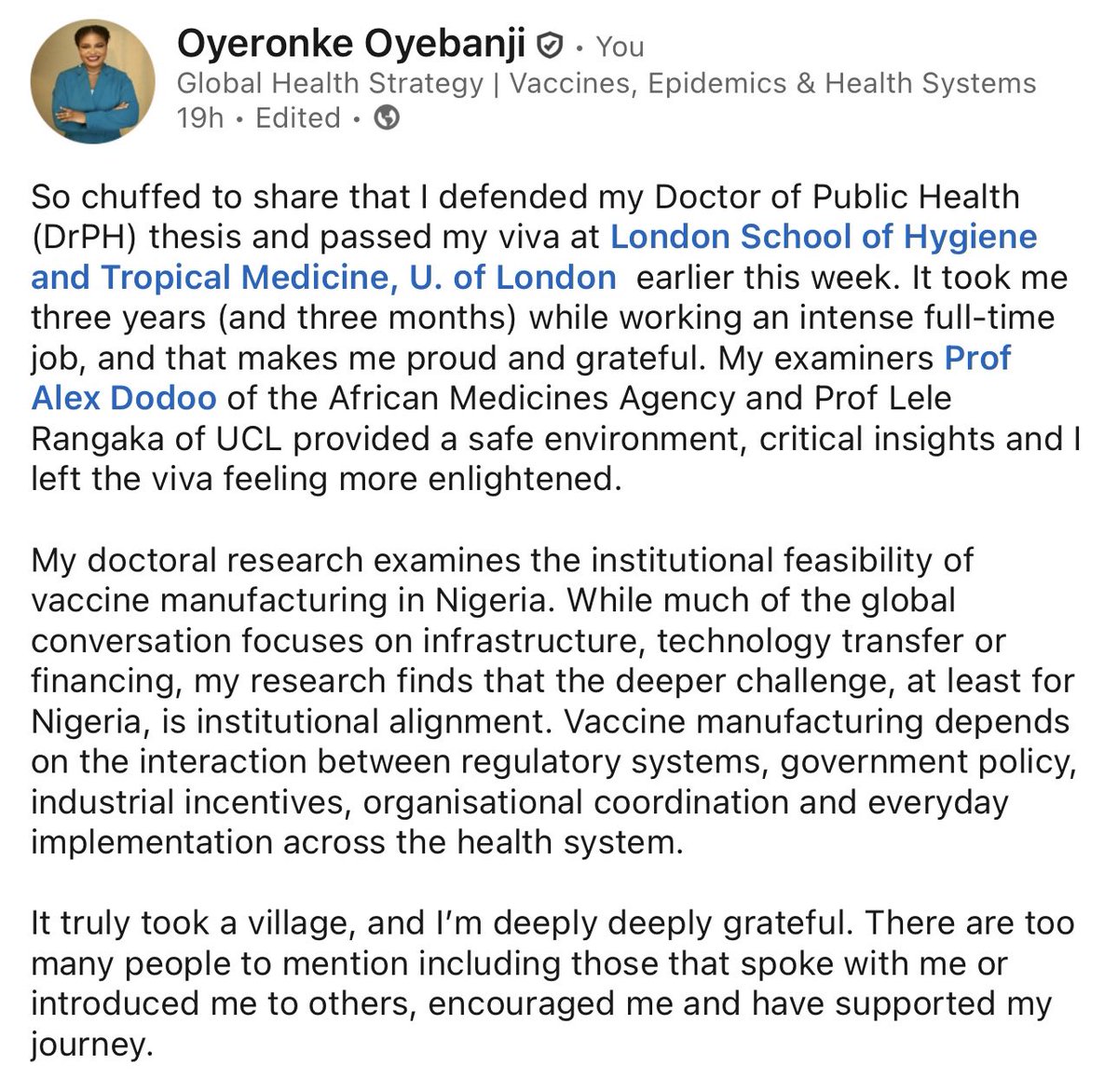
Feels surreal to say that I’ve completed my Doctor of Public Health degree @LSHTM, analysing Nigeria’s vaccine manufacturing ambition
Ten years after my BSc & while building a career I love
I wish there were more stories like this when I was starting. Hopefully it inspires❤️
English
1914 Reader 已转推

Movement of The People
@DoubleEph connects the dots between the upheaval of the 19th century, ‘heterogeneous’ nature of the Akoko region, and the underdevelopment it faces today.
Superb work 👏🏾
open.substack.com/pub/1914reader…
English
New essay: @DoubleEph on the hollowing out of rural communities in Southwestern Nigeria 1914reader.com/p/movement-of-…
English
1914 Reader 已转推

Imagine you're the government of say, Bangladesh, and you closed your your universities and your state-run fertiliser firms this week because of the energy crisis, and you get the call to say the US is launching a fresh trade probe to get you tariffed up again
United States Trade Representative@USTradeRep
Ambassador Greer announced the initiation of Section 301 investigations into acts, policies, and practices of various economies relating to structural excess capacity and production in manufacturing sectors. Learn more: ustr.gov/about/policy-o…
English
1914 Reader 已转推

Urea shortages = fertiliser shortages = global food price hikes and people aren’t taking this seriously enough, is becoming a common theme.
Fertiliser is v important, but isn’t vital every year. The one year impact can be low
Also global stocks of food are pretty high

English
1914 Reader 已转推