Augur

3.4K posts

Augur banner
Augur

Augur

@AugurProject

Research and development has returned to Ethereum's first ICO. $REP https://t.co/JvmFs0peIu

worldwide 加入时间 Kasım 2014
391 关注146.3K 粉丝
Augur
Augur@AugurProject·
Augur was born in 2016 when these ideals were the great promise, delivering the first decentralized prediction market & oracle platform, and will rebuild now in 2026 along the same principles. An unstoppable truth machine for dispute resolution that is open source, immutable, permissionless, and trustless. Crypto empowers people with freedom. An indiscriminatory playground where economics drive outcomes. We're proud to build towards this purpose.
Ethereum Foundation@ethereumfndn

Today, the Foundation’s Board released the EF Mandate. This document, which was first intended for EF members, reaffirms the promise of Ethereum, and the role of EF within this ecosystem.

English
4
4
35
3.3K
Augur
Augur@AugurProject·
@VitalikButerin The Augur oracle stands with these ideals. Decentralization 🫡
English
0
1
7
625
vitalik.eth
vitalik.eth@VitalikButerin·
This is the new EF Mandate. For many of you, the contents should be no surprise, and a clarification along the lines that we have been going and thinking for the past few months. But the clarification is nevertheless worth making. Ethereum is a unique object and has a unique role in the world. Its role is to be a sanctuary technology, to preserve technological self-sovereignty, to enable cooperation without coercion, domination or rugpulling, and to provide an escape hatch, to ensure that no single person, organization or ideology's victory in cyberspace can be total. The Ethereum Foundation is a steward of Ethereum - the original steward, and today, the steward specifically dedicated to preserving and expanding the above aspects of Ethereum. This means a heavy emphasis on CROPS (censorship and capture resistance, open source, privacy, security), both at the protocol layer, and at the access layer, user-facing applications and tools that we create or contribute to. There are things that we do in Ethereum because we believe that they are valuable for the underlying goals that we have for Ethereum. There are things that we do not do because from the perspective of our values we find them uninteresting (or worse, harmful). But there are also things that we do not do because while they are useful, they are not our role. At the Ethereum protocol layer, we focus on decentralization, verifiability, inclusion guarantees, protocol liveness, security and privacy first and foremost. We also value capabilities (eg. L1 scale, account abstraction, perhaps some forms of in-protocol aggregation), particularly because improvements in these capabilities better enable users to properly benefit from Ethereum's CROPS properties and displace the need for higher-layer intermediaries that might weaken the extent to which Ethereum's properties carry over into the full stack. We also believe that the Ethereum protocol must strive to pass the walkaway test. "We do X to specialize to serve the use cases of today, if more use cases appear later, we will continue to keep adding more EIPs for them later" is logic fit for many other blockchains whose names you hear often on this forum, but we do not believe it is logic fit for a decentralization-first blockchain like Ethereum. At the application layer, we focus on making "the zero option" - user experience that goes hard on ensuring security and privacy, avoiding dependence on intermediaries, and respecting the user's agency - as high quality as possible. We see this as complementary to work in the Ethereum ecosystem that "goes broad", starting from the world that it exists, and brings it onchain and improves its properties over time. Such work has its natural home outside the EF. We intend to be supportive of such efforts. We believe that the two are complementary: tools that are developed within the EF can be adopted by anyone, including partially, and even partial adoption that improves people's security, privacy and agency is a good thing. But the form of user experience that is more heavily insistent on CROPS properties is where we want the EF to develop its center of expertise. This does not mean shrinking from the hard questions. We believe in a vision of self-sovereignty that protects users, and does not leave users in the cold to face environments where they lose their life savings if they make a mistake, and click "yes" on a confirmation screen by accident two seconds after. But such protection must be designed based on a philosophical baseline of empowering the user, not empowering centralized organizations that claim to act in the user's name. This quadrant of design space - caring about users' (including non-experts') well-being and safety, and yet insistent on doing this in a way compatible with their agency and freedom, is underserved (not just in crypto, but in the world). We wish to use Ethereum as a platform to build out and showcase this quadrant, and ideally work with others to expand its reach over time. This is also a new chapter in how we see our position in the world. We must see ourselves not just as the Ethereum community, but also as maintainers of the Ethereum tool within what you might call the CROPS community or the sanctuary tech community, or a dozen of other words that have for a long time been used by people with similar values to us but far outside Ethereum. This means open-mindedness to new conceptions of what things in the world are our natural allies. Ethereum is not the world. Ethereum is a specific object in the world that is here to have specific properties. The Ethereum Foundation is a specific organization within Ethereum - one steward, not the sole one. I encourage all to read the mandate in detail; it includes concrete examples of how we intend to deal with the challenges and nuances of these ideas. We are doubling down on Ethereum and are excited about its next chapter.
Ethereum Foundation@ethereumfndn

Today, the Foundation’s Board released the EF Mandate. This document, which was first intended for EF members, reaffirms the promise of Ethereum, and the role of EF within this ecosystem.

English
324
238
1.5K
255.5K
Augur
Augur@AugurProject·
@VitalikButerin Augur Lituus is modularizing and separating the oracle from the markets.
Augur tweet media
English
1
1
7
1.5K
vitalik.eth
vitalik.eth@VitalikButerin·
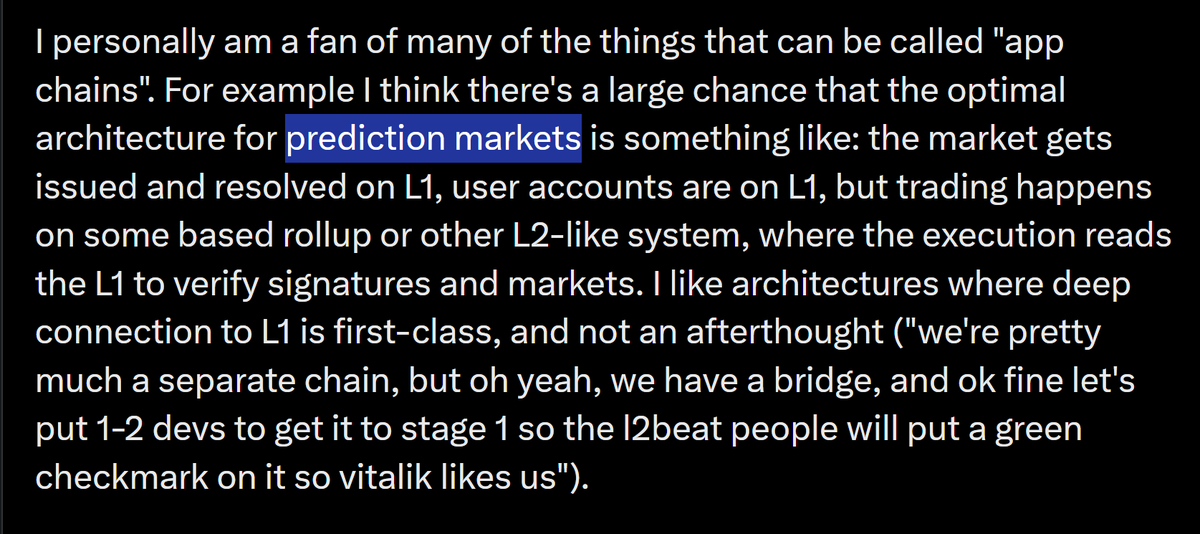
Have been following reactions to what I said about L2s about 1.5 days ago. One important thing that I believe is: "make yet another EVM chain and add an optimistic bridge to Ethereum with a 1 week delay" is to infra what forking Compound is to governance - something we've done far too much for far too long, because we got comfortable, and which has sapped our imagination and put us in a dead end. If you make an EVM chain *without* an optimistic bridge to Ethereum (aka an alt L1), that's even worse. We don't friggin need more copypasta EVM chains, and we definitely don't need even more L1s. L1 is scaling and is going to bring lots of EVM blockspace - not infinite (AIs in particular will need both more blockspace and lower latency than even a greatly scaled L1 can offer), but lots. Build something that brings something new to the table. I gave a few examples: privacy, app-specific efficiency, ultra-low latency, but my list is surely very incomplete. A second important thing that I believe is: regarding "connection to Ethereum", vibes need to match substance. I personally am a fan of many of the things that can be called "app chains". For example I think there's a large chance that the optimal architecture for prediction markets is something like: the market gets issued and resolved on L1, user accounts are on L1, but trading happens on some based rollup or other L2-like system, where the execution reads the L1 to verify signatures and markets. I like architectures where deep connection to L1 is first-class, and not an afterthought ("we're pretty much a separate chain, but oh yeah, we have a bridge, and ok fine let's put 1-2 devs to get it to stage 1 so the l2beat people will put a green checkmark on it so vitalik likes us"). The other extreme of "app chain", eg. the version where you convince some government registry, or social media platform, or gaming thing, to start putting merkle roots of its database, with STARKs that prove every update was authorized and signed and executed according to a pre-committed algorithm, onchain, is also reasonable - this is what makes the most sense to me in terms of "institutional L2s". It's obviously not Ethereum, not credibly neutral and not trustless - the operator can always just choose to say "we're switching to a different version with different rules now". But it would enable verifiable algorithmic transparency, a property that many of us would love to see in government, social media algorithms or wherever else, and it may enable economic activity that would otherwise not be possible. I think if you're the first thing, it's valid and great to call yourself an Ethereum application - it can't survive without Ethereum even technologically, it maximizes interoperability and composability with other Ethereum applications. If you're the second thing, then you're not Ethereum, but you are (i) bringing humanity more algorithmic transparency and trust minimization, so you're pursuing a similar vision, and (ii) depending on details probably synergistic with Ethereum. So you should just say those things directly! Basically: 1. Do something that brings something actually new to the table. 2. Vibes should match substance - the degree of connection to Ethereum in your public image should reflect the degree of connection to Ethereum that your thing has in reality.
English
1.7K
612
5K
1M
vitalik.eth
vitalik.eth@VitalikButerin·
There have recently been some discussions on the ongoing role of L2s in the Ethereum ecosystem, especially in the face of two facts: * L2s' progress to stage 2 (and, secondarily, on interop) has been far slower and more difficult than originally expected * L1 itself is scaling, fees are very low, and gaslimits are projected to increase greatly in 2026 Both of these facts, for their own separate reasons, mean that the original vision of L2s and their role in Ethereum no longer makes sense, and we need a new path. First, let us recap the original vision. Ethereum needs to scale. The definition of "Ethereum scaling" is the existence of large quantities of block space that is backed by the full faith and credit of Ethereum - that is, block space where, if you do things (including with ETH) inside that block space, your activities are guaranteed to be valid, uncensored, unreverted, untouched, as long as Ethereum itself functions. If you create a 10000 TPS EVM where its connection to L1 is mediated by a multisig bridge, then you are not scaling Ethereum. This vision no longer makes sense. L1 does not need L2s to be "branded shards", because L1 is itself scaling. And L2s are not able or willing to satisfy the properties that a true "branded shard" would require. I've even seen at least one explicitly saying that they may never want to go beyond stage 1, not just for technical reasons around ZK-EVM safety, but also because their customers' regulatory needs require them to have ultimate control. This may be doing the right thing for your customers. But it should be obvious that if you are doing this, then you are not "scaling Ethereum" in the sense meant by the rollup-centric roadmap. But that's fine! it's fine because Ethereum itself is now scaling directly on L1, with large planned increases to its gas limit this year and the years ahead. We should stop thinking about L2s as literally being "branded shards" of Ethereum, with the social status and responsibilities that this entails. Instead, we can think of L2s as being a full spectrum, which includes both chains backed by the full faith and credit of Ethereum with various unique properties (eg. not just EVM), as well as a whole array of options at different levels of connection to Ethereum, that each person (or bot) is free to care about or not care about depending on their needs. What would I do today if I were an L2? * Identify a value add other than "scaling". Examples: (i) non-EVM specialized features/VMs around privacy, (ii) efficiency specialized around a particular application, (iii) truly extreme levels of scaling that even a greatly expanded L1 will not do, (iv) a totally different design for non-financial applications, eg. social, identity, AI, (v) ultra-low-latency and other sequencing properties, (vi) maybe built-in oracles or decentralized dispute resolution or other "non-computationally-verifiable" features * Be stage 1 at the minimum (otherwise you really are just a separate L1 with a bridge, and you should just call yourself that) if you're doing things with ETH or other ethereum-issued assets * Support maximum interoperability with Ethereum, though this will differ for each one (eg. what if you're not EVM, or even not financial?) From Ethereum's side, over the past few months I've become more convinced of the value of the native rollup precompile, particuarly once we have enshrined ZK-EVM proofs that we need anyway to scale L1. This is a precompile that verifies a ZK-EVM proof, and it's "part of Ethereum", so (i) it auto-upgrades along with Ethereum, and (ii) if the precompile has a bug, Ethereum will hard-fork to fix the bug. The native rollup precompile would make full, security-council-free, EVM verification accessible. We should spend much more time working out how to design it in such a way that if your L2 is "EVM plus other stuff", then the native rollup precompile would verify the EVM, and you only have to bring your own prover for the "other stuff" (eg. Stylus). This might involve a canonical way of exposing a lookup table between contract call inputs and outputs, and letting you provide your own values to the lookup table (that you would prove separately). This would make it easy to have safe, strong, trustless interoperability with Ethereum. It also enables synchronous composability (see: ethresear.ch/t/combining-pr… and ethresear.ch/t/synchronous-… ). And from there, it's each L2's choice exactly what they want to build. Don't just "extend L1", figure out something new to add. This of course means that some will add things that are trust-dependent, or backdoored, or otherwise insecure; this is unavoidable in a permissionless ecosystem where developers have freedom. Our job should make to make it clear to users what guarantees they have, and to build up the strongest Ethereum that we can.
English
2.6K
1.7K
10K
6.3M
Augur
Augur@AugurProject·
@BryanMicon Yeah, the space needs an oracle where youre not trusting some token whales or a dev multisig. The Augur design makes resolution a permissionless open market structure. If you have to trust, then trust in the market! We think its a beautiful solution to a very important piece.
English
1
0
1
77
Bryan Micon
Bryan Micon@BryanMicon·
@AugurProject Haven't done a deep enough dive on the UMA but remember some outlandish shenanigans in some market settlements back there. Been casually following Augur since jump, would be cool if you guys solved an important piece.
English
1
0
2
113
Augur
Augur@AugurProject·
@BryanMicon Would be great for everyone. Token-voting designs have caused damage. Imagine instead being able to take the money from people trying to manipulate the oracle.
English
1
0
1
206
Augur
Augur@AugurProject·
@griffgreen @thedaofund True security comes from actual decentralization. Shift the macro incentives away from quick & dirty monetization and towards building aligned tech. We need products that will still stand after the dust settles, no matter the storm. Thats what crypto's about.
English
1
0
1
58
griff.eth - $GIV Maxi
griff.eth - $GIV Maxi@griffgreen·
@AugurProject @thedaofund Wow, one of the few DAOs more OG than TheDAO! Curious to hear your thoughts on what we need to do for Ethereum Security, feel free to DM!
Platanal, Costa Rica 🇨🇷 English
1
0
5
95
thedao.fund
thedao.fund@thedaofund·
TheDAO is back. BULLISH A decade later, we’re opening a new chapter. TheDAO Security Fund: activating 75,000+ ETH to strengthen Ethereum security. thedao.fund
GIF
English
261
258
1.3K
483.6K
Augur 已转推
Augus
Augus@AugusLSN·
@0xquasarproject @AugurProject Yeah, you cant get away from people trying to game resolution, the best you can do is make it as expensive as possible to try. IMO its cheap these days, and thats why you see so much bs.
English
2
1
9
2.6K
Augur
Augur@AugurProject·
Introducing the Augur Lituus whitepaper. We’re generalizing the original Augur oracle into Ethereum-native infrastructure for protocols and prediction markets that want to outsource resolution to a system that’s expensive to game. No token voting, no vetoes. The paper also surveys the oracle landscape and examines how different designs perform under economic pressure. One of two products currently under active development as part of Augur’s revival. @lituusfoundation/the-augur-lituus-whitepaper-9a93162028f2?postPublishedType=initial" target="_blank" rel="nofollow noopener">medium.com/@lituusfoundat
Augur@AugurProject

x.com/i/article/2014…

English
10
2
28
3.9K
Augur
Augur@AugurProject·
@ChazSchmidt Great description. Augur makes people resolving markets be the ones who put their money where their mouth is.🫡
English
1
0
0
215
Chaz Schmidt💚
Chaz Schmidt💚@ChazSchmidt·
new prediction market users learning in real time. old timers like me have seen this before. back in the day, when an @AugurProject prediction market would be disputed long enough, you were forced to choose your reality and live with your decision forever. Augur's dispute process let users stake $REP tokens to challenge a market's outcome. If unresolved, it escalated through higher stakes rounds. A final disagreement could fork the entire protocol, forcing $REP holders to vote with their tokens on which version of reality is correct. Oddly enough @AugurProject seems posting again. I guess I'll have to check it out.
English
1
0
1
264
Augur
Augur@AugurProject·
Augur launched on Ethereum in 2016, championing permissionless prediction markets and trustless resolution. Built without backstops, upgradeable contracts, or “security councils,” it delivered on crypto’s core ideals. Ten years on, Augur is back. Much has changed, but we’re still building on Ethereum, guided by the same principles. Three strong quarters in, heres our fiscal Q3 update from the Lituus Foundation. 2026 is the year of Augur. @lituusfoundation/augurs-decade-q3-fiscal-update-20d8deafa533" target="_blank" rel="nofollow noopener">medium.com/@lituusfoundat
Augur tweet media
English
8
1
37
4.6K
Augur
Augur@AugurProject·
@CarlosO34468167 Oracles tell prediction markets which side to pay out. Its important this is done in a robust, decentralized way because otherwise whomever has the power to resolve prediction markets can rug traders
English
0
0
0
86
Carlos Oliveira
Carlos Oliveira@CbdsoOliveira·
@AugurProject what is te relation between oracles (such as Link and Pyth) and prediction markets?
English
1
0
0
97
Augur
Augur@AugurProject·
Augur is coming to #ETHCC 🔥 If you’re into oracles, prediction markets, or decentralization — let’s talk. DMs open 🔮
English
5
1
23
3.5K
AG
AG@GeoOnchain·
Crypto History Fact of the Day: Did you know the FIRST ICO on Ethereum was a Prediction Market? The project was @AugurProject!They raised 5M & had Vitalik as an advisor. Augur reach an ATH MC of 1.16B in 2018! How does this fair for @Polymarket,@Kalshi,@MyriadMarkets in 2025?
AG tweet mediaAG tweet media
English
16
0
80
5K
Augur
Augur@AugurProject·
@cashpandajesus @usv We deeply considered many routes initially, including a deployment of the current version of Augur (v2) on a low-fee L1 like solana, or an L2. Ultimately, we decided to take what we think is a more revolutionary approach, with the generalized oracle approach: Augur Lituus.
English
1
0
0
90
panda jesus
panda jesus@cashpandajesus·
@AugurProject @usv fair enough, why not rebuild on solana or something cheaper where there aren't those sorts of issues? also, why not improve UX?
English
2
0
0
80
USV
USV@usv·
What We're Actively Looking For: Each week we create a non-exhaustive but instructive list of the types of opportunities we're looking for. Every search is an extension of our larger thesis work and conversations. This week's OH @ USV is 5 things we're actively looking for --
English
2
4
84
41.3K
Augur
Augur@AugurProject·
@cashpandajesus @usv The 2020 Trump market utilizing the Catnip frontend successfully resolved over $10 mil in open interest, proving Augur worked. But right after that, eth gas went parabolic, and Augur’s on-chain eth design became too expensive. So that was part of the issue.
English
1
0
1
62
panda jesus
panda jesus@cashpandajesus·
@usv why didn't @AugurProject work for this? (outside an obviously stupid UX, maybe that is the answer)
English
1
0
0
84
Augur
Augur@AugurProject·
@sherwoodones @whalecalls true, although Augur v2 (launched in 2020) mainly utilized DAI.. and successfully handled over $10 mil in open interest for the presidential election market in 2020.
English
1
0
0
53
ones
ones@sherwoodones·
@whalecalls early and they built the product around a volatile native asset (eth) whereas polymarket built theirs around stables. partially a function of augur being too early (stables not widely intrgrated 5+ years ago) very simple difference in design choice but massive difference in ux
English
1
0
2
247
WhaleCalls
WhaleCalls@whalecalls·
Why did augur not become the winner of prediction markets ? Despite 10s of millions being dumped to support it ? Too early ?
English
18
0
50
7.1K