Tino M
725 posts



Tino M 已转推

“Coloured abayas can lead men to sin.”
At this rate, is there anything that won’t seduce a Muslim man?
Perfumes ❌
Bags ❌
Coloured abayas ❌
Face/hair ❌
English

Turkish President Recep Erdogan plans to visit the United States for the FIFA World Cup.
Airport welcome? Cancel it.
Red Carpet? Roll it up.
City Hall visit? Refuse it.
Photo Op? Skip it.
No LA welcome for dictators.
#WorldCup #WorldCup2026


English
@Efesfan6891 @Orthodox_cross You're Ottomoman r*pe babies. Your great grandmother was literally a harem cum dumpster. 😂
English

@Orthodox_cross Bro we are not greek homosexuals. We are brave we are here. Your race coward and gay we are not and never...
English

They act like we're the ones planning to attack them. Its their government threatening to invade Greece because theyre scared of Israel.
Civixplorer@Civixplorer
🇹🇷 Türkiye actually had a surprisingly small population up until a few decades ago.
English
@aslankiral1561 @Orthodox_cross And you will fail like you always do. Bottom of the sea will be your bed.
English

@Orthodox_cross Don't misunderstand, we will attack Greece independently of Israel, primarily the islands.
English
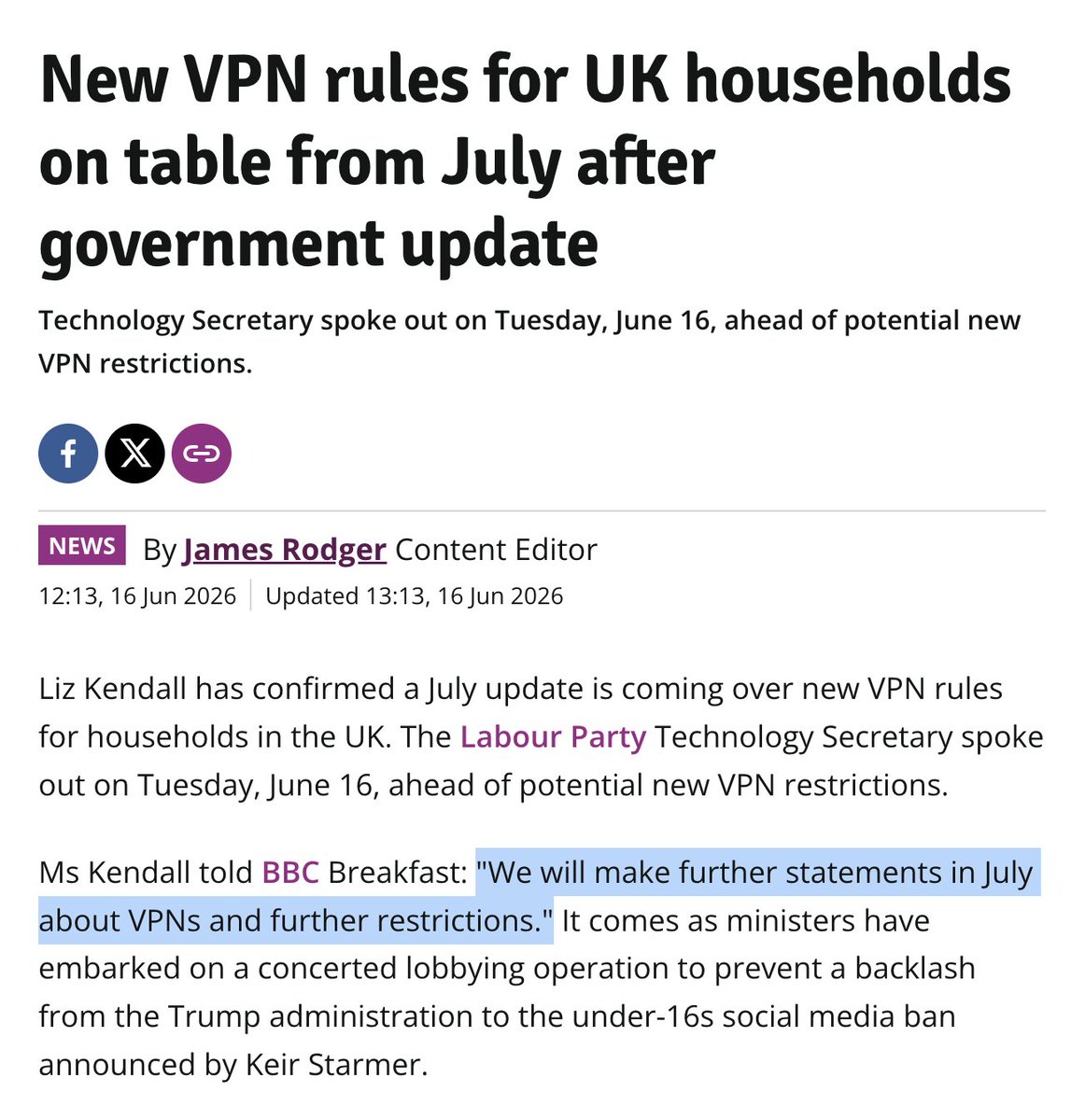
This is the type of stuff that leads to civil war. All of these actions are designed to clamp down on freedom of speech. The people MUST fight back against a tyrannical government.
#UK
International Cyber Digest@IntCyberDigest
THEY ARE GOING TO BAN VPNs THEY ARE GOING TO BAN VPNs THEY ARE GOING TO BAN VPNs THEY ARE GOING TO BAN VPNs THEY ARE GOING TO BAN VPNs THEY ARE GOING TO BAN VPNs THEY ARE GOING TO BAN VPNs THEY ARE GOING TO BAN VPNs THEY ARE GOING TO BAN VPNs THEY ARE GOING TO BAN VPNs
English
Tino M 已转推

THEY ARE GOING TO BAN VPNs
THEY ARE GOING TO BAN VPNs
THEY ARE GOING TO BAN VPNs
THEY ARE GOING TO BAN VPNs
THEY ARE GOING TO BAN VPNs
THEY ARE GOING TO BAN VPNs
THEY ARE GOING TO BAN VPNs
THEY ARE GOING TO BAN VPNs
THEY ARE GOING TO BAN VPNs
THEY ARE GOING TO BAN VPNs
English
Tino M 已转推




Top 10 Oldest Religions in the World
1. ☪️ Islam — Since Prophet Adam (AS)
2. 🕉️ Hinduism ~ 4,000 years
3. 📜 Zoroastrianism ~ 3,500 years
4. 🕎 Judaism ~ 3,000 years
5. 🌿 Shinto ~ 2,600 years
6. 🧘 Jainism ~ 2,600 years
7. 🌼 Buddhism ~ 2,500 years
8. ☯️ Taoism ~ 2,500 years
9. ⚖️ Confucianism ~ 2,500 years
10. ✝️ Christianity ~ 2,000 years

English
@HeraldOfRome We know. Nobody takes the claims of Mongolias rebranded r*pe babies aka "Turds" seriously.
English

The people of Greece, Constantinople, and Anatolia were of the exact same ethnicity in medieval times, and they did not see themselves as separate peoples or separate cultures or ethnicities at all.
Lately some Turks have been pushing the lie that modern Greeks have nothing to do with the east Romans, and they manage this by inventing a fantasy where the east Romans only ever lived in Anatolia, as if Greece and Anatolia were home to two completely different ethnicities back then.
In reality both lands were full of Greek speaking Romans who shared the same Roman political ideology, followed the same Greek church and the same Greek literary culture, and that culture was the direct continuation and evolution of the literary culture of the ancient Greeks.
Anthony Kaldellis, in his book Hellenism in Byzantium, wrote that:
The east Roman philosopher and theologian, and Ecumenical Patriarch of Constantinople ‘‘Gennadios Scholarios again affirmed how little these so-called internal divisions signified:
‘it makes no difference whether I am from Thessaly or Byzantion, given that Thessalians and Byzantioi differ neither in their language nor in belief nor in customs, as perhaps they once did,’ ’’
Kaldellis also wrote that:
‘‘We should not view Romania as a multi-ethnic empire but as the nationstate of the Romans that happened at times to include a number of partially assimilated minorities within its borders, as have all modern nation-states, indeed all states, throughout history.’’
Herald of Rome@HeraldOfRome
The east Romans believed they were one true unified nation! Romania to them was not a multicultural empire of many peoples but a single people. So they looked down on the barbarians and mocked them as nothing more than scattered tribes with no real nationhood of their own. Minorities were expected to assimilate into the nation and serve its interests, and emphasizing multiculturalism the way modern states do would have been taboo back then. Only when a minority assimilated fully and became indistinguishable from the locals did they count as native Romans, so people who refused to assimilate could still be seen as barbarians, which means that even in taking outsiders in there was a meritocratic idea behind it. And they would not just accept the mass settlement of barbarians for the sake of increasing manpower and GDP like modern states do Anthony Kaldellis, in his book Hellenism in Byzantium, wrote that: ‘‘No Roman would consent to a settlement [of barbarians] whose purpose was merely to increase the manpower available to the emperor at the expense of Roman unity.’’ And that: ‘‘Byzantium was not multi-ethnic in the way that some modern states aspire to be, namely multi-cultural, where ethnic diversity is recognized and even highlighted; rather, ethnic origins were irrelevant and usually forgotten after the requirements of assimilation were met. ‘Empire,’ then, is a misleading term because it tends to group Romania along with ‘multiethnic states’ such as the Persian, Holy Roman, or Ottoman empires, which were explicitly understood as encompassing different ethnic groups or nations ruled by a single authority. The early Roman empire also falls within this category. Byzantium, then, was not an empire, if current terminology presupposes ‘the inner incompatibility of empire and nation.’ The res publica was not a federation of ethnic groups or a dominion by one of the rest. In his lament for the fall of Constantinople in 1204, Niketas Choniates complained that the Latin aggressors were ‘not true nations (ethne) but indistinct and scattered tribes (gene)’ (577); presumably, he believed that Romania constituted a distinct and unified ethnos.’’ ‘‘Consider also the inclusive definition of ‘indigenous inhabitants’ (autochthones) offered by the twelfth-century Aristotelian commentator Stephanos: ‘those who are not migrants or colonists from another land, or who, if they come from another land, have lived in this land long enough to be old-timers and in this respect resemble the indigenous inhabitants, like those who resemble the indigenous inhabitants of Constantinople.’ ’’ For context, ‘‘Romania’’ meant Romanland, meaning the land of the Romans. It was the equivalent of Italia or Germania. It meant the whole Roman nation and it's land. Source: Anthony Kaldellis, Hellenism in Byzantium, 2007.
English

🛑 SUDAN NELL'INFERNO: LA FEROCIA JIHADISTA E LA COLPEVOLE CODARDIA DEI PALAZZI DEL POTERE MONDIALE❗️❗️❗️
La diplomazia internazionale muore nel Darfur, vittima del suo stesso silenzio geopolitico e di una codardia istituzionale che rasenta la complicità. Di fronte alla sistematica depravazione ideologica e alla violenza più disumana che sta consumando il Paese, i palazzi del potere occidentale e le Nazioni Unite scelgono l'inerzia, calcolando il peso dei popoli sulla bilancia della convenienza strategica.
L’ipocrisia dei vertici globali, pronti a sbandierare il diritto internazionale solo quando politicamente redditizio, è ormai insostenibile. Voltarsi dall'altra parte mentre un’intera popolazione viene abbandonata al macello non è neutralità: è fallimento morale. La storia non concederà sconti a questa colpevole e feroce indifferenza. 👇👇👇
Via @MorEdge_Insight 👇
⚠️ ATTENZIONE: IMMAGINI DI UNA VIOLENZA ESTREMA E SCONVOLGENTE
Se siete facilmente impressionabili, vi consiglio di non guardare. Questo è uno dei filmati più terrificanti che io abbia mai pubblicato, ma è fondamentale mostrare la pura depravazione di questa ideologia. Atrocità simili si sono verificate il 7 ottobre, così come per mano dell'Isis contro yazidi e curdi. Ricorda inoltre la barbarie nazista, a cui i moderni islamisti si ispirano nei metodi. Eventi del genere sono stati ampiamente documentati in tutto il Sudan nel corso del conflitto.
Nella mia vita ho visto le cose peggiori che si possano immaginare, ma persino questo mi ha dato la nausea.
Il video, risalente all'ottobre 2025, mostra alcuni uomini di una minoranza tribale africana di fede musulmana nel Darfur, in Sudan, fatti prigionieri e ammassati dentro un container metallico scoperto, senza alcuna via di fuga, circondati da miliziani armati delle RSF (sunniti). Si vedono i prigionieri rannicchiati l'uno contro l'altro, poi il container viene dato alle fiamme dal basso: un denso fumo grigio-bianco avvolge la struttura e il fuoco brucia vivi questi uomini, nel tentativo di cancellare le prove del massacro. Come sempre, i jihadisti filmano tutto.
La didascalia recita: "Salvate El Fasher, salvate il Sudan".
È assolutamente straziante 💔😱
Italiano
Tino M 已转推

@100Kypros @grok Techinally all of them because Anatolian "Turks" are just occupation rebranded Greeks/Armenians/Assyrians
English

Of the top 100 monuments in Turkey how many were built by Turks or Turkic peoples.
@grok
Evren Sener@EvrenSAuthor
Aerial views of ancient Lycia: a 2,000-year-old ancient theatre where 3,000 fans watched the Türkiye-Australia FIFA World Cup match on June 14, 2026.
English
Tino M 已转推

One of the biggest threats to Muhammad's claim of prophethood was not a Christian, a Jew, or a pagan.
It was his own scribe: Abdullah ibn Sa'd ibn Abi Sarh.
According to early Islamic sources, he used to write Muhammad's revelations and would sometimes suggest alternative wording. Muhammad accepted the changes.
That raised a serious problem. If the Qur'an was the exact word of God, why could a human scribe alter the wording and have it approved?
Abdullah eventually concluded something was wrong and left Islam. What happened next?
When Muhammad conquered Mecca, he specifically ordered that Abdullah ibn Sa'd be killed, even if he was found clinging to the Kaaba.
The earliest biography of Muhammad records that when Uthman brought Abdullah to seek pardon, Muhammad remained silent for a long time, hoping one of his companions would kill him on the spot. After Uthman left, Muhammad reportedly said:
"I kept silent so that one of you might get up and strike off his head."
A man exposes problems in the revelation, leaves the religion, and suddenly becomes marked for death.
If Muhammad was certain he was receiving divine revelation, why fear the testimony of a former scribe?
Truth does not need assassinations to defend it.
— Sirat Rasul Allah, Ibn Ishaq
— Tabaqat Ibn Sa'd


English
Tino M 已转推

The Muslim Brotherhood-backed Sudanese Armed Forces (SAF) attacked villagers in the Nuba Mountains, home to the majority of Sudan’s Christian population.
It has been revealed that the Sudanese Armed Forces (SAF), with the support of the Muslim Brotherhood, launched a drone attack on Byam, a village in Sudan’s Nuba Mountains, on May 2.
The Sudan National Observatory for Human Rights (SNOHR) has sent a team to investigate the tragedy, although fatalities have not yet been confirmed.
The Nuba Mountains region is a historically marginalized area, home to non-Arab ethnic groups that have faced severe repression under Islamist authorities.
On Christmas Day last year, an SAF drone strike killed 11 Christians and injured 18 others who were taking part in a procession to their local church.

English
Tino M 已转推

One of Abu Mohammad al-Julani's jihadists announces over the radio to his subordinates:
"Do not leave a single member of the Alawite sect alive. You must slaughter all the pigs. The most honorable person among the Alawites… slaughter him as well. Leave neither young nor old... Slaughter them all. None of them deserve to live in safety. Where is their security? Take them to the middle of the sea, where they will be safe… among the fish... Go ahead! Good luck!"
Sick🤬
English

English

@killedbyanfpv @HellenicEchoes He accepted already Greeks and Armenians have subhuman genes
English


Tino M 已转推
Popular Islamic scholar with millions of followers, Zakir Naik, claims that abusing girls who do not comply with Islamic dress code is allowed by Allah, and that if a girl is raped and murdered, it is her own fault.
This is another level of disgusting and evil.
English
@tetiri01 @ekathimerini I agree, its time to liberate Constantinople.
English

@ekathimerini There is no such thing as international law. If there were, I would have witnessed it during the genocide in Gaza. Now everyone should do what they want.
English