We're celebrating @mathsweek with a free webinar for TY, 5th and 6th Year students featuring a series of short talks on how maths can be used to tackle real-world challenges.
📅 Date: Wednesday 15 October 2025
🕐 Time: 13:30–15:00
👉 Register via myUCD.
myucd.ie/visiting-ucd/e…
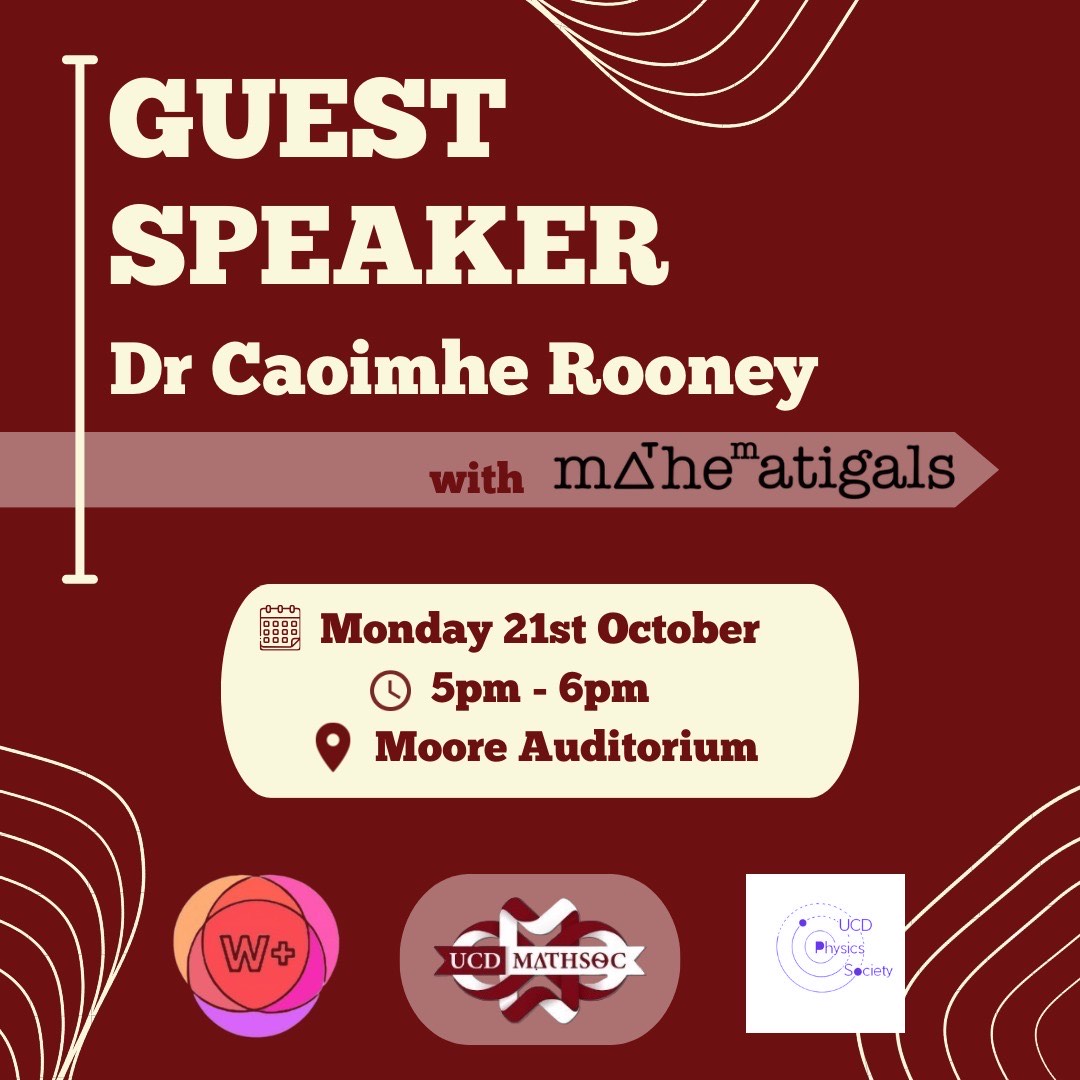
Please join us for a talk by Dr. Caoimhe Rooney (@CaoimheRooney11) from Mathematigals (@mathematigals) on Monday 21st October at 5pm in the Moore auditorium. The talk is aimed at undergraduate mathematics students, but anyone with an interest in mathematics is welcome to join.
📊💻Happy Maths Week 2024 @mathsweek
🗓️11am Monday 14 October: Introductory webinar to the @ucddublin workshops by Dr Áine Byrne from @UCDMathStat
Thank you to all the teachers who registered their classes to take part in a series of interactive Mathematical Mysteries workshops this week. Email enquiries to: orla.donoghue@ucd.ie
As part of the School’s summer undergraduate Research Projects program in 2024, we will have a session of talks on Friday, July 26 starting at 11am in the seminar room, E0.32. See below link for schedule and further details
maths.ucd.ie/%7Eosburn/usrp…
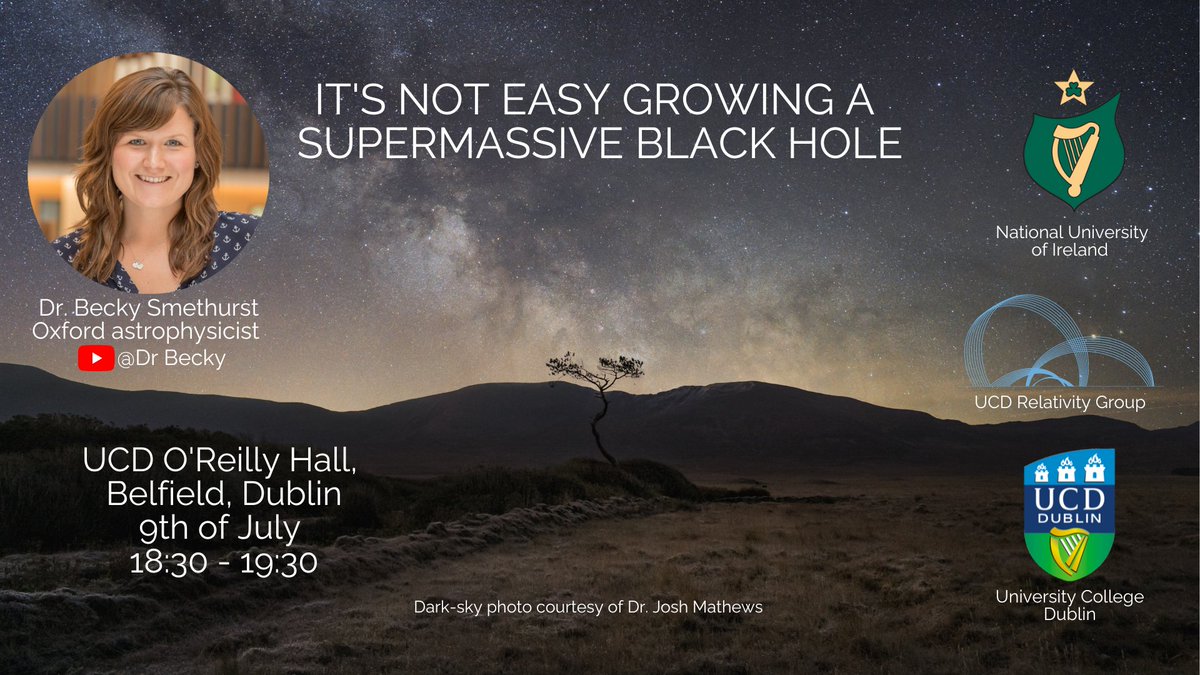
Please join us for the outreach event "It's not easy growing a supermassive black hole," with Dr Becky Smethurst (@drbecky_ )!📍UCD O'Reilly Hall, Dublin 📅9th July🕚 18:30 - 19:30
Register at eventbrite.ie/e/its-not-easy…
The School of Mathematics & Statistics programme of summer research projects for undergraduates has been launched. Closing date is Monday 8th April
Details are available at:
ucd.ie/mathstat/newsa…@ucddublin@ucdscience
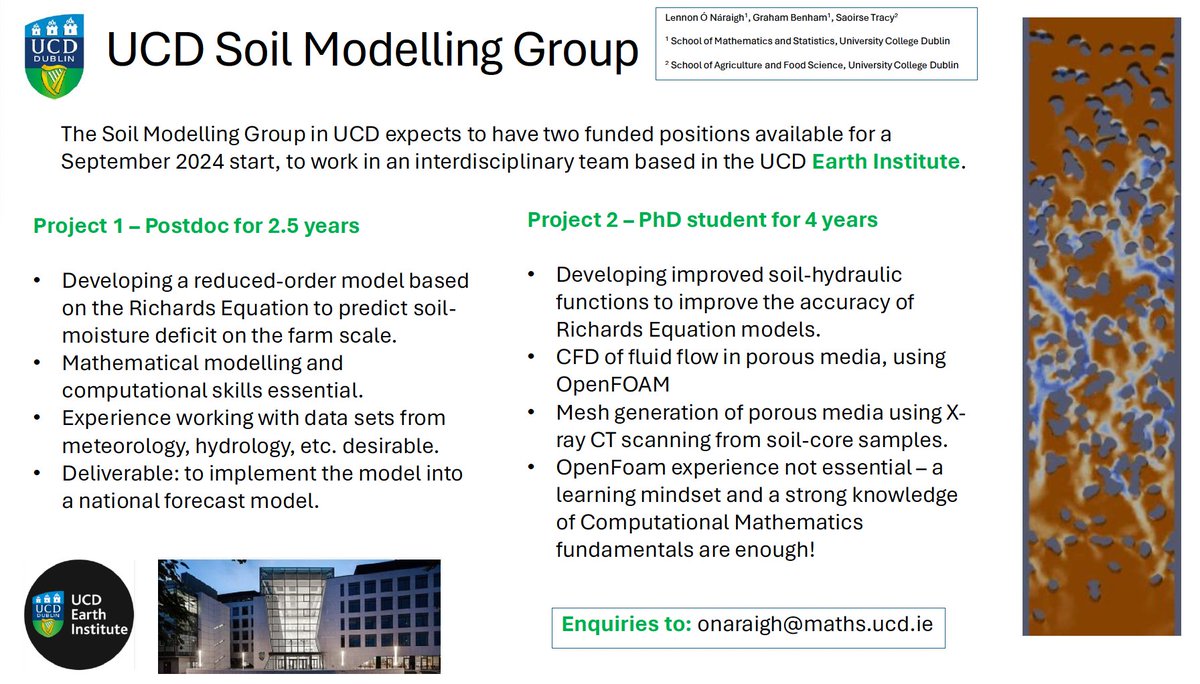
The UCD Soil Modelling Group (Lennon O'Narraigh, Graham Benham and Saoirse Tracy) will have funding for 1 PhD student and 1 Postdoc to work on a very interesting project starting in September. See attached below for more details.
7 PhD positions available at UCD @UCDMathStat!
Scholarships include a stipend of 22k euro (tax-free).
Closing date: March 22nd
Details are available at ucd.ie/mathstat/study…
Please RT!
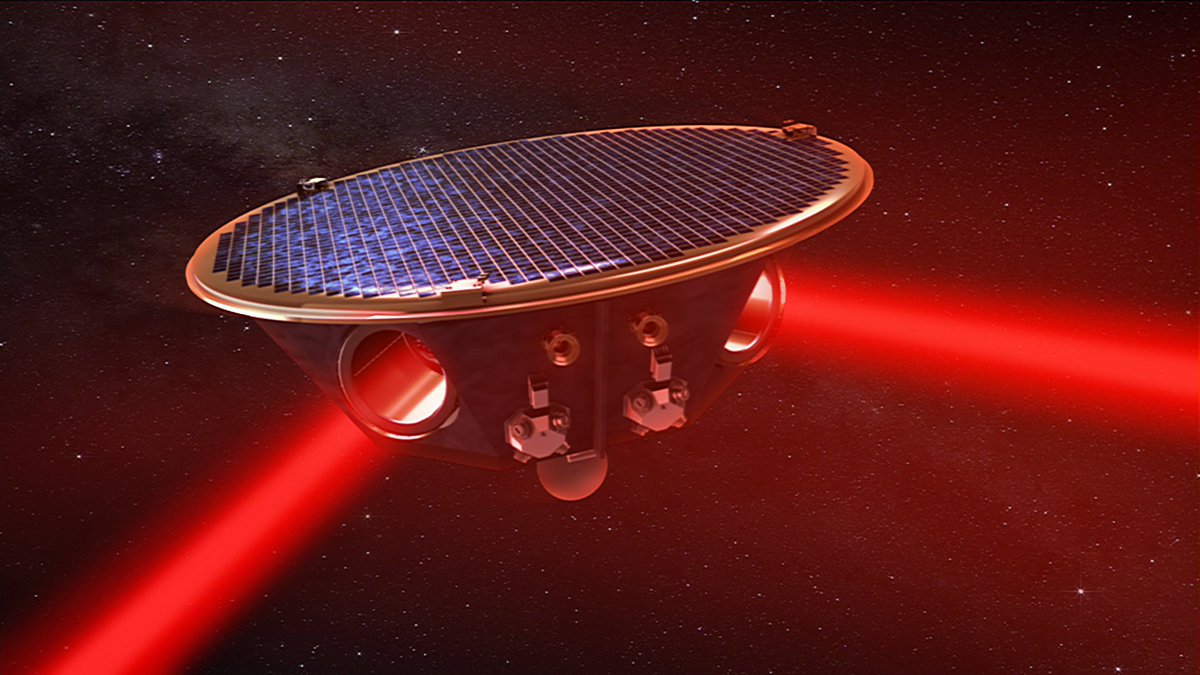
🌌🛰️ UCD Relativity Group plays key role in first ever gravitational-wave observatory in space
Researchers from the UCD School of Mathematics and Statistics are behind the European Space Agency’s plan to unravel the mysteries of gravitational waves with the first ever orbital observatory designed to study the ripples in space and time caused by the motion of black holes.
The Laser Interferometer Space Antenna (LISA) mission, the first scientific endeavour to detect gravitational waves from space, has been approved by the ESA’s Science Programme Committee.
This formal adoption of the project means that its mission concept and technology are sufficiently advanced to be greenlit for the construction of its instruments and spacecraft.
Led by ESA, the LISA Mission is a collaboration between the ESA, NASA, the space agencies of EU member states, and the LISA consortium - an international team of scientists working together to bring the project to fruition.
The LISA mission will measure ripples in space and time that come from the motion of black holes and other sources, and a key ingredient required to understand these signals will be the precise theoretical models of gravitational waves that have been developed by the Relativity Group at the UCD School of Mathematics and Statistics.
“This is a big day for the UCD Relativity Group. We have been working for decades to understand the motion of black holes. The models we are developing will be a key ingredient in the scientific discoveries of the LISA mission,” said Dr Niels Warburton, a group leader for the UCD Relativity Group, and co-chair of the LISA Consortium Waveform Working Group.
Just over a century ago, Einstein predicted that when massive objects accelerate, they shake the fabric of spacetime, producing miniscule ripples known as gravitational waves.
The UCD Relativity group uses Einstein’s theory of General Relativity to study black holes and other sources of gravitational waves, and by comparing the theoretical models that they have developed with the data collected by LISA, scientists from around the world will be able to probe the properties of galactic centers throughout the lifetime of the universe, as well as testing the limits of Einstein’s theory of gravity (General Relativity) and much more.
“LISA is an endeavour that has never been tried before. Using laser beams over distances of several kilometres, ground-based instrumentation can detect gravitational waves coming from events involving star-sized objects – such as supernova explosions or merging of hyper-dense stars and stellar-mass black holes. To expand the frontier of gravitational studies we must go to space,” said LISA project lead Nora Lützgendorf, an astrophysicist working for the ESA.
“Thanks to the huge distance travelled by the laser signals on LISA, and the superb stability of its instrumentation, we will probe gravitational waves of lower frequencies than is possible on Earth, uncovering events of a different scale, all the way back to the dawn of time.”
Not just a single spacecraft but a constellation of three, the orbiting gravitational-wave detector will trail the Earth around the Sun in the pattern of an equilateral triangle that is 2.5 million km long, more than six times the distance between the Earth and the Moon. Each spacecraft will exchange laser beams over this distance. The launch of the three spacecraft is planned for 2035, on an Ariane 6 rocket.
LISA will detect, across the entire Universe, the ripples in spacetime caused by black holes. This will enable scientists to trace the origin of these monstrous objects, to chart how they grow to be millions of times more massive than the Sun and to establish the role they play in the evolution of galaxies.
The mission is poised to capture a direct glimpse into the very first seconds after the Big Bang.
“With the adoption decision, LISA is now firmly established in ESA’s programme of missions. We are looking forward to realising LISA in a close collaboration of ESA, NASA, ESA member states and the wider LISA Consortium” said Karsten Danzmann, Lead of the LISA Consortium, Max Planck Institute for Gravitational Physics and Leibniz University Hannover.
“This trailblazing mission will take us to the next level in a really exciting area of space science and keep European scientists at the forefront of gravitational wave research,” added Carole Mundell, ESA Director of Science Carole Mundell.
The UCD Relativity Group are full members of the LISA consortium, and will host over 300 international researchers at the biennial LISA Symposium at UCD this summer.
Congratulations to Assoc. Professors Kazim Buyuboduk and Robert Osburn of the UCD School of Mathematics and Statistics who have been awarded individual IRC Laureate awards. @ucddublin@UCD_Research@ucdscience
Congratulations to @FredericDiasUCD and the rest of team working on the HIGHWAVE ERC project which was featured in the new Little Book of Irish Science
gov.ie/en/press-relea…
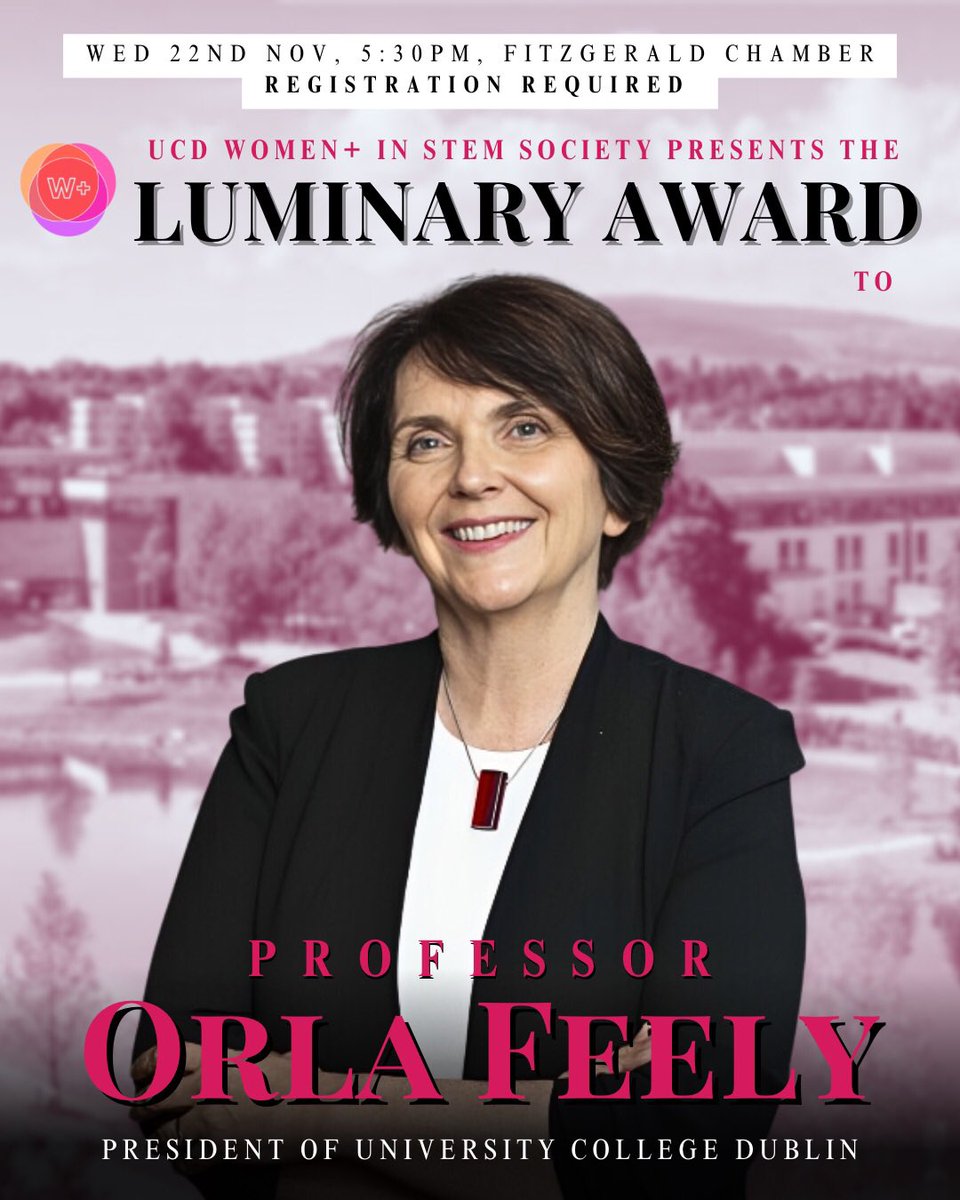
We are excited to announce that the we will be presenting UCD President, Professor @OrlaFeely with the inaugural Luminary Award.
Join us next Wednesday at 5:30pm in the Fitzgerald Chamber. Registration is required to attend. Register here: shorturl.at/apswG
Science Week runs from 12-19 Nov. SFI and UCD have free tickets to give away. Register via Eventbrite using the promo code 'simplysciencefriend' cmere.ie
Theme for Science Week '23 is 'Human' which asks how decisions we make today impact future generations?