ℕathan ℂrock

177 posts

ℕathan ℂrock banner
ℕathan ℂrock

ℕathan ℂrock

@mathnathan

I like automating inductive inference

Tallahassee, FL 加入时间 Nisan 2011
285 关注210 粉丝
ℕathan ℂrock
ℕathan ℂrock@mathnathan·
Frustrated with coding agents not having access to context in sibling repos? Yes, GitHub MCP servers is one way, but search through those tool only pulls small code windows around search terms. Very underpowered and slow. Would be great to grep or read entire files easily. Here is a quick setup I use that gives my coding agents and subagents direct access to all up-to-date sibling repo context without mucking up my dev environment 1. Make a .deps directory in your repo 2. Perform a shallow clone (--depth 1 --branch main) of all siblings repos into that dir 3. Add .deps to .gitignore, .dockerignore, and to files.exclude, search.exclude, and files.watcherExclude in .vscode/settings.json (this makes it "invisible") 4. Add a hook (.claude/hooks or .github/hooks) that performs a git fetch + git pull for the repo an agent is looking at for ALL Read|Grep|Bash(ls|grep|wc|etc) operations. This way, before every lookup we do a quick "refresh" of the repo. 5. Update all your agent files and instructions to direct them to look to .deps when they need any cross context information about sibling repos (data contracts, IaC variable names/secrets/groups, library implementation details, etc) Now you have an always up-to-date "invisible" context layer for all of your coding agents in multi-repo environments. This has been a game changer for me. Let me know if you have any different approaches! #ClaudeCode #GitHub #CodingAgents #DevOps
English
0
0
0
17
ℕathan ℂrock
ℕathan ℂrock@mathnathan·
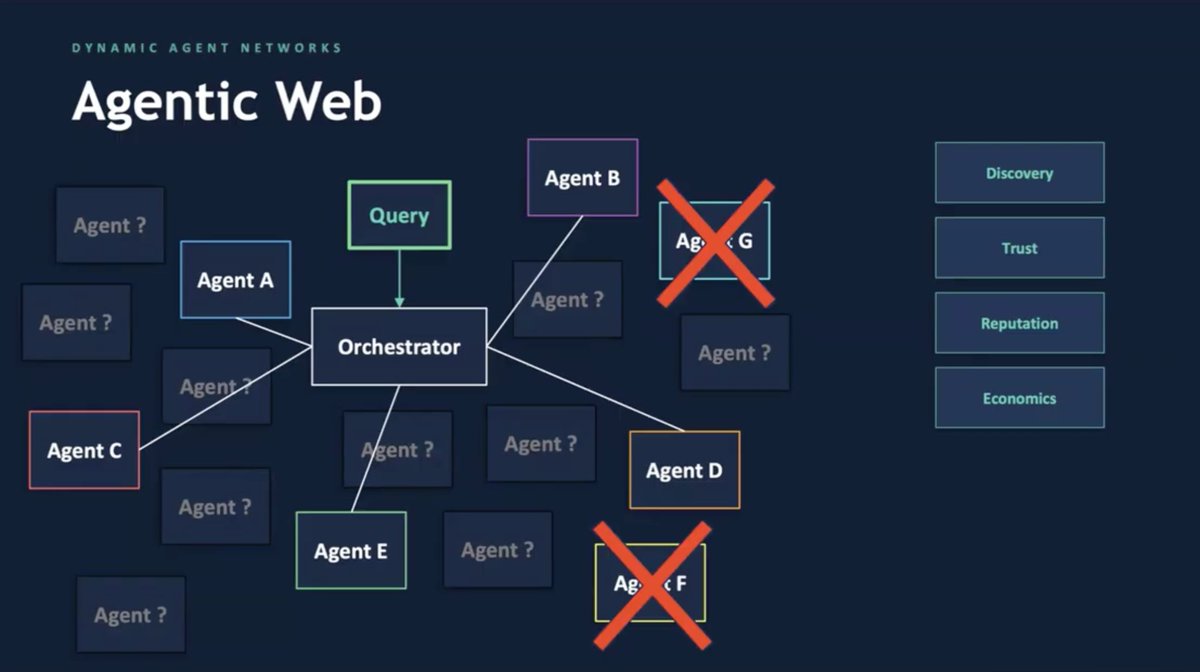
Agents are all the rage today, but what is the technology of tomorrow? I argue the infrastructure of the internet as we know it will change. The way with which humans search for and interact with information will be agent-mediated demanding a new infrastructure - the Agentic Web. I presented some challenges in Building the Agentic Web at the AIMLx 2026 conference. youtu.be/DZ-x_nb6PXk
YouTube video
YouTube
ℕathan ℂrock tweet media
English
0
0
1
19
Jamil
Jamil@JamilWanders·
@mathnathan Loved the preeentstion at AI house yesterday keep up the great work
English
1
0
1
20
ℕathan ℂrock
ℕathan ℂrock@mathnathan·
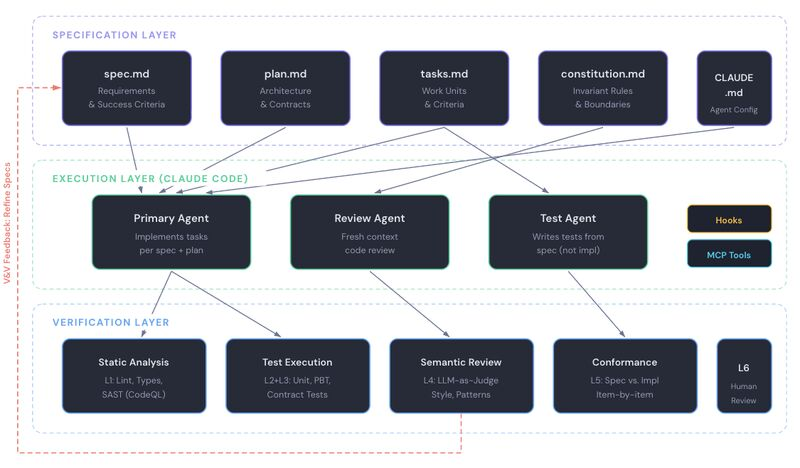
Wrote up a deep reference on integrating Claude Code + Spec-Driven Development + formal V&V into one closed-loop engineering pipeline. nathancrock.com/writing/ai-eng… None of the pieces are new individually. The contribution is showing how they compose into a coherent end-to-end methodology for agentic development at scale.
ℕathan ℂrock tweet media
English
1
0
1
85
ℕathan ℂrock
ℕathan ℂrock@mathnathan·
Here is a short chat I had with @Jakob_Emerson about our production AI tools improving health care. There is so much good to do with AI!
Becker's Hospital Review@BeckersHR

Listen Here: podcasts.apple.com/us/podcast/pre… In this episode, Dr. Nathan Crock of Premera Blue Cross shares how the AI-powered chatbot “Alice” is helping hundreds of customer service representatives quickly find accurate information, reducing call times, improving member satisfaction, and enhancing internal knowledge management. #podcast #healthcare #leadership #healthcareinnovation

English
0
0
1
64
ℕathan ℂrock
ℕathan ℂrock@mathnathan·
Here are two exciting implications I'm seeing emerge... • Task-induced attractors: When a sufficiently expressive system—silicon or biological—is trained to predict language, its internal states drift toward a common geometric “attractor manifold” in representation space. Different paths, same destination. • Information-theoretic gravity: The convergence appears driven less by architecture and more by the objective: compressing high-entropy language into predictive codes. That looks a lot like an information-theoretic fixed point. Bottom line Early evidence suggests we may be witnessing a universal representational geometry emerging from shared objectives. The alignment is not yet perfect and varies by modality and scale, but it hints at a profound principle waiting to be formalised. Understanding those constraints could unify cognitive neuroscience and machine learning—and, perhaps, guide the next generation of models. (Please provide your thoughts and opinions on this! Would love to find some collaborators to explore these topics)
English
1
0
1
48
ℕathan ℂrock
ℕathan ℂrock@mathnathan·
I read two studies this weekend that provide further evidence suggesting there might be some universality to learned representations... 1️⃣ Meta AI: shows that activations in large speech and text models align, layer-by-layer, with intracranial recordings from children and adults. (ai.meta.com/research/publi…) 2️⃣ Cornell (vec2vec): demonstrate that diverse language models—BERT, T5, RoBERTa, etc.—can be linearly translated into a single shared latent space with almost no loss of meaning. (lnkd.in/eDt9Yj2n) What do these works imply?
ℕathan ℂrock tweet media
English
1
0
1
68
ℕathan ℂrock
ℕathan ℂrock@mathnathan·
@elonmusk Please keep posting garbage like this. It is driving all the smart, talented, and interesting people to Bluesky.
English
0
0
0
3
ℕathan ℂrock
ℕathan ℂrock@mathnathan·
I’m curious about the impact on attention and performance when structuring system messages… Which is better and why? 1️⃣ `{“role”: “system”, “content”: system_message + fewshots}` 2️⃣ `{“role”: “system”, “content”: system_message}, {“role”: “system”, “content”: fewshots}`
English
1
0
1
72
ℕathan ℂrock 已转推
Soumith Chintala
Soumith Chintala@soumithchintala·
While async Tensor Parallelism is common among the elite private codebases, the PyTorch team put together a public, accessible and readable one. pretty cool work from @foofoobuggy @cHHillee @lessw2020 @lc_whr tianyu and @wanchao_ Read more here: discuss.pytorch.org/t/distributed-…
Hieu Pham@hyhieu226

Tensor parallelism is central to all LLM workloads, from pretraining to inference, yet is hard to get right. That is why @PyTorch's AsyncTP is amazing. Even more amazing is when reading it, I learn that the idea originates from a paper by my teammate @MalekiSaeed. Congrats!

English
5
41
314
33.6K
Leland McInnes
Leland McInnes@leland_mcinnes·
I'm looking for some great examples of annotated data maps (UMAP/t-SNE/other scatterplots). Ideally something with great aesthetics, that also conveys a lot of information about the data. Link to examples in the replies; and don't hesitate to link to your own work.
English
18
8
53
13.9K
Yann LeCun
Yann LeCun@ylecun·
Your premise is false. Intelligent systems require the ability to reason and plan. Reasoning and planning involve a search for solutions (actions) that minimize objectives. Those objectives measure not only whether the imagined actions fulfill a goal but also whether a number of guardrails are satisfied. By construction, such a system can not produce any action that will violate the guardrails, according to the predictions of its internal world model. I call this objective-driven AI. The question becomes one of designing appropriate guardrails. We are familiar with that. It's like making laws. Except that objective-driven systems will be completely unable to violate these laws (unlike humans).
English
137
21
557
145.9K
Sabine Hossenfelder
AI becoming intelligent and AI developing its own values and being able to act on them are two different problems. The former -- intelligence -- is likely to precede the latter. I don't think it will be long and I think not enough attention is being paid to the most obvious immediate problem: Any individual, company, or government in possession of a device that vastly outperforms average human intelligence will be incredibly powerful. The potential for abuse is enormous. The human brain doesn't work with magic. It's a big wobbly thing with a lot of connections that can process a lot of information -- sometimes well, sometimes not so well. It is not an optimal device for intelligence because it's not what it evolved to be. The human brain evolved to keep us alive. This means among other things it needs to be energy efficient, which indeed it is quite good at. But artificial brains have no such limits so of course they will eventually outperform humans. If you don't understand why superior intelligence is scary, you've read too many touchy sci-fi stories in which human irrationality saves the day. But humans didn't come to dominate this planet because they're somtimes irrational, they came to dominate despite of it. x.com/rolandkuhn/sta…
English
214
98
977
257.6K
ℕathan ℂrock
ℕathan ℂrock@mathnathan·
@karpathy Just did the same thing a few weeks ago! My go to config: Pyenv + Poetry + VS Code. Curious to see what you come up with
English
0
0
0
49
Andrej Karpathy
Andrej Karpathy@karpathy·
Setting up my shiny new fully maxed out Space Black MacBook Pro M3 Max 128GB 16-inch (upgrading from an M1 Air). I always like to set up the new one with a clean slate, from scratch - this time I will not allow my dev configuration to get out of hand. Then we'll talk to it.
English
352
130
5.6K
596.6K
ℕathan ℂrock
ℕathan ℂrock@mathnathan·
@schotz Mathematically, growth is a subset of change, no? Change refers to the difference between two states at two different time points, c_ij = f(t_i) - f(t_j). Growth is a particular type of change. At a minimum, c_ij is growth if c_ij > 0. For many points, call it "consistent growth"
English
0
0
1
32
Schotz
Schotz@schotz·
Do we really need to make a distinction between growth and change depending on the number of time points we used to estimate? Can we only say growth if there are three or more time points? To me it seems an unnecessary distinction but could be convinced otherwise.
English
2
1
4
2.2K
ℕathan ℂrock 已转推
Mark Tenenholtz
Mark Tenenholtz@marktenenholtz·
The core of so many arguments about LLMs: Group 1 is builders who have pragmatic expectations of LLMs, and use them accordingly. They're quite happy with them. Group 2 is shitfluencers who are jumping on the hype wave and ruining it for everyone. Group 3 hates group 2 and loves showing the deficiencies of LLMs to get back at them. Some are realists, others just have very high expectations of AI. Group 1 doesn't understand group 3, because they just ignore group 2 and make use of it. They feel like group 3 is being unfair to LLMs and cherry-picking. Now, group 3 starts arguing with group 1. "LLMs are not reliable! They can't always perform complex reasoning!" they shout. "We agree!" group 1 responds. "But they're still useful!" And that argument continues, between two groups that agree more than they realize. Meanwhile, group 2 frolics about, ignoring this entire debate, continuing to post "10 ways to make $10k/mo with ChatGPT" And the cycle continues.
English
76
218
1.4K
396K
ℕathan ℂrock
ℕathan ℂrock@mathnathan·
@karpathy Instead of future CS professors saying: "I had to write code on computers with only 512KB of RAM." They'll say: "I had to write prompts with a context length of only 4,096 tokens"
English
12
40
739
58.7K
Andrej Karpathy
Andrej Karpathy@karpathy·
With many 🧩 dropping recently, a more complete picture is emerging of LLMs not as a chatbot, but the kernel process of a new Operating System. E.g. today it orchestrates: - Input & Output across modalities (text, audio, vision) - Code interpreter, ability to write & run programs - Browser / internet access - Embeddings database for files and internal memory storage & retrieval A lot of computing concepts carry over. Currently we have single-threaded execution running at ~10Hz (tok/s) and enjoy looking at the assembly-level execution traces stream by. Concepts from computer security carry over, with attacks, defenses and emerging vulnerabilities. I also like the nearest neighbor analogy of "Operating System" because the industry is starting to shape up similar: Windows, OS X, and Linux <-> GPT, PaLM, Claude, and Llama/Mistral(?:)). An OS comes with default apps but has an app store. Most apps can be adapted to multiple platforms. TLDR looking at LLMs as chatbots is the same as looking at early computers as calculators. We're seeing an emergence of a whole new computing paradigm, and it is very early.
Andrej Karpathy tweet media
English
296
1.9K
9.2K
2.1M
ℕathan ℂrock
ℕathan ℂrock@mathnathan·
Reading recent publications and can't help but feel like I'm hearing the same voice over and over...📄🤖 #WrittenByLLM?
English
0
0
0
279