
Hoang Pham

504 posts

Hoang Pham banner
Hoang Pham

Hoang Pham

@shockmath

加入时间 Aralık 2011
1.2K 关注343 粉丝
Hoang Pham 已转推
Brian McCaig
Brian McCaig@BrianMccaig·
📆Wednesday, 29 October 2025 at 11 ET Vietnam Firms and Labour Markets Online Seminar Join Dr. Hoang Pham (@shockmath) for a seminar on how the 2001 US-Vietnam Bilateral Trade Agreement reduced labour market distortions in Vietnam. Register eventbrite.ca/e/vietnam-firm…
Brian McCaig tweet media
English
1
6
21
3.9K
Hoang Pham
Hoang Pham@shockmath·
I am presenting a paper on how the US- Vietnam Bilateral Trade Agreement (BTA 2001) affects labor market power distortions in Vietnam’s manufacturing at the Vietnam online seminar organized by @BrianMccaig . Please attend if you are interested.
Brian McCaig@BrianMccaig

Reductions in U.S. tariffs on Vietnamese imports reduced labor market distortions in Vietnam. Join us on Oct 29, 11 am ET, for the next Vietnam online seminar by Dr. Hoang Pham. Register here eventbrite.ca/e/vietnam-firm…

English

0
0
2
235
Hoang Pham 已转推
Ahmad Lashkaripour
Ahmad Lashkaripour@ALashkaripour·
I have several papers that explore tariff wars using economic models. Here’s what they tell us about likely outcomes (🧵) TLDR: All countries ultimately lose. While the overall impact isn’t catastrophic for larger economies like the US, it’ll be devastating for small countries.
Ahmad Lashkaripour tweet media
English
19
321
1.1K
190.7K
Hoang Pham 已转推
Katie M Bollman
Katie M Bollman@KathrynBollman·
Interested in firearm demand, policy, and anticipatory behavior? Check out this new WP, with ⁦@benconomics⁩ , Ed Rubin, & Garrett Stanford
Katie M Bollman tweet media
English
1
6
11
2.8K
Philip A. Luck
Philip A. Luck@paluck·
I am excited to be joining @CSIS as the Director of the Economics Program and Scholl Chair in International Business, leading a team conducting rigorous, applied economic analysis to shape U.S. strategic and economic policy.
CSIS@CSIS

Former Deputy Chief Economist at the Department of State @paluck has joined the CSIS Economic Security and Technology Department to lead research at the intersection of growth, technology competitiveness, and economic security. Read the full announcement: csis.org/news/csis-name…

English
1
1
13
1.6K
Hoang Pham 已转推
Andrea Presbitero
Andrea Presbitero@a_presbitero·
🚨🚨New paper on "Bank financing of global supply chains," with @lalfaro, Mariya Brussevich, and @CMinoiu. Looking forward to presenting it @ASSAMeeting and at the @sffed next week. We study how (specialized) banks helped the great reallocation following the 2018-2019 trade tensions. We make 3 main points: 1. In reallocating their sourcing from Chinese suppliers to other Asian countries, U.S. importers face large search costs ($1.9 million, 5% of annual revenue). 2. In response to the tariff-induced input cost shock, tariff-hit importers increased their demand for bank credit 3. Tariff-hit firms with specialized banks (those offering specialized trade finance services to Asian markets) were 15 pps more likely and 3 months faster to establish new supplier relationships than firms with other banks.
Andrea Presbitero tweet media
English
3
28
80
12.7K
Hoang Pham 已转推
Ben Golub
Ben Golub@ben_golub·
In economics, editors, referees, and authors often behave as if a published paper should reflect some kind of authoritative consensus. So valuable debate happens in secret, and the resulting paper is an opaque compromise with anonymous co-authors called referees.
joseph francis@joefrancis505

I made this graph in 2014, and a decade later I think I understand why open debate in economics declined: the peer review system took over, and the debate moved behind closed doors. This trend was, moreover, not just confined to economics. Peer review killed open debate.

English
25
120
793
118.2K
Tom Zylkin
Tom Zylkin@TomZylkin·
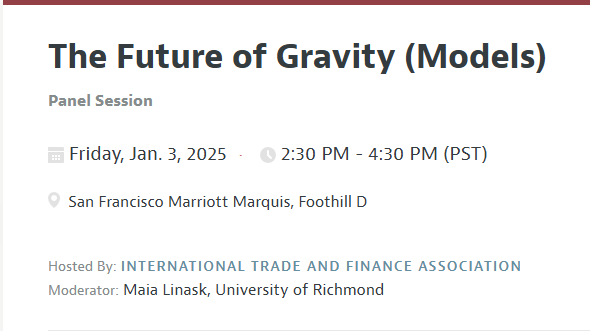
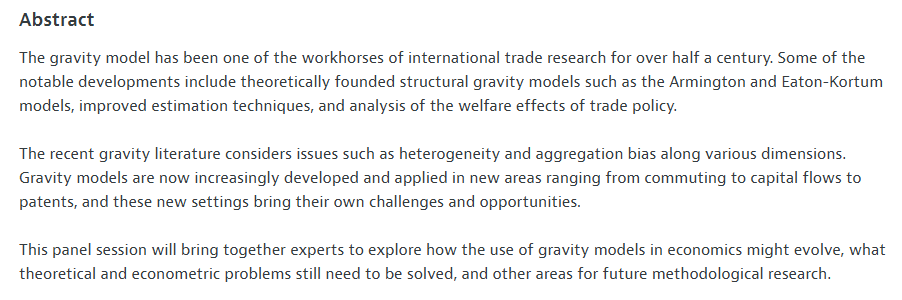
I am delighted to let the world know about this upcoming ASSA panel session on *the future of gravity models* that my colleague Maia Linask and I are organizing, in conjunction with @itfaconference.
Tom Zylkin tweet mediaTom Zylkin tweet media
English
2
16
71
8.3K
Hoang Pham
Hoang Pham@shockmath·
@TomZylkin @itfaconference It would be nice to see a writeup or publication of your discussion in this section Tom. Thanks for sharing the info!
English
1
0
2
97
Hoang Pham
Hoang Pham@shockmath·
@farmerrf Both prominent specific-factors model (short-) and Heckscher-Ohlin model (long-run) have this distributional implications. The problem is how the model is interpreted and political economy of redistribution. Most textbook models assume tariffs are inefficient in redistribution.
English
1
0
0
92
Roger E. A. Farmer
Roger E. A. Farmer@farmerrf·
1. Pre tariff: Car manufacturer can build a plant in Mexico, where wages are lower, and ship cars to consumers in the US. 2. Post tariff: Car manufacturer builds plant in the US and pays higher wages. Cars are more expensive but incomes of those producing the cars in the US are higher. 3. You and I, high earner academics, are worse off as we have to pay more for our cars. 4. Workers in Detroit are better off as they now have a job which pays more than enough to compensate them for the higher priced car. 5. Grocery stores return to Detroit suburbs where residents can now afford to buy food. Most recent international models of trade do not model the distribution of income between owners of capital, owners of land and workers since they focus on intermediate goods trade. But these distributional effects are central to arguments in favor of tariffs. The repeal of the Corn Laws in the UK in the 19th C — an event that arguably was instrumental in economists’ focus on trade — was a political struggle between the owners of land and a newly created class of manufacturers. In the case of the Corn Laws the event was the removal of trade protections which benefited manufacturers to the cost of landowners. But the point still stands. Trade protections have distributional effects. Trade protections also have dynamic effects. China has a thriving sector that produces green energy infrastructure, including nuclear power plants. That infrastructure was nurtured through trade barriers and the importation of capital, including nuclear technology, from the U.S.
Jon Murphy@jmurphy8289

@farmerrf @VincentGeloso It's unclear how or why tariffs, which act as a regressive tax when applied to consumer goods, would redistribute income back to middle and working class families. Furthermore, since tariffs increase the cost of manufacturing in the US, one fails to see how they would return mfg

English
8
4
25
7.3K
Hoang Pham 已转推
Christopher Clarke
Christopher Clarke@EconChrisClarke·
Our department is hiring a teaching economics professor at the Vancouver, WA (Portland metro) campus. We begin reviewing applicants on November 1st. Please share with your students on the market interested in a teaching career. aeaweb.org/joe/listing.ph…
English
0
7
19
7.1K
Hoang Pham 已转推
Todd Pugatch
Todd Pugatch@toddpugatch·
Many (most?) teachers nudge students to get the academic support they need. But what's the optimal way to nudge? How often, when, how, and to what form of support? Now in print @J_HumanResource: Nick Wilson & I tackle these questions via RCT: 1/ jhr.uwpress.org/content/59/5/1…
English
3
11
29
3.5K