@sudoingX I had an AMD 6800 XT 16gb collecting dust and now I have it running Qwen 9b q6 with both Open-webui and Hermes front ends developing code. Thanks to your posts in part. I still can’t get octopus invaders for prompt to start, but that wasn’t the intention of the exercise.
if you have a 12gb graphics card collecting dust in an old gaming rig or workstation, read this.
i ran a 9 billion parameter model on a single RTX 3060. 50 tokens per second. it wrote a full space shooter from scratch, 3,263 lines across 13 files. zero handwritten code. zero cloud. zero API calls.
your data never left the machine. not once.
you're probably sitting on more local intelligence than you realize. stop paying per token for work that should stay private.
I'm not the only one doing this.
- karpathy
best thought leader, best person to learn from imo. Nanochat is the best way to get into training LLMs its the simplest and most digestible source for building your first AI model
- steipete
This guys GitHub is a national treasure, his writing is also very strong. Peekaboo, summarize.sh, openclaw, oracle, just talk to it, etc.. all unique and very useful
- badlogicgames
Mario’s Pi is a staple AI engine and possibly the best, simplest, open source agentic loop to learn from. Despite what people say about his methods, I think he’s going to set some new standards for Open source contribution. Big respect.
- TheAhmadOsman
This man is the GPU king, giveaways and lots of dense educational content around self hosting and home inference. He’s also tight with pretty much all the open weight labs and has them on for interviews regularly
- sudoingX
This is an up and comer who will change the game, he's pushing the limits of what a single gpu can do
- Ex0byt
I can confidently say this man will be fundamental in making local inference on massive models possible.
- alexinexxx
I genuinely feel motivated by her drive. She’s a real hard worker learning about GPU kernel programming. Also good aesthetics
- gospaceport
I would not have gotten into building my own hardware without this man’s hard work. He’s taught me so much about hardware and the economics of this. He also has the most impressive homelabs I’ve ever seen.
- alexocheema
The founder of Exolabs, pioneering Apple hardware inference, he’s also very engaged in the community and a good guy all around. If you are interested in Mac minis and Mac Studios this is your guys.
- nummanali
This guy is so prolific, he’s made tons of CLI tools for managing llm subscription budgets, using Claude code with alternative models etc..
- thdxr
The entire Opencode team is wonderful but Dax specifically is a good writer. More anti-doomer content to sooth your anxieties.
- juliarturc
If you are interested in the science, Julias channel is where it’s at. Almost everything I’ve learned about LLM compression has been from her.
- Teknium
The Nous research & Prime intellect teams are both some of the most hard-working and principled people around. Tough fight in an industry so aggressive.
- victormustar
Head of Product for Huggingface, enabling us all to publish our work.
- louszbd
Head of community at ZAI some of the top LLMs available right now that are open weights. They supercharged the movement
- SkylerMiao7
Making frontier intelligence fit on 10k USD of hardware. Via MiniMax
- crystalsssup
Building the best Open Weight model on the market, and releasing their latest research before their next gen model.
Believe it or not these people are carrying the entire industry and giving us a fighting chance.
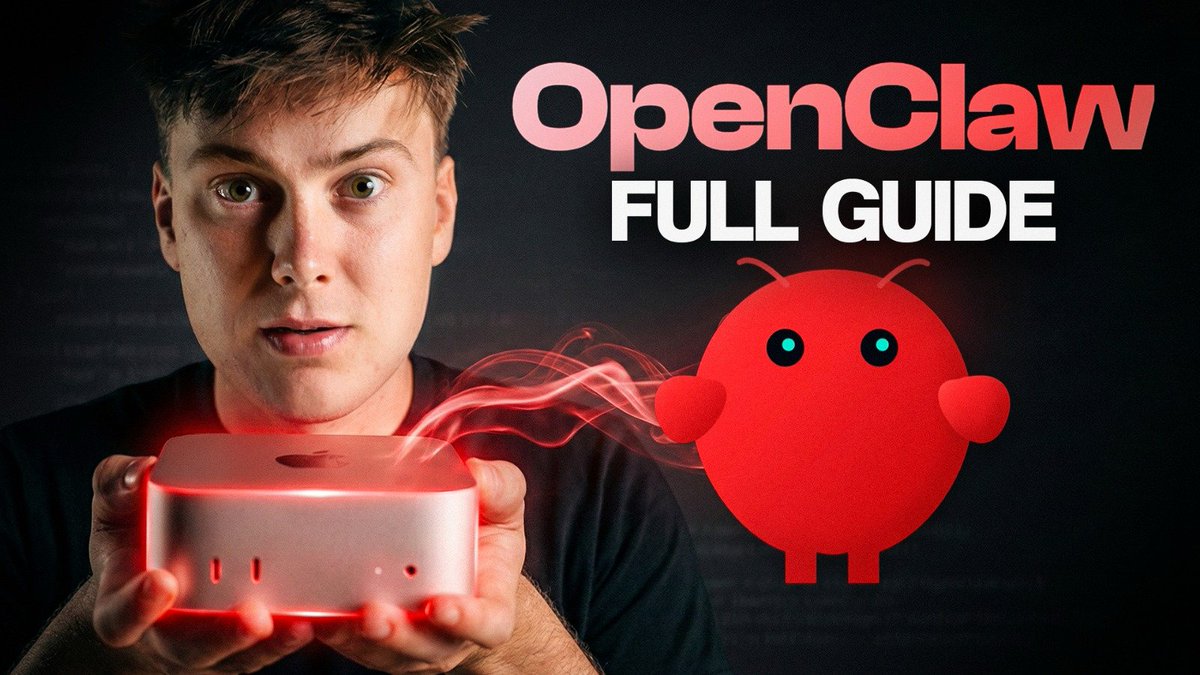
THE ULTIMATE GUIDE TO OPENCLAW (1hr free masterclass)
1. fix memory so it compounds
add MEMORY.md + daily logs. instruct it to promote important learnings into MEMORY.md because this is what makes it improve over time
2. set up personalization early
identity.md, user.md, soul.md. write these properly or everything feels generic. this is what makes it sound like you and understand your world
3. structure your workspace properly
most setups break because the foundation is messy. folders, files, and roles need to be clean or everything downstream degrades
4. create a troubleshooting baseline
make a separate claude/chatgpt project just for openclaw. download the openclaw docs (context7) and load them in. when things break, it checks docs instead of guessing
this alone fixes most issues!!
5. configure models and fallbacks
set primary model to GPT 5.4 and add fallbacks across providers. this is what keeps tasks running instead of failing mid-way
6. turn repeat work into skills
install summarize skill early. anything you do 2–3 times → turn into a skill. this is how it starts executing real workflows
7. connect tools with clear rules
add browser + search (brave api). use managed browser for automation. use chrome relay only when login is neededthis avoids flaky behavior
8. use heartbeat to keep it alive
add rules to check memory + cron healthif jobs are stale, force-run themthis prevents silent failures
9. use cron to schedule real work
set daily and weekly tasksreports, follow-ups, content workflowsthis is where it starts acting without you
10. lock down security properly
move secrets to a separate env file outside workspace. set strict permissions (folder 700, file 600). use allowlists for telegram access. don’t expose your gateway publicly
11. understand what openclaw actually is
it’s a system that remembers, acts, and improves. basically, closer to an employee than a tool
this ep of @startupideaspod is now out w/ @moritzkremb
it's literally a full 1hr free course to take you from from “i installed openclaw”to “this thing is actually working for me”
most people are one step away from openclaw working
they installed it, they tried it and it didn’t click
this ep will make it click
all free, no advertisers, i just want to see you build your ideas with ideas with this ultimate guide to openclaw
watch
Um hacker simplesmente hackeou o @cline e instalou o OpenClaw em 4.000 computadores com prompt injection 🫠
Olha que loucura:
- O time do Cline criou um workflow de triagem de issues automatizado no GitHub, usando o próprio Claude pra ler e categorizar os tickets
- O hacker abriu uma issue com um prompt injection no título — o Claude leu, achou que era uma instrução legítima, e executou
- Com isso, ele encheu o cache do GitHub com lixo até forçar a deleção dos caches legítimos de build, substituiu por caches envenenados, e roubou os tokens de publicação do npm
- Com os tokens em mãos, ele publicou uma nova versão do cline que parecia idêntica a anterior, só que com uma linhazinha a mais no package.json: "postinstall": "npm install -g openclaw@latest"
Resultado: 4,000 devs instalaram o openclaw nas suas máquinas sem saber (aka: um agente com acesso total ao seu computador) 🥲
Muito importante lembrar que IAs não têm malícia e por isso prompt injections são, na minha opinião, a maior vulnerabilidade delas.
Resumindo galera: CUIDADO.
quem quiser ler na íntegra: thehackernews.com/2026/02/cline-…
jensen just compared openclaw slop house to linux and called it the most popular open source project in history.
i admire jensen but he has clearly never used openclaw on a small model. if his team had spent one day in my DMs watching people migrate off it to hermes agent because their tool calls kept failing he might have framed things differently.
openclaw's founder left for openai. the codebase is 125K+ lines of typescript bloat. the sandbox blocks the tools that actually matter. small models can't use the MEDIA: syntax so your images never arrive. i know because i found that bug, wrote the fix, and got it merged into hermes agent the same day.
you don't need a $4,699 DGX Spark or a corporate "openclaw strategy" to run an autonomous agent. you need a half decade old GPU sitting in your drawer and a framework that actually works from 7B to 70B without special syntax.
hermes agent. 30+ tools. 11 model specific parsers. runs on a RTX 3060 at 35-50 tok/s. the fix i submitted yesterday is already in production.
jensen i respect the vision but the migration is already happening and it's not going in the direction you announced.
octopus invaders is not a game project. it's my benchmark. every model gets the same prompt. same spec. full game with audio, UI, pixel art, physics, and multifile architecture. if a model can build this autonomously on one GPU it can build anything you throw at it.
open sourced the full code, all prompts, and iteration docs here:
Live: github.com/sudoingX/octop…
test it against your own setup and tell me what you see.
Hermes Agent v0.3.0 ☤
248 PRs. 15 contributors. 5 days.
• Real-time streaming across CLI and all platforms
• First-class plugin architecture, package and share tools+commands+skills
• /browser connect to live Chrome via CDP
• @vercel AI Gateway model provider
• @browser_use browser tool provider
• VS Code, Zed, and JetBrains integration
• Voice mode with local Whisper
• PII redaction everywhere
9 new skills. 50+ bug fixes. Much more in the full changelog.
🚨 BREAKING: A new research paper proved that the future computer will have no apps at all and no operating systems like Windows, macOS, or Linux.
Instead, it may run entirely on AI agents.
The concept is called AgentOS.
Here’s the problem researchers identified.
Today’s AI agents are becoming incredibly capable.
Systems like OpenClaw can already:
• control a local computer
• execute complex workflows
• connect and use external tools
• perform multi-step tasks autonomously
But there’s a hidden limitation.
All of these agents still run inside traditional operating systems.
And those systems were designed for a completely different era.
Modern operating systems like Windows, macOS, and Linux were built around two interaction models:
• GUI (Graphical User Interface) clicking icons and navigating windows
• CLI (Command Line Interface) typing commands into a terminal
These models were designed for humans manually operating software.
Not for AI agents coordinating complex tasks across dozens of tools.
This creates a fundamental mismatch.
And it leads to several problems.
First: fragmentation.
Every application exists in its own silo.
Data, workflows, and permissions are separated across different programs.
Second: context loss.
When a task spans multiple tools, the system has no unified understanding of what the user is trying to accomplish.
Each app only sees a small piece of the workflow.
Third: messy permissions and hidden automation.
Many AI tools bypass normal system controls to get things done.
Researchers call this phenomenon “Shadow AI.”
Where autonomous agents operate across systems without clear structure, governance, or transparency.
In short:
AI agents are powerful.
But the operating system architecture isn’t designed for them.
So researchers propose a new paradigm.
A new type of operating system called AgentOS.
Instead of apps running on the system…
The system itself becomes an AI coordination layer.
At the center is something called the Agent Kernel.
Think of it as the brain of the entire computer.
This kernel continuously interprets user intent and manages intelligent agents.
It can:
• understand natural language requests
• break complex tasks into smaller steps
• coordinate multiple specialized AI agents
• select the right tools for each step
And traditional software?
It evolves into something called Skills-as-Modules.
Instead of launching separate applications, capabilities become modular skills that agents can dynamically combine.
For example, instead of manually opening multiple tools:
• a document editor
• a spreadsheet
• a presentation app
• an email client
You simply say:
“Analyze this report, extract the key insights, create slides, and send them to my team.”
The Agent Kernel interprets the request.
Then it automatically selects and orchestrates the required skills.
No apps.
No switching windows.
Just intent → execution.
In other words:
Computers stop being app platforms.
They become intent platforms.
We just completed the largest decentralised LLM pre-training run in history: Covenant-72B. Permissionless, on Bittensor subnet 3.
72B parameters. ~1.1T tokens. Commodity internet. No centralized cluster. No whitelist. Anyone with GPUs could join or leave freely.
1/n
OpenClaw is the most powerful AI tool available right now.
Most people have heard of it, but almost no one uses it correctly.
For weeks, I went deep on everything - optimal setups, testing real workflows & more.
The only video you need to get started 👉 youtu.be/wIARN03rPqM
Le mec qui a créé Claude Code (@bcherny) vient de montrer comment son équipe dresse l’IA.
Un fichier. CLAUDE.md. Tu le poses à la racine de ton projet. Dedans : les erreurs passées, les conventions, les règles. Claude le lit à chaque session.
Résultat : l’agent s’améliore sans que tu retouches une ligne de code. Chaque bug corrigé devient une règle permanente.
Boris Cherny utilise ça tous les jours chez Anthropic. Je vous mets son template ici.
Prêt à copier/coller et à adapter à votre guise :
### 1. Plan Mode Default
- Enter plan mode for ANY non-trivial task (3+ steps or architectural decisions)
- If something goes sideways, STOP and re-plan immediately — don't keep pushing
- Use plan mode for verification steps, not just building
- Write detailed specs upfront to reduce ambiguity
### 2. Subagent Strategy
- Use subagents liberally to keep main context window clean
- Offload research, exploration, and parallel analysis to subagents
- For complex problems, throw more compute at it via subagents
- One task per subagent for focused execution
### 3. Self-Improvement Loop
- After ANY correction from the user: update `tasks/lessons. md` with the pattern
- Write rules for yourself that prevent the same mistake
- Ruthlessly iterate on these lessons until mistake rate drops
- Review lessons at session start for relevant project
### 4. Verification Before Done
- Never mark a task complete without proving it works
- Diff behavior between main and your changes when relevant
- Ask yourself: "Would a staff engineer approve this?"
- Run tests, check logs, demonstrate correctness
### 5. Demand Elegance (Balanced)
- For non-trivial changes: pause and ask "is there a more elegant way?"
- If a fix feels hacky: "Knowing everything I know now, implement the elegant solution"
- Skip this for simple, obvious fixes — don't over-engineer
- Challenge your own work before presenting it
### 6. Autonomous Bug Fixing
- When given a bug report: just fix it. Don't ask for hand-holding
- Point at logs, errors, failing tests — then resolve them
- Zero context switching required from the user
- Go fix failing CI tests without being told how
## Task Management
1. **Plan First**: Write plan to `tasks/todo.md` with checkable items
2. **Verify Plan**: Check in before starting implementation
3. **Track Progress**: Mark items complete as you go
4. **Explain Changes**: High-level summary at each step
5. **Document Results**: Add review section to `tasks/todo. md`
6. **Capture Lessons**: Update `tasks/lessons. md` after corrections
## Core Principles
- **Simplicity First**: Make every change as simple as possible. Impact minimal code.
- **No Laziness**: Find root causes. No temporary fixes. Senior developer standards.