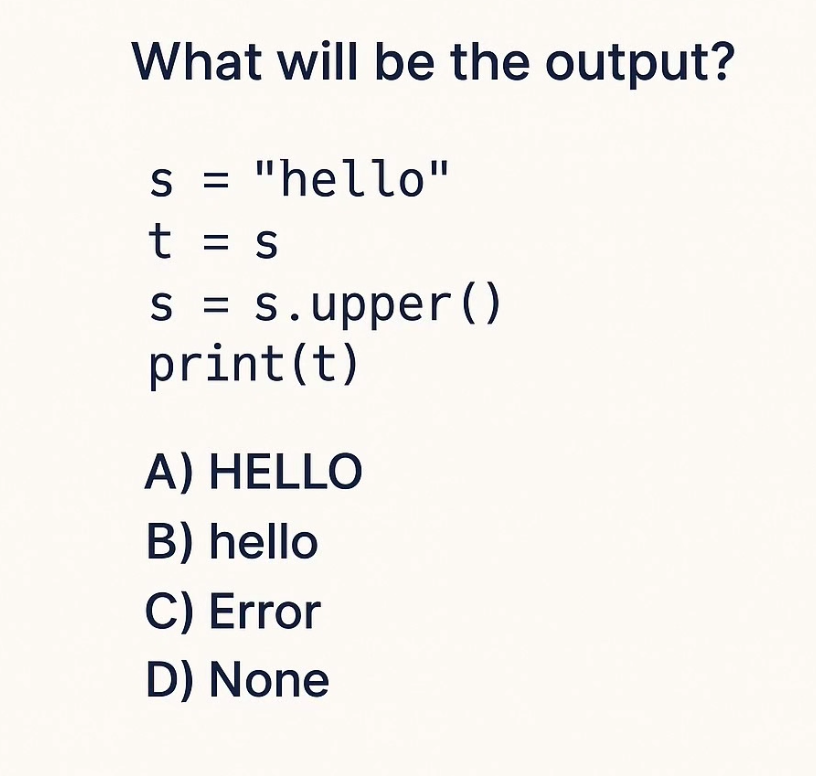
@PythonPr Answer: B) hello
Solution: On the surface it looks trivial.
s is initialized 'hello'.
t is assigned s.
s is modified to upper. So it 'HELLO' now
t is printed. What is the value of t?
t hasn't explicitly been changed, so it's going to the initial 'hello'.
But you might
+
@PythonPr have seen some bizarre stuff with lists.
Where you change one variable, and the change automatically reflects in another variable. Eg.
a = []
b = a
b.append(1)
the append to b automatically modifies `a` as well.
Why doesn't that happen here?
The reason is because
+