

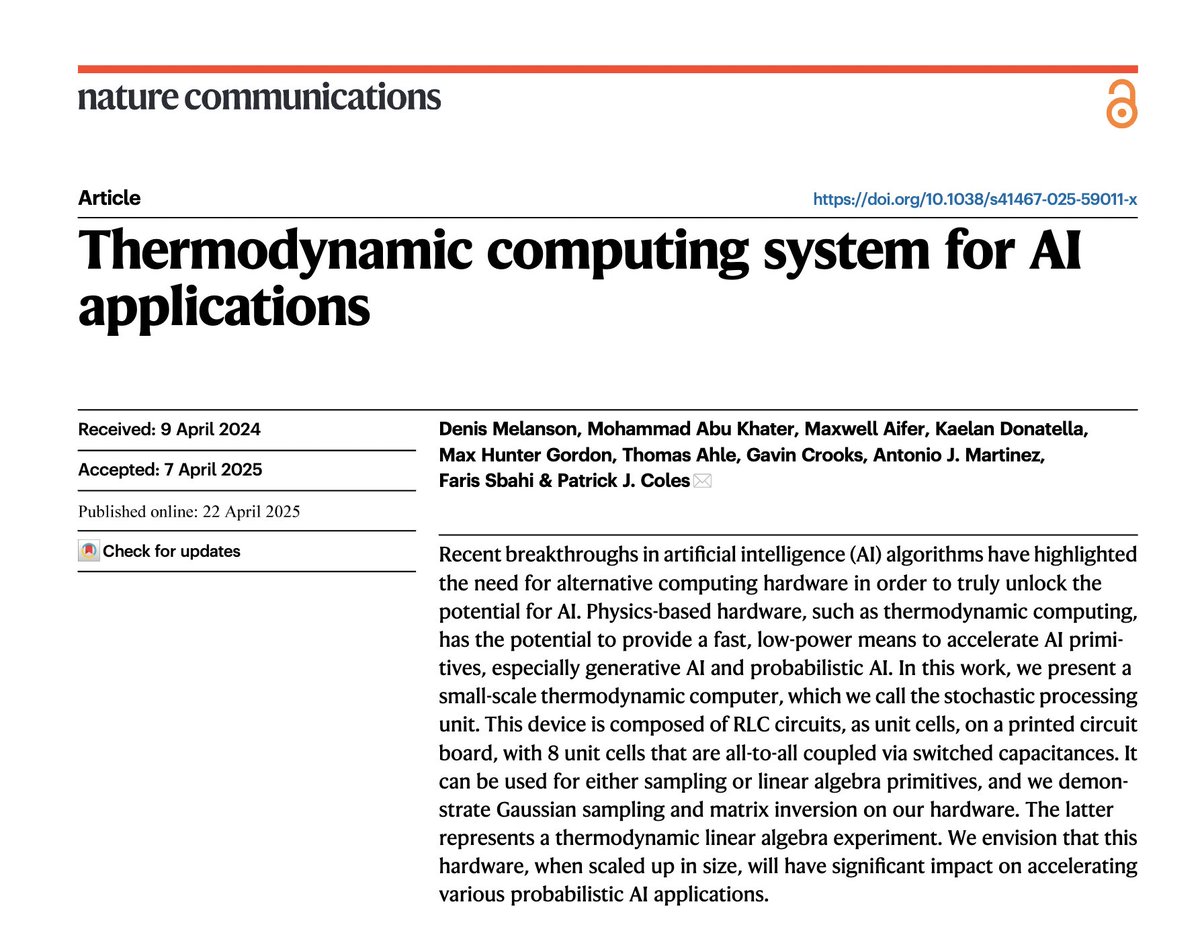
We're excited to share that our research "Thermodynamic computing system for AI applications" has been published in @NatureComms, detailing our early work on a prototype thermodynamic computer. Our stochastic processing unit used coupled RLC circuits with injected noise to demo various thermodynamic algorithms, like matrix inversion, Gaussian sampling, and ML uncertainty quantification. A scaled-up version of this architecture would significantly impact probabilistic AI applications.
Fortunately, we are already making progress in this direction! As shared at NYC Deep Tech Week, we're now building the Carnot architecture - silicon that enables unprecedented scaling for thermodynamic computing. Our approach simulates Langevin dynamics to accelerate algorithms that reason about the physical world, with transformational applications in generative design, scientific computing, and probabilistic reasoning.
Congratulations to Denis Melanson, Mohammad Abu Khater, Maxwell Aifer (@MaxAifer), Kaelan Donatella, Max Hunter Gordon, Thomas Ahle (@thomasahle) , Gavin Crooks (@gavincrooks), Antonio J. Martinez (@zaqqwerty_ai), Faris Sbahi (@FarisSbahi), and Patrick Coles (@ColesThermoAI)!
Read the full article here: rdcu.be/eiJHB
English


