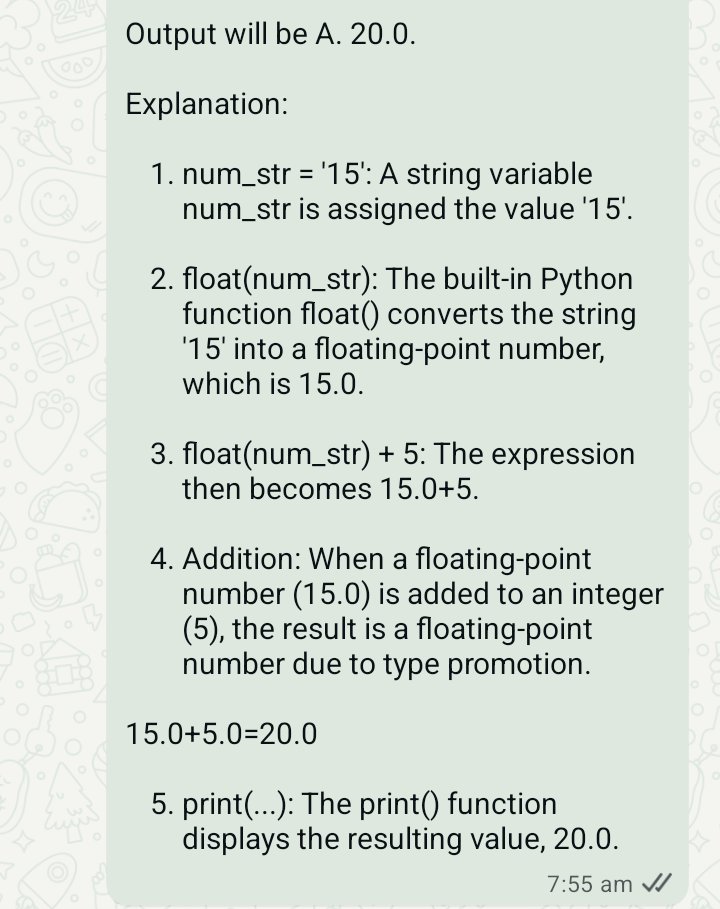
@PythonPr Answer: A) 20.0
float('15') converts string to 15.0
› 15.0 + 5 = 20.0
For beginners: float + int always returns float.That's why it's 20.0, not 20. Python keeps the decimal even when the result is a whole number.
@PythonPr A (20.0)
The string '15' is stored in the variable num_str.
The variable is converted to float (decimal), & added to 5. When you perform arithmetic between a float and an integer, the result is automatically promoted to a float.
@PythonPr Answer:-(A)20.0
When you convert a string to a float, it becomes a number. So float('15') is 15.0 and then add 5 makes it 20.0 because In Python, when you add a float and an integer, the result is always a float.
@PythonPr The jump from ‘15’ → 15.0 → 20.0 looks simple — but that’s cognition in miniature.
Every cast is a translation of context, not just type.
That’s how we model reasoning too — recursion that remembers why it converted.”
#SecondMindSystems#RecursiveReasoning#AI#Python