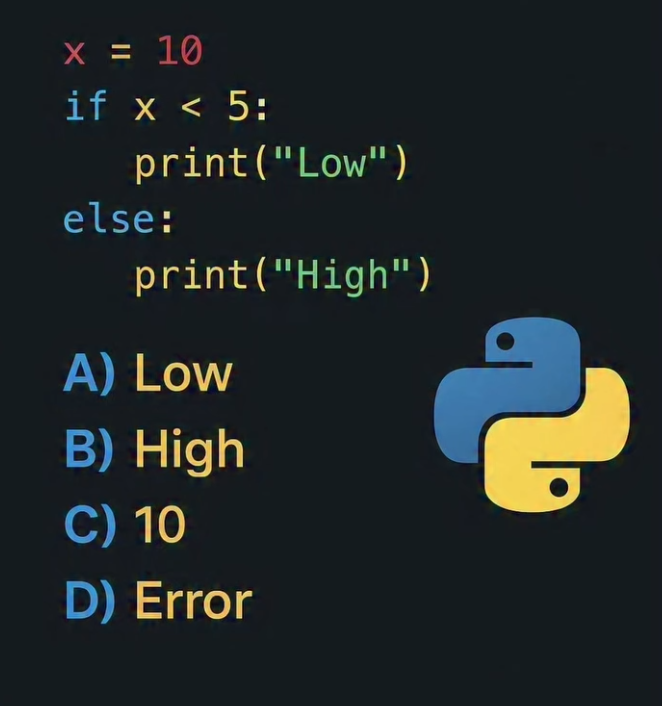
@PythonPr The correct answer is B) High.
The code initializes the variable x with the value 10. The if statement checks the condition x < 5. Since 10 is not less than 5, the condition is false. As a result, the code in the else block is executed, which prints the string "High"
@PythonPr The correct answer is **B) High**.
**Explanation:**
The variable `x` is equal to 10. The condition `if x < 5` is false because 10 is not less than 5. Therefore, the code in the `else` block is executed, which prints "High".