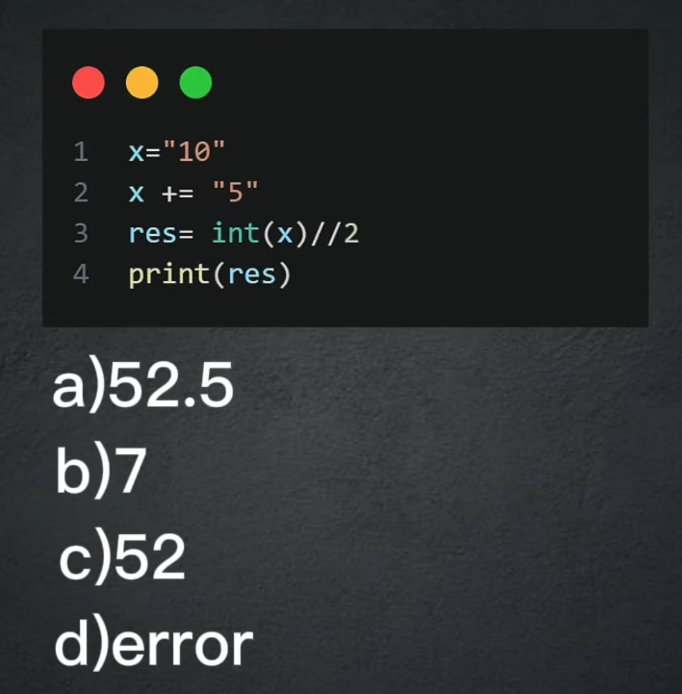
@PythonPr Correct answer: C) 52
Explanation:
x = "10" creates a string.
x += "5" concatenates strings → "105".
int(x) converts it to 105.
105 // 2 is floor division → 52.
@PythonPr Answer: c) 52
This demonstrates basic Python string manipulation and integer division:
Line 1: The variable x is initialized as a string with the value "10".
Line 2: The string "5" is appended to the current value of x (string concatenation). This changes the
@PythonPr Answer= 52
Adding strings together concatenate them. So giving us "105". Casting the results into int()
converts it into an integer, so now we ve 105. // Is called floor division operator. It divides then discard the decimal part, thus giving us 52
@PythonPr C) 52
x = '10' the quotes mean 10 is treated as a string.
x += '5' since both values are strings, we concatenate x becomes '105'.
res = int(x) // 2 int converts x to an integer 105, // performs floor division.
105 divided by 2 results in 52, with the decimal part dropped.