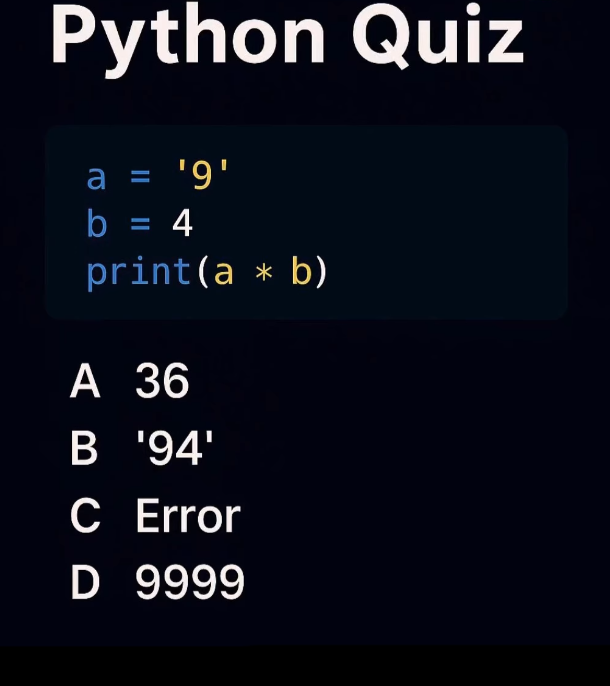
@PythonPr Answer: D 9999
Solution: Observe that '9' is a string, not an int.
b is an int 4.
So,
a * b
is a multiplication of string and int.
Sounds strange, but this is just repetition of the string.
So, '9' * 4 is the string '9' repeated 4 times, ie,
9999
that's what gets printed.
@PythonPr (d) 9999
In Python, when the multiplication operator (*) is used with a string (a = '9') and an integer (b = 4), it performs string repetition, not mathematical multiplication. The original string is repeated the number of times specified by the integer.
Why!?
@PythonPr "9999"
a is a string, not a number. So Python doesn’t do math here. It does what it always does with strings and integers.
'9' * 4 means “repeat the string '9' four times,” not “multiply like an adult.
You asked Python for arithmetic, and it said, “Best I can do is copy-paste.”
@PythonPr While adding a string and an integer (+) causes an error, multiplying a string by an integer is a perfectly valid operation, so correct answer is D as here the string 9 gets repeated 4 times and becomes 9999