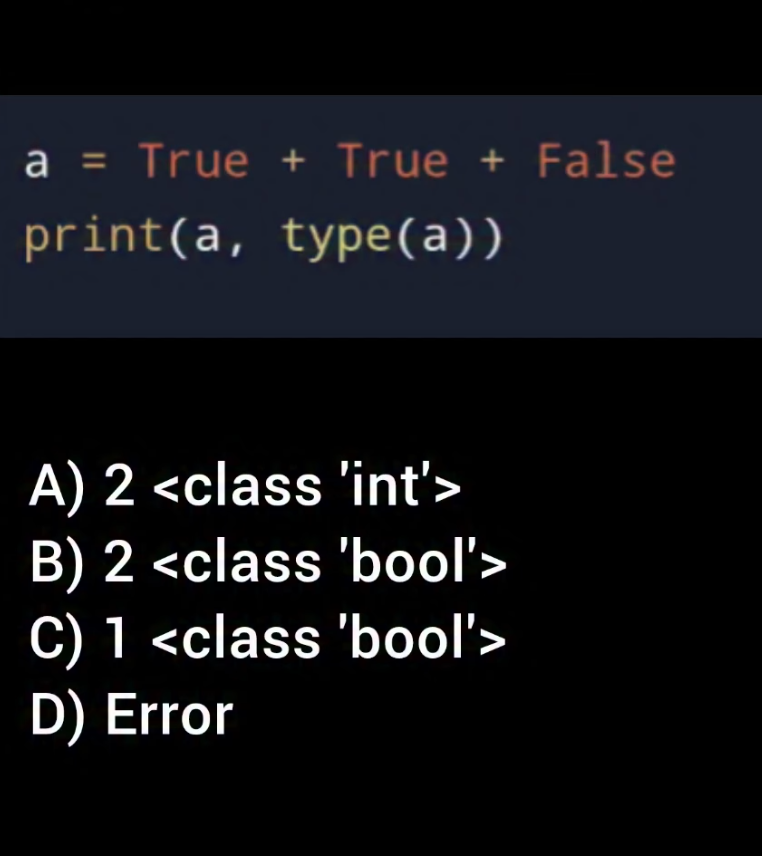
@PythonPr Answer: A) 2 <class 'int'>
In Python, True and False are subclasses of integers, with True having a value of (1) and False having a value of (0). When used in arithmetic operations, their integer values are used. The expression becomes (a=1+1+0). This results in
@PythonPr Answer: A) 2 <class 'int'>
In Python, boolean values are a subclass of integers, where True is treated as 1 and False as 0. So the expression True + True + False becomes 1 + 1 + 0, which results in 2. Since arithmetic addition is performed, the final value is an integer.
@PythonPr Answer: A) 2 <class 'int'>
Step by step:
› True = 1, False = 0 in arithmetic
› 1 + 1 + 0 = 2
› Result is int, not bool!
For beginners: When you do math with booleans, Python converts them to integers. True becomes 1, False becomes 0.