@PythonPr Answer: B) 1 3
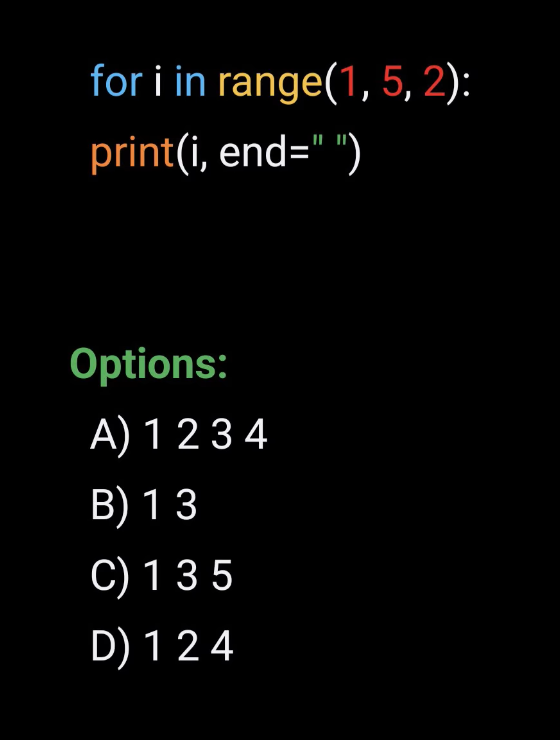
The Python code uses the range(start, stop, step) function. start is 1 (inclusive). stop is 5 (exclusive). step is 2.
The loop starts at (i=1). The next value of (i) is (1+2=3). The next value would be (3+2=5), but this is equal to the stop value, so the loop
@PythonPr B 13 is the right answer
Simple use of for loop and range function (start,end,stepsize) here stepsize is given 2 and by default is 1 end is excluded and start is included here so output will be
1,
1+2 = 3
3+2 = 5 but end is excluded so we answer will be 1 3.
@PythonPr The correct answer is B) 1 3.
range(1, 5, 2) starts at 1, stops before 5, and steps by 2.
So it produces: 1, 3.
With end=" ", they print on the same line:
1 3
@PythonPr B
Range
Start from 1 (inclusive)
End at 5 (exclusive), so 4 is the max range
Step size 2
1 prints
1 + 2 (step size) - 3 prints
3 + 2 (step size) - 5 out of range