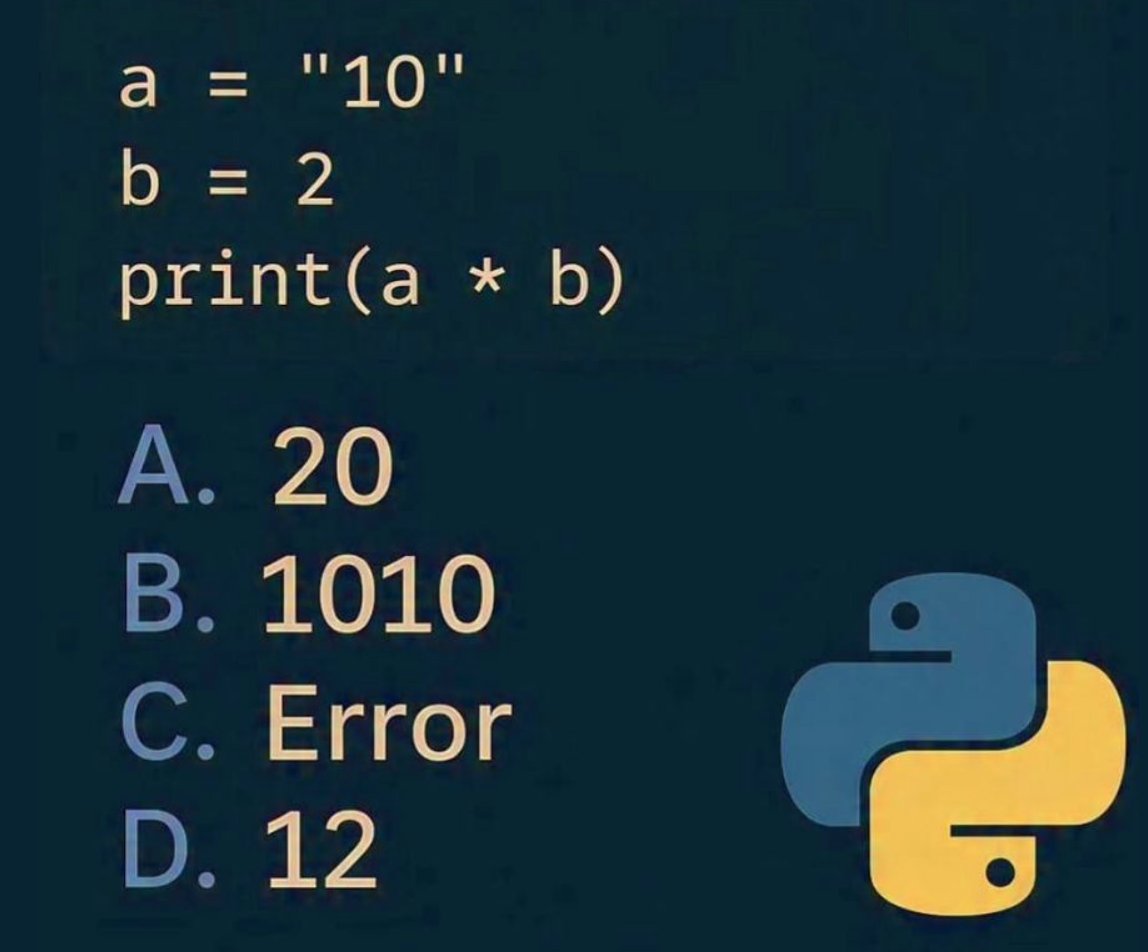
El operador * está reimplementado para algunos tipos de datos en Python (gracias al método mágico __mul__).
En el caso de las cadenas de texto, el comportamiento es replicar la cadena tantas veces como indique el entero por el que se multiplica.
Por tanto, la solución es la B:
1010
@PythonPr Option B : 1010
a is a string, not a number. In Python, multiplying a string by an integer repeats the string. So "10" * 2 becomes "1010". The print statement outputs 1010, not 20, because no numeric multiplication occurs here.
@PythonPr Output : 1010
a = "10" means it's string
b = 2 means it's integer
Print ("10" * 2 ) means string repetition
so "10" is written two times
Output is 1010
Floats are rejected because the Sequence Protocol requires discrete indexing; partial repetition breaks UTF-8 encoding boundaries—how do you render 0.5 of a multi-byte character? Negatives are clipped to zero in the CPython source (string_repeat) to maintain Total Function semantics and avoid breaking dynamic loops.
If we allowed 1.5x, would it be s + s[:len(s)//2]? That breaks the Algebraic Monoid properties where (s*a)*b must equal s*(a*b). Integer-only domains keep the math clean.