Post
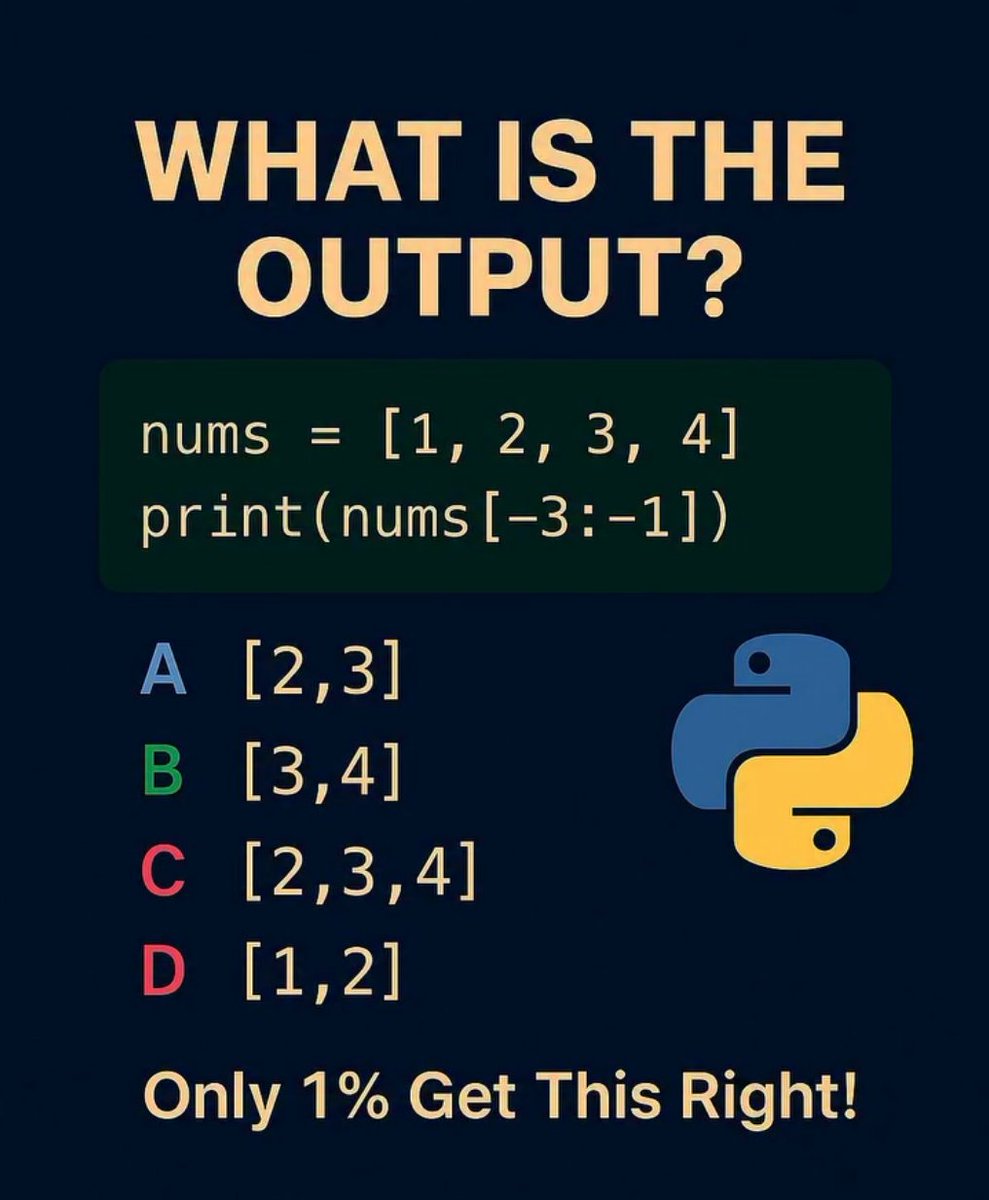

@Python_Dv Output: [2, 3]
Why:
-3 starts at index 1 (2), -1 stops before the last element (4).
So the slice includes elements at indices 1 and 2 → [2, 3].
English

@Python_Dv Answer: A → [2, 3]
-3 starts at value 2.
-1 stops before last element.
So Python returns only the middle slice.
English

@Python_Dv A) [2, 3]
Negative indexing is like counting how many weeks until due date.
Start from the end, don't include the last one 😅
English

@Python_Dv Answer is A) [2, 3]
-3 starts at 2, -1 stops before the last element.
So it returns elements at index 1 and 2 → [2, 3]
English


@Python_Dv A — [2, 3]
-3 starts at 2, -1 stops before the last element.
English

@Python_Dv A [2,3]
, @grok it counts from -3 to -1 but it excludes -1.
English








@Python_Dv b)
-3 you need to count in reverse order
so you start in 3,
Finally you finish in -1 is the last number of the list.(5)
In python the last number not count
English