🔍 Let's dive into Python floats! A practical journey to understand their precision limitations and applications. 🚀 Whether you're a data scientist or engineer, this thread's for you!
#Python#DataScience@YourPythonFun
A float in Python represents real numbers, but with precision limits. 🤔
They're not always "accurate"—important to know for scientific computations! 🌟
#PythonTips#Coding
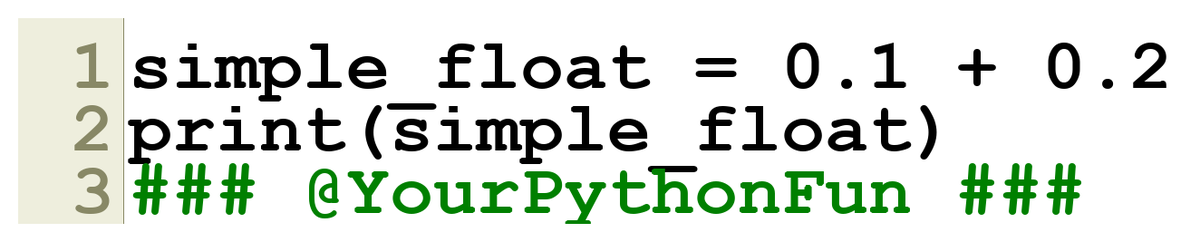
Ever wondered why 0.1 + 0.2 doesn't exactly equal 0.3? 🔍
Due to binary floating-point precision, results can be surprising! 🧪
Check out this code snippet. 📸
#PythonCode
Scientific notation with floats helps express very large or small numbers succinctly. 📏
Example: 1.23e4 represents 12300.
Useful in data science & engineering!
#PythonForDataScience
Before diving deep into Python floats, ensure your basics are solid. A foundation in Python fundamentals is crucial!
Start with the essentials here 👇
learnpython.com/?ref=mdnlm2f
Understanding floats is key to handling complex computations accurately! ⚖️
Use these insights to boost your projects now. 📈
Follow @YourPythonFun for more tips & tricks! 🔔
#PythonProgramming#DataEngineering