
Altimeter Capital

273 posts

Altimeter Capital banner
Altimeter Capital

Altimeter Capital

@AltimeterCap

We research and invest in tech innovation, backing visionary founders and companies in public and private markets. Disclaimers: https://t.co/hUVZJoTrdz

Menlo Park & Boston انضم Mart 2024
83 يتبع4.8K المتابعون
تغريدة مثبتة
Altimeter Capital
Altimeter Capital@AltimeterCap·
Altimeter Founder & CEO Brad Gerstner (@altcap) joined the @theallinpod with Jensen Huang at @nvidia GTC. 3 moments worth your time: • Jensen’s take on why the $50B factory is actually the cheapest option • Discussion on why Wall Street's Nvidia forecasts may be underestimating Nvidia’s TAM • Jensen’s opinion on why Dario's $1T revenue call could be too conservative
The All-In Podcast@theallinpod

🚨MAJOR INTERVIEW: Jensen Huang joins the Besties! The @nvidia CEO joins to discuss: -- Nvidia's future, roadmap to $1T revenue -- Physical AI's $50T market -- Rise of the agent, OpenClaw's inflection moment -- Inference explosion, Groq deal -- AI PR Crisis, Anthropic's comms mistakes -- Token allocation for employees ++ much more! (0:00) Jensen Huang joins the show! (0:26) Acquiring Groq and the inference explosion (8:53) Decision making at the world's most valuable company (10:47) Physical AI's $50T market, OpenClaw's future, the new operating system for modern AI computing (16:38) AI's PR crisis, refuting doomer narratives, Anthropic's comms mistakes (20:48) Revenue capacity, token allocation for employees, Karpathy's autoresearch, agentic future (30:50) Open source, global diffusion, Iran/Taiwan supply chain impact (39:45) Self-driving platform, facing competition from active customers, responding to growth slowdown predictions (47:32) Datacenters in space, AI healthcare, Robotics (56:10) OpenAI/Anthropic revenue potential, how to build an AI moat (59:04) Advice to young people on excelling in the AI era

English
0
1
3
1.6K
Altimeter Capital أُعيد تغريده
Freda Duan
Freda Duan@FredaDuan·
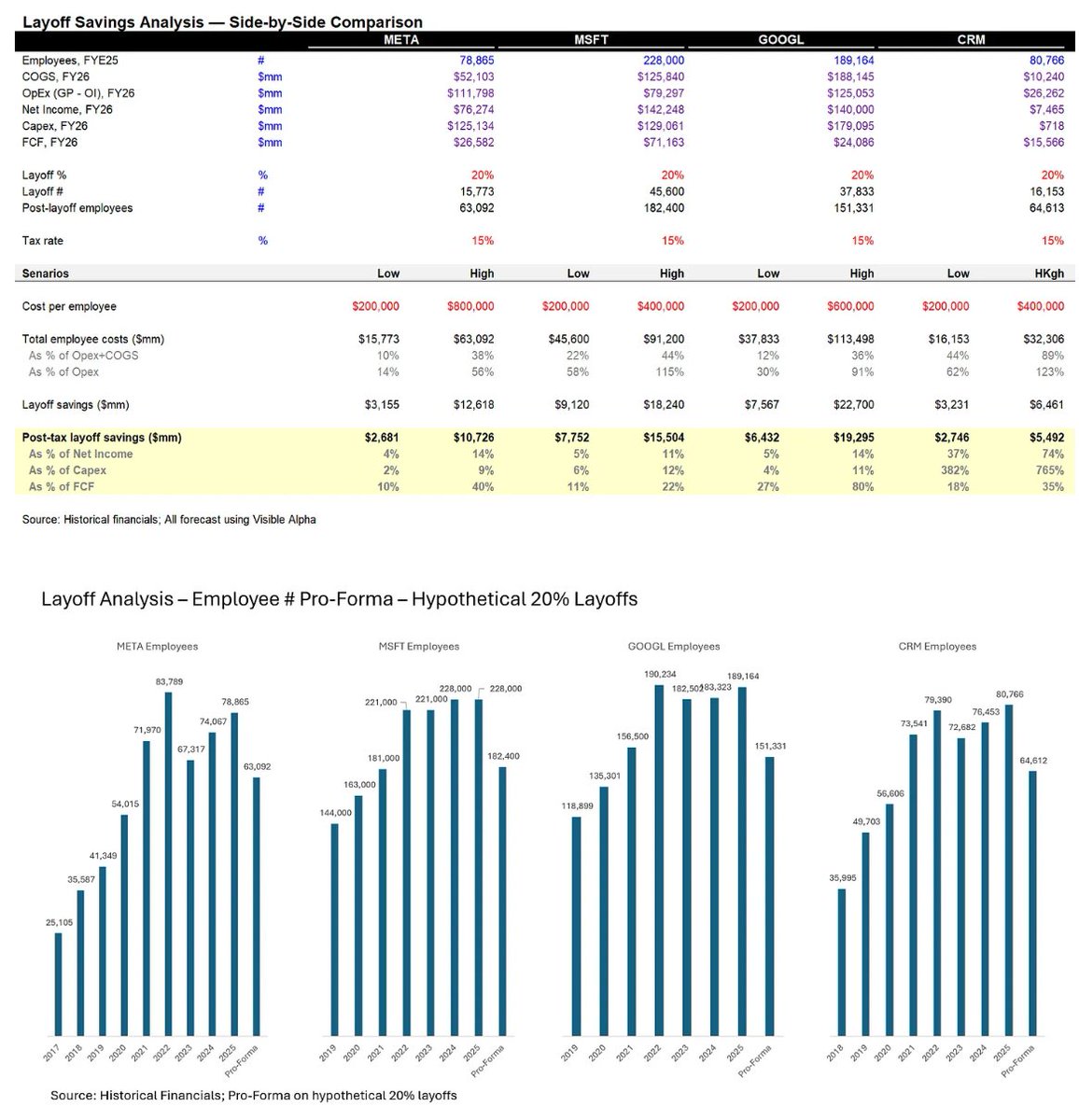
Layoffs Impact - Lots of chatter around reorgs & layoffs recently. I wanted to build a simple framework to understand the financial impact. All scenarios below are purely hypothetical. Key Observations: 1/ SaaS is far more sensitive than Big Tech Using $CRM as a reference (and likely representative of other SaaS names): Assume ~$200k average salary per employee Layoffs can drive: - ~40% uplift to GAAP EPS - ~20% uplift to FCF This is meaningful. Labor is a much larger % of the cost base, so cuts flow through cleanly. 2/ Big Tech: smaller EPS impact, larger FCF leverage For $META, $MSFT, $GOOGL: A 20% layoff implies: - ~5–15% uplift to EPS - Significantly larger impact on FCF The key difference: these companies are already highly profitable, so incremental savings show up more clearly in cash than in earnings. Take $GOOGL as an example: At $200k–$800k salary per employee: - FCF could increase by ~30–80% - Equivalent to enabling ~10% incremental CapEx deployment In other words, layoffs don’t just boost margins - they can directly fund the AI capex cycle. --- To ground the analysis, here are the base assumptions: - 20% workforce reduction - 15% tax rate - $200k–$800k salary range per employee Full analysis: open.substack.com/pub/robonomics…
Freda Duan tweet media
English
3
7
46
6.4K
Altimeter Capital
Altimeter Capital@AltimeterCap·
Wall Street has Nvidia growing at 7% by 2029. Brad (@altcap) put the number directly to Jensen. Jensen: "They just don't understand the scale and the breadth of AI."
Altimeter Capital@AltimeterCap

Brad (@altcap) pushed Jensen on the $50B factory vs cheaper ASIC alternatives. Jensen: "The $50 billion factory will generate for you the lowest cost tokens." Jensen argues not to equate the price of the factory with the price of the token.

English
3
2
39
10.6K
Altimeter Capital
Altimeter Capital@AltimeterCap·
Brad (@altcap) pushed Jensen on the $50B factory vs cheaper ASIC alternatives. Jensen: "The $50 billion factory will generate for you the lowest cost tokens." Jensen argues not to equate the price of the factory with the price of the token.
Altimeter Capital@AltimeterCap

Altimeter Founder & CEO Brad Gerstner (@altcap) joined the @theallinpod with Jensen Huang at @nvidia GTC. 3 moments worth your time: • Jensen’s take on why the $50B factory is actually the cheapest option • Discussion on why Wall Street's Nvidia forecasts may be underestimating Nvidia’s TAM • Jensen’s opinion on why Dario's $1T revenue call could be too conservative

English
0
0
4
9K
Altimeter Capital أُعيد تغريده
Erik Kriessmann
Erik Kriessmann@ekriessmann·
Power is upstream of economic value. True on Earth. True in space. Economic value will concentrate in platforms that can deliver unique capability and large amounts of power on orbit. @K2SpaceCo delivering 20kW per satellite is a massive unlock. It creates a new operating regime that expands the frontier of what is technically and economically possible. Higher-power payloads. More compute. Stronger propulsion. Greater maneuverability. Entirely new mission areas. T-Minus ~10 days to Gravitas
Karan Kunjur@KaranKunjur

We have shipped our 20kW satellite - Gravitas - to the launch site. Given the supply chain to operate at this power regime doesn’t exist, we had to build 85% of the satellite in-house. This includes building our own large solar arrays, high power propulsion system, large batteries, large reaction wheels and much more. This launch will represent the first time all of these systems are test on orbit together. Internally at @K2SpaceCo, we’ve thought about a few levels of success for this mission - we expect mission success to fall somewhere along this spectrum: - Tier 1 (Baseline mission success): Deploy solar arrays, establish comms, operate the satellite —> we’ve now got an operational 20kW satellite on orbit - Tier 2: Power on the payloads, activate the 20kW propulsion system —> we’re completing payload missions and have fired the highest power hall thruster ever flown on orbit - Tier 3: Orbit raise the satellite, test performance in high radiation environments (like 2,000km) —> we’ve collected massive amounts of data on the performance of the platform in very very difficult environments More than anything, Gravitas represents the start of an iterative journey, where we will take the data we receive from this first satellite and incorporate it into the next wave of satellites launching next year. We’re excited to start this journey, we’ll report back as we get more data. Thanks to Tim for covering our story on TechCrunch techcrunch.com/2026/03/19/k2-…

English
1
1
16
1.9K
Altimeter Capital أُعيد تغريده
Apoorv Agrawal
Apoorv Agrawal@apoorv03·
What drove ChatGPT from 0 to a billion users? How do they plan to get the next billion? New pod. Sat down with @nickaturley, Head of ChatGPT, for one of the more candid conversations I've had on the show. We cover GPU allocation tradeoffs, retention smile curves, pricing, Code Red as a strategy, bringing on @steipete from OpenClaw, and why Nick believes curiosity is the only perma-skill in the age of AI (with a shoutout to our friend @bgurley's new book). full interview in comments
English
6
8
90
12.8K
Altimeter Capital أُعيد تغريده
Jamin Ball
Jamin Ball@jaminball·
Awesome stuff from the @Hammerspace_Inc team. Storage is more important than ever. In the age of AI, storage systems will need to be re-invented to keep up with model's insatiable demand for data (both during training and inference). Nvidia today came out with their "AI Data Platform" reference architecture to help enterprises solve these storage challenges. Pumped to see Hammerspace listed as 1 of 12 partners, alongside some legendary storage companies! nvidia.com/en-us/data-cen…
English
3
4
29
7K
Altimeter Capital أُعيد تغريده
Freda Duan
Freda Duan@FredaDuan·
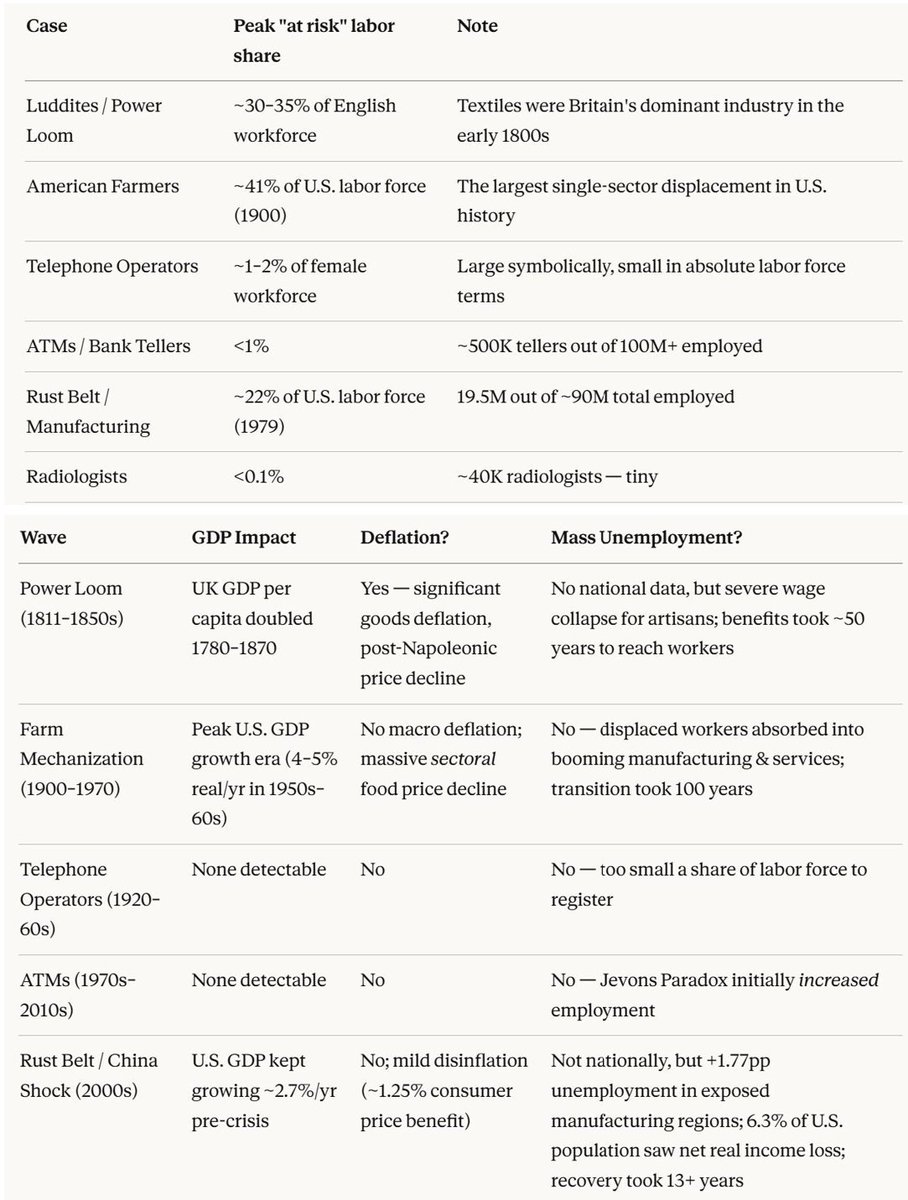
Heard $Druckenmiller on a podcast: "Anybody who believes that(i.e. AI will be very deflationary and it will lead to massive job losses) with conviction suffers from arrogance and not an open mind…every technological revolution since was known to man, it’s been declared, for jobs it’s the end of the world…So let’s say the pessimists are right on AI, it’s possible you get a government response with printing and universal income." That got me intrigued, so I asked $Claude and $GPT to go back through history and review a few cases where societies feared that new technologies or structural shifts would trigger permanent mass unemployment: The Luddites (1811-1850s); American farmers (1800s-1970s); Telephone operators (1920s-1960s); ATMs and bank tellers (1970s-2010s); The Rust Belt (1980s-present); Radiologists and AI (2016-present). Full case study: open.substack.com/pub/robonomics… In none of these cases did we get sustained, economy-wide deflation or permanent mass unemployment. --- What actually feels different this time? Speed. The shift from 41% to 2% of the labor force in agriculture took roughly a century. Telephone operators faded over about 60 years. ATMs played out over roughly 40 years. Even Rust Belt deindustrialization - often seen as shockingly fast - unfolded over 20-30 years. AI could move much faster. --- What happens if AI really does cause deflation or unemployment? The Fed has four main anti-deflation tools: - Cut interest rates - QE - Forward guidance - Coordinate with fiscal stimulus - the 2020 playbook These tools can support aggregate demand. What they cannot do well is determine who benefits. The most likely macro outcome may look something like a Rust Belt at scale: nationally, GDP still grows, unemployment stays moderate, and headline deflation never really shows up. But underneath those aggregates, inequality widens and pain gets concentrated. --- If $Dario is directionally right - say 50% of entry-level white-collar jobs disappear within 1-5 years - the math gets meaningful quickly: - Current unemployed = 168M x 4% = 6.7M - 50% of entry-level white-collar jobs displaced = 5M-7.5M - Unemployment could rise toward roughly 7-9% - Historically, U.S. unemployment has usually ranged between roughly 4% and 10% outside extreme crises. A move from 4% to 7-9% would not be unprecedented - but it would be large enough to reshape politics, wages, and social expectations. --- Long way of saying: I’m trying not to be “arrogant without an open mind.” As $Druckenmiller said: "you just have to always be looking at what other people might not be, and then if you’re prepared for it mentally, you can adjust quickly enough, um, in your portfolio to it as it unrolls." +++ Full analysis: open.substack.com/pub/robonomics…
Freda Duan tweet media
English
28
79
551
98.9K
Altimeter Capital أُعيد تغريده
Clark Tang
Clark Tang@_clarktang·
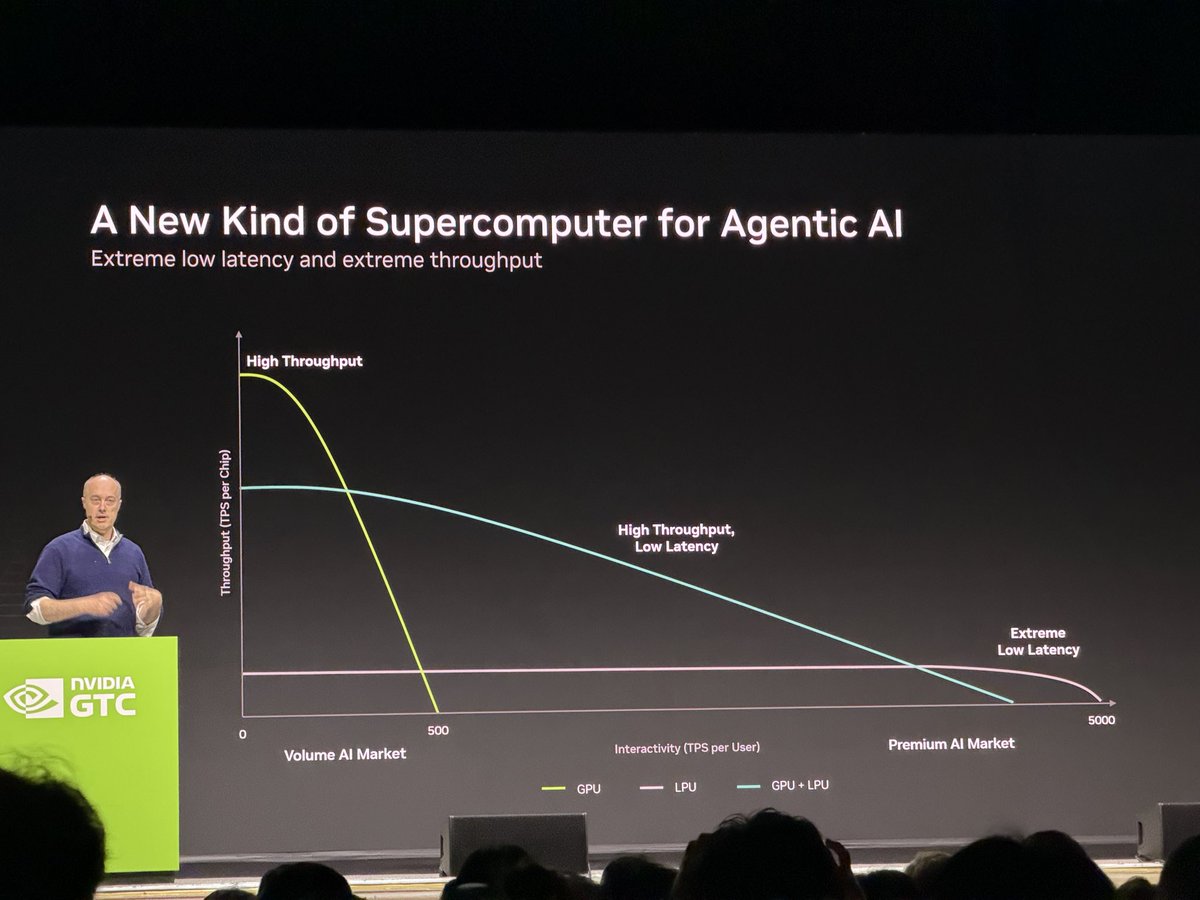
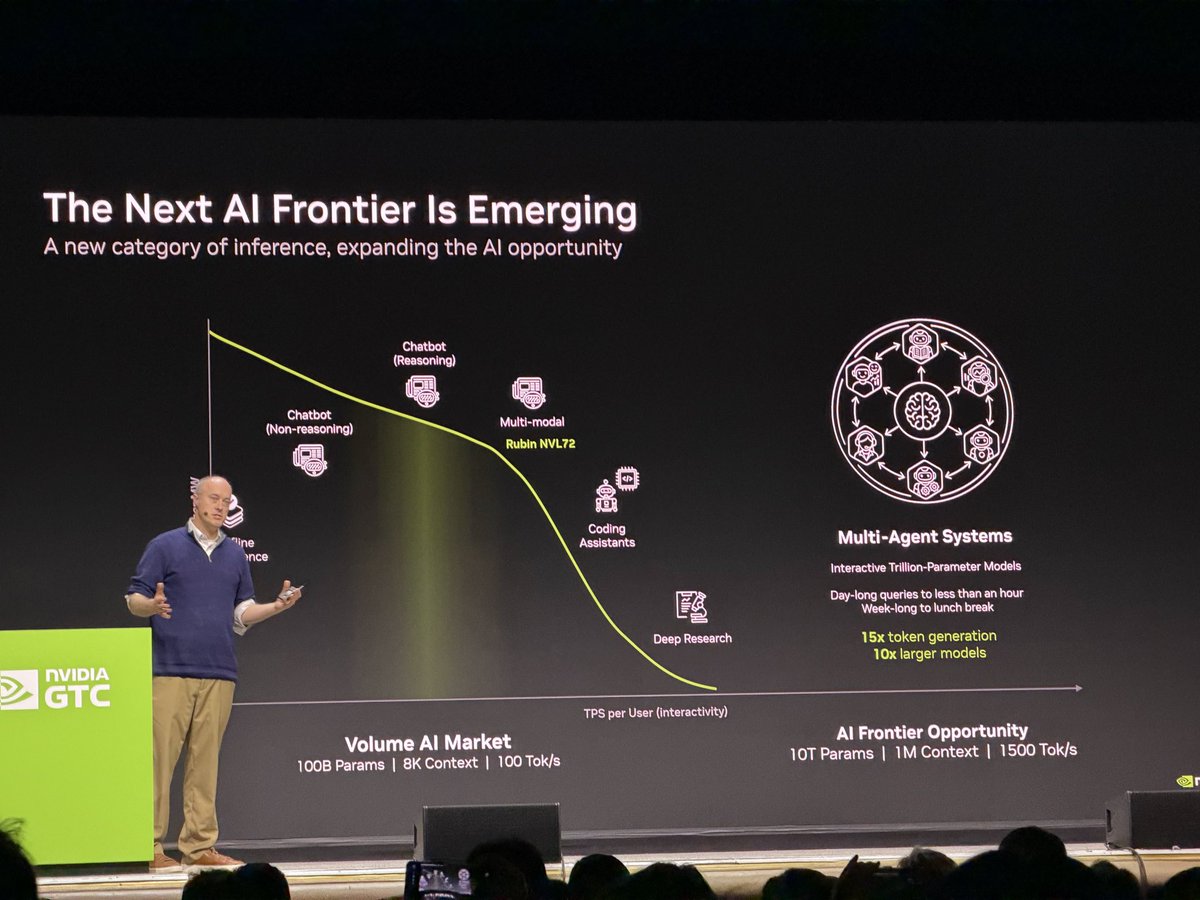
Ian buck presentation actually really great and compelling - explaining why we need to push out to pareto frontier (agent swarms), why we need to push higher token /s. Why the hybrid architecture of GPU + LPU is much better than just GPU or LPU standalone… pretty awesome
Clark Tang tweet mediaClark Tang tweet media
English
4
16
114
13.6K
Altimeter Capital
Altimeter Capital@AltimeterCap·
Altimeter partner Apoorv Agrawal (@apoorv03) joined @TBPN to share his thoughts on consumer AI, durability, and what it takes to build a lasting platform. A few highlights: 🏆 On winner-take-most dynamics: "History has shown us that these consumer markets have been winner take most. Sometimes winner take all." 📈 On ChatGPT: Apoorv discussed how ChatGPT is the only app in AI that shows what we call a smile curve — where users come back over time after having churned. 🌍 On the next wave of users: Apoorv anticipates that the next phase of utility will come from proactive AI... not waiting for you to log on, but coming to you. ⚡ On the public vs. private market disconnect: Apoorv comments that the public markets are a very efficient mechanism for repricing — but not always hyper efficient in times like now, when the change is so fast. Full episode linked below. 👇
English
0
2
11
2.3K
Altimeter Capital أُعيد تغريده
Thomas Reiner
Thomas Reiner@treiner5·
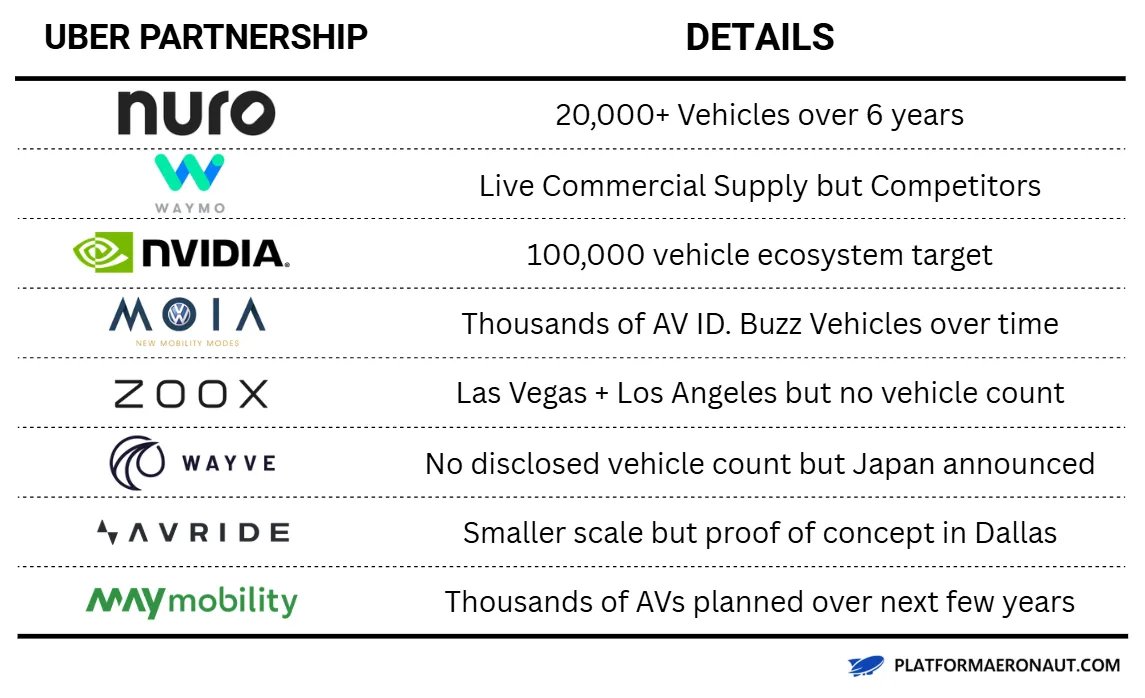
Uber Is Quietly Winning the AV Rideshare Setup If 2025 was the proof point that consumers will actually take autonomous rides at scale, 2026 is starting to look like the year the strategic map gets redrawn. For the last few years the AV debate has mostly been framed around who has the best self-driving technology. That still matters of course. But increasingly that is the wrong question for investors. The more important question now is: who is best positioned to turn AV supply into a scaled rideshare network? That is a different question entirely. To level set: this is no longer just about the best AV stack @Waymo is the only player that has really crossed from demo to scaled commercial reality. The company said in February it was already doing more than 400,000 paid rides per week across its operating markets, and it raised another $1.6 billion while laying groundwork for expansion into more cities. Its new Arizona manufacturing facility with $MGA is designed to produce “tens of thousands” of autonomous vehicles per year at full capacity. That is the most real robotaxi business in the U.S. by a mile. But the leap from “best AV operator today” to “winner of AV rideshare economics” is not automatic. Because scaled rideshare is not just a software problem. It is a supply problem, a dispatch problem, a maintenance problem, a financing problem, and maybe most importantly a utilization problem. That is where $Uber's setup starts to look much more interesting than the market gives it credit for. Uber is not trying to win autonomy. It is trying to win the network. Uber’s strategy now looks pretty clear: let others build the autonomous brain, while Uber becomes the default marketplace, demand layer, and utilization optimizer. That may end up being the smarter economic position. A lot of commentary around AV tends to sloppily bundle “partnerships” together as if they are equal. They are not, some partnerships are real supply, some are geographic options, but Uber increasingly has both.
Thomas Reiner tweet media
English
11
19
110
39.9K
Altimeter Capital أُعيد تغريده
Freda Duan
Freda Duan@FredaDuan·
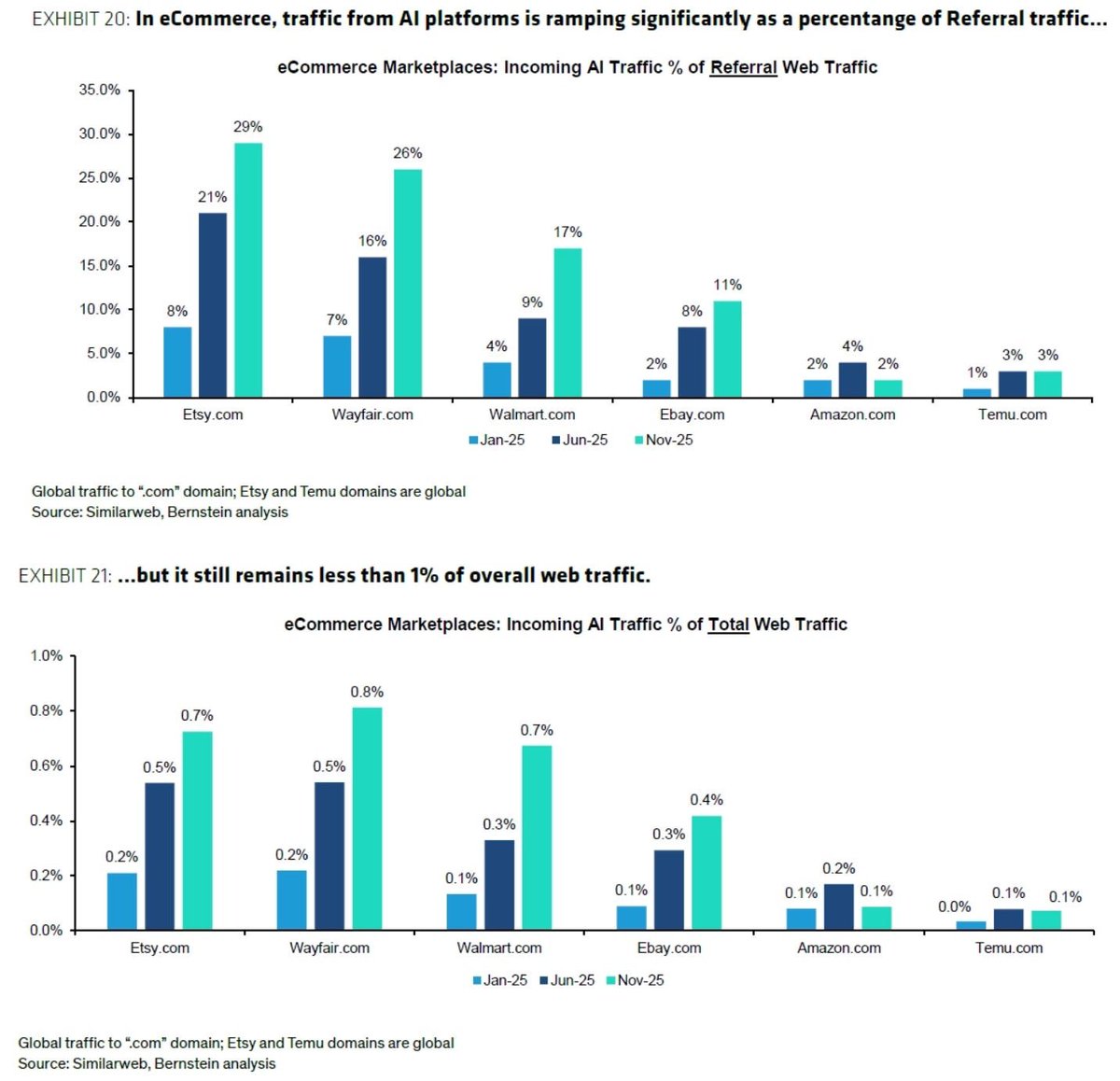
Agentic Commerce Update | 1Q2026 Recap - 3 most interesting developments in agentic commerce over the past few months… 1/ @ChatGPTapp scaling back from an end-to-end shopping destination and pivoting to a shopping entry point that routes transactions to specialized commerce apps (source: The Information). 2/ All commerce platforms embedding agents directly in their products ( $BKNG $EXPE $AMZN). The most interesting example to me may be AMZN’s “Buy for Me” - agent can complete purchases from other brands inside the Amazon Shopping app when Amazon itself does not carry the product. 3/ B2B commerce is seeing early agentic adoption on the sourcing side, where the workflow is highly research-intensive. --- Guiding principles - what likely holds regardless of how agentic commerce evolves 1/ AI is all about democratizing information and resources Commerce has historically been closer to a seller’s market. Consumers are largely shown what platforms choose to surface - through ads, rankings, and distribution channels. Each layer adds another “tax” in the form of marketing spend, platform fees, or payments. AI agents should gradually shift power toward the buyer. Instead of navigating layers of marketing and platform incentives, consumers can theoretically access the best product for their needs directly. This dynamic may be even more powerful in B2B commerce, which historically has been opaque, fragmented, and relationship-driven. 2/ Faster, cheaper, better rules Faster & cheaper: Price competition should intensify across retailers and even payment providers; Scale advantages may matter more, not less - AMZN’s logistics and fulfillment advantage still remains structurally difficult to replicate Better: more personalized and context-aware - agents matching products to a buyer’s specific needs, constraints, and preferences. 3/ Control of the top of the funnel matters (still) Today $AMZN generates roughly $80B+ (source: Visible Alpha consensus number) in ads revenue, largely because shopping intent starts on $AMZN. If discovery shifts upstream toward AI interfaces (e.g. ChatGPT or GOOGL’s Gemini), the economics of the top of the funnel could shift meaningfully. --- h/t Bernstein analysis: More analysis on each company in here: open.substack.com/pub/robonomics…
Freda Duan tweet media
English
7
6
63
8.1K
Altimeter Capital
Altimeter Capital@AltimeterCap·
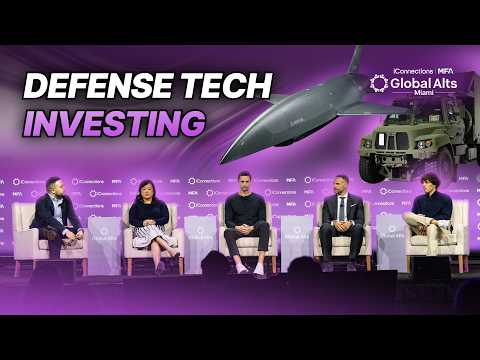
Altimeter partner Erik Kriessman (@ekriessmann) spoke on a panel at iConnections on investing in cutting-edge defense technologies — alongside investors and allocators from 137 Ventures, ICG Advisors, and the University of Utah. A few of Erik's key takeaways: 🎯 On talent and company formation: "Few companies will ever matter in any sector. I think that's even more true in defense. Talent's going to concentrate against a couple of opportunities that are actually worthwhile to go after." 🏗️ On what success looks like: Teams that understand customer requirements, can deliver on them, and can build trust with government partners — whether that means shaping requirements or meeting them. 🔩 On the industrial base landscape: Beyond the platform plays, Erik highlighted the importance of companies supplying irreplaceable inputs across the defense ecosystem — like @VulcanElements, which is onshoring rare earth magnets critical to every satellite, drone, submarine, and fighter jet. 🤝 On collaboration: The ecosystem is more collaborative than people expect. Companies like @anduriltech, @HadrianInc, @Castelion, and @K2SpaceCo work together to deliver full solutions — and the best founders understand that building the best product alone isn't how you win. You have to know how to sell. The discussion highlighted how the current wave of defense innovation has been building for well over a decade. Watch Building the Best Product Is Not How You Win in Defense... youtu.be/BLJcFOWlmGE?si…
YouTube video
YouTube
English
0
3
9
1.8K
Altimeter Capital أُعيد تغريده
Apoorv Agrawal
Apoorv Agrawal@apoorv03·
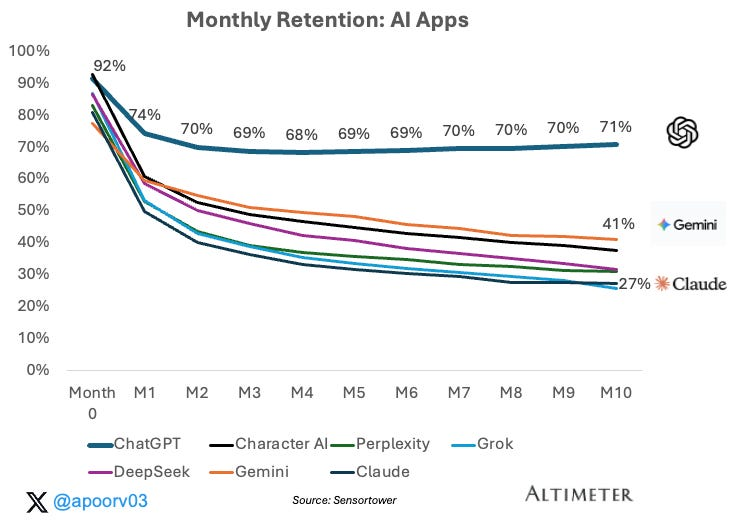
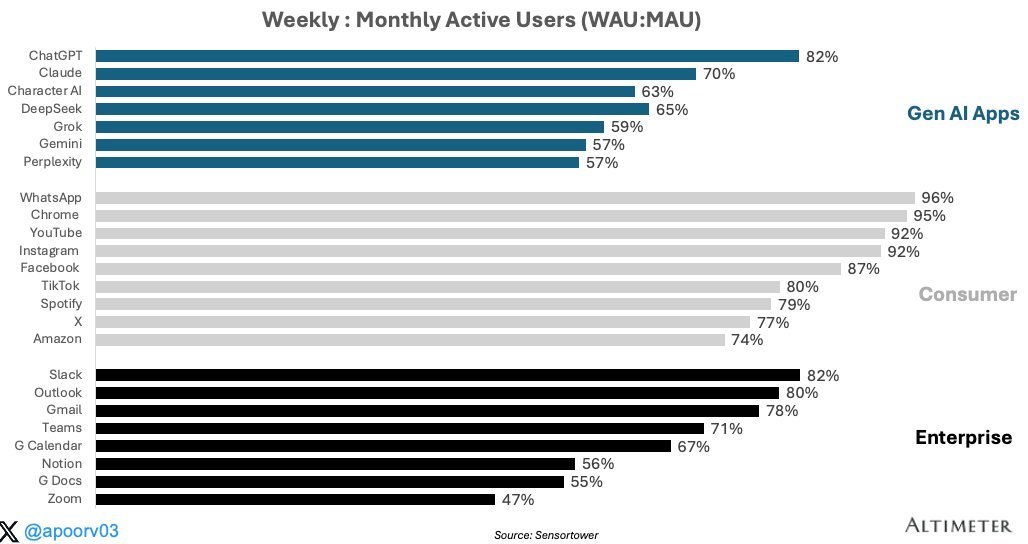
Consumer markets follow a power law: winner take most, if not winner take all. Google took 90%+ of search. Facebook took social. Apple took mobile profits. But user #s are not conclusive. Remember Clubhouse? It hit 10M downloads in its first month. Or BeReal? was #1 on the App Store. Neither built a habit. Usage makes headlines. Habits build franchises. In this Part 2, I dig deeper into how AI engagement and retention. Data suggests ChatGPT is not just the largest AI app. It is also the stickiest. x.com/apoorv03/statu…
Apoorv Agrawal tweet media
English
4
5
25
3K
Altimeter Capital أُعيد تغريده
Thomas Reiner
Thomas Reiner@treiner5·
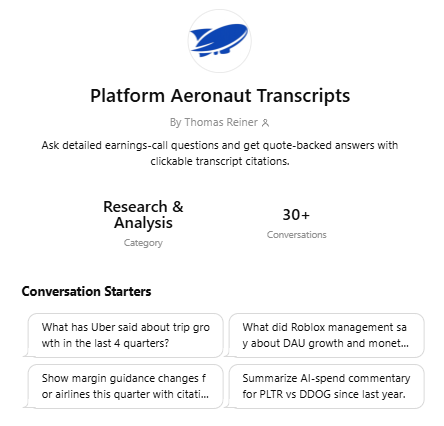
I built out an MCP server and linked it up to a CustomGPT that right now anybody can use to ask questions and query transcripts: chatgpt.com/g/g-69a7bf0d3c… If you get a bad response or it feels lacking reply below with a screenshot of it and I can tweak. It's a good learning method for how all this works on the back end. It's not an OpenAI app because it's super arduous to go through the approval process. But you should be able to pin it in your ChatGPT app to save to your sidebar. Also it's unlocked so anybody can share and utilize the link right now but if people start abusing it or it looks like it's costing me a ton on the MCP hosting side I'll probably switch it to oauth for free subscribers only.
Thomas Reiner tweet media
Thomas Reiner@treiner5

I've had a personal tool for awhile that summarizes earnings call transcripts and I decided to productize it into a website: transcripts.platformaeronaut.com It's been good training on data ingestion, coding, LLMs, and structuring data feeds and APIs. Most importantly I think it's actually useful. Let's take $UBER for example, I have auto-flowing and summarized transcripts as well as historical price data with overlays for stock performance after earnings events. Most interesting within each summary is the Q&A summary which helps digest and quickly get you the relevant details discussed: When you have a full data feed of transcripts and clean them up you can start doing cool analysis across quarters and companies. One example I've put in the statistics page is an analysis of how often an executive is evasive, partially answers, or directly answers Q&A: There's going to be 10x more analysis I can do so this is just the start. One entertaining bit is the inverse and look at which analysts on the street ask questions that most often result in evasive answers from management. Still some data clean up to do here but entertaining to start. 👀@baker_never_y For now I've gated the AI Summaries and Presentations to free subscribers to my substack. If you're already a subscriber just enter your email and you'll get a magic link to login where you can view everything and add a watchlist with email alerts for transcripts and summaries. If you're not a subscriber it's free, just sign up for platformaeronaut.com and you'll be enabled to login immediately via magic link. Part growth hack and part just wanting to get something out of the effort 🤷‍♂️ Tickers added with full AI summaries so far include $AAL $AAPL $ABNB $ADBE $ALGT $AMZN $APP $BKNG $CART $CRM $DAL $DASH $DLVHF $ETSY, $EXPE, $GOOG $GRAB $JBLU $LUV $LYFT $MDB $META $NOW $PINS $RBLX $RDDT $SHOP $SNOW $TOST $TRIP $TSLA $TWLO $U $UAL $UBER $ULCC $WDAY and there's a ton more I'm adding.

English
0
1
1
1.6K