For those interested in emergence and computation, I have a new homepage and substack under construction. I am also on 🦋 at the same handle. jessicaflack.wordpress.com c4computation.substack.com
Jessica Flack
11.6K posts

@C4COMPUTATION
Lambent Society Founder | Professor | Hourglass Emergence + Foundations of Computation | Flourishing | Kitchen Alchemist + Vegetarian | Privacy | @EMERGCOMP

For those interested in emergence and computation, I have a new homepage and substack under construction. I am also on 🦋 at the same handle. jessicaflack.wordpress.com c4computation.substack.com


Hello @substack Wondering if you can help. My initial Substack was hacked. I finally managed to delete it but it is still registering as in use. My new Substack might also be hacked as my security question protocol (which I in fact never set up) does not work and consequently I cannot log in although sometimes I can post notes as if I am logged in. . . It’s all rather odd behavior. Links to the old and new accounts are below. A hacker who edits these posts as I write them keeps indicating that my accounts are censored until “bit’. I have no idea what this means and censorship is illegal regardless, not to mention excruciatingly irritating. Could you PLEASE delete the old account and send a password reset note to the iCloud email associated with my new account? Thanks! OLD (SUPPOSEDLY DELETED) c4computation.substack.com NEW (WITH LOGIN WEIRDNESS) @jessicaflack" target="_blank" rel="nofollow noopener">substack.com/@jessicaflack


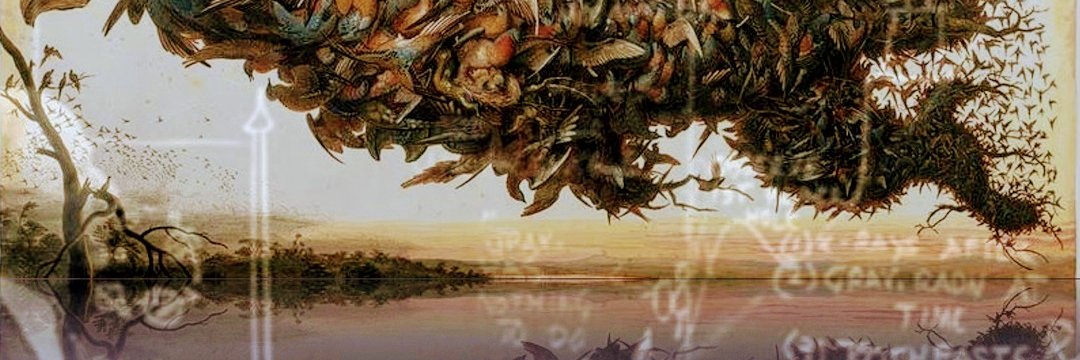
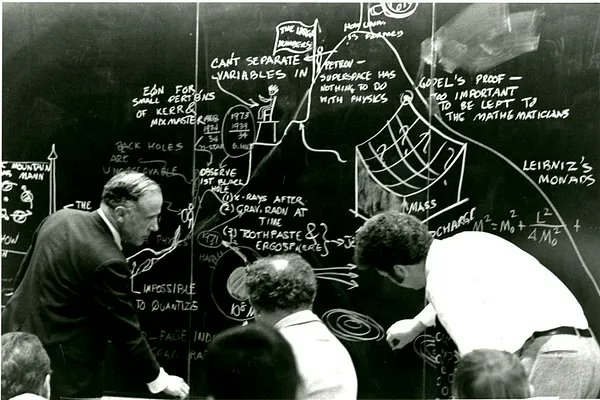
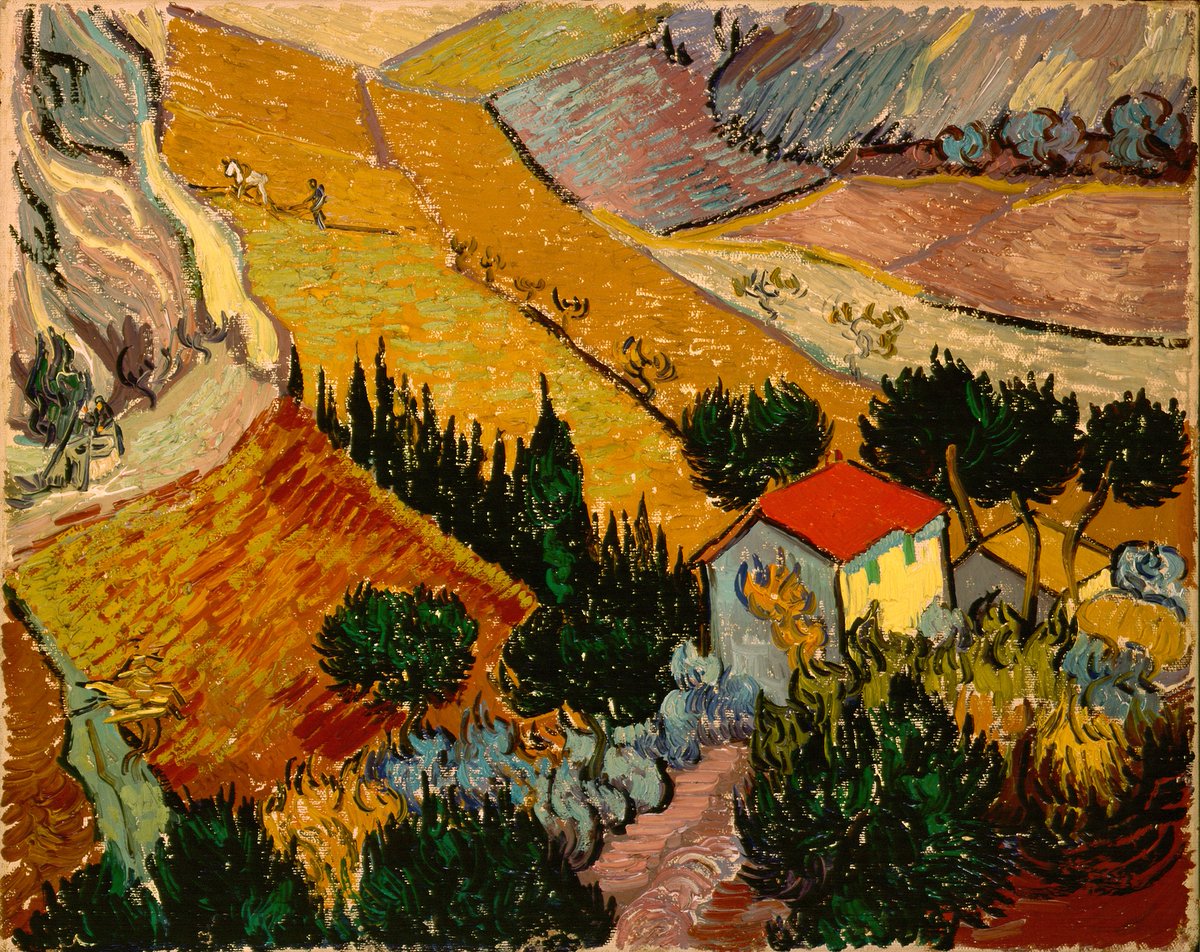
A potential renaissance is within our collective grasp. Several related but not yet widely known science advances are challenging old boundaries and revealing new sets of questions. These advances help inform our understanding of emergence, the evolution of the universe, and our place in it, and also have profound pragmatic implications for how we live the days and years of our lives. Almost as incredible as these innovations is the story of how across time and space they were discovered, suppressed, and came into view again—slowly consolidating into a coherent framework for understanding how the very small connects to the very large. There is no doubt these advances can contribute to human and whole earth flourishing. The complexity derived from the fact that our lives play out over many time and space scales—with change and uncertainty inevitable—might seem to undercut the possibility of flourishing, especially in the context of advances that stretch the limits of imagination. It is in fact the other way around. Uncertainty provides the opportunity to challenge and overcome perceived limits—and hence to flourish—as long as we recognize one constant. As the story of these discoveries suggests, trouble arises when we allow the erosion of individual and civil liberties, a ‘we “can just do things” mentality’ that undermines our collective memory of history, fail to hold to account those who exploit others, and stifle innovation while simultaneously failing to maintain an orienteering mindset as we explore the limits of the knowable universe. If we course-correct, the future is open with a new frontier and age of exploration before us. On Babel Blog, you will find posts on bits of the science that contributed to these advances, as well as gain a glimmer of the tragic, brutal, determined, creative, and heroic path that led to the present moment. jessicaflack.wordpress,com/blog Image: The physicist John Wheeler working at a Princeton blackboard but as if he were looking at Walton Ford’s painting, “Falling Bough”, a fantastic depiction of collective behavior. Composite image by JCF. Wheeler photograph by Kip Thorne.


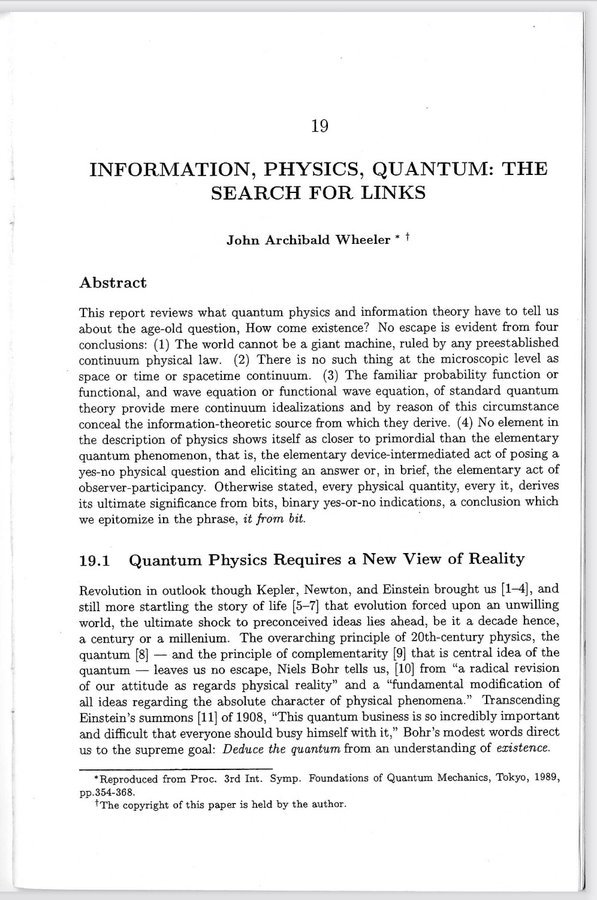
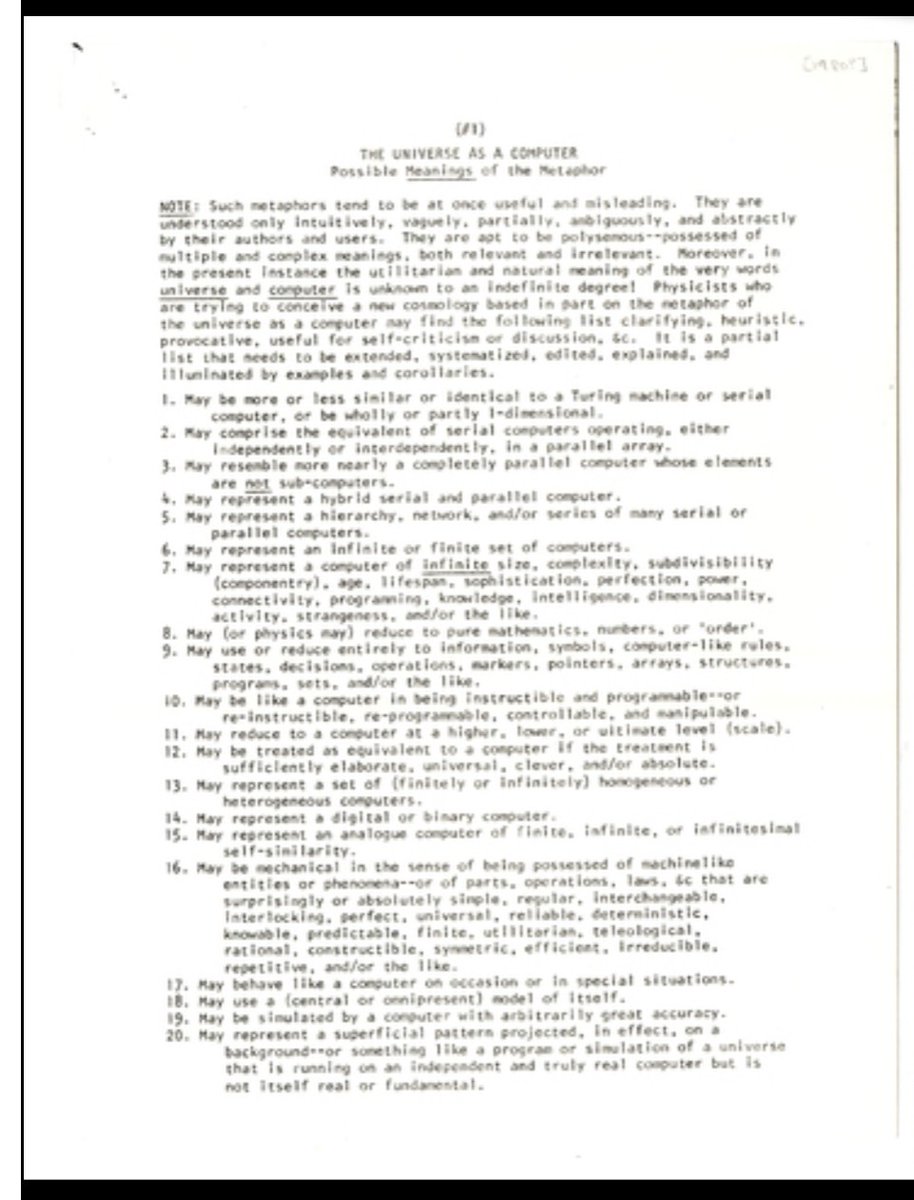
Wheeler's 48 definition-metaphors for computation + the universe as a computer. From a ~1980 note available in the Wheeler repository at APS—by way of my old twitter-friend Dave Bacon—and pasted below with my very brief annotations. diglib.amphilsoc.org/islandora/obje… Dave highlights #39 in his lovely blog post: dabacon.org/pontiff/2024/0… 39. No one knows how simple, powerful, universal, natural, and/or complex computers might ultimately become–and it might be in these ultimate senses that the universe is or resembles a ‘computer’. (It might even be possible to devise revolutionary types of computers by studying and applying computational or computer-like properties of the universe.) I find interesting Wheeler's juxtaposition of 8+9: 8. May (or physics may) reduce to pure mathematics, numbers, or ‘order’. 9. May use or reduce entirely to information, symbols, computer-like rules, states, decisions, operations, markers, pointers, arrays, structures, programs, sets, and/or the like. #21 is a pragmatically useful operational definition identifying basic elements without hoopla (In my work I operationalize the elements of computation similarly): 21. All natural phenomena, entities, and systems (be they trees, rocks, : molecules, bacteria, men, societies, rivers, stars, diseases, clouds, or whatever) may be computers or computer-like (have programs, perform computations, use circuitry, possess memory, use languages, process information, use Boolean logic, or the like). #23 seems at odds with a central message of the it from bit paper: no turtles. The It from bit is a later work piblished in 1990 and delivered as talks in 1989 @sfiscience + elsewhere. 23. All known laws may be controlled or created by higher laws (possibly arranged in a hierarchy or network). How to rethink #30 given growing consensus universe is lumpy? x.com/C4COMPUTATION/… 30. May be a lattice–or spacetime may be wholly quantized. #32—I hope not! 32. May essentially represent but a single, individual particle, event, or computer (that somehow generates the illusion of a multifarious world); or a single iterative or recursive operation repeating itself forever or toward a finite future destiny. #34—The 21st century science question!! 34. It may be possible to show that information and computation are fundamentally indistinguishable and hence equivalent, or that all of the following must in a similar way be equivalent: information, computation, energy, mass, space, time, and/or the like. Like #21, #40 is pragmatically useful. 40. May function in ways similar or identical to such computer or mental processes as generalization, recognition, categorization, error correction, time sequence retention, induction, symbolic logic, analogical reasoning, and/or the like. #45—The universe as chatty-cat micromanager! 😹 45. May represent a great hierarchical network of specialized ‘administrators’ or ‘administrative! processes, functions, systems, laws, constraints, &c. Also, may contain things analogous to questions, answers, experiments, orders, requests, negotiations, conversations, messages, traffic cops, supervisors, inspectors, translators, arbitrators, pioneers, &c. And #48—Lovely! 48. All that exists in the universe (including relationships, entities, interactions, laws, &c that are conventionally thought of as being inert, static, or time-invariant) may in fact be time-asymmetric or an uninterrupted process of change or of cosmoplastic or cosmopoietic interadjustments and interchanges; in this ‘everywhere~ always~novel universe! work and information- could be omnipresent and quintessential.


GAMES AND METAGAMES Old School 1. So and so is feeling a bit ill and will be out for the game tonight. 2. So and so will be ill thanks to the nano tech containing E. coli we added to his food delivery last night. New School 1. The above @NBA game is just one ’battle’ in a ‘Second Life Type’ game between very high stakes players betting on individuals over their careers or lifetimes. 2. The individuals—avatars—are ‘designed’ and purchased (without knowing a thing about this bio-cultural engineering) using gene editing tech. The players betting on them can buy ‘interventions’ that include choosing a family to raise an avatar, arranging debilitating ‘allergy‘ shots for the avatar in childhood, and manipulating college admissions, etc. . Sound fun?

posing for family portrait #sentimental #memory #snowleopard


Science is distributed around the world, across groups, departments, and institutes, sometimes in competition and sometimes in collaboration. This dynamic when founded on integrity, open-mindedness, excellence, creativity, and playful rigor fuels innovative solutions to challenges and advances understanding. There need not and should not be one trajectory forward. The future is open and there is room + need for many approaches. Embrace pluralism and have fun.


The physicist John Wheeler, inventor of the phrase, "it from bit" at a Princeton blackboard discussing what in nature can be quantized but as if he were looking at Walton Ford's, "Falling Bough," a fantastic depiction of collective behavior.


Neither recurrence nor back propagation or related algorithms have anything necessarily to do with ‘time looping.’ The scientific sense of ‘time looping’ doesn't result in optimization—or ’improvement’ of the status quo—in meaningful ways. It likely for the most part adds complexity and erodes canonical causality. One can’t in fact “just do things” sensu Mr. Altman—not only due to ethical issues but also because the effects are not as they appear on the surface. jessicaflack.wordpress.com/blog (censored) image: Ansel Adams