تغريدة مثبتة
ComprehensibleLatin
152 posts

ComprehensibleLatin
@ComprehensLatin
For the promotion of reading authentic Latin texts, primarily from the medieval and modern periods. Personal account of Aaron Decker.

Madison, WI انضم Haziran 2025
42 يتبع274 المتابعون

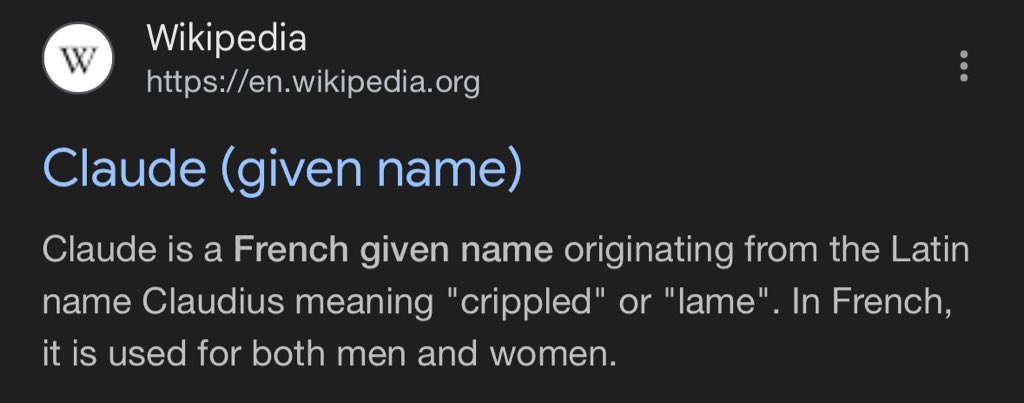
@owenbroadcast Crippled, just like Vulcan/Hephaestus.
Inherent in the usage of external supplementation is the introduction of (often unforeseen) trade-offs.
English

We need a name for this sort of thing.
I suggest 'eschato-judicial hyperbole', wherein normal words (like 'good man') are repurposed in an extreme way for rhetorical purposes.
The issue, of course, is that these statements are often taken (or asserted) non-hyperbolically and whole systems are built on them, with the consequence of overthrowing the field of ethics.
Arguably the OP is a juke and also a species of profanity.
English

@TW1NKD3STR0YER Looks pretty neat. As an enhancement you might want to make selection snap to word boundaries so that partial words don't wind up in the translation chunk.
English

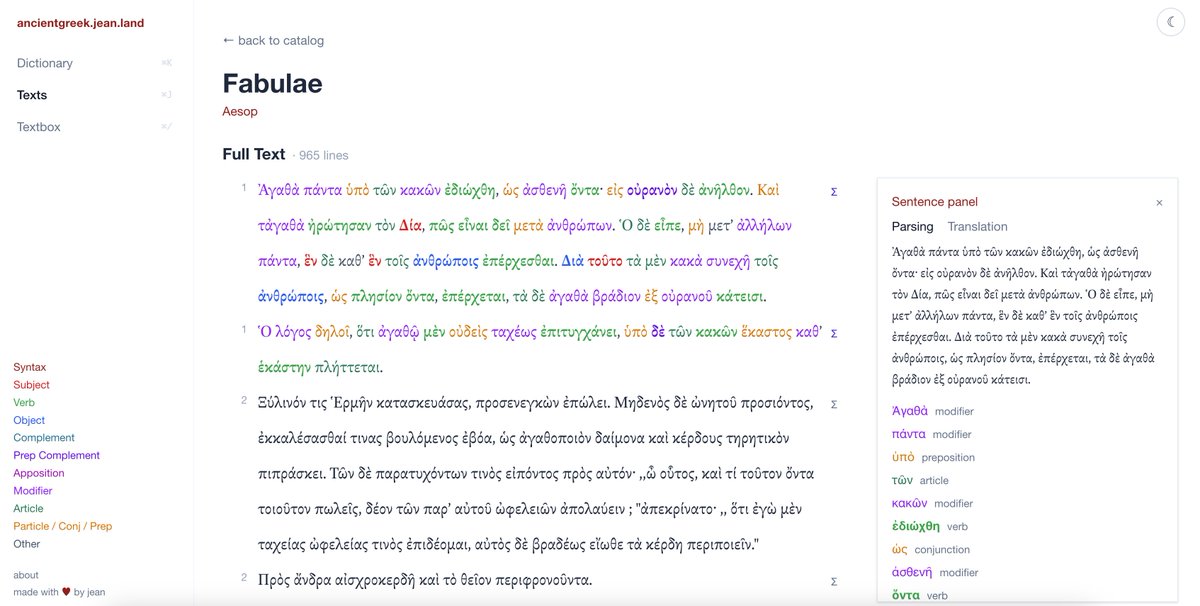
i made a website for learning ancient greek! it has a dictionary, a comprehensive corpus, and it integrates with all sorts of nice publicly available tools.
pls visit at ancientgreek.jean.land

English

@r_h_martins In seriē meā textuum intermediōrum, erit Bedae Venerābilis 'Explānātiō Apocalypsis', quī līber habet lēctiōnēs ex Vulgātā.
Latviešu

@ComprehensLatin Quaedam lectiones ex Vulgata etiam interessantes essent.
Català

@Nuskylicious @AT_Ancient I should also add: for the books in my intermediate text series, I have PDFs available for free on my site. So you could see what level of vocab is used before buying.
Ritchie's Fabulae Faciles is also available for free.
English

@ComprehensLatin @AT_Ancient Oh man, I’d love to see a concordance of the entire program, just to know what little they’re missing.
English

I might try to put together a master word list in the future. It would be in the thousands of words.
I think Familia Romana has several thousand unique words, the Navigatio has around 1,600 unique words, etc.
I have text files of all the texts (available on my Github), the main challenge is putting them all together for parsing, and then weeding out things that you wouldn't put in a vocab list, such as medieval variant spellings or poorly attested words. Also deciding on what lexeme a wordform is from can be a challenge -- it's a problem I have solved in the new program I wrote, but I don't have that data for the Navigatio or Historia Brittonum, as I wrote those using an older system.
English

@ComprehensLatin @AT_Ancient I just think it would be nice to see a complete list of vocabulary they would encounter along the way. I don’t know how possible that is, I’m just commenting on the magnitude of the project
English

The main homework assignment is to re-read the passage from Familia Rōmāna that we read during class, and then I also have them re-read a previous chapter from Familia Rōmāna. When they are done they have a parent initial their reading log, certifying that they did the reading.
For "re-reading" I tell them that they should understand the gist of the passage and about 90%+ of the words. If they are below that threshold, I have printable glossaries that they can use.
English

@ComprehensLatin What is a good homework assignment you give every class? I teach at a Homeschool ministry and it is only 50 minutes once a week. What is a good HW assignment you think?
English

The idea with the '10+' class is that we'll have a class called 'Latin Literature' that's open to sophomores, juniors, and seniors. It will rotate through texts in my intermediate text series so that students can continue Latin through all of high school.
ComprehensibleLatin@ComprehensLatin
The new textbook list for the Latin program I'm running: by the time students finish 10th grade, they will have read 100k+ words (over half a million, counting re-reading) and have read three complete medieval Latin works.
English

Some data on feasibility:
- Three 45-minute classes each week, 1.5 hours of homework each week.
- This year's 5th grade class is the first class to be entirely on this schedule; they have already completed through chapter 8 and we still have about eight weeks left in the year.
- My ninth grade class completed the Historia Brittōnum in just over a semester.
- Last year's ninth grade class completed the Nāvigātiō in two semesters.
- Total cost for all of the books is about $125.
- (The Gesta Francōrum hasn't been published yet but I'll probably have it out by the end of summer).
English

The caveats:
- please don't use these to make Familia Rōmāna into a 'look up every word in the dictionary drill'. If your students are having to look up more than, say, 25% of the words, then they should head back to an earlier chapter and re-read at a reasonable pace until they have a better control of the vocab.
- I generated these by hand with the help of a computer program I wrote. AI was not involved. If you find typos, please DM me and I'll get them fixed.
- the sheets are licensed under Creative Commons BY-NC-SA, so feel free to print, edit, and use them for personal or classroom use. However, you can't sell them.
- the first 25 chapters are up right now. I'll be filling in the remaining chapters as we reach those in my 8th grade Latin course.
English

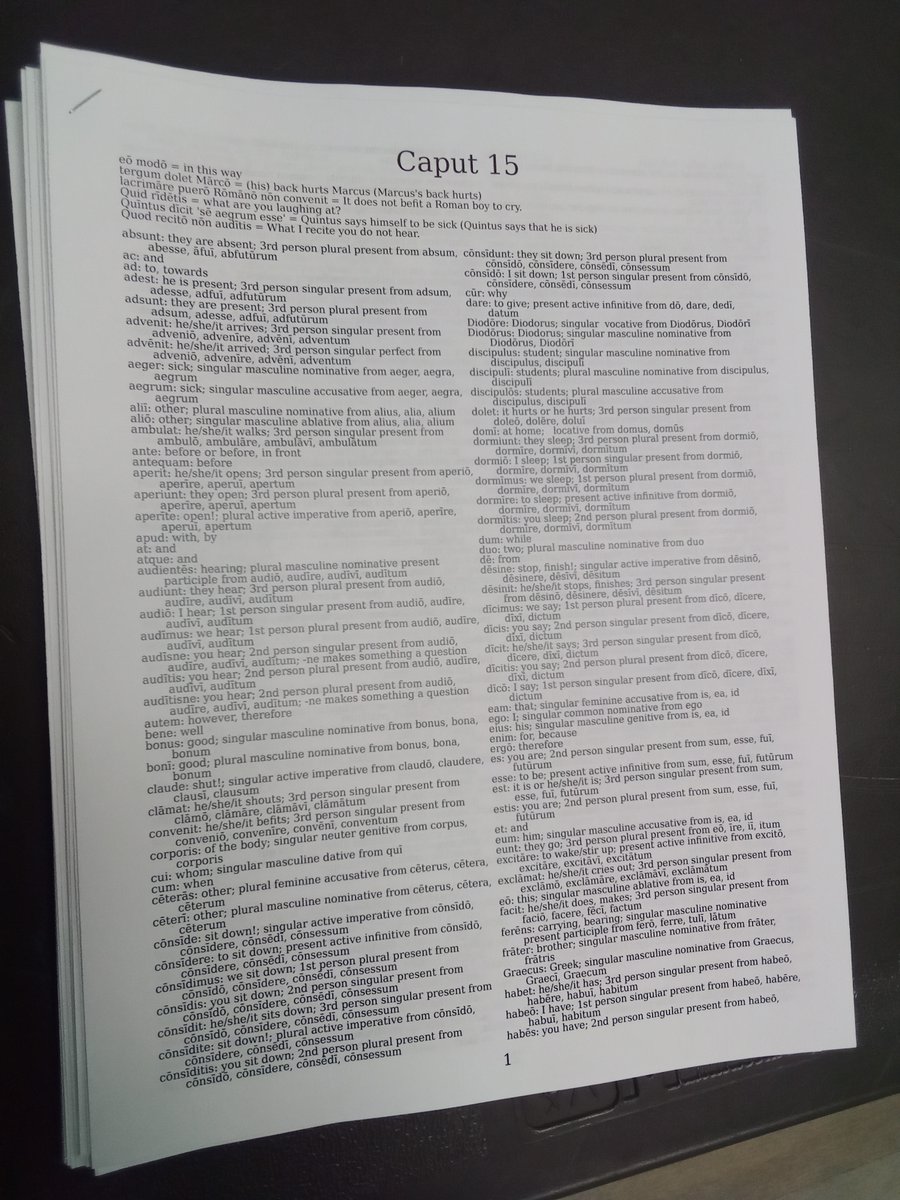
New resource: printable chapter-by-chapter glossaries for Familia Rōmāna.
My students have found these to be helpful while doing re-reading of Familia Rōmāna chapters at home, for the occasions where they might be unsure of a word's meaning.
Available for free at comprehensiblelatin.com/resources.html

English

@richardrohlin 's new podcast is a lot of fun.
This episode mentioned the Voyage of St. Brendan, which my 9th grade Latin class is reading through right now. (For those interested in a reader's edition of that work, a free PDF is available on my site).
youtube.com/watch?v=XoHRxl…

YouTube
English

@StarkConor The "What to do after Familia Romana" gap is what I've been aiming to fill with my intermediate text series. (PDFs available for free at comprehensiblelatin.com )
English

A fun thought for future Latin pedagogy:
It would be a lot of fun, and useful I think, to write a sequel to LLPSI filling the large gap between ch. 35 of that book and ch. 1 of Roma Aeterna.
Some plotlines to develop:
-What happens to Aemilia’s and Iulius’s new baby?
-Does Marcus have a redemption arc? Melior erit puer an non?
-What happens to Medus and Lydia in Graecia?
-Can we hear more about Aemilius in Germania?
Such a book might include further practice with the sequence of times, vocabulary pertaining to res quotidianas (useful for immersion classes), quin-clauses, etc.
What do you think?
English

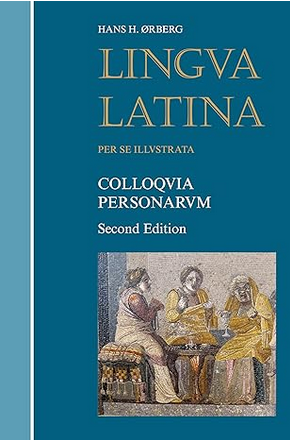
@StarkConor Colloquia Personārum provides some backstory and maps onto chapters 1-25 difficulty-wise. My students (5-10th grade) have found it enjoyable.

English

@miltonappl3 Jigoro Kano did this with Judo. Felt that his throwing techniques were an avenue towards spiritual development.
English

@JgerthJgerth5 @F_Lactantius @ComprehensLatin Well, there is some pretty cool stuff in the works, not gonna lie 😎
2026 will have some fun announcements!
English

Familia Rōmāna is really good, but it suffers from a couple of drawbacks:
- a significant amount of re-reading is required to learn the words, which can become boring.
- the story itself is sometimes slow-paced (e.g. ch. 12 where the whole chapter is Julius telling Marcus about Roman military equipment)
- characterization is generally good (e.g. you could see how Iulius would have been like Marcus when he was younger) and some of the story arcs are fun (like Medus & Lydia) but, overall, the book doesn't really go anywhere. It's a BIG improvement over random, context-less sentences (or, even worse, charts of word endings), but it's not up to the level of being a story that one would read on its own if it were in English.
Some of these are largely imposed by the format:
- the book can only be so big, as to not be unwieldy.
- the book aims to cover all of the main grammar forms, which drives the plot in places (e.g. Syra having bad hearing so that we can see indirect quotations be used). This imposition can be seen by contrasting Familia Rōmāna with its companion book, Colloquia Persōnārum, which feels faster-paced because each story is story-driven and doesn't aim for needing to 'cover everything'.
@colingorrie 's Old English reader Osweald Bera improves upon Familia Rōmāna in that the story is much more compelling, to the point where I wanted to read the next chapter just to find out what happens to the characters.
So what do we do for Latin? My most feasible proposal is that we need a few novels, around 5,000-20,000 words in length, written at about a Familia-Romana-chapter-15 level of difficulty, where the plot moves quickly. Stories that should exist on their own merits, but are written in simple enough form to be read at a reasonable pace by learners.
English

@HarriusHaller I have Roma Aeterna but have never gotten around to finishing it since some of the authentic medieval texts I wanted to read were less difficult.
English

@ComprehensLatin There is a huge gap in difficulty between Familia Romana and Roma aeterna.
I suggest these books to bridge it (plus all Orberg's companion books).
Also, I would go through the syntax chapters in any good grammar book.
Then one will be ready to tackle real Latin authors.

English