
Donavon Noggle أُعيد تغريده
Donavon Noggle
39.8K posts


Donavon Noggle
@DNoggle719op7
Souls like Vines with God inherit life and love with sweet buds of Earth so fair have gone to heaven to Blossom there. ⚔️GarryOwen!⚔️
انضم Mayıs 2023
2K يتبع1.3K المتابعون
Donavon Noggle أُعيد تغريده
More than two years ago, my PSI staff discovered and made public emails in which Dr. David Morens bragged to colleagues about his efforts to avoid transparency by destroying federal records and using his personal email to communicate on “sensitive issues.”
Today, @OIGatHHS announced that Dr. Morens has been arrested and charged with conspiracy and destruction of federal records. I applaud OIG’s new leadership for taking this much needed step forward to hold Dr. Morens accountable.
English
Donavon Noggle أُعيد تغريده

Anonymity. Faith. Controversy.
@DefiyantlyFree joins to unpack anti-Semitism on the right, Candace Owens, and what’s really going on beneath the surface.
Subscribe via the link in my bio!
English
Donavon Noggle أُعيد تغريده

Wisconsin's Bryan Steil racks up a wide money advantage over Democrats jsonline.com/story/news/pol… via @RicoReporting
English

Why use a Catholic church when she had an Anglican church in Rome?
This pretense of unity is scandalous
Michael Haynes 🇻🇦@MLJHaynes
Video clip of Sarah Mullally leading Anglican Evensong in Rome’s Catholic church of Sant’Ignazio on Monday. She commissioned her representative in Rome during the ceremony, rather than using the Anglican church in the city. 🎥@ArchbishopSarah
English
@ProtecttheFaith Then you call on the name of your god, and I will call on the name of the Lord The god who answers by fire he is God.
One fire is traditional society value. The other is modern societies interpretation into society values
Then, now, and forever is the same as past present future
Janesville, WI 🇺🇸 English
Donavon Noggle أُعيد تغريده

Well done, Milky Way Farm of South Carolina. Well done. 👏👏👏
“He covers the heavens with clouds; He prepares rain for the earth; He makes grass grow on the hills.”
-Psalm 147:8

English
Donavon Noggle أُعيد تغريده

There’s a reason this hymn stills the room. Its power lies in the fact that it wasn’t born of comfort, but of unimaginable grief.
In 1873, after losing his young son and his fortune, Horatio Spafford sent his wife and four daughters ahead to Europe. Their ship sank, and only his wife survived.
As Horatio later sailed to reach her, the captain paused the vessel over the spot where his daughters were lost. It was there, amid the waves of his own heartbreak, that he penned the words: “It is well with my soul.”
This timeless declaration of faith is brought to life here by the Zero 8 Chorus. It reminds us that peace isn’t the absence of pain, but a strength that carries us through it.
English
Donavon Noggle أُعيد تغريده

FLASHBACK: Navy SEAL Team Six operator Matt Bissonnette exposed the truth that Obama personally delayed the bin Laden mission by 24 hours purely so he could attend the 2011 White House Correspondents’ Dinner.
The operation was locked in for a moonless night with perfect weather and air density. At Obama’s direction, it was pushed back one day. Temperatures spiked, lift dropped, and one of the stealth Black Hawks crashed inside the compound, exactly the risk the original timeline had been engineered to avoid.
Bissonnette put it bluntly, Because Obama needed to hit the White House Correspondents’ Dinner.
The team already had razor-thin prep time after receiving the tip. That vanity-driven delay forced them to fly in suboptimal conditions, all so Obama could deliver cheap shots at Trump and play Lion King clips while operators risked everything.
Mission success came despite the politics, not because of them.
Bissonnette’s account lays bare the cost of putting Washington optics above warrior safety.
English

No dumb bitches were hurt in the making of this video. Nah, they were hurt really bad 😂
English
Donavon Noggle أُعيد تغريده

The Catholic Church is not the church of the Bible.
English
Donavon Noggle أُعيد تغريده

Donavon Noggle أُعيد تغريده
I was a Navy SEAL, then did corporate Leadership, then ran a small cafe in Northern Wisconsin, went to law school for a year, then decided to run for congress.
I have never lied or been ashamed of any of these things because they are part of who I am.
@RebeccaforWI is ashamed of her past because she knows people in #WI03 hate the political machine she has been part of her whole life and freely lies about it because she wants power.
Wisconsin Right Now@wisconsin_now
Reminder: Rebecca Cooke scrubbed her website, which mentioned that she helped run Kirk Bangstad’s campaign, but we recovered the deleted website via the Wayback Machine. She’s tried to reposition herself as a waitress with a broken down car, not a left-wing political operative.
English

Where this in the Bible?
Anthony@Catholicizm1
The thief on the cross was saved by the prayers of Mary. Everyone knows this.
English

The thief on the cross was saved by the prayers of Mary. Everyone knows this.
James Bond@VERVELOVE
@Catholicizm1 How about the man on the cross?????????? What great work did he do? I'll wait.
English
@sola_chad From the mouth of Jesus to the thiefs ears.
Janesville, WI 🇺🇸 English

🙄 Nothing like reposting a poorly constructed & (laughably) plagiarized AI penned article posted on Facebook to make yourself look pseudo-intelligent. The ridiculous term “career ended” is a finality statement and obviously untrue given where we are now.
m.facebook.com/story.php?stor…
Elena 🇺🇸@LanieASassyVet
In 1969, William Shatner’s career ended on national television. Not metaphorically. Not slowly. It stopped abruptly, with a network decision and a canceled time slot. NBC canceled Star Trek after three seasons of modest ratings. Executives who had never fully understood the show—and who had nearly ended it earlier before a fan campaign saved it, finally pulled the plug. The Enterprise’s mission ended early. And William Shatner, who had played Captain James T. Kirk with intensity and unforgettable pauses, suddenly had no role left. He was thirty-eight. Divorced. Financially struggling. And facing an industry that had little interest in an actor tied to a canceled sci-fi show many dismissed as a fad. Shatner found himself living out of a camper, traveling between small theater jobs that paid minimal wages. The man who once commanded a starship was now performing in regional productions, hoping audiences would show up. This was not the plan. Most actors would have left the industry and found stability elsewhere. Shatner didn’t. He doubled down. In the early 1970s, something unusual began. Fans of Star Trek started gathering - small conventions in hotel ballrooms, dismissed by mainstream culture as niche and strange. The industry mocked them. “Trekkies,” they were called. Most actors avoided these events. Shatner didn’t. He met fans. Signed autographs. Answered questions. Showed up when others wouldn’t. Because while others saw failure, he saw something different. Star Trek wasn’t gone. It was evolving. The show thrived in syndication. Viewers rewatched episodes, shared recordings, built communities, and kept the story alive. The audience was growing. By the mid-1970s, Star Trek had become something larger than television - a cultural force driven by its fans. And Shatner, who stayed connected, became its living symbol. Hollywood had overlooked it. The audience had not. In 1979, Paramount Pictures revived Star Trek as a feature film. Shatner returned and not as a fading actor, but as someone the audience had kept alive. The film succeeded because the fans showed up. They had waited. They had believed. And so did he. Years later, Shatner admitted something revealing: At first, he didn’t understand the fans. “I thought they were obsessed,” he said. Then he realized that they were sustaining him. They kept the character alive. The story alive. His career alive. They weren’t obsessed. They were committed. Shatner learned from them. He learned respect for audience passion. He learned reinvention. He adapted. He starred in T.J. Hooker. He took on new roles. He embraced self-awareness. He appeared in commercials that leaned into his persona, recorded music, and kept working. Then came Boston Legal. At seventy-three, he played Denny Crane, a role that blended humor and vulnerability, and won two Primetime Emmy Awards. The same style once mocked was now celebrated. He had never stopped evolving. And then - something unexpected. At ninety, Shatner went to space. On October 13, 2021, he flew aboard Blue Origin’s New Shepard rocket. The actor who once imagined space travel finally experienced it. He returned visibly moved, reflecting on Earth’s fragility, beauty, and significance. It completed a journey few could imagine. From struggling actor to cultural icon. From canceled show to lasting legacy. From fiction to reality. William Shatner didn’t just play Captain Kirk. He embodied the idea: exploration, persistence, and reinvention. He entered spaces others avoided - fan conventions, unconventional roles, unfamiliar paths, and turned them into opportunities. He proved that failure isn’t permanent, that audiences matter, and that reinvention is always possible. The fans once dismissed as outsiders were right. The story mattered. The vision mattered. And William Shatner learned to see it.They didn’t just preserve nostalgia. They preserved possibility. They kept something alive... and in doing so, they kept him alive too. That’s the story. Not just success - but understanding. Not just survival - but transformation. William Shatner played Captain Kirk for only three seasons. But he spent decades living the message: Keep moving forward. Keep adapting. Keep exploring. The mission continues.
English
@davidaxelrod @jimmykimmel Let him do it in private clubs for free speech tickets it has no place on the national stage. It's not entertainment ahead of a tragic attack on lives encouraging it.
Janesville, WI 🇺🇸 English

I like @jimmykimmel. He's funny & courageous at a time when there has been too much cowardice.
That said, this WAS a tasteless joke.
The WH will use any issue to demand he be fired because his satire touches a nerve, and ABC is right to resist.
But he'd be right to apologize.
Yashar Ali 🐘@yashar
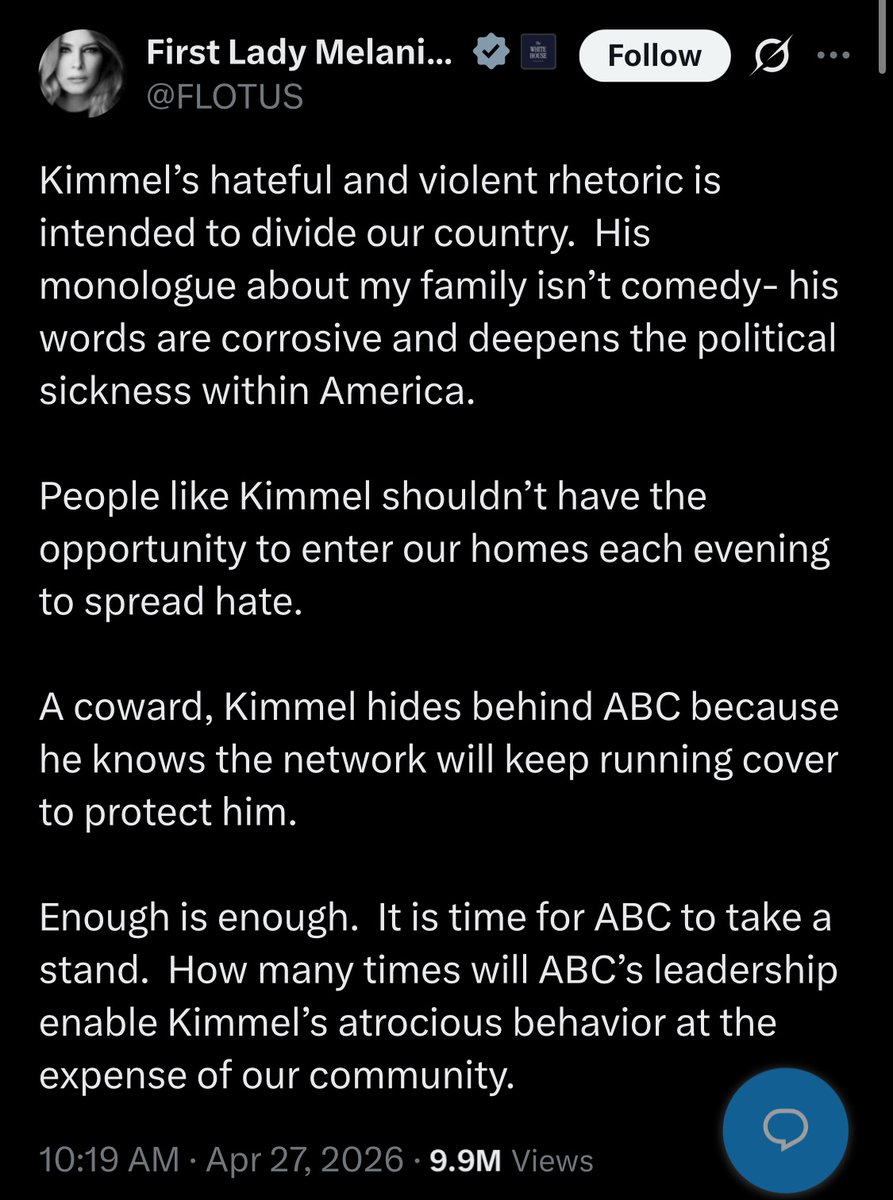
First Lady Melania Trump has issued a statement demanding that ABC fire Jimmy Kimmel.
English

Dear @Flotus
STFU
This country has been divided with violent rhetoric by your evil, insane husband
This is Donald Trump's America. If you find its tone of discourse unsatisfactory, fix it, take it up with the mindless creature you have enabled - or just leave
Signed,
America
English

I feel like I’m losing my mind. This can’t be real. Is this real? Is it a movie? A dream?
They’re all just obsessed… with straight faces.. about… a fucking ballroom?
Acyn@Acyn
Lindsey Graham says they are going introduce legislation that’s going to authorize 400 million dollars to be spent on building the ballroom: We pay for it by offsetting it with customs fees. The sooner we get the ballroom built, the better it is for the country.
English