
تغريدة مثبتة
Jairo
42.3K posts


@BlueFox__94 @Cldddy @swamthetiber25 Okay so real quick before we move on, you disagree with my assessment of 1 Corinthians 11?
English

@JairoRod01_ @Cldddy @swamthetiber25 Paul wasn’t commenting on the Real Presence, but on Corinthians consuming the Eucharist unworthily, i.e., with unconfessed mortal sins.
English

As a Protestant I asked why this passage was taken literally and not “I am the door”, the usual evangelical retort. I wished someone would have answered me like this:
After multiplying loaves for the crowd, Jesus makes a shocking claim: “The bread that I will give is my flesh (sarx) for the life of the world.” (John 6:51)
The Greek word sarx, meaning literal, physical flesh, is rarely, if ever, used metaphorically in Scripture. Even many Protestant scholars acknowledge that this language is unusually graphic and difficult to read symbolically. The crowd is immediately disturbed: “How can this man give us his flesh to eat?” (John 6:52)
If they had misunderstood Him, this was the moment to explain. Jesus often corrected misunderstandings, like when Nicodemus thought being “born again” meant re-entering the womb (John 3), or when the disciples thought He spoke of literal bread in Matthew 16. But here, Jesus does the opposite. He repeats and intensifies the teaching.
“Truly, truly, I say to you, unless you eat the flesh of the Son of Man and drink His blood, you have no life in you.” (John 6:53)
In fact, He repeats this teaching six times in just ten verses, each time making it more explicit and direct. This repetition signals the importance of His words and indicates that He intends them to be understood literally rather than metaphorically. The Greek word for “eat” shifts to trogein, which means “gnaw” or “chew,” a term that implies a physical, bodily act. This Greek term is used nowhere else in Scripture metaphorically, further emphasizing the literal nature of His command.
For a Jewish audience, consuming flesh and blood would have been scandalous, which underscores the radical nature of Jesus’ teaching. Remarkably, this is the first instance recorded in Scripture where a crowd walks away because of a teaching, highlighting the difficulty and gravity of His words.
The result? Many of His disciples are scandalized: “This is a hard saying; who can listen to it?” (John 6:60)
“Many of His disciples turned back and no longer walked with Him.” (John 6:66)
Rather than back down, Jesus lets them leave. If He had merely meant a symbol, He had every opportunity to explain it away or soften His language. But He doesn’t. Instead, He turns to the Twelve and asks: “Do you also want to leave?” (John 6:67)
Peter’s response is telling: “Lord, to whom shall we go? You have the words of eternal life.” (John 6:68)
Peter affirms the reality of Jesus’ words. The disciples understood exactly what Jesus was saying: He wasn’t offering a symbol of His body and blood; He was offering His actual body and blood, and they were ready to receive it.

English
@grok @BlueFox__94 @rondon216 @Cldddy @swamthetiber25 These writings sound a lot like what my Pastor says when he prays over the lords supper. I can see how a casual could walk by and misunderstand him as saying the bread and wine are actually flesh and blood.😬😬
English

Anamnesis (Greek: ἀνάμνησις) means "remembrance" or "recollection." In the Eucharist (Luke 22:19; 1 Cor 11:24-25), it is the liturgical memorial where the Church makes Christ's Paschal Mystery—His passion, death, resurrection, and ascension—present and effective now, not merely a mental recall but a re-presentation of His once-for-all sacrifice (CCC 1362-1366).
Church Fathers echo this in early liturgies and writings. St. Justin Martyr (c. 150 AD) calls the Eucharist the "food which has been made into the Eucharist by the Eucharistic prayer... the flesh and blood of that incarnated Jesus," offered as thanksgiving (1 Apology 66). The Apostolic Tradition of Hippolytus (c. 215 AD) includes an anamnesis: "We offer to you the bread and the cup... remembering His death and resurrection." St. Irenaeus (c. 180 AD) describes it as the "new sacrifice of the new covenant" where creation becomes Christ's Body and Blood (Against Heresies 4:17-18).
Română
You didnt answer the question. WHEN the Jews at the Passover lamb. Were they actually bringing forth the same sacrifice as in the past and sacrificing the lamb so the Angel of death would Passover them? Or were they doing it symbolically to try to grasp as best as they could the original event?
English

@JairoRod01_ @BlueFox__94 @Cldddy @swamthetiber25 @grok You might note Jews haven't had a lamb at Passover since 70 AD. The eating of the Passover Lamb occurs at Catholic and Orthodox liturgies.
English
Jairo أُعيد تغريده
No, Jewish Passover (Pesach) is observed annually as a memorial and retelling of the original Exodus event in Egypt, per Exodus 12-13 and Deuteronomy 16. The Seder meal recalls how God spared the Israelites that one night via the lamb's blood. It's not a repeated "real sacrifice" to newly avert the angel of death— that was a singular historical act. Without the Temple, no actual lamb is sacrificed today; the shank bone on the plate is symbolic.
English
@rondon216 @BlueFox__94 @Cldddy @swamthetiber25 Hey @grok do Jews eat the Passover meal every year as a real sacrifice so the Angel of death will Passover their household?
English
The Jews didn't just remember that first Passover, it was brought forward and made present. And they ate a real Passover lamb, not a symbol, as they were instructed by God to do so. Full participants in the Passover sacrifice. Yet, the fulfillment of the Passover Lamb, Jesus Christ, it's only symbolic?
English
“It was brought forward and made present” in a real sense? Like they were actually sacrificing the lamb for the angel of death to Passover their household? Or more in a symbolic sense. Like remembering it vividly so as to understand as much as they could the weight of what happened in Egypt.
English
Again I also eat the lords supper, you and me both eat the lords supper. Our differences lies in whether or not the Lords Supper is truly the body and blood of Christ and whether it’s the real sacrifice on the cross done for forgiveness of sins. So to better apply the question you asked me let me ask you
“Do the Jews eat the Passover meal every year so that the Angel of death passes over them? Or do they take it in remembrance of the original event?”
English
@JairoRod01_ @BlueFox__94 @Cldddy @swamthetiber25 Did God instruct the Jews to eat a symbol of a Passover lamb?
English
First Paul defines what the unworthy manner was, just a couple verses prior correct? Let me know where I’m wrong.
1. Paul says the Corinthians are eating and drinking for their own personal gain. Getting drunk and feasting while some stay hungry. He does NOT define it as rejecting a true presence.
2. One does not have to desecrate the very thing itself in order to desecrate the very thing itself. For example, if we’re having a part in honor of the memory of your bday. And I show up and desecrate the part in honor of your bday, and you say “you ruined my bday” did I truly ruin the day you were born? OR did I ruin the event that was being held in honor of your bday.
3. Discern means to recognize. (Re) (cognize) to bring forth in one’s mind. The Corinthians were not recognizing Jesus sacrifice during the lords supper but were rather eating and drinking to get their fill.

English
@JairoRod01_ @Cldddy @swamthetiber25 So close, brother.
How do you take Paul in 1 Corinthians 11:27, then?
English
@RickWMiller1 @swamthetiber25 So far I’ve addressed
“why didn’t Jesus call back his disciples when thy left”
“Why does Paul say we sin against the flesh and blood of Jesus in 1st Corinthians”
“How can we take the Lords Supper in an unworth manner if it’s only figurative”
English

@JairoRod01_ @swamthetiber25 You are arguing with yourself and never really engaging the arguments.
English
@RickWMiller1 @swamthetiber25 Don’t you think you’re right? Doesn’t the amount of times you’ve had this debate make you confident in your position?
English
You aren’t as good as you think you are. Kinda arrogant and cocky. But what you have really done is reveal an unwillingness to deal with the arguments presented, so when you say, “I’ve heard it all before,” what you are actually saying and visible to all reading this is, “I’ve decided I’m right before the argument starts.”
English
I don’t think you understand where you and me disagree. I also eat the lords supper. I also do it with high reverence and respect. I take the lords super very serious. As Paul says were to bring forth in our consciousness the sacrifice Jesus made for us. It should be very real to us. But is it actually Jesus body and blood? Am I taking it for forgiveness of sins? No. I’m just taking it with the highest reverence.
English
@JairoRod01_ @Cldddy @swamthetiber25 And guess what the Jews did with the sacrificed Passover Lamb?: They ate it!
English
English
@JairoRod01_ @RickWMiller1 @swamthetiber25 Then quote yourself with links to said past engagements of yours.
English
I’m literally replying to your arguments in real time dude. You and me are literally debating these points rn in other threads. I’m just stating that they aren’t conclusive and I’ve got responses to them as you can see in real time as I respond to your arguments in the other threads
English
@JairoRod01_ @swamthetiber25 If your answers are so strong, they should survive being stated out loud. Saying “I’ve got it handled elsewhere” just tells everyone you don’t want to handle it here.
English
I disagree, I see it as completely plausible that Jesus starts out by telling them the Gospel through figurative language, and the crowd reject Jesus divinity, afterwards Jesus continues teaching with figurative language the same message but NOW the crowd is more hostile and want to misunderstand Jesus. Why? Because of Jesus claim to divinity. You claim canabolism is a big sin, but the greatest sin and the main alegation towards Jesus during his trial was his claim to divinity. This seperates Jesus and the crowd. As well as lots of his disciples, but not the 12. This makes more sense to me
English
You’re collapsing two different sections
In Gospel of John 6:
•v. 29–40 → believe
•v. 51–58 → eat my flesh / drink my blood
Jesus moves forward, He doesn’t redefine backward.
If “eat = believe,” then the second half adds nothing. That’s not how Jesus teaches.
2) The crowd’s reaction changesmbecause the claim changes
They grumble earlier about Him coming from heaven (v. 41).
But they’re shocked later at:
👉 “How can this man give us his flesh to eat?” (v. 52)
Different reaction → different teaching.
3) Jesus intensifies, not clarifies
Instead of saying “I meant believe,” He doubles down:
👉 “eat… drink… unless you do, no life”
That destroys your “He already explained it” claim.
4) This isn’t a parable filter moment
When Jesus uses figurative language with crowds, He explains it to the disciples later.
Here:
👉 disciples struggle (v. 60)
👉 many leave (v. 66)
👉 no symbolic clarification—only “Do you also want to go?”
That’s not hidden metaphor. That’s a hard teaching
If your reading is right, Jesus teaches plainly, then switches to language that drives people away, and never fixes it.
English
@RickWMiller1 @swamthetiber25 I’ve engaged them elsewhere in the threads I’m just saying I’ve heard it all before, and I have an answer for all of them, if this is as good as it gets it’s not conclusive evidence
English
That’s not an argument, it’s dismissal.
1) You didn’t engage the evidence
I gave:
👉 Gospel of John 6 (eat my flesh, no correction)
👉 First Epistle to the Corinthians 10–11 (real participation; guilt of the body and blood)
You didn’t answer any of it, you just called it “not conclusive.”
2) The historical record is one-sided
Earliest Christians all affirm the real presence:
•Ignatius of Antioch: Eucharist = flesh of Christ
•Justin Martyr: not ordinary bread and drink
•Irenaeus of Lyons: truly His body and blood
That’s not “weak proof.” That’s unanimity from the start.
3) Your position has zero early support
Show one early Christian saying:
👉 “It’s just symbolic”
You can’t, because that view shows up much later with Protestants. You erase 1500 years of Christianity. Kinda like the Mormons in some ways.
“Not conclusive” is what you say when you won’t deal with the data.
Scripture + earliest Christians point one way.
Your view shows up centuries later.
English
Jairo أُعيد تغريده

Jairo أُعيد تغريده


Yes correct. Jesus literally explains his words just verses prior. They say what must we do and he tells them straight up believe in the one God sent. They are in disbelief and reject Jesus came down from heaven, is it a surprise that Jesus only confused them more? I see this to fall inline perfectly with how he chose to speak to crowds.
English
You just replaced Jesus’ words with your interpretation.
1) Jesus already says “believe”—then adds “eat”
In Gospel of John 6, He moves from belief → eating.
If “eat = believe,” He’s repeating Himself. He’s not.
2) Paul says it’s real participation
First Epistle to the Corinthians 11:27
👉 guilty of the body and blood
You don’t incur that level of guilt over a metaphor for faith.
Faith is required, but Jesus still commands eating.
If “eat” just means “believe,” His command becomes pointless.
English
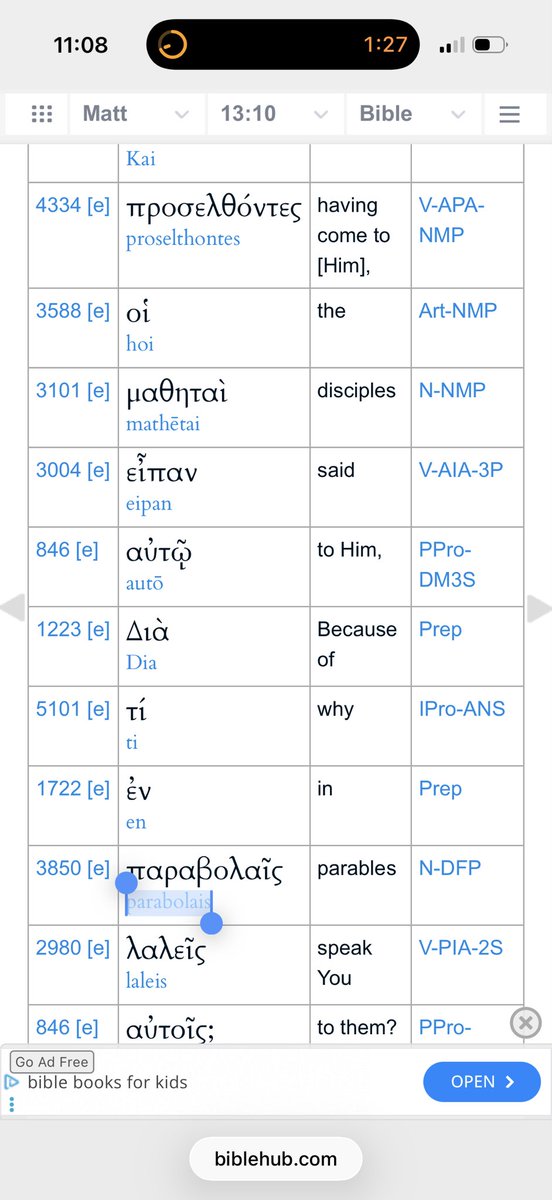
@RickWMiller1 @swamthetiber25 In Greek parable encapsulation figurative language as well. It’s a broad term because Jesus did not just speak in parables but also figurative language and similes as well as metaphors.

English
You’re misusing the “parable filter.”
Jesus hides truth from crowds, but explains it to His disciples (see Gospel of Matthew 13).
In Gospel of John 6, they’re confused, and He never says it’s symbolic.
No parable. No clarification. Just repetition.
If it’s figurative, Jesus abandons His own method and lets disciples walk over a misunderstanding He never corrects.
English