LatchBio

638 posts

LatchBio banner
LatchBio

LatchBio

@LatchBio

Data Infrastructure for Biology

San Francisco, CA انضم Temmuz 2021
40 يتبع4.3K المتابعون
LatchBio أُعيد تغريده
Kenny Workman
Kenny Workman@kenbwork·
Talks at the intersection of systems engineering and computational biology 0:20 Why study systems x biology in "age of agents" 5:50 Forch: Building a utilitarian cloud container orchestrator (Max Smolin, LatchBio) 41:25 cyto: Ultra high-throughput processing of 10x Flex single-cell sequencing (Noam Teyssier, Arc Institute) 1:04:30 SLAF: A single-cell omics storage format for the virtual cell era (Pavan Ramkumar, SLAF Project) 1:33:30 Lessons in Perturbation Modeling: STATE, STACK, and Beyond (Dhruv Gautam, Arc Institute + UC Berkeley) 2:03:15 Leveraging Serverless Distributed Computing to Scale Computational Biology (Ben Shababo, Modal) Topics span container orchestration, single-cell infra, perturbation modeling for biology at scale.
English
2
6
51
3.3K
LatchBio أُعيد تغريده
Kenny Workman
Kenny Workman@kenbwork·
Hosting another computing x biology reading group with Modal. Progress has really picked up the past 6 months + many interesting projects to highlight. - Max Smolin (LatchBio): Building "Forch", a Utilitarian Cloud Container Orchestrator - Noam Teyssier (Arc Institute): cyto: ultra high-throughput processing of 10x-flex single cell sequencing - Pavan Ramkumar (SLAF Project): SLAF: A single-cell omics storage format for the virtual cell era - Dhruv Gautam (Arc Institute): Lessons in Perturbation Modeling: STATE, STACK, and Beyond - Ben Shabobo (Modal): Leveraging Serverless Distributed Computing to Scale Computational Biology Come join us for pizza and good technical talks on March 4th in Mission Bay, SF. Design decisions, paper highlights + snippets of source code.
Kenny Workman tweet media
English
4
3
44
3.1K
LatchBio أُعيد تغريده
Kenny Workman
Kenny Workman@kenbwork·
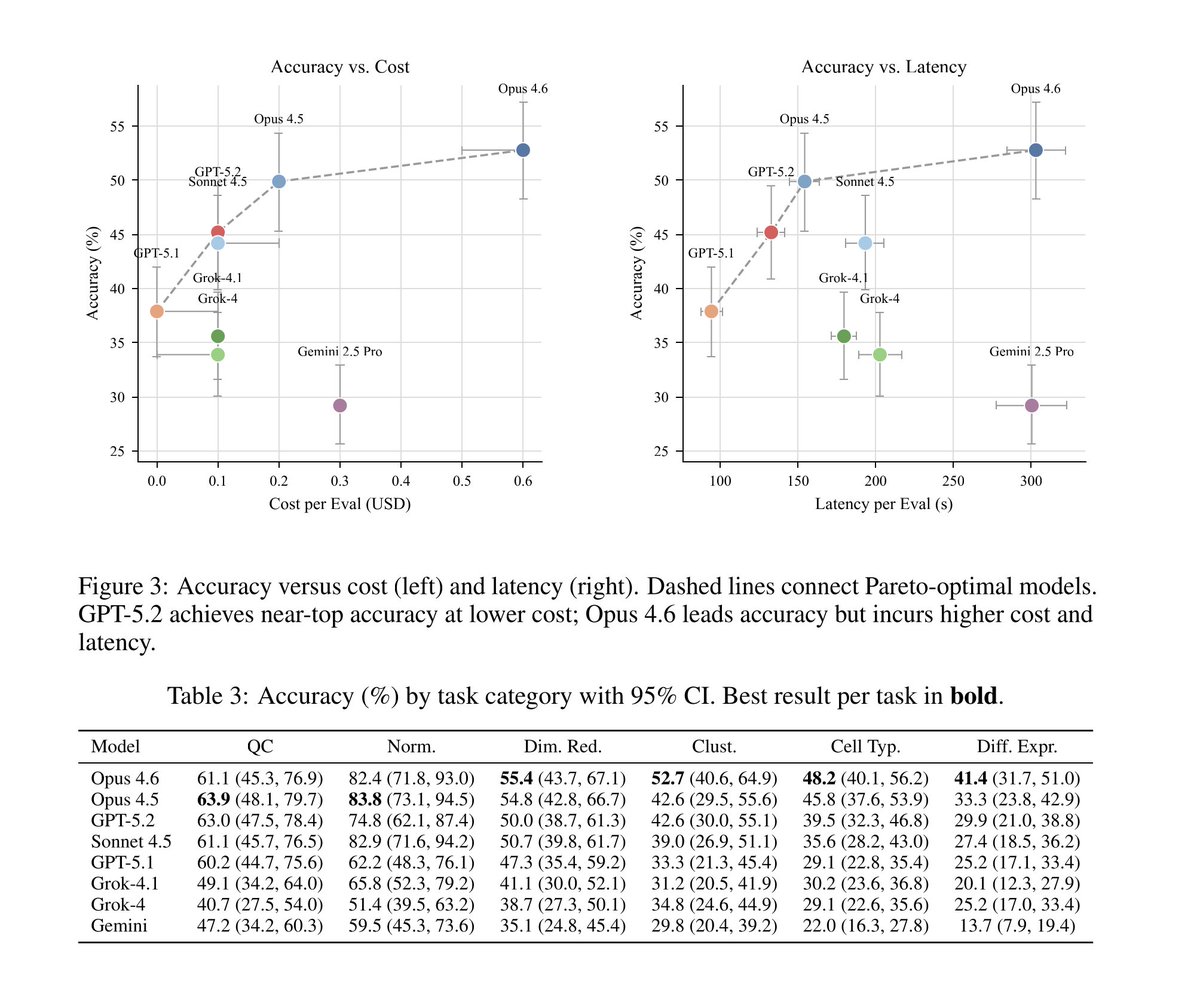
How good are frontier models at analyzing single cell data? scBench, 394 verifiable problems from real scRNA-seq workflows, shows the best model (Opus4.6) gets 53% accuracy. Better than spatial, but the best agents still fail roughly every other routine analysis task:
Kenny Workman tweet media
English
4
16
82
10K
LatchBio أُعيد تغريده
Hannah Han Le
Hannah Han Le@lehannahle·
Surprising how frontier models are still pretty weak at biology! It's been fun working with Kenny, Zhen, @Harihara_subrah to build this benchmark. Below is a further breakdown of a model’s analysis journey, where it fails, plus insights that nearly 2X performance in our tests:
Kenny Workman@kenbwork

2026 will be the year of agents in biology. But we need better benchmarks. We worked with scientists to turn real world analysis into verifiable problems. SpatialBench stratifies frontier models, shows harnesses matter, and reveals distinct failure modes between model families:

English
2
6
17
5.8K
LatchBio أُعيد تغريده
Alfredo Andere
Alfredo Andere@AlfredoAndere·
Made a website to easily visualize the results (which the team worked really hard on): benchmarks.bio We believe that making LLMs better at biological data analysis is one of the best ways to make them more useful to scientists. We will continue to expand to more types of platforms (including beyond spatial) and to more kinds of eval types.
Alfredo Andere tweet media
Kenny Workman@kenbwork

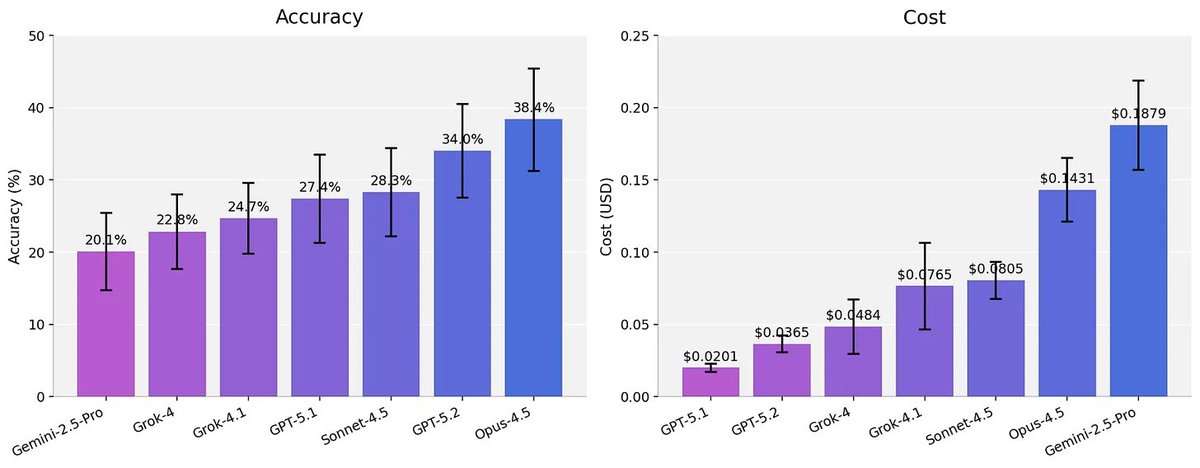
2026 will be the year of agents in biology. But we need better benchmarks. We worked with scientists to turn real world analysis into verifiable problems. SpatialBench stratifies frontier models, shows harnesses matter, and reveals distinct failure modes between model families:

English
2
12
102
15.7K
LatchBio أُعيد تغريده
Kenny Workman
Kenny Workman@kenbwork·
2026 will be the year of agents in biology. But we need better benchmarks. We worked with scientists to turn real world analysis into verifiable problems. SpatialBench stratifies frontier models, shows harnesses matter, and reveals distinct failure modes between model families:
Kenny Workman tweet media
English
6
20
152
101.3K
LatchBio أُعيد تغريده
Kenny Workman
Kenny Workman@kenbwork·
Launching a public agent sandbox for spatial biology. Five demo flows tailored to specific kits/machines Try it now: agent.bio This is a shippable intermediary towards reliable and widely deployed agentic systems used to make expensive scientific decisions.
English
3
18
81
20.9K
LatchBio أُعيد تغريده
owl
owl@owl_posting·
We don't know what most microbial genes do. Can genomic language models help? there's only one way to find out! this is a 1 hour and 42 minute interview with an MIT professor (the famous @Micro_Yunha) chatting about these questions, her work in solving them at @tatta_bio, and more. zoomer captions are back too Links in reply! Timestamps: 00:00:00 - Clips + sponsor roll from the wonderful @LatchBio 00:02:07 – Introduction 00:02:23 – Why do microbial genomes matter 00:04:07 – Deep learning acceptance in metagenomics 00:05:25 – The case for genomic “context” over sequence matching 00:06:43 – OMG: the only ML-ready metagenomic dataset 00:09:27 – gLM2: A multimodal genomic language model 00:11:06 – What do you do with the output of genomic language models? 00:17:41 – How will OMG evolve? 00:20:26 – Why train on only microbial genomes, as opposed to all genomes? 00:22:58 – Do we need more sequences or more annotations? 00:23:54 – Is there a conserved microbial genome ‘language’? 00:28:11 – What non-obvious things can this genomic language model tell you? 00:33:08 – Semantic deduplication and evaluation 00:37:33 – How does benchmarking work for these types of models? 00:41:31 – Gaia: A genomic search engine 00:44:18 – Even ‘well-studied’ genomes are mostly unannotated 00:50:51 – Using agents on Gaia 00:54:53 – Will genomic language models reshape the tree of life? 00:59:18 – Current limitations of genomic language models 01:08:54 – Directed evolution as training data 01:12:35 – What is Tatta Bio? 01:19:02 – Building Google for genomic sequences (SeqHub) 01:25:46 – How to create communities around scientific OSS 01:29:06 – What’s the purpose in the centralization of the software? 01:35:37 – How will the way science is done change in 10 years?
English
4
25
91
44K
LatchBio أُعيد تغريده
Alfredo Andere
Alfredo Andere@AlfredoAndere·
If you read this and thought, “awesome - but I’d do X/Y/Z to make the post stronger,” consider applying to our Growth Engineer role. We focus our marketing on a handful of highly-technical prospects and reach them with value-add content: blog posts, market maps, in-person events, and product launches. The right person is able top own these end-to-end from idea → design → implementation → distribution. We want someone who empathizes with scientists and knows what’s useful to them. My assumption is they'll need prior computational biology context to do this well (happy to be proven wrong though). If this sounds like you or someone you know, reach out.
Kenny Workman@kenbwork

Agents are finally starting to work in biology. We’ve partnered with Anthropic and major biotech vendors - Vizgen, AtlasXOmics, Takara, 10x Genomics - to build a tool that allows scientists to steer their own analysis with natural language. Raw spatial data to publication quality figures. Our team believes this will soon be the standard way biologists interact with data. Spatial biology agents look a bit different from coding products: - tailored to the molecular details of each kit type - run in sandboxes on very large machines - orchestrate data infra, eg. bioinformatics workflows, with tool calls - build graphical analysis notebooks to communicate results Detailed breakdown of engineering decisions, product philosophy and concrete flows follows:

English
0
4
22
5.6K
LatchBio أُعيد تغريده
Kenny Workman
Kenny Workman@kenbwork·
Agents are finally starting to work in biology. We’ve partnered with Anthropic and major biotech vendors - Vizgen, AtlasXOmics, Takara, 10x Genomics - to build a tool that allows scientists to steer their own analysis with natural language. Raw spatial data to publication quality figures. Our team believes this will soon be the standard way biologists interact with data. Spatial biology agents look a bit different from coding products: - tailored to the molecular details of each kit type - run in sandboxes on very large machines - orchestrate data infra, eg. bioinformatics workflows, with tool calls - build graphical analysis notebooks to communicate results Detailed breakdown of engineering decisions, product philosophy and concrete flows follows:
English
26
105
575
112.6K
LatchBio أُعيد تغريده
Kenny Workman
Kenny Workman@kenbwork·
Many are aware of the exponential growth of data in biology but the true scale of frontier assays is often abstract. Spatial epigenetics is finally approaching a size that breaks most systems: each slide is on the order of 100s of GB and a multi-slide cohort will quickly reach many TBs. Unlike traditional downstream workflows in multi-omics, useful downstream scientific questions require biologists to manipulate this data in highly interactive and non-standard ways. This is a very hard problem. AtlasXOmics was one of our early customers and have personally watched their molecular throughput compound over the years. The assay volume is a function of the size of capture spots on their chips, which has continued to drop every few months, and is still nowhere near saturating commodity semiconductor components.
AtlasXomics@AtlasXomics

Spatial FFPE ATAC-seq has arrived! AtlasXomics now brings single-cell chromatin accessibility mapping to FFPE tissue, unlocking spatial epigenomic insights from the world’s vast archives of clinical samples. Using our 5.5 × 5.5 mm chip at 10 µm resolution, we can now profile open chromatin directly in preserved tissue — maintaining spatial context. Check out our first FFPE kidney dataset on the interactive data portal, showcasing the robust performance and sensitivity of this new spatial assay. View more at: lnkd.in/e-8sTMnY #SpatialBiology #Epigenetics #CancerResearch

English
2
7
86
13.5K
LatchBio أُعيد تغريده
Kenny Workman
Kenny Workman@kenbwork·
Been working with Anthropic + handful of major sequencing providers to orchestrate our existing platform with the latest models. A window has opened up in the past few months as trends underpinning the explosive agentic software products - improving tool use, code reasoning, multi-turn workflows - now translate well to concrete tasks in biological data analysis with a good amount of engineering. If you speak to biologists sitting on large molecular data, they are often able to produce a very clear description of what they want out of it - specific scientific questions, ability to reason about biological validity of outputs, details of the plots and figures - but often lack the procedural skill to get there. Rather than general purpose analysis or literature distillation sandboxes, we believe precise and user-tested workflows adapted to the details of each specific machine/kit type will have a more immediate impact on industry. Spending years building stable data infra was very important. Looking forward to sharing details over the coming weeks. Long skeptical of the practical application of LLMs to biology, have personally been surprised by early technical results and (importantly) the response from real scientists.
Anthropic@AnthropicAI

We’re building tools to support research in the life sciences, from early discovery through to commercialization. With Claude for Life Sciences, we’ve added connectors to scientific tools, Skills, and new partnerships to make Claude more useful for scientific work.

English
9
9
252
41.8K
LatchBio أُعيد تغريده
Alfredo Andere
Alfredo Andere@AlfredoAndere·
Next week we’ll release a new interface to analyze multi-omics data. We've been patiently building bindings for the past two years. When we tested Sonnet 4.5, as we do routinely after every model release, we realized capabilities we thought were still 1-2 years away are now here.
Alfredo Andere tweet media
Anthropic@AnthropicAI

We’re building tools to support research in the life sciences, from early discovery through to commercialization. With Claude for Life Sciences, we’ve added connectors to scientific tools, Skills, and new partnerships to make Claude more useful for scientific work.

English
3
3
20
4.8K
LatchBio أُعيد تغريده
Kenny Workman
Kenny Workman@kenbwork·
Large volumes of structured spatial data will help us discover new targets, mechanisms and drugs too difficult to reason about with unaided cognition. Releasing: (1) 25M curated cells - the largest open access spatial atlas to date - across 11 major vendors (2) a tiled AnnData file format and visualization ecosystem to explore big matrix data in the browser without a server
Kenny Workman tweet mediaKenny Workman tweet media
English
4
12
126
10.4K
LatchBio أُعيد تغريده
Kenny Workman
Kenny Workman@kenbwork·
Computing x engineering biology is a playground for systems. Come join us for round three of the SF systems reading group with a focus on biotech. - Noam Teyssier (Arc Institute): BINSEQ: A Family of High Performance Binary Formats for Nucleotide Sequences ​- Aidan Abdullali (LatchBio): A Distributed Filesystem Built on Postgres and S3 - ​Abhinav Adduri (Arc Institute): Scaling Deep Learning to 1B+ Single Cells Presentations on design decisions and paper highlights. We'll read snippets of source code, learn from each other and vibe. 5:30ish on 8/20
Kenny Workman tweet media
English
12
21
254
28.8K
LatchBio أُعيد تغريده
Kenny Workman
Kenny Workman@kenbwork·
Data is the oil of modern biotech. New tools allow us to model living systems too complex for unaided human cognition. Latch is releasing a new capabilities in data curation + delivery: - 30M observational cell atlas across 150 diseases, 200 tissues, 27 technologies - a partnership with two expert labeling teams - an agentic, human-in-the-loop framework for mass scRNA-seq curation
Kenny Workman tweet media
English
1
13
41
10.1K