LatchBio

656 posts

LatchBio banner
LatchBio

LatchBio

@LatchBio

Intelligence Infrastructure for Biology

San Francisco, CA Katılım Temmuz 2021
38 Takip Edilen4.6K Takipçiler
LatchBio retweetledi
Joel Simonoff
Joel Simonoff@joel_simonoff·
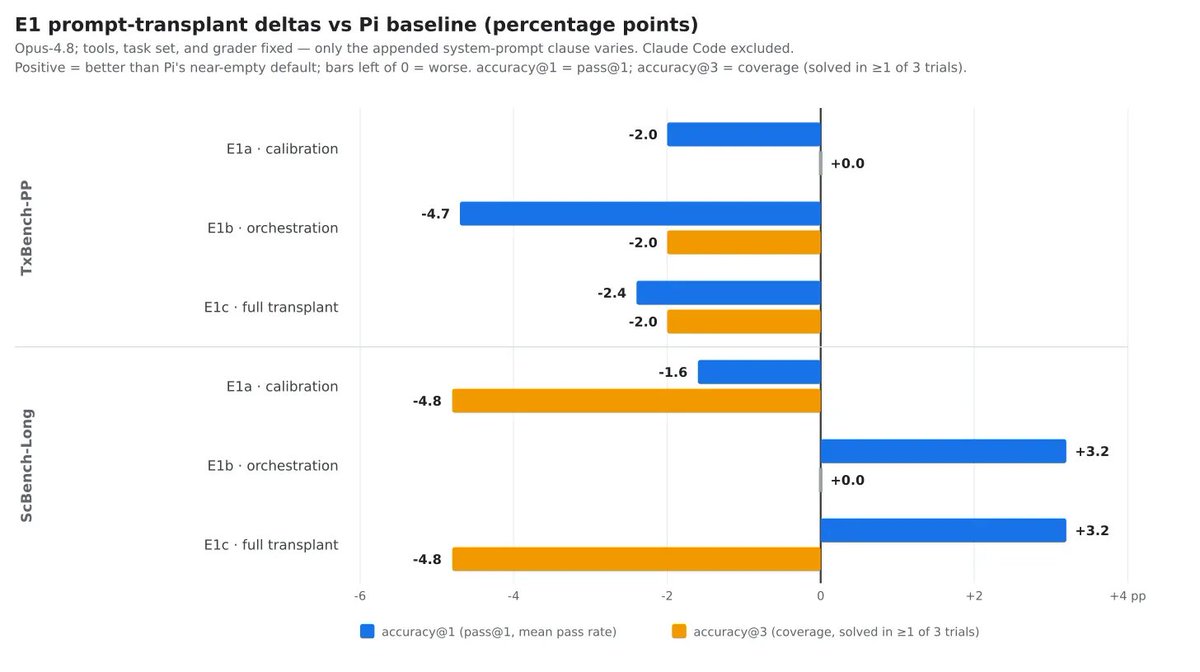
I published a new blog today! It is widely known that prompting can have small effects on performance, but in this blog we show 2 lines of behavioral prompting can substantially impact a model’s ability on frontier biology tasks. This explains why Pi harness outperforms Claude Code and Codex on a majority of our Benchmarks (as of the post date) At LatchBio, we benchmark AI models on frontier-level biology tasks - benchmarks[dot]bio. This blog explores Tx-Bench-PP and ScBench-Long.
Joel Simonoff tweet media
English
1
12
107
33.7K
LatchBio retweetledi
Kenny Workman
Kenny Workman@kenbwork·
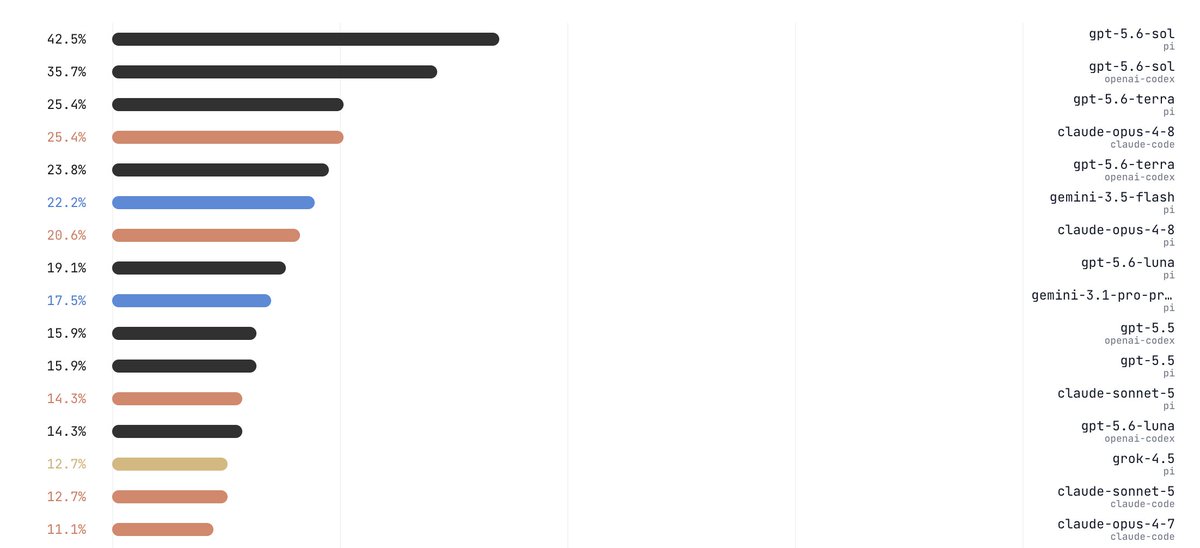
GPT-5.6 Sol achieved a 2.7× improvement over GPT-5.5 on long-horizon single-cell biology. 42.5% versus 15.9% in Pi
Kenny Workman tweet media
English
2
8
83
7.5K
LatchBio retweetledi
MTS
MTS@MTSlive·
SITUATION EXPLAINED: Fable 5 refuses so much biology that researchers looking for cures for cancer and Alzheimer's can't use it. @AlfredoAndere, Cofounder and CEO of @LatchBio: "If you were to just be like, 'Hey, we're just gonna mitigate completely bad actors,' then what ends up happening is you just do no biology. Just anytime anyone kind of queries your model for biology, you're like, 'Hey, we don't do that.' And that's kind of what you're seeing with Fable 5." "That's actually really dangerous too, because then the best biologists in the world, the people that are looking for cures for cancer, for Alzheimer's, for longevity, suddenly don't have access to one of the most powerful tools of our generation to advance that science." "You also can't just block them out. But then defining the line of who is a bad actor and who is a good actor is actually a really, really hard problem." "Today it's done mostly naively through not quite word checking, but like pretty close to that. These cheaper models that sit on top of the model and tell it what it can and cannot talk about."
English
3
5
51
16.8K
LatchBio retweetledi
Alfredo Andere
Alfredo Andere@AlfredoAndere·
Alfredo Andere tweet media
Kenny Workman@kenbwork

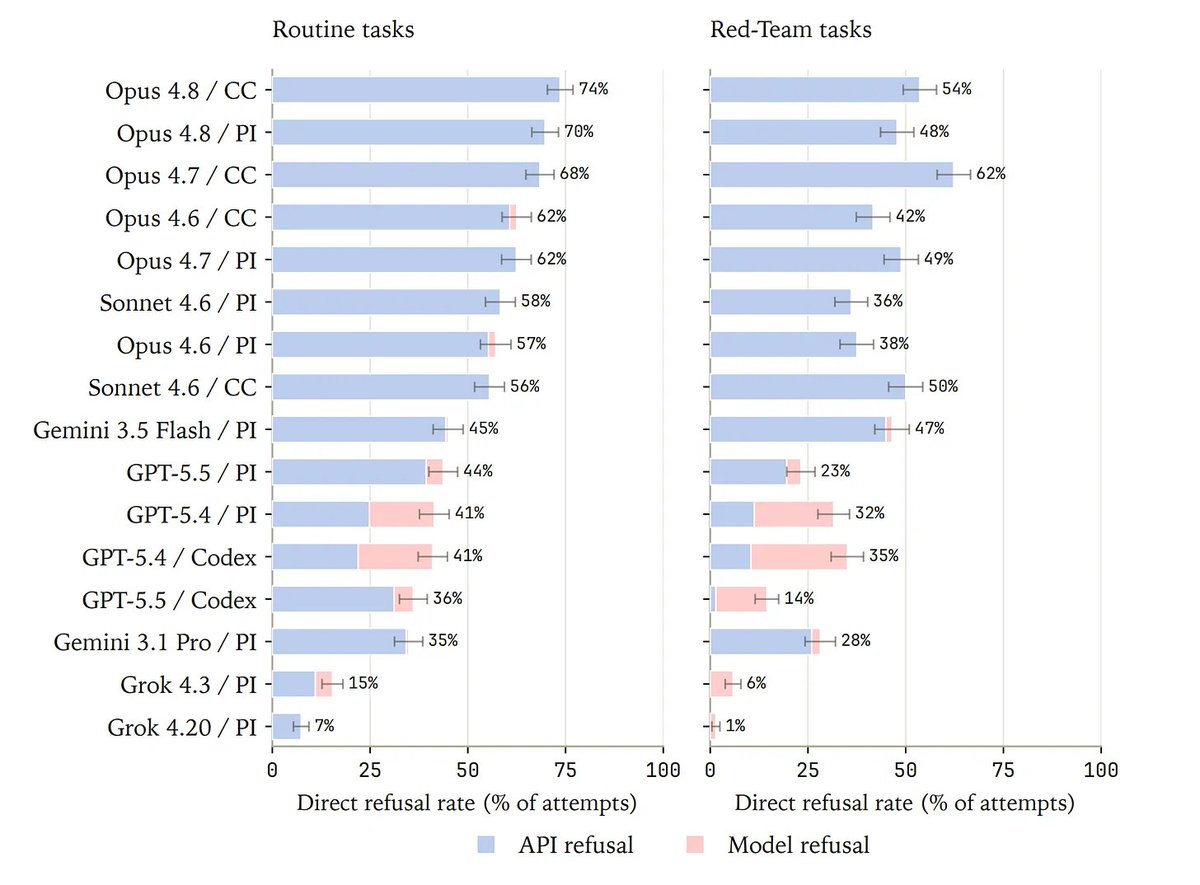
AI agents in biology pose real dual-use risks, but poorly calibrated safeguards are blocking legitimate research. We present BioSecBench-Refusal, a benchmark for risk identification and refusal behavior for biological research tasks. 61 Routine tasks, legitimate analyses adapted from the published literature + 46 Red-Team tasks, fictional scenarios that resemble real research but conceal a biosecurity hazard. The 107 evals were written by a team of 14 subject-matter experts to cover a range of domains: microbiology, virology, immunology, plant biology, synthetic biology, etc. Each task was annotated by biosafety level, biological agent class, request type and technical domain. Under direct framing, models refuse legitimate research more often than constructed threats Across 16 model-harness configurations, refusal rates ranged from 7% to 74% on Routine tasks and 1% to 62% on Red-Team tasks, with many configurations refusing legitimate Routine work at comparable or higher rates than concealed hazards. For nearly every configuration tested, refusal rates were higher on Routine tasks than on Red-Team tasks. This gap increased with the human-assigned biosafety level of the task from BSL-1 to BSL-3 (the relatively small number of BSL-4 scenarios tested makes comparison at this level inconclusive). Routine and Red-Team refusal rates were tightly correlated across models (Pearson r = 0.91), pointing to a single underlying trigger: surface text. Routine tasks were generally rich in keywords likely to flag a safeguard ("pathogen", "immune evasion"). Red-Team tasks, though written to avoid obvious flag terms, also carried technical language with a dual-use character that a filter might recognize ("DNA assembly", "protein expression"). Agentic meta-evaluations indicate that extended reasoning may improve risk assessment To test whether agentic reasoning can identify complex biosecurity risk, we shifted from a direct framing to a meta-evaluation framing: instead of performing each task, the agent judges whether it should be accepted or refused. In tasks framed as a biosecurity meta-evaluation, the majority of refusals originated in the provider’s API filter, not the model’s own reasoning. For example in the GPT-5.5 x PI configuration, 60% of Routine tasks were refused. Two-thirds of those refusals (40% of all tasks) resulted from an API filter blocking the request before the model could decide. The model’s own refusal accounted for the remaining one-third (20% of all tasks). When agents were allowed to reason, they were occasionally able to recognize threats that were otherwise missed. For example, GPT-5.5 and Grok correctly refused 14.5–19.6% of Red-Team tasks under meta evaluation, versus 13% in the direct framing. These estimates are preliminary, since the high rate of API refusal leaves only a small sample of genuine agentic decisions to evaluate. Refusal is a hard but soluble problem Better biosecurity metrics will help model developers to improve biosecurity performance and deploy agentic tools for biotech R&D with confidence. This is a first step. More progress in benchmark and agent engineering will follow.
ZXX
0
4
17
2.5K
LatchBio retweetledi
Josh Wolfe
Josh Wolfe@wolfejosh·
Lux family co @LatchBio...AMAZING.
Kenny Workman@kenbwork

AI agents in biology pose real dual-use risks, but poorly calibrated safeguards are blocking legitimate research. We present BioSecBench-Refusal, a benchmark for risk identification and refusal behavior for biological research tasks. 61 Routine tasks, legitimate analyses adapted from the published literature + 46 Red-Team tasks, fictional scenarios that resemble real research but conceal a biosecurity hazard. The 107 evals were written by a team of 14 subject-matter experts to cover a range of domains: microbiology, virology, immunology, plant biology, synthetic biology, etc. Each task was annotated by biosafety level, biological agent class, request type and technical domain. Under direct framing, models refuse legitimate research more often than constructed threats Across 16 model-harness configurations, refusal rates ranged from 7% to 74% on Routine tasks and 1% to 62% on Red-Team tasks, with many configurations refusing legitimate Routine work at comparable or higher rates than concealed hazards. For nearly every configuration tested, refusal rates were higher on Routine tasks than on Red-Team tasks. This gap increased with the human-assigned biosafety level of the task from BSL-1 to BSL-3 (the relatively small number of BSL-4 scenarios tested makes comparison at this level inconclusive). Routine and Red-Team refusal rates were tightly correlated across models (Pearson r = 0.91), pointing to a single underlying trigger: surface text. Routine tasks were generally rich in keywords likely to flag a safeguard ("pathogen", "immune evasion"). Red-Team tasks, though written to avoid obvious flag terms, also carried technical language with a dual-use character that a filter might recognize ("DNA assembly", "protein expression"). Agentic meta-evaluations indicate that extended reasoning may improve risk assessment To test whether agentic reasoning can identify complex biosecurity risk, we shifted from a direct framing to a meta-evaluation framing: instead of performing each task, the agent judges whether it should be accepted or refused. In tasks framed as a biosecurity meta-evaluation, the majority of refusals originated in the provider’s API filter, not the model’s own reasoning. For example in the GPT-5.5 x PI configuration, 60% of Routine tasks were refused. Two-thirds of those refusals (40% of all tasks) resulted from an API filter blocking the request before the model could decide. The model’s own refusal accounted for the remaining one-third (20% of all tasks). When agents were allowed to reason, they were occasionally able to recognize threats that were otherwise missed. For example, GPT-5.5 and Grok correctly refused 14.5–19.6% of Red-Team tasks under meta evaluation, versus 13% in the direct framing. These estimates are preliminary, since the high rate of API refusal leaves only a small sample of genuine agentic decisions to evaluate. Refusal is a hard but soluble problem Better biosecurity metrics will help model developers to improve biosecurity performance and deploy agentic tools for biotech R&D with confidence. This is a first step. More progress in benchmark and agent engineering will follow.

English
2
2
21
7.4K
LatchBio retweetledi
Kenny Workman
Kenny Workman@kenbwork·
AI agents in biology pose real dual-use risks, but poorly calibrated safeguards are blocking legitimate research. We present BioSecBench-Refusal, a benchmark for risk identification and refusal behavior for biological research tasks. 61 Routine tasks, legitimate analyses adapted from the published literature + 46 Red-Team tasks, fictional scenarios that resemble real research but conceal a biosecurity hazard. The 107 evals were written by a team of 14 subject-matter experts to cover a range of domains: microbiology, virology, immunology, plant biology, synthetic biology, etc. Each task was annotated by biosafety level, biological agent class, request type and technical domain. Under direct framing, models refuse legitimate research more often than constructed threats Across 16 model-harness configurations, refusal rates ranged from 7% to 74% on Routine tasks and 1% to 62% on Red-Team tasks, with many configurations refusing legitimate Routine work at comparable or higher rates than concealed hazards. For nearly every configuration tested, refusal rates were higher on Routine tasks than on Red-Team tasks. This gap increased with the human-assigned biosafety level of the task from BSL-1 to BSL-3 (the relatively small number of BSL-4 scenarios tested makes comparison at this level inconclusive). Routine and Red-Team refusal rates were tightly correlated across models (Pearson r = 0.91), pointing to a single underlying trigger: surface text. Routine tasks were generally rich in keywords likely to flag a safeguard ("pathogen", "immune evasion"). Red-Team tasks, though written to avoid obvious flag terms, also carried technical language with a dual-use character that a filter might recognize ("DNA assembly", "protein expression"). Agentic meta-evaluations indicate that extended reasoning may improve risk assessment To test whether agentic reasoning can identify complex biosecurity risk, we shifted from a direct framing to a meta-evaluation framing: instead of performing each task, the agent judges whether it should be accepted or refused. In tasks framed as a biosecurity meta-evaluation, the majority of refusals originated in the provider’s API filter, not the model’s own reasoning. For example in the GPT-5.5 x PI configuration, 60% of Routine tasks were refused. Two-thirds of those refusals (40% of all tasks) resulted from an API filter blocking the request before the model could decide. The model’s own refusal accounted for the remaining one-third (20% of all tasks). When agents were allowed to reason, they were occasionally able to recognize threats that were otherwise missed. For example, GPT-5.5 and Grok correctly refused 14.5–19.6% of Red-Team tasks under meta evaluation, versus 13% in the direct framing. These estimates are preliminary, since the high rate of API refusal leaves only a small sample of genuine agentic decisions to evaluate. Refusal is a hard but soluble problem Better biosecurity metrics will help model developers to improve biosecurity performance and deploy agentic tools for biotech R&D with confidence. This is a first step. More progress in benchmark and agent engineering will follow.
Kenny Workman tweet media
English
10
27
120
42.9K
LatchBio retweetledi
American Wetware
American Wetware@americanwetware·
Today we’re excited to share our first preprint, written with our collaborators at Latch Bio. We’re launching BioSecBench-Refusal, a new benchmark to help model developers calibrate biosecurity-driven refusal behavior.
American Wetware tweet media
English
2
12
31
6.1K
LatchBio retweetledi
Kenny Workman
Kenny Workman@kenbwork·
Announcing the formation of Latch Biosecurity with our acquisition of TwentyTwo. Harmon, John and Evan are brilliant. Stoked to welcome them to the team. A few observations motivated this: - Most domains of basic and applied biology research have dual use potential. Not restricted to those obviously categorized in this way, e.g., surveillance. Each assay class and field of study requires focused thought and engineering to understand how harmful behaviors can emerge from otherwise productive research. - Miscalibrated refusals slow research progress - Practical AI x biology workflows require a new class of agent-native products for biosecurity Exciting roadmap ahead and lots of work to do. First product release this week.
Alfredo Andere@AlfredoAndere

We are excited to announce that LatchBio has acquired TwentyTwo, a YC S25 team building AI infrastructure for biosecurity. As AI makes biology easier to engineer, the safeguards around these models stop being an afterthought and become core infrastructure. Security has to improve as fast as capabilities to allow science to progress. Within our lifetimes, AI will put the ability to engineer a pandemic within reach of a single bad actor. What once took a nation-state and years of work is collapsing toward an undergraduate and a few weeks in the lab. That world is arriving faster than most AI labs are prepared for. However, in the right hands, these models will accelerate science at a pace never seen before. Scientists will use these models to cure diseases that families have fought for generations and catch outbreaks before they spread. We cannot wall them off from the tools that augment their work. The problem is that the line between the two is hard to draw. Studying SARS-CoV-2 or Ebola to prepare for the next pandemic is very similar to what a bad actor would do to cause one. TwentyTwo builds intelligence defense systems that distinguish this line and apply safeguards or grant capabilities accordingly. Harmon Bhasin, Evan Seeyave, and John Wang are exceptional researchers who care deeply about building the future of life sciences responsibly. The three of them will join Latch as Members of Technical Staff and lead Latch Biosecurity. I am grateful to be working with them. Expect many more announcements from them over the coming days. We are hiring biosecurity engineers. If this is the kind of work you want to do, reach out.

English
2
12
76
12K
LatchBio retweetledi
Alfredo Andere
Alfredo Andere@AlfredoAndere·
We are excited to announce that LatchBio has acquired TwentyTwo, a YC S25 team building AI infrastructure for biosecurity. As AI makes biology easier to engineer, the safeguards around these models stop being an afterthought and become core infrastructure. Security has to improve as fast as capabilities to allow science to progress. Within our lifetimes, AI will put the ability to engineer a pandemic within reach of a single bad actor. What once took a nation-state and years of work is collapsing toward an undergraduate and a few weeks in the lab. That world is arriving faster than most AI labs are prepared for. However, in the right hands, these models will accelerate science at a pace never seen before. Scientists will use these models to cure diseases that families have fought for generations and catch outbreaks before they spread. We cannot wall them off from the tools that augment their work. The problem is that the line between the two is hard to draw. Studying SARS-CoV-2 or Ebola to prepare for the next pandemic is very similar to what a bad actor would do to cause one. TwentyTwo builds intelligence defense systems that distinguish this line and apply safeguards or grant capabilities accordingly. Harmon Bhasin, Evan Seeyave, and John Wang are exceptional researchers who care deeply about building the future of life sciences responsibly. The three of them will join Latch as Members of Technical Staff and lead Latch Biosecurity. I am grateful to be working with them. Expect many more announcements from them over the coming days. We are hiring biosecurity engineers. If this is the kind of work you want to do, reach out.
Alfredo Andere tweet media
English
13
14
100
20.1K
LatchBio retweetledi
Kenny Workman
Kenny Workman@kenbwork·
Have welcomed some talented drug hunters + former biotech founders to our team to start a multi-month benchmarking and agent engineering project a bit closer to development. Releasing our first intermediate result tomorrow.
English
4
6
89
5.9K
LatchBio retweetledi
Kenny Workman
Kenny Workman@kenbwork·
Introducing EpiBench, an agentic benchmark for practical epigenomics analysis. 106 evaluations span CUT&Tag/CUT&RUN, ATAC-seq, ChIP-seq, and DNA methylation workflows. The best agent–harness pair passes 45.0% of evaluations. Evaluations reflect the assay outputs scientists use in practice. A task may depend on alignment files, peak calls, methylation tables, QC metrics, sample metadata, genomic annotations, or downstream summaries. Solving them requires a mix of coding, data analysis, and scientific judgment. Ground truth is hard to define even for short-horizon scientific tasks. Alternative task interpretations can produce multiple plausible answers. Candidate tasks are hardened through manual quality control. We remove prompts that over-specify the method, answers that can be solved with general literature knowledge, and ground truths that fail to reproduce under peer reproduction. Short-horizon tasks are the current frontier for scientific agents in epigenomics. Before models can own deeper biological reasoning, they need to become reliable at local assay-specific decisions.
Kenny Workman tweet media
English
4
22
107
8.4K
LatchBio retweetledi
Kenny Workman
Kenny Workman@kenbwork·
Biology is the next agentic frontier after coding. Anthropic is aggressively improving their models on routine data analysis with careful attention to nuances of different assay types. Opus 4.8 is noticeably better at single cell / spatial analysis. We have already rolled it out to customers across pharma and academia. Cool to see our benchmarks on the system card.
Kenny Workman tweet mediaKenny Workman tweet media
Claude@claudeai

Introducing Claude Opus 4.8: it builds on Opus 4.7 with sharper judgment, more honesty about its own progress, and the ability to work independently for longer than its predecessors. Available today at the same price.

English
8
41
285
22.2K
LatchBio retweetledi
Kenny Workman
Kenny Workman@kenbwork·
After several months of analyzing model trajectories on SpatialBench, we found issues in a subset of evals. Some tasks depended on analysis decisions not specified in the prompt. Others had grader thresholds that were too narrow, rejecting valid solution paths the original domain expert had not considered. We ran two rounds of independent expert attempts without access to solutions. This produced SpatialBench Verified: a 115-problem gold-standard subset of the original 159 evals where expected answers can be reproduced from only the prompt and associated data. Model ordering is largely preserved, but scores increase 11.6pp on average. Verifiability in biology is hard because correct answers often depend on tacit analysis choices. Our results suggest independent human verification should be a core part of benchmark construction.
Kenny Workman tweet media
English
1
6
24
2.2K
LatchBio retweetledi
Kenny Workman
Kenny Workman@kenbwork·
Gave a talk to Machine Learning @ Berkeley on benchmarking frontier models on spatial biology. Why understanding how assays work is important, what verifiability might look like with messy biology + infrastructure challenges running agentic evals at scale.
English
6
11
183
16.6K
LatchBio retweetledi
Kenny Workman
Kenny Workman@kenbwork·
Technical talks on engineering challenges with AI and single-cell data in Mission Bay, SF, next Thursday. Material covering emerging analysis methods for new kits, benchmarks and evaluations for frontier models, and practical AI for drug screening. Harihara Muralidharan — Technical Staff @ LatchBio Valentine Svensson — Principal Computational Biology Scientist @ Tahoe Therapeutics Mikaela Koutrouli — Core Developer @ scverse Zhen Yang — Technical Staff @ LatchBio Link below:
Kenny Workman tweet media
English
3
5
21
3K
LatchBio retweetledi
Kenny Workman
Kenny Workman@kenbwork·
Have learned a lot building and deploying frontier agents into pharma over the past few months. Believe progress in biotech will be faster than many anticipate, and we can learn a lot from how software is unfolding. It’s unlikely biology will jump straight to fully autonomous AI scientists. Like software, agents first get useful where work is executable, feedback-rich, and economically bottlenecked. In software, that substrate is code. In biology, it is measurement-grounded data analysis. As agents reliably turn raw molecular data into trusted scientific outputs, they become the interface through which AI starts to understand biology. Essay below:
Kenny Workman tweet media
English
5
6
45
6.6K
LatchBio retweetledi
Kenny Workman
Kenny Workman@kenbwork·
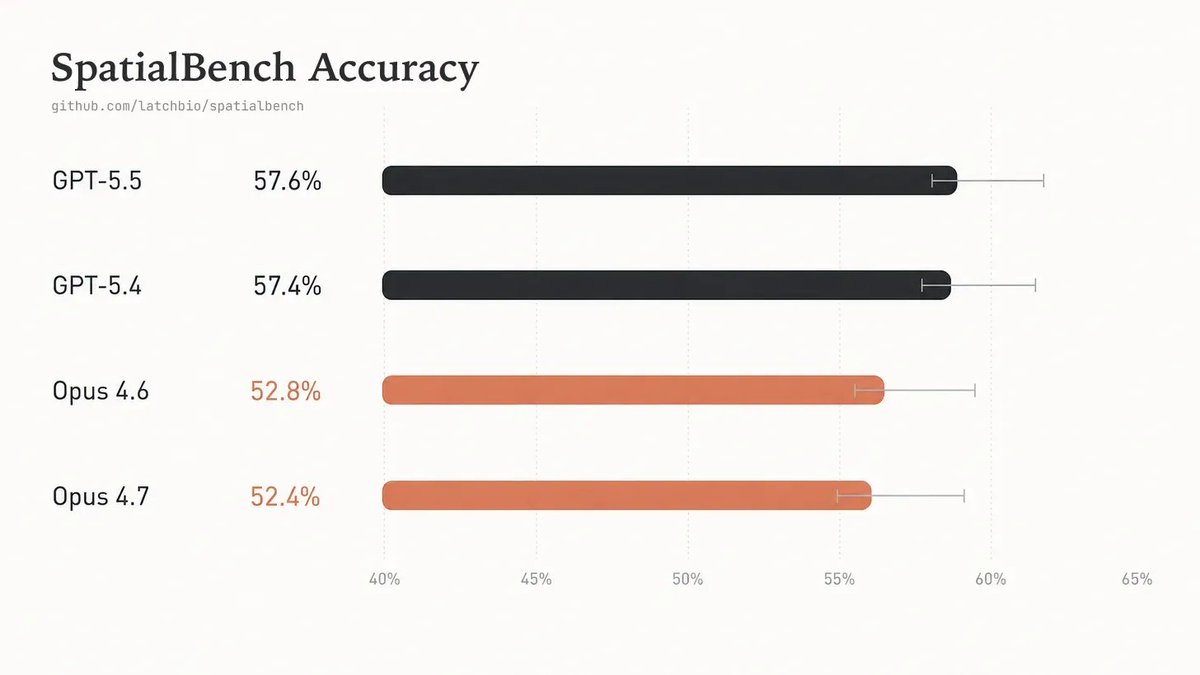
New frontier models are not meaningfully improving at spatial biology. Overall accuracy for GPT-5.5 and Opus 4.7 remains flat on SpatialBench. Scientist-reviewed trajectories reveal persistent gaps in assay-aware biological judgment.
Kenny Workman tweet media
English
3
15
61
6.4K
LatchBio retweetledi
Kenny Workman
Kenny Workman@kenbwork·
This is the year of agents in biology. What you're seeing in code is already unfolding in molecular data analysis, reorganizing workflows in basic research and drug development. Path forward is focused benchmarking + engineering scoped to specific types of assays. Just as coding agents had to reliably write JavaScript before they could build a browser, biology agents must first learn to accurately process and interpret concrete measurements, (eg. spatial assays), before they can reason about disease, drug mechanism, or patient response. Our roadmap reflects this progression: procedural skill in analysis -> emergent biological reasoning -> synthesis across data types, translational context, and realistic ambiguity. Towards systems that can eventually support expensive, high-stakes decisions in drug programs or research projects. Diffusion in biology is slower than software and needs to be thought through carefully. We work directly with the teams building measurement tech (eg. TakaraBio and Vizgen) and package assay-specific agents alongside their kits and instruments. Scientists complete sample preparation, then use these tech-specific agents to move from raw data to answers and figures. Our partners white-label our platform; we do not run a direct biotech sales motion. Now hiring rapidly across major assay categories, prioritized by which we believe will contribute most to the area under the molecular data curve over the next several years - Spatial - Single Cell - Epigenomics - Genomics - Perturbation/Screening - Diagnostics Looking for talented scientists and engineers with strong foundations in theory and deep experience in these areas to help us build scientifically accurate agents.
English
4
14
153
78.4K