Lukas Hack

356 posts

Lukas Hack

Lukas Hack

@LukasHack_

Postdoctoral Researcher in Economics @KOFETH @ETH | Formerly @EconUniMannheim @GESSuniMannheim | Macro - Monetary - Fiscal

Mannheim, Baden-Württemberg انضم Mart 2020
1.2K يتبع976 المتابعون
Lukas Hack أُعيد تغريده
Refet Gürkaynak
Refet Gürkaynak@RefetGurkaynak·
CEPR Monetary Economics and Fluctuations program meeting. Members and non-members alike are welcome to submit relevant work. mailchi.mp/cepr/cfp-cepr-…
English
1
12
72
12.7K
Lukas Hack
Lukas Hack@LukasHack_·
📜Maybe John H. Cochrane's cautionary words against another inflation surge may not be as unwarranted as I initially thought(lnkd.in/enuABe4V ) Caveat: Only 1/3 of the experts expect an @ecb interest rate hike, so restrictive monetary policy may dampen the impact END
English
0
0
0
67
Lukas Hack
Lukas Hack@LukasHack_·
✎Why 4.7%? The FMT survey asked for several war scenarios and the marginal effect of a 10-dollar increase in the oil price on inflation is 0.25 percentage points. So, 2.7% + 0.25% x (180-100)/10 = 4.7%, as a back-of-the-envelop calculation. 4/X
English
1
0
0
89
Lukas Hack
Lukas Hack@LukasHack_·
❓What are the consequences of the hostilities in the Middle East for the German economy? 1️⃣Experts expect the war to last for 1-3 months, keeping oil prices elevated at 100$ 2️⃣German Inflation is expected to rise to 2.7% in 2026, calling for potential @ecb rate hike Short🧵
English
1
1
5
437
Lukas Hack
Lukas Hack@LukasHack_·
@makro_philip @ben_moll Link top journal publications with conference volumes, i.e., lighter refereeing to get into the „AER quarterly conference“, with proper(!) peer review only after presentation? Less restrictive and actually feasible to implement. Of course, initial light refereeing is a challenge
English
0
0
3
193
Philip Jung
Philip Jung@makro_philip·
@ben_moll Give researcher a yearly budget to submit x papers, say x=3. Rest can be put online as working paper. Call it an Acemoglu tax, given that he would pay the largest price, but quality would likely improve on average?
English
1
0
24
3.6K
Lukas Hack أُعيد تغريده
Gauti Eggertsson 🇺🇦
Gauti Eggertsson 🇺🇦@GautiEggertsson·
AI is a game changer for economic research. We will look back and think: before and after. The junior job market used to place enormous value on technical skills — and rightly so. We wanted to pass on the latest research methods to new PhD students. But the cost of mastering frontier solution techniques has dropped dramatically. I now find myself replicating papers and experimenting with frontier methods in an evening or a few days using Claude Code. That would have taken weeks before — which in practice meant I wouldn’t have done it at all. So what does the new equilibrium look like? Some are pessimistic: ChatGPT can write PhD dissertations, they say. Maybe. But those dissertations won’t push the frontier or generate excitement. I take the other side of that bet. We are in the business of figuring out how the world works and generating new knowledge. There is plenty we don’t understand, and no shortage of questions to answer. AI just accelerates the process. The returns on conceptual thinking and original ideas are now relatively higher compared to the technical grunt work of debugging code and cleaning datasets. I think this is a great development. My guess is it will also erode the monopoly that top US schools — and a handful of others — have long enjoyed. Part of that monopoly rested on access to knowledge that didn’t travel easily. Person-to-person transmission has always been far more efficient than learning from books or published papers — which are outdated by the time they appear, given publication lags. Now knowledge transmission is nearly instantaneous. I find myself using techniques I understood in principle but could never justify the time to implement, because other methods were simply faster. That’s no longer true. The same goes for big data work. One question keeps nagging me though: how should this change how we teach?
English
32
99
563
120.7K
Lukas Hack أُعيد تغريده
Julius Betschka
Julius Betschka@JuliusBetschka·
Die KI-generierten Video zu ICE im @heutejournal haben das Zeug zum echten Medienskandal. Der Sender täte gut daran, schnell Intention & Fehlerkette zu benennen & eine Wiederholung auszuschließen. Schlimm, wenn man nicht mal im ÖRR auf Echtheit von Bildern vertrauen kann.
Deutsch
1
216
2.1K
142.7K
Joshua Gans
Joshua Gans@joshgans·
@Simon_Mongey @ben_golub This is not surprising given the model used, Claude. It is good at providing something that looks like a paper but is terrible at actually doing the formal work. Other models are better.
English
1
0
2
233
Lukas Hack أُعيد تغريده
Matthias Meier
Matthias Meier@MatthiasMeier1·
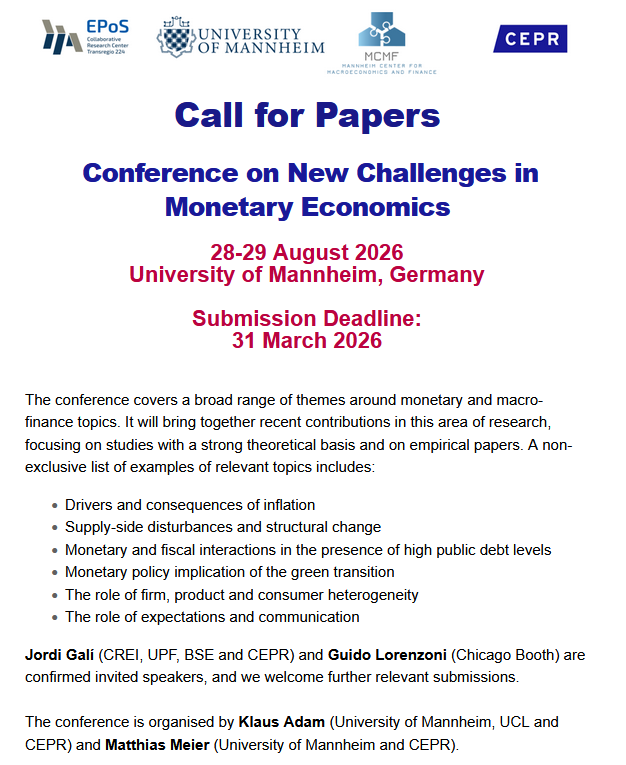
📢Call for Papers 𝐂𝐨𝐧𝐟𝐞𝐫𝐞𝐧𝐜𝐞 𝐨𝐧 𝐍𝐞𝐰 𝐂𝐡𝐚𝐥𝐥𝐞𝐧𝐠𝐞𝐬 𝐢𝐧 𝐌𝐨𝐧𝐞𝐭𝐚𝐫𝐲 𝐄𝐜𝐨𝐧𝐨𝐦𝐢𝐜𝐬 📝Mannheim, August 28-29 🚨Fantastic keynotes: Jordi Galí @CREIResearch and Guido Lorenzoni @ChicagoBooth 📅Deadline: March 31 My great co-organizer: @KlausAdam
Matthias Meier tweet media
English
1
32
118
13.8K
Lukas Hack أُعيد تغريده
Michael Bauer
Michael Bauer@michaelbauer_hh·
This Thursday Gernot Müller (@uni_tue) will kick off the new year for the Virtual Seminar on Monetary Economics, organized by @sffed and @cepr_org. He'll present his paper "Inflation Forecast Targeting Revisited". Join us at 11am Eastern via Zoom! cepr.org/events/event-s…
English
1
4
31
1.1K
Lukas Hack أُعيد تغريده
Ludwig Straub
Ludwig Straub@ludwigstraub·
🚨Application deadline coming up for our 2026 heterogenous-agent macro workshop in Frankfurt! June 8-10 in Frankfurt, Germany. Run with @a_auclert and Matt Rognlie. Hosted by @MathiasTrabandt. All the details are here 👉 tinyurl.com/GMTS2026 Apply by this Friday!
Ludwig Straub tweet media
English
1
29
122
22.2K
John Cochrane
John Cochrane@JohnHCochrane·
Absolutely! VARs in some sense answer what if there is a small transitory shock against a stable rule. The big question is, what if you change in rule. 1980-82 was a change in rule. Lots of historical analysis (Sargent 4 inflations) addresses that. Just pushing back no causality in macro.
English
2
2
25
2.8K
John Cochrane
John Cochrane@JohnHCochrane·
Not quite true. Chris sims vector autoregressons tried to find small exogenous movements in monetary policy, similar to and preceding micro techniques. Like micro not perfect, but important.
Cesar Chavez@CesarChavezP29

Last article of 2025. What would have happened if the Fed hadn't raised rates in 2022? You can't answer this with an RCT, DiD, or RD. That's not a failure, it's the nature of the question. Why macro never had a credibility revolution, and why that's not a bad thing. Link: carloschavezp29.substack.com/p/why-macro-ne…

English
5
13
148
27.7K
Lukas Hack أُعيد تغريده
International and Monetary Economics Network
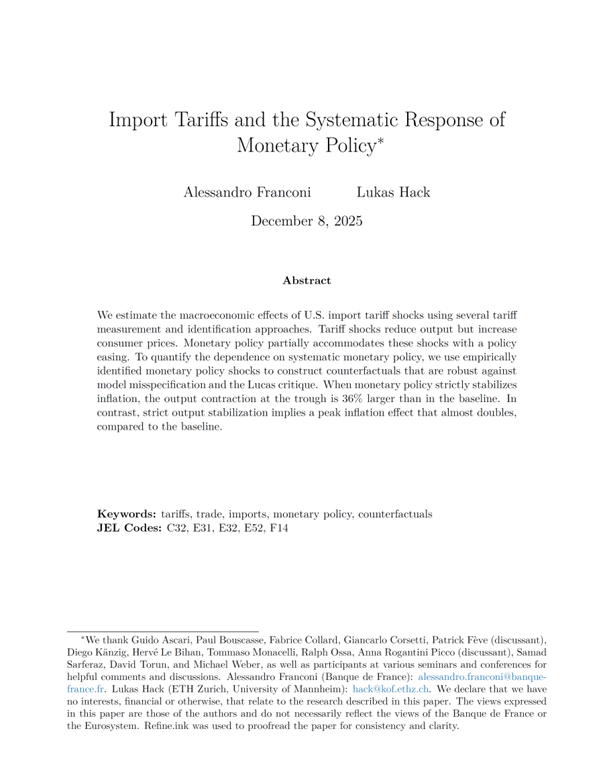
Highly relevant! "Import Tariffs and the Systematic Response of Monetary Policy" by Alessandro Franconi and Lukas Hack. "We estimate the macroeconomic effects of U.S. import tariff shocks using several tariff measurement and identification approaches. Tariff shocks reduce output but increase consumer prices. Monetary policy partially accommodates these shocks with a policy easing. To quantify the dependence on systematic monetary policy, we use empirically identified monetary policy shocks to construct counterfactuals that are robust against model misspecification and the Lucas critique. When monetary policy strictly stabilizes inflation, the output contraction at the trough is 36% larger than in the baseline. In contrast, strict output stabilization implies a peak inflation effect that almost doubles, compared to the baseline." papers.ssrn.com/sol3/papers.cf…
International and Monetary Economics Network tweet media
English
1
9
52
3.1K
Lukas Hack
Lukas Hack@LukasHack_·
🎄✨Are you looking for a Christmas read and have been wondering: ❓What are the macro effects of tariffs? How are these effects shaped by the systematic response of central banks? ❗A new paper with Alessandro Franconi provides an answer. 📝Paper: shorturl.at/Usn3o
Lukas Hack tweet media
English
0
18
84
5.3K
Lukas Hack أُعيد تغريده
Matthias Meier
Matthias Meier@MatthiasMeier1·
🚨Now publicly available: New monetary policy shock series Download link: matthias-meier-econ.github.io/files/HackIstr… A brief 🧵: 1/4
Lukas Hack@LukasHack_

I am very happy that my paper on the systematic origins of monetary policy shocks (joiint with @KlodianaIstrefi @MatthiasMeier1) is out as @banquedefrance Working paper: lnkd.in/eYkz7gfa We also made our new monetary policy shocks available: shorturl.at/239f6

English
1
19
73
10.5K
Lukas Hack
Lukas Hack@LukasHack_·
I had a great time presenting my research on bracket creep/fiscal drag at the @BancoDeEspana today! Thanks to @MortezaaGhomi for inviting me! The paper shows that imperfect adjustments of the tax code to inflation matter for the macroeconomy. Paper: shorturl.at/0QVwk
English
1
1
17
1.3K
Lukas Hack
Lukas Hack@LukasHack_·
Extensive margin price changes play an important role for inflation dynamics, as inflation and price adjustment frequencies correlate strongly during the inflation surge. But which macroeconomic news matter for these extensive margin price setting decisions? Tune in & find out
Central Bank Research Association@CebraOrg

🎄 Hello December! Join us for another exciting #CEBRA webinar on inflation. 🗓 Thursday, Dec 4 | 11:00 AM EST / 5:00 PM CET TOPICS: 🎤 @LukasHack_: “Which Macroeconomic News Matters for Price-Setting?” 🎤 Andrei A. Levchenko: “The Granular Origins of Inflation” Moderator: @hmontag3 (BLS) 👉 Sign up: us06web.zoom.us/webinar/regist… #Webinar #Macroeconomics #Inflation #Research #Economics #InflationRate
English
0
0
5
446