Shaker Cherukuri

10.9K posts

Shaker Cherukuri banner
Shaker Cherukuri

Shaker Cherukuri

@ProcessISInc

Agentic Workflows, Root Cause & Gap Analysis, AI Systems Engineering. Carbon in the Agentic loop. Golf & Travel. #IU #UofL $CMI $CAT $GE $GEV $BAH

انضم Haziran 2009
170 يتبع831 المتابعون
تغريدة مثبتة
Shaker Cherukuri
Shaker Cherukuri@ProcessISInc·
How Jet engines are powering Data Centers? $GEV GE Energy and $GE GE Aviation synergies would have created an epic combo right now for AI datacenter power needs with the Turbines design, manufacturing and supply chain scale and scope for Gas turbines and Jet Engines. They are separate companies now unfortunately. Caterpillar $CAT mentioned in this article owns Solar Turbines which manufactures industrial gas turbines for power generation. Cummins Inc $CMI not mentioned here has a power generation business that sells mostly diesel generators. The engine business for Cummins and Caterpillar sell the diesel engine to the power business and also other sectors like trucking, off highway, marine etc. Those sectors are also seeing demand boost from this AI datacenter buildout. GE Vernova Energy is also seeing a huge demand surge for it heavy duty gas turbines for the grid and microgrids for the datacenters. I worked at these companies in the past. Interesting to see this play out. The stock valuations of these firms are at all time high and still rising. Picks and shovels of AI datacenter buildout. wsj.com/business/energ…
English

0
0
1
459
Shaker Cherukuri أُعيد تغريده
Mark Cuban
Mark Cuban@mcuban·
We directionally agree. ✔️ Where we disagree is that employees will fully share, or even accurately share .their “corporate knowledge”. They are protective of that knowledge. Most of which is not documented anywhere. That’s their “edge”. They certainly aren’t going to share that with any system they believe to create a threat(s) to their job or future. Humans know they have an expiration date. AI doesn’t believe it expires. As far as “recursive”, I realize some see this as the holy grail and future of AI in companies, I think it’s great for anything with specified processes or anything built on math. Anything recursive that touches strategy will be a problem for a company. Why ? Because even though all companies will use different data, the results of recursive systems will start to look very similar to each other, diminishing any competitive advantage. AI is a “leapfrog” business. Much like software was back in the day. Every day, week, month, there are new features. You know this better than anyone. You are in a race But they all tend to end up in 90pct the same place. With that 10pct value being the reason why customers pick one over the other. Point being, that in early days the products seem very different. Over time they will be less and less so. Early adopters get an edge. But that edge dissipates. Being recursive isn’t the advantage it was expected to be We saw this with NBA analytics. When the Mavs were the first team to use analytics for everything, we had a huge advantage. We could trick teams into playing their worst lineups, because they didn’t even know what their worst lineups were Today, analytics have become an efficient market in the nba. Everyone has pretty much the same output and values per shot type. And, use the same or similar systems to get there. But players, like employees in enterprises, figured out what metrics they had to outperform to differentiate themselves. They learned to draw more fouls. To create and make mid range shots at a better percentage, because they knew that would be what defenses left open. Business is no different. They have to anticipate that in the next 5 years or so, everyone will have the same tools, info and knowledge, with deltas on the margin Which is exactly what has happened with every new tech. Over time the same shit is available to everyone. The early adopters, that iterated and executed the best, were the winners All of which is why I’m not a doomer. Why I don’t think there will be mass unemployment. The only layoff trigger will be upstart, native companies replacing incumbents. Or more likely get acquired by them. That’s the way I see it. But I could be wrong 🤷🏼‍♂️
Adam.GPT@TheRealAdamG

Very aligned. A few comments: 1. I think repaving and reinventing have a big Venn diagram overlap. I have gravitated to the word repaving to mean that the workflows that exist today in software will be reimagined via a first principals as AI stitched other with software as glue between the inputs and outputs of models. 2. The other part of this is data. Information and knowledge are both data problems. Human and systems data need to be integrated. Systems get connected with a semantic / metadata layer (aka not moving data, but integrating it so agents can access it). Here is what we did internally (openai.com/index/inside-o…) and those learnings + what our FDE teams learned are directly informing the “business context” layer of our Frontier platform (openai.com/business/front…). As for human data, that’s where the strength of the models + top down executive buy in are unlocking Enterprise customers is allowing for the accelerated mapping of things. Whether it is tribal knowledge, undocumented processes or legacy systems — today’s models (audio, visual understanding, computer use, etc) can be used as tools to ingest, break down and “understand” that human data and bring that unstructured data also into the context layer. Then you hill climb. With data connected, just like with “memory” in ChatGPT, there will be “organizational memory” for co mpanies. That will start to have a compounding effect. While we don’t have recursive systems yet, I think you start to get something that feels like. 3. Not doing this or some version of this is not an option. Some will lead and some will follow, but I think this new world we are going into is the real “digital transformation”. The internet and what got built on top of that was transformative, but I think it would look small in hindsight. However, it was an absolute prerequisite to get everything connected (as infra) to then layer on intelligence. As John Chambers used to espouse: “the network is the platform”. He was right, but also wrong where the value accrues. Companies will have no choice or they’ll just find themselves to be slow, laggards and under massive margin pressures. Things will just get “repaved” with AI as the substrate. I think we’ll see the first big waves of early adopters move at scale in 2026.

English
41
28
199
183.9K
Camus
Camus@newstart_2024·
Bryan Johnson (the guy spending millions to reverse aging) dropped his 5-sentence anti-aging diet: “Lentils, vegetables, berries, nuts, seeds, extra virgin olive oil. Avoid sugar, processed foods, fried foods, additives, and anything you can’t pronounce.” Bonus rule: He eats everything in a 6-hour window (last meal at 11 a.m.), then fasts 18 hours straight — says it’s the key to his elite sleep. Time-restricted eating (like his 6:18 pattern) improves insulin sensitivity, reduces inflammation, and boosts autophagy — all linked to slower biological aging in human trials. Do you eat in a tight window like this? Or do you think it’s too extreme for real life? Your take 👇
English
63
77
780
231.3K
Shaker Cherukuri
Shaker Cherukuri@ProcessISInc·
@BdrooDr @davidasinclair Age related improvement is common I was told. Eye ball elongation reduction with age. Could also be all the outdoor time spent golfing in last decade or so
English
0
0
1
32
David Sinclair
David Sinclair@davidasinclair·
Eye fact 👀: ~80% of people over 45 have reduced focusing ability & according to Japan’s Dr. K. Tsubota, the lack of violet light hitting our retinas, in part due to doctor’s recommendations to avoid sunlight, is a major cause of vision loss with age research-highlights.keio.ac.jp/2019/07/b.html
David Sinclair@davidasinclair

Every week, I tell one of my students to increase the font size on their slides, especially numbers. Here’s how you know you’re good: Take 5 steps back from your laptop or monitor. If you can still read every letter & number clearly, you’re probably good 👍

English
20
61
623
69.7K
Shaker Cherukuri
Shaker Cherukuri@ProcessISInc·
@mcuban Fortune 500 firms appear to be adopting a targeted approach for AI functionally and in BUs resulting in Operating Margin expansion (SG&A reduction). COGS reduction (for Gross Margin improvement) is lot harder and will come much later I think.
English
0
0
0
44
Shaker Cherukuri أُعيد تغريده
Mark Cuban
Mark Cuban@mcuban·
If my “repaving” you mean “reinventing “, yes. One of the challenges is that most corporate knowledge is still in someone’s head. Knowledge is far different than information. LLMs and agents can capture all the information it can touch, internally and externally to the company But there are things that you, me and everyone, security guards, salespeople, whoever, do to make the things we do fit the way we want them to. None of that shit is documented anywhere. You can give LLMs or Agents to employees to improve how they do their jobs. But that isn’t all that much impact for bigger companies. If you want to truly gain from AI, You can’t do it the way it was done, and just add AI. That’s why so many companies have struggled to get a return. Which I think is your point ? You have to reinvent your business to maximize the benefit from the tech. That is hard. There aren’t many CEOs capable of reinventing their company around tech they don’t understand. Nor are there many shareholders in public companies willing to allow them to take that chance. Let me rephrase that. There are ZERO public companies who will at this point, allow the ceo to wing it and reinvent the company around Ai. None. It’s one reason @costplusdrugs has been able to reinvent our manufacturing. We optimize to the technology and train and retrain our employees to fit it. Our public competitors can’t begin to consider what we do. You live this. Curious what you think about the above ?
Adam.GPT@TheRealAdamG

It feels like we are top of the 3rd inning. The models aren’t the problem, they’re smart enough now. Now it’s about applying them at scale. AI-enabling a process or workflow (like we’ve been doing) is one thing. But reimagining and repaving that process or workflow as AI-native is where transformational change will begin to occur — at scale. It goes slow until it goes really fast. I think that’ll be the story of 2026.

English
54
32
219
167.2K
Wassym Bensaid
Wassym Bensaid@WassymBensaid·
@Aurelien_Gz Love hearing this! - the design and software teams poured their heart and soul into every pixel.
English
4
0
131
2K
Aurelien
Aurelien@Aurelien_Gz·
the amount of craft behind the rivian website is beyond crazy.. at each interaction there is something mesmerizing happening
English
27
63
1.5K
119.5K
Shaker Cherukuri
Shaker Cherukuri@ProcessISInc·
@UziCryptoo Defined benefit probably. Not offered anymore. No pensions in most of the Private sector now.
English
0
0
0
97
Uzi
Uzi@UziCryptoo·
Spoke to a teacher from New York. Makes $140,000/yr with a 10 month schedule. Retires in 2026 with ~ $90,000/yr pension + full health benefits. Traditional careers like this can be game changers. Why aren’t more people doing this?!
English
531
39
1.7K
1M
Shaker Cherukuri أُعيد تغريده
Mark Cuban
Mark Cuban@mcuban·
That is not to say agents won't have value for you. There is a reason that the big online retailers like Amazon are doing all they can to stop agents from having access to their prices. They know their prices aren't the lowest, that they price not only to market, but to your price points. Could this be where Amazon takes a hit ? "Send your agent to our website to shop for everything. Actual shipping cost. Not member fees. We aren't afraid of your shopping agents! We welcome them " And what about companies like Temu and Shein..OMG. How do we even determine the tax domicile of a source when agents will do all work to determine how to mislead import offices ? And it's very feasible today to use AI to figure out the best selling products on Amazon and then just tell AI to knock it off. Literally. Only solution is a trust system where a vendor puts down a bond before they can sell anything to any person or agent in the USA , and allow everyone to compare that product to their own to determine if it's a knockoff or original. And after that 90 day review, gov AI agents approve or reject their ability to sell to USA residences. And if they do , the agent has to pay to the feds, their taxes, sales and estimated income tax , on each sale Shit gonna get crazy We need to start thinking about how we allow international companies access and how we protect our companies
English
86
38
443
178.2K
Mary Talley Bowden MD
Mary Talley Bowden MD@MaryBowdenMD·
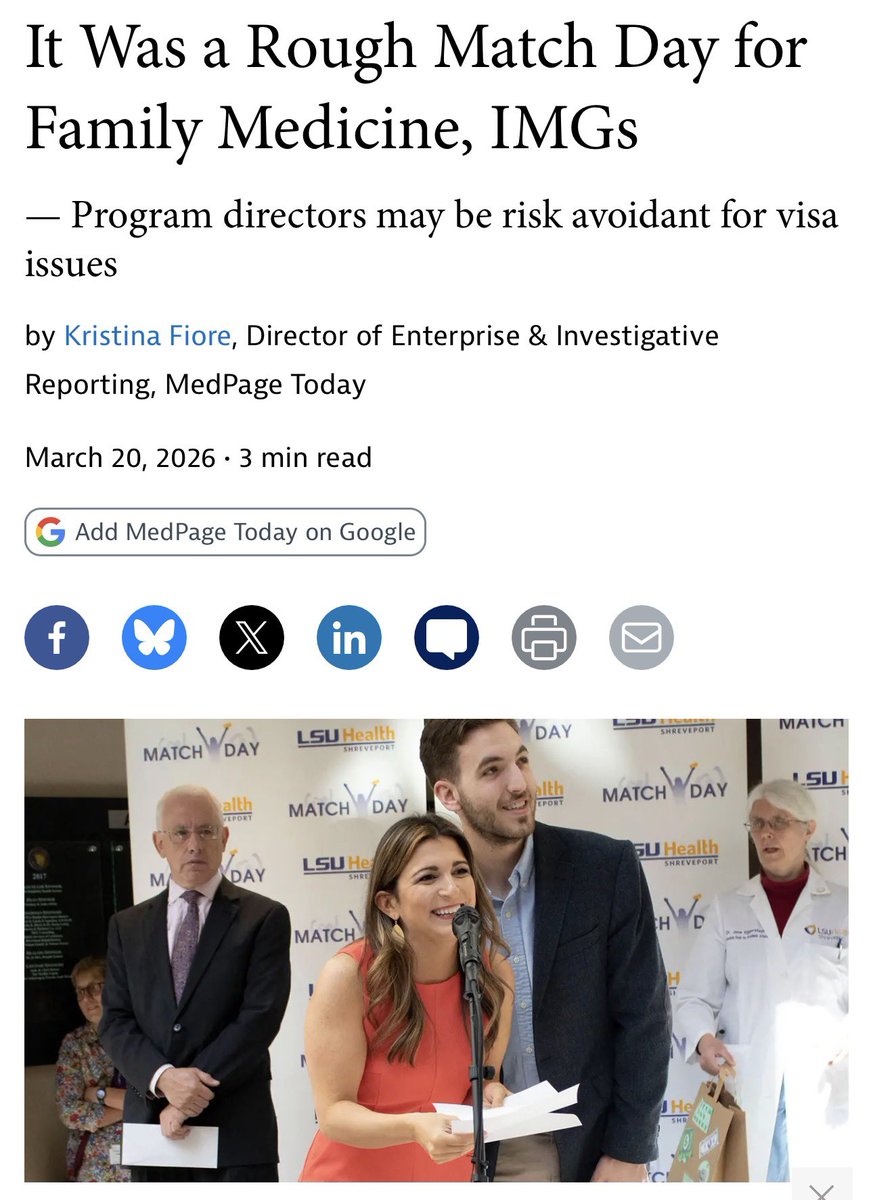
1367 US medical students did not get a US residency spot. 6733 international, non-US medical students got a US residency spot.
Mary Talley Bowden MD tweet media
English
2K
10.7K
24.9K
2.9M
Shaker Cherukuri أُعيد تغريده
APCI
APCI@_APCI·
$615,000,000 That’s how much a federal audit says #PBMs overcharged a government health program. And this happened under a “transparent” model. Reform isn’t optional anymore. #PBMReform #PharmacistsFightBackAct ow.ly/ry7i50YwZu2
APCI tweet media
English
9
53
132
50.6K
Shaker Cherukuri
Shaker Cherukuri@ProcessISInc·
@mcuban Used to go computer lab to use Unix workstation or PC in the 90s grad school. Before Netscape ipo.
English
0
0
0
212
Mark Cuban
Mark Cuban@mcuban·
I’m going to tell you how much worse it was at the start of the PC Revolution for white collar workers trying to adapt, vs today with AI Today, presumably every white collar worker has access to a smart phone and/or a PC/laptop. Back then, a PC cost $4,995 , an off brand was $3,995. 5k in 1984 is about $16k today. It was really expensive. The only reason I could learn how to code and support software is because my job let me take home a PC to learn. By reading the software manual. Literally. RTFM. Or pay to go to training. Classes that started at hundreds of dollars then. It was expensive. It absolutely limited who could get ahead. Today, ANYONE can go to their browser, to the AI LLM website of their choice, and type in the words “I’m a novice with zero computer background, teach me how to create an agent that reads my email and …” That concept applies to LEARNING ANYTHING Think about what this means. Any employee of any company can say “ I need to learn how to xyz for my job , which is to do the following: Tell me what more information do you need to help me be more efficient, productive and promotable”. Or “ what new skills can you teach me that will help me reduce my chances of getting laid off “. Or “what suggestions do you have for me to communicate to my boss, who I barely know, to help my chances of staying employed “ These aren’t great prompts. But they are a start that anyone can take. Think about how incredible that is. Back in the day was so much harder for white collar workers. It was harder for new grads because unless they took comp sci, they probably had never used a PC. Big Companies are going to cut jobs. No question about it. Small companies is are going to need more and more AI literate thinkers who can help them compete or get an edge What I tell every entrepreneur, and it’s more crucial today. “ when you run with the elephants there are the quick and the dead. Adopt tech quickly , you can out maneuver big companies. “
Mark Cuban@mcuban

An article from the 90s explaining how in the 1980s, personal computers changed the dynamic of college vs high school workers. College grads learned how to use PCs and grew wages faster Mind you, this was when interest rates were 15pct, white collar unemployment was the highest it’s been any non covid year, general unemployment was 10pct, there was a recession, 18pct mortgages, and the start of the savings and loan industry collapse. The economy was a mess. Except it was the start of the “digital revolution “ which lead to change. Here we are at the early days of the AI revolution. I think it will be very analogous to what happened back then. If you think learning how to use Clause seems daunting, imagine being 50 yrs old in 1983, not knowing how to type, using a 1.0 key adding machine with a tape roll to do all your work as an analyst and realizing you had to figure out how your brand new IBM PC and lotus 1-2-3 worked. Or having only used a typewriter your entire career , then having to learn the new PC and WordStar. Trust me. WordStar key combinations were far harder to learn than telling Claude what you want done Lots of people couldn’t figure it out. Those who did were more productive Ctrl QA with AI nber.org/digest/sep97/h…

English
325
459
4.4K
907.4K
Shaker Cherukuri أُعيد تغريده
Mark Cuban
Mark Cuban@mcuban·
An article from the 90s explaining how in the 1980s, personal computers changed the dynamic of college vs high school workers. College grads learned how to use PCs and grew wages faster Mind you, this was when interest rates were 15pct, white collar unemployment was the highest it’s been any non covid year, general unemployment was 10pct, there was a recession, 18pct mortgages, and the start of the savings and loan industry collapse. The economy was a mess. Except it was the start of the “digital revolution “ which lead to change. Here we are at the early days of the AI revolution. I think it will be very analogous to what happened back then. If you think learning how to use Clause seems daunting, imagine being 50 yrs old in 1983, not knowing how to type, using a 1.0 key adding machine with a tape roll to do all your work as an analyst and realizing you had to figure out how your brand new IBM PC and lotus 1-2-3 worked. Or having only used a typewriter your entire career , then having to learn the new PC and WordStar. Trust me. WordStar key combinations were far harder to learn than telling Claude what you want done Lots of people couldn’t figure it out. Those who did were more productive Ctrl QA with AI nber.org/digest/sep97/h…
English
168
217
1.8K
1.2M