The Protestant Philosopher

2.7K posts

The Protestant Philosopher banner
The Protestant Philosopher

The Protestant Philosopher

@ProtPhilosopher

Building a Philosophical Defense of Protestantism | Dr. Christopher Cloos

انضم Ocak 2022
571 يتبع1.9K المتابعون
تغريدة مثبتة
The Protestant Philosopher
The Protestant Philosopher@ProtPhilosopher·
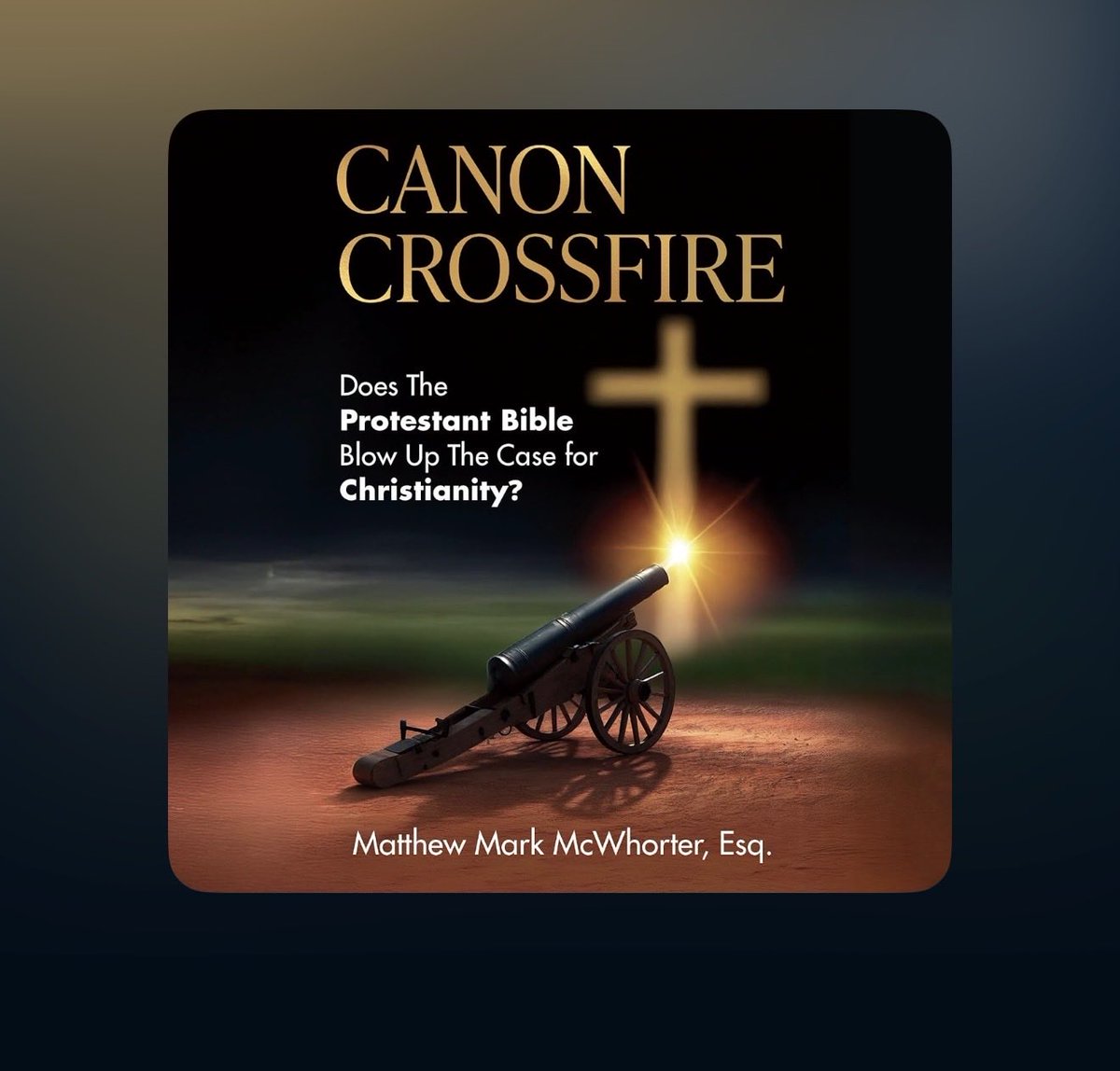
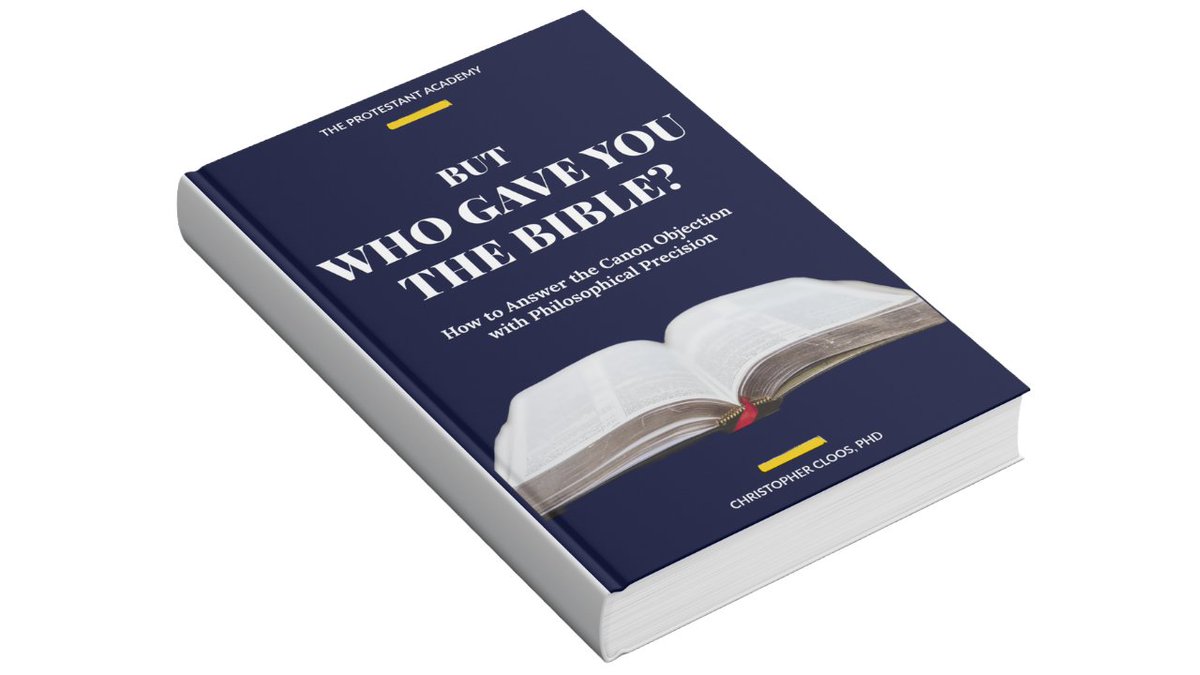
"But who gave you the Bible?" Most Protestants freeze when they hear this. I wrote a free guide that shows you how to answer the Canon Objection to Sola Scriptura with philosophical precision. Get your free guide now: protestantacademy.com
The Protestant Philosopher tweet media
English
10
5
45
2.7K
The Protestant Philosopher
The Protestant Philosopher@ProtPhilosopher·
Thanks for your reply. Let me address each point. 1. Yes, "multiple councils and synods before Trent listed the 73-book canon, including the Ecumenical Council of Florence," but the question is what the status of those councils imply about the status of the canon. Though all three lists were materially identical, they weren't normatively identical, and none of the lists were binding or dogmatic. Cajetan was writing 90 years after Florence, which is arguably the strongest case for the 73-book canon pre-Trent, and said this about the deuterocanonicals at the end of his commentary on Esther: "And in this place we conclude the commentaries on the historical books of the Old Testament. For the rest (i.e., Judith, Tobit, and the books of the Maccabees) are reckoned by divine Jerome as outside the canonical books and he places them among the apocrypha, with the book of Wisdom and Ecclesiasticus, as is clear in the Prologus Galeatus. Nor ought you be disturbed if you find somewhere those books reckoned among the canonical, whether in the sacred councils or among the sacred teachers. For the words of both councils and teachers ought to be brought back to the revision of Jerome, and according to his opinion expressed to bishops Chromatius and Heliodorus, those books (and if there are any other similar in the canon of the Bible), are not canonical, i.e., are not normative (regulares) to confirm those things which are of the faith. But they can be called canonical (that is, normative) for the edification of the faithful, as received and authorized in the canon of the Bible. For with this distinction you can discern the things said by Augustine in book 2 of De doctrina christiana, and written in the Council of Florence under Eugene IV, and written in the provincial councils of Carthage and Laodicea, and by Popes Innocent and Gelasius. To the praise and glory of Almighty God, at Rome in the year of salvation 1532, but in the 64th year of my life, on the 19th day of July, Amen." [Ref: Thomas de Vio, In omnes authenticos Veteris Testamenti historiales libros, commentarii (Paris: Soleil d’Or, 1546), 481v–82r.; as quoted in Gallagher, E. L. (2025). The Apocrypha through History. Oxford University Press] So, the Cardinal very high up in the Church, who was tasked with putting Luther in check, argued that the council of Florence ought to be read in light of Jerome's distinction between the canon proper, which has books that can confirm doctrines, and the apocryphal books that should be read only for edification. This shows that right until the eve of Trent the canon was not settled at the highest levels of the Church. So that the lists appeared in councils that didn't dogmatically define the canon doesn't cut much ice. 2. You say, "No one contests that Jerome struggled with this,... But he did outwardly comply with Rome." I'm not sure what you mean by "outward compliance." If by this you mean he did his job of translating the apocrypha, then that's doing what the Church tasked him with doing. But he "outwardly" and "visibly" relegated those 7 texts to a secondary status, a non-canonical status. And that matters the most when it comes to discerning his impact on the Medieval manuscript tradition that upheld his smaller canon, and it matters how others like Cajetan thought those books should be judged in light of Jerome's canonical distinction, which traces back to way before Jerome. 3. This point is confused. You say that because Jerome allowed the apocrypha to be read in Church and most Protestants don't read them in Church that I can't use Jerome, who was your own Church's greatest translator of the Bible, in making a point about the status of those books regarding the canon. I can agree that the 66-book Bible is canonical because it contains the very books Jerome himself would endorse as canonical. That he allowed other books to be read for edification, and that modern Protestants don't by and large do that, doesn't mean I can't reference Jerome on the status of those books as lesser on the very issue of their canonical status. The point you're making is a red herring at best and completely confused at worst. 4. You again make a mistake regarding history. You say, "Jerome is an outlier and is not the Pope or magisterium." Jerome is not an outlier, tough he's obviously not the Pope or magisterium. He represents a tradition, a robust tradition, of Catholics endorsing a smaller canon. Jerome is no minor figure or mere outlier in this regard. Through his translation work and its impact on Medieval manuscript tradition, he exerted a huge impact on the Church. Further, I can set Jerome aside and simply note that one of today's best scholars on the history of the deutrocanonicals had this to say at the end of his detailed historical exposition of their histories. This is right before he discusses Trent, "As the mid-sixteenth century approached, the Catholic opponents of Luther and his movement did not maintain a uniform position on the status of the deuterocanonical books." [Ref: Gallagher, E. L. (2025). The Apocrypha through History. Oxford University Press, p. 172]. Again, until the eve of Trent there wasn't a "uniform position on the status of the deuterocanonical books." It took making denying them anathema for those books to be officially, dogmatically made "canonical" according to the Catholic Church. But, even then there was decent and the matters passed with a mere 44% yes vote. So I wrote a letter to clarify the factual errors in your original letter to Protestants and you've replied to me with red herrings and more errors. Again, you're telling a just-so story that doesn't reflect the actual historical details and its nuance.
English
0
1
6
162
Dr Taylor Marshall™️
Dr Taylor Marshall™️@TaylorRMarshall·
Good post, but you need a couple of corrections: 1) Multiple councils and synods before Trent listed the 73-book canon, including the Ecumenical Council of Florence. 2) No one contests that Jerome struggled with this, and disagreed with Augustine and most 4-5the century saints on the matter. But he did outwardly comply with Rome. 3) Jerome still explicitly teaches that the deuteros should be read in church for the edification of the people. 99% of Protestants would burn down the church if Pastor Jim started reading from 2 Maccabees on Sunday morning. This proves they still disagree with Jerome’s position. You can't claim Jerome because you disagree with his acceptance of their being read for edification in the liturgy of the church. 4) Jerome is an outlier and is not the Pope or magisterium.
English
21
23
409
5.9K
The Protestant Philosopher
The Protestant Philosopher@ProtPhilosopher·
I noticed several errors in Dr. Taylor Marshall's letter to Protestants. So I offer a corrected version below, addressed to Catholics. Dear Catholics, Your Bible contains 7 non-canonical books, added by the Council of Trent in 1546 over the objections of your own best bible scholar. Marshall says Jerome "changed his mind" about the deuterocanonical books around 402 AD in obedience to Pope Damasus. I've read Jerome's prefaces. This doesn't hold up. Damasus died in 384. Jerome wrote his famous Prologus Galeatus in 391. It excluded the deuterocanonicals as part of the canon. He labels these books as apocrypha. That's 7 years after Damasus was gone. That's not obedience to a living pope. The quote Marshall uses from Against Rufinus, which reads "What sin have I committed if I followed the judgment of the churches?", isn't about the canon. It's about Jerome's decision to translate from the Hebrew instead of the Septuagint. Rufinus attacked him for it. Jerome defended himself. In context, he's talking about translation method, not about which books belong in the Bible. And Jerome didn't stop his take. I've quoted these before, but here he is for the next 24 years of his life: 391: "Whatever is outside of these is set aside among the apocrypha." 398: The Church reads Tobit and the Maccabees "not for the authoritative confirmation of ecclesiastical doctrines." 405: Tobit is excluded from "the catalogue of Divine Scriptures." Judith is "considered among the apocrypha." 406: Cites the Book of Wisdom with "if one wishes to accept this book." 415: Still distinguishing Wisdom ("lest you gainsay this volume") from Ecclesiastes ("about which there can be no doubt"). This is one of his last works. Gallagher, a top scholar on Jerome on the canon, explains, "All of our evidence indicates that he always considered them outside the canon." Jerome never retracted. He never published a revised list. Never wrote "I was wrong." He translated Tobit and Judith under pressure, finished each in a single day, and attached prefaces denying them canonical status. That's not submission. That's a scholar doing what he's told while making sure everyone knows what he thinks. Dear Catholics, please drop the fan fiction that Jerome submitted to Rome on the canon. He held the same position from 391 until he died in 420. And Trent overruled him 15 centuries later by a vote of 24(Y)-15(N)-16(A). It passed by 44%. Not exactly a passing grade. Surely not one I'd write letters to Protestants about.
Dr Taylor Marshall™️@TaylorRMarshall

Dear Protestants, Your Bible lacks 7 canonical books, removed by Martin Luther and John Calvin as “Apocrypha”. Protestants often quote Saint Jerome to justify this removal. Saint Jerome later changed his mind about the 7 deuterocanonical books in obedience to Pope Damasus. His famous quote from the Helemeted Preface (quoted daily by Protestants) doubting the 7 deuteros dates from 391. Nine years later he wrote that he had submitted to the Catholic position and rejected his private opinion. Can Protestants please drop their fan fiction that Jerome was a Proto-Protestant? Later in life (in Against Rufinus around 402 AD), he defended the Church's judgment on the 73-book canon saying, "What sin have I committed if I followed the judgment of the churches?"

English
61
59
381
34.2K
ZZZZZZIFFSTER
ZZZZZZIFFSTER@IFFFMEISTER·
@ProtPhilosopher neither of you (respectfully) are really right about this. It's more nuanced than the way either is presenting this
English
3
0
4
1.3K
The Protestant Philosopher
The Protestant Philosopher@ProtPhilosopher·
An officially endorsed Catholic Encyclopedia says the opposite of what you suggest. The deuteros weren't made standard because they appeared on a list at regional councils. Rather their status was in dispute through the whole period you're referring to, as the encyclopedia indicates, "Few are found to unequivocally acknowledge their canonicity. The prevailing attitude of Western medieval authors is substantially that of the Greek Fathers." The Greek Fathers excluded them. If the 73 book canon had the kind of widespread acceptance you're describing, the Catholic Encyclopedia wouldn't describe the medieval period as ongoing hesitation.
English
0
0
1
5
Bible Study Faithful to the Magisterium
@ProtPhilosopher was made the standard in the West because of those canonical judgements. While some codices may have had local variants like those found in the Orthodox canon, they were exceptions to the rule and never gained widespread acceptance in the West the way the 73 book canon did.
English
2
0
0
29
The Protestant Philosopher
The Protestant Philosopher@ProtPhilosopher·
"But who gave you the Bible?" Most Protestants freeze when they hear this. I wrote a free guide that shows you how to answer the Canon Objection to Sola Scriptura with philosophical precision. Get your free guide now: protestantacademy.com
The Protestant Philosopher tweet media
English
10
5
45
2.7K
The Protestant Philosopher
The Protestant Philosopher@ProtPhilosopher·
@KennethGriswold Liturgical judgments are not equivalent to canonical judgments. A text can be part of liturgy without that equating to an endorsement of that text as canonical.
English
0
0
1
8
Bible Study Faithful to the Magisterium
@ProtPhilosopher Whole Catholic rites in the West used the Deuterocanonical books in the same way as they treated any other Scripture in the Liturgy, for example. The use of the Deuterocanonical part of Daniel is so ancient in the Divine Office (in a part that is Scripture on other days)...
English
2
0
0
31
The Protestant Philosopher
The Protestant Philosopher@ProtPhilosopher·
The Vulgate is an interpretation. And Jerome did his job faithfully because he was told to do so, but he also attached a disclaimer in the preface, "This preface to the Scriptures may serve as a helmeted introduction to all the books which we now turn from Hebrew into Latin, so that we may be able to know that whatever is outside of these is set aside among the apocrypha. Therefore, Wisdom, which is commonly ascribed to Solomon, and the book of Jesus son of Sirach, and Judith and Tobit, and The Shepherd are not in the canon." Attaching a disclaimer saying that those books aren't canonical isn't making a judgment that they are canonical. And the regional councils of Rome, Carthage, and Hippo weren't universally binding on the Church.
English
0
0
1
10
Bible Study Faithful to the Magisterium
@ProtPhilosopher I don't know how you can say that the Vulgate is not a canonical judgement. Just because Jerome didn't like the canonical judgement made, doesn't mean that Rome, Carthage, and Hippo weren't trying to make definitive lists of Scripture, nor does it negate that the Vulgate...
English
2
0
0
27
The Protestant Philosopher
The Protestant Philosopher@ProtPhilosopher·
There's a lot I could say here, but let me be brief. Convergence occurs when independent opinions across time universally and naturally come to agree on the canonical status of a set of texts. The 27 book NT is a perfect case in point. Though there were a couple of centuries of dispute of the edge cases, or the so-called antilegomina like Hebrews and Revelation, that disagreement converged into those books being canonical. Contrast that with the deuterocanonicals. There's a long, well-attested tradition dating back to Jerome showing that the deuterocanonicals were regarded as edifying but not possessing canonical status. That tradition continued for a thousand years until a 44% vote at Trent made not including them in the canon anathema. That they were included in the Vulgate or referred to as Scripture doesn't equate to them being regarded as canonical for the years 400 - 1500 as you suggest. Ancient Churches used them as edifying for faith and practice, but that's not the same thing as judging them canonical. Further, the deutrocanonicals haven't achieved that natural, independent, universal assent that's the hallmark of convergence. Protestants continue to make Jerome's distinction that they are non-canonical.
English
0
0
1
6
Bible Study Faithful to the Magisterium
@ProtPhilosopher How can you say "convergence on the Deuteros never arrived." Please define what "convergence on" something means, because the overwhelming majority of Christians from 400 - 1500, and every faithful Catholic, Orthodox, and other Christian if the ancient Apostolic churches use them
English
1
0
0
13
The Protestant Philosopher
The Protestant Philosopher@ProtPhilosopher·
@KennethGriswold On begging the question, I'm not assuming nothing else has divine causality. I'm arguing it. In my complete work I have an exclusionary argument showing nothing else could occupy the position of being the sole infallible norm of faith and practice.
English
0
0
1
9
The Protestant Philosopher
The Protestant Philosopher@ProtPhilosopher·
I'm not arguing "Aquinas was right about everything, so his metaphysics proves my canon." I'm using Aquinas's metaphysics of exemplar causality because the argument is good and because they are Catholic-friendly metaphysical commitments. I'm trying to start from shared assumptions and show what they entail. You're free to reject the Thomistic distinctions regarding causality, but that puts you at odds with your own tradition. Further, a Protestant like Turretin applies a very similar model of causality to Scripture. And it's a genetic fallacy if you're simply crying foul because I'm using a part of Thomas's view of causality.
English
0
0
1
11
Bible Study Faithful to the Magisterium
@ProtPhilosopher Is the intellect of St. Thomas not a "properly functioning intellect"? If not, why are you using him to come to conclusions about God? I also HIGHLY question your judgement about how the metaphysical qualities of God translate to that which He inspires. Lots of assumptions.
English
1
0
0
16
The Protestant Philosopher
The Protestant Philosopher@ProtPhilosopher·
On the Thomas point, I'm not claiming that every individual person will arrive at the correct canon on their own. The self-authentication is a corporate promise, not a guarantee each individual with arrive at the correct canon. That's why I emphasize convergence across time. Aquinas's intellect was properly function. He also lived in a tradition inherited from the Vulgate. The fact that someone like Aquinas could be impacted by his Church context is what I'd expect. The key is what the community across time arrived at and converged on. Convergence on the deuteros never arrived.
English
1
0
0
6
Bible Study Faithful to the Magisterium
@ProtPhilosopher Okay, I found the self-authentication one after some more careful reading. I find it ironic that you claim that God's truth is "self-evidencing to a properly functioning intellect" while using the St. Thomas to make your metaphysical claims while ignoring the canon he recognized.
English
2
0
0
14
The Protestant Philosopher
The Protestant Philosopher@ProtPhilosopher·
Regarding the mapping between the tiers and how you go from the divine attributes to the textual attributes, I'm working on an article that explicitly draws all the connections. They're many-to-many mappings, so while I can't rehearse them all here, I can just mention that I'm not hand wavy about that. I actually make all the connections in detail.
English
0
0
1
8
Bible Study Faithful to the Magisterium
@ProtPhilosopher I also don't understand how you got from the 5 metaphysical qualities (shouldn't omniscience be in this category too,so 6?) and that in the "1st tier" to either form of sufficiency, perspicuity, or self-authentication.
English
4
0
0
116
The Protestant Philosopher
The Protestant Philosopher@ProtPhilosopher·
You're asking good questions. Omniscience is in the communicative tier because it directly governs the content of a communicative act. That is, God as omniscient knows everything that needs to be communicated. That's a communicative perfect, not just a metaphysical one. The other ones are in the second tier because they don't directly govern communicative content. Rather, they govern normative standing of what the author creates. So, omniscience tells you what goes in the communication. And something like soverignty tells you where it stands in relation to other sources. Those are different roles.
English
0
0
1
64
The Protestant Philosopher
The Protestant Philosopher@ProtPhilosopher·
Yes, I'd be glad to expand on that. The responses get things going in the direct direction, but they're not the full explanation. The vulgate is a physical codex. It's not a canonical judgment. And those manuscripts came with Jerome's preferences, which said the deuteros are not for the authoritative confirmation of Church doctrines. And other codices have different amount of books and variations on books. So, if being included in a codex is equal to canonicity, then there's other books in other codices that need to be added to your 73 books, which is bigger than the canon Rome endorses. Whatever the criterion you use to exclude the extra 4+ books in other codices and canons, that judgment wasn't in a codex. Which means that being included in a codex wasn't the criterion all along. A codex is like a table of contents, while a canon is a theological judgment. And, as the reply in the guide you quoted says, "show me a 73-book Bible before Trent," as the judgment wasn't made until Trent.
English
2
0
0
72
Bible Study Faithful to the Magisterium
@ProtPhilosopher I just glanced at this. Your answer to the "show me a 66-book Bible before Luther" is "show me a 73-book Bible before Trent"? Am I misunderstanding ? Every standard version of the Vulgate for 1000 years would have been a 73 book Bible. I imagine there are still 100s existing.
English
1
0
0
114
Tim Williamson
Tim Williamson@timwmson·
Hoping that @gavinortlund hosts @ProtPhilosopher for a discussion along the lines of the Attribute Inscripturation Thesis soon. This is incredibly helpful and edifying thinking!
The Protestant Philosopher@ProtPhilosopher

I feel like we've discussed this already, but let me explain it again. Let me first clarify that the whole thing isn't riding on Jerome, as you suggested. He's a key proponent of a tradition throughout your Church's history. It's one that views the deuterocanonicals as being non-canonical but edifying. This tradition pre-dates the councils in the late 300's. So, the whole thing isn't riding on Jerome. That said, let me mention the big picture. The big picture is that what you have are citations by Jerome. What I have are canonical judgments. These are different categories, as I explained in another reply. Top Jerome scholar Edmon Gallagher has concluded that you can't infer from Jerome citing them as Scripture to that being equal to, or a reliable guide to, how he views their canonical status. Why? Mainly because at the same time Jerome is citing them as Scripture he's declaring them non-canonical. For instance, Jerome cited Wisdom as "Divine Scripture" and then wrote "if one is pleased to receive this book" when citing the same book in his Commentary on Zechariah (406). He cited Sirach authoritatively and then wrote that the Church reads these books "not for the authoritative confirmation of ecclesiastical doctrines" (398). He "defended" the additions to Daniel as read in the Church and then wrote in the same commentary that they "exhibit no authority as Holy Scripture" (407). He quoted Baruch and then called it "totally unworthy of treatment" in his Commentary on Jeremiah (414-420). So, you're confusing citation practice with canonical judgment. The Fathers themselves distinguished these categories. Athanasius cited Wisdom as "Scripture" and the Shepherd of Hermas with "it is written" while excluding both from the canon. Jerome did the same thing. Your list shows he valued the books. His own formal statements, often in the same books you're citing, say the opposite.

English
2
1
4
355
The Protestant Philosopher
The Protestant Philosopher@ProtPhilosopher·
Thanks, Wes, for your response. You did make a good point regarding sin, but you've largely not offered an argument in reply to the points I keep raising. I'll be more direct in this regard. In your last reply, you say you're not moving the goalposts. But I quoted you back to you. You raised a case involving disagreement over book Z that centrally depended on disagreement generating the normative pressure. I responded to it. Then you said disagreement isn't doing the work. When I pointed this out with your own quotes, you said disagreement "makes visible" the underlying issue. But, that's moving away from how you originally formulated and pressed the issue. It's fine if your position changed, but let's not pretend the formulation hasn't shifted. That's the goalposts shifting without you acknowledging it. You then say even if everyone agreed, the authority of the canon "still depends on each person's judgment that the agreement is correct." No. It doesn't. The authority of the canon depends on God's authorship, as I've been arguing and you still haven't addressed. Judgment is the means of recognition, not the source of authority. What you keep doing is collapsing the epistemic question into the ontological one. "How do you know?" is a different question from "What makes it authoritative?" And the Catholic structure is similar in this regard. The authority of the Magisterium doesn't depend on your judgment, but your access to it goes through your judgment. If access going through fallible judgment undermines the thing, your model fails also. On the sin analogy, you say I'm making a trivial point and that it's confusing to hear from a philosopher. I'll return the compliment. You're equivocating between two different kinds of authority. The moral law is authoritative because God is its author. Its enforcement is divine judgment, which both of us affirm. The Magisterium's teaching on contraception is authoritative because the Magisterium says it is. If the enforcement mechanism for the Magisterium's teaching reduces to "God will judge sin," then the Magisterium isn't adding anything to the picture that my model doesn't already have. I also believe God judges sin. I also believe pastoral correction happens within the life of the Church. As I repeatedly pointed out, Protestant churches have real authority in the way you described. So what is the Magisterium adding? You said it provides a trans-communal authority that "binds the Church as such." I asked how that binding actually works in practice. You responded by describing divine judgment and pastoral correction, both of which exist in my model. So I ask you to please identity what function your trans-communal authority performs that confessional Protestant churches don't. Otherwise all you're saying is that your model takes a wider scope, which, given it's a bigger church, isn't much of a point. Regarding self-trust, you say the issue isn't whether self-trust is involved in recognition but "whether it remains the ultimate determiner of doctrine." I've argued across multiple replies that self-trust does remain the ultimate determiner on your model. You haven't engaged those arguments. You just keep repeating your position that on the Catholic model, private judgment ceases to be the final court of appeal. But restating your position isn't the same as defending it. If those arguments are wrong, tell me where they fail. If they're right, your discontinuity story is a piece of fiction. You end by saying, "it doesn't follow that God must provide revelation in a self-interpreting form rather than alongside a living authority to adjudicate its meaning." So, despite how you editorialize your own argument, you're saying what I thought you were saying. You're saying Scripture, on its own, isn't sufficient to do the work it was designed to do. It needs an institutional authority alongside it to adjudicate its meaning. But if God is the primary author of Scripture, and God is essentially wise, loving, and good, then the text he authored communicates what it was designed to communicate. To say it needs an additional institution to adjudicate its meaning is to say something about God's communicative act was deficient. Was God not wise enough to produce content accessibly? Not loving enough to give his people a usable gift? Not good enough to provide fair epistemic access to the truths they need for salvation? You've arrived at the place my Attribute Inscripturation Thesis is designed to address. So all of the questions I raised at the end of my last reply still apply. Why would a perfectly wise, loving, and good God arrange the text so poorly that there's this whole other complex institutional layer needed just to have Scripture do the work it's designed to do in binding the conscience? Or do you deny that God is the primary author of Scripture? Or do you deny that he is perfectly wise, loving, or good? Or do you claim that Scripture contains errors or possibly could? I look forward to your direct response to these questions. Thanks again for our exchange. Blessings.
English
0
0
1
48
Wes
Wes@WesleyBancroft·
Just a quick response: I’m not moving the goalposts. Disagreement just makes visible the underlying issue which is where authority is located even apart from disagreement (this has always been my point if I have not communicated it clearly). Even if everyone agreed, on your model the authority of the canon still depends on each person’s judgment that the agreement is correct, so the structure hasn’t changed. I’m not assuming a Catholic answer (yes I happen to be Catholic), my question is just an inquiry: what in your paradigm actually binds the Church as such rather than merely describing agreement within communities? That’s where your model lacks a trans-communal authority wherein a believer can exit a community based on their own judgement. Now the contraception points. This seems like a completely trivial point and is confusing to hear coming from a philosopher: lack of enforcement doesn’t negate authority which is also the case within your paradigm. Sin isn’t “enforced”. This is basic moral theology, and within a Christian context is obvious. Did the Reformers “enforce” their unanimous beliefs on contraception? Contraception is 99% of the time a choice made in private either way, so its enforcement is not even feasible. The Church formally condemns all artificial contraceptive acts as sinful just as every Christian had for 2000 years. So what you are saying is that sin is a paper tiger? I hope that’s not the case. If a person came out and said they do not adhere to the doctrine non-contracepting acts (or any doctrine for that matter) they would be held accountable to God’s judgment just as they were prior to Lambeth. Not sure if you are aware of what excommunication entails but committing sin willfully and publicly is not *necessarily* one of them. If you are living within the Church and participating in the Christian life you would definitely be chastised, corrected and called to repentance for committing such a sin, whether a Priest, Deacon, spiritual director or faithful friend who follows what the Church has formally called a binding doctrine. Again, sin is not a “paper tiger”. Disobedience to an authority that claims the right to bind conscience is the issue at hand, and in your model authority collapses when not voluntarily accepted. Self-trust doesn’t solve this, because the issue isn’t whether self-trust is involved in recognition, but whether it remains the ultimate determiner of doctrine, and in your model it does. And appealing to Scripture’s divine ontology doesn’t answer the epistemic question of who has the authority to identify and interpret it for the Church nor does it follow that God must provide revelation in a self-interpreting form rather than alongside a living authority to adjudicate its meaning, which Scripture gives testimony to as a paradigm of authority.
English
1
0
0
67
CATHOLIC MAXIMUS
CATHOLIC MAXIMUS@EcciusMaximus·
His logic is that Jerome has the ultimate authority in deciding the 7 deutercanonical books which is why he cited the year (391ad). Ok let’s play that out, here are quotes post 391ad where St Jerome states the 7 deutercanonical books are divine scripture, that’s roughly 95% of his life for those keep track, there are books & books of quotes from him so just adding a few. Also, Protestants, pls stop using St Jerome, he was 1000% Roman Catholic (St. Jerome - Contra Vigilantium (Against Vigilantius, ch. 6)🇻🇦 <<< Post-391 quotations >>> • c. 393–397, Commentary on Ephesians written in Bethlehem quotes Sirach 2:1 as “Divine Scripture says” and Wisdom 1:4–5 as “authoritative” on the Holy Spirit. • c. 396–398, Against Jovinian 1.4, 1.26, 2.15 he cites Wisdom 3:13, Sirach 26:19–21, Tobit 12:8–9, Judith 8:25–27 as normative proofs for virginity, almsgiving, and martyrdom. • 398–404, Commentary on Matthew he cites Sirach 5:13 and Wisdom 1:11 as “Divine Scripture.” • c. 406–408, Commentary on Daniel he defends the deuterocanonical additions to Daniel as read in the Church and uses them exegetically. • c. 414–416, Dialogue against the Pelagians 1.25–26 he quotes Wisdom 1:5 and Sirach 15:11–17 as authoritative on free will and grace. • 417–419, Letter 133 to Ctesiphon he quotes Sirach 15:14–17 as “Divine Scripture says.” • Post-410)l, Jerome quotes Baruch 3:36–38 “This is our God… seen on earth and conversed with men.”
The Protestant Philosopher@ProtPhilosopher

Fr. Mike Schmitz says "one guy in Germany" took 7 books out of the Bible. Luther's 1534 Bible included them. Jerome denied their canonical authority in 391. Fr. Mike's fish story keeps getting bigger. New article: protestantreview.substack.com/p/did-luther-c…

English
4
17
103
5.5K
The Protestant Philosopher أُعيد تغريده
The Protestant Philosopher
The Protestant Philosopher@ProtPhilosopher·
Hi Wes...Thanks for your reply. I must admit that I'm struggling to nail down your objection. It might help if i just include quotes from what you've said. It feels like you raise an objection, often a very sharp one, then I respond to it, and then you say that wasn't your objection. It feels a bit like the goal posts keep getting moved. Let me try to explain why and then you're welcome to have the last word or prompt me with more questions if you feel like continuing. In your last reply, you distanced yourself from disagreement doing any work in your objection. But just a few replies back you raised a really good case that centrally revolved around disagreement. You said: "Suppose Books A–Z actually possess the divine properties necessary. You conclude that A–Z are canonical, while I conclude that only A–Y are. Both of us could still say, 'These books are objectively canonical whether or not we recognize them,' so the real question immediately returns: who has the authority to settle the dispute and bind the Church’s judgment? If recognition is fallible and grounded in our assessment of textual properties, your account seems unable to explain why one identification of the canon should obligate believers over another." As I said a minute ago, disagreement is the engine driving this way of putting your objection. It brings out the structural issue in an important way regarding Sola Scriptura. Disagreement between book Z being canonical or not, when it in fact is, is what undergirds or pressures me to "explain why one identification of the canon should obligate believers over another." The disagreement generates questions concerning obligations. This is a great point because Sola Scriptura has a normative dimension and you're suggesting this case of disagreement, given SS, entails there's no way to definitively resolve the disagreement in terms of what believers ought to believe. Now, notice what happens when you abandon the disagreement piece, as you just did in your latest reply. You said, "even if EVERYONE agreed, on your model the authority of the canon and its content still depends on each person’s fallible judgment that these are the right books and the right interpretations." But, this is false. If everyone agreed on the canon, that wouldn't bring out or entail that on my model everything is riding on fallible judgment. The unanimous convergence would be strong, if not conclusive, confirmatory evidence. It would show that judgment is not in any problematic way relying on individual private judgment. Rather, it would show our recognition is accurate and veridical and tracking the very objective properties inherent in the text that make it fit to be the sole norm of faith and practice. That is, without the pressure from a case of disagreement your objection becomes very standard. It's the kind a Protestant can easily dispatch with the distinction between recognition of authority vs. constitution of authority. What made your objection interesting for me was that it wasn't such a stock Catholic objection. Something real seemed to hang on the case involving disagreement. In your last reply you continued with a "deeper problem." You want a Church-wide binding authority. But, if this really is your objection it begs the question in favor of the Catholic model. That is, you're proposing criteria only a top-down monarchical model could satisfy, which obviously the bottom-up local jurisdiction Protestant model can't satisfy. That's just to end up saying the Catholic model isn't the Protestant model, which isn't very forceful or deep. What you really need to show, which is what I think you started to show, is that the Catholic model is more valuable than the Protestant model because it has this feature of Church-wide resolving of disputes. You need to show how it actually works and that it actually generates that value. I think you tried to do so by way of the contraception case, but that resulted in me showing that your model doesn't work as advertised. It's a paper tiger on that very issue. In principle universal binding is ultimately no authority on that very issue if the overwhelming majority of congregants aren't bound by the rule, or don't adhere to it, and the Church doesn't censure and excommunicate those who do contracept. To my knowledge, the Church doesn't enforce, nor has it formally clarified, this supposed universally binding Church decree. So, there's talk about this in principle benefit to the Catholic model that doesn't show itself to have any real authority as it plays out. Next you accuse me of an infelicitous shift from in principle authority to compliance, but I was following your lead. You brought up stats about contraception and shifts among Protestants, etc. Here you are bringing up not merely what's on the books in principle but the practical consequences of what's on the books concerning options for compliance. It looked like you were trying to make the value argument. "The doctrine of contraception shows the difference very clearly. Under sola scriptura, Protestants may oppose contraception, permit it, or treat it as a matter of prudence, and no trans-communal authority exists that can bind all Protestants and definitively settle the question. Up until Lambeth 100% of Christians believed it was immoral, somehow now 88%-99% (based on semi-recent polls) of Protestants no longer do, rendering the individual or local communion as the final court of appeal. By contrast, when the Catholic Church teaches that contraception is intrinsically wrong, that teaching remains authoritative whether individual Catholics joyfully assent, begrudgingly submit, or dissent outright, because authority is not constituted by their continuing consent, but precedes and judges it." Then you say, "You shifted from authority in principle to compliance, but I would have not expected a professional philosopher to make this mistake. Those clearly aren’t the same thing. The fact that many Catholics ignore the Church’s teaching on contraception doesn’t undermine its authority any more than widespread lawbreaking undermines civil laws." Yes, the aren't the same thing. I agree. But, if the Catholic Church's teaching on contraception has no enforcement mechanism, then it's not analogous to the case of civil laws, which have extensive enforcement mechanisms. Is anyone excommunicated for using birth control? Disciplined? If not, then it's essentially a dead law and you're defending a paper tiger on that issue. You're right that compliance isn't the same thing as authority, even in principle. But, if that "authority" never produces compliance or tries to secure it, then it's a weird thing to argue is better than my model of authority. What value is there to in principle authority that is merely a paper tiger? You also mentioned levels of trust, which you "agree that trust shifts things up a level." Then you say things that are confusing, "In your model, that higher level judgment never goes away. It continues to determine what counts as revelation. In the Catholic model, it leads to recognizing an authority that can then speak for the Church independently of your ongoing evaluation. The question is not whether we keep *thinking*, but whether our judgment remains the thing that finally binds doctrine, and in your model it does." But, this misses the whole point of what I suggested. The key point is that on your model it is epistemic self-trust that is leading you to "recognize an authority that can then speak for the Church." Again, I've argued that you don't magically cease being an epistemic agent after you exercise self-trust in recognizing the authority of your church. It's self-trust all the way up and down, as in the case I raised regarding you questioning the canonicity of Tobit. There's no automatic deferal mechanism that bypasses the processing of the reliability of the authority in light of your first-order evidence that conflicts with its official teaching whether P. Yet, my point here is even sharper than it appears. I've pierced the supposed veil of private fallible judgment that ceases after you make the one big fallible judgment to join the Church. That is, you're now exercising fallible judgment based on self-trust within the bubble. There's ongoing evaluation and fallible judgment even when you become Catholic. So the pre-conversion one big fallible judgment is a myth. Post-conversion things continue, even "up a level." As I said earlier, "Trust can't do magic. It can't bypass the normal evaluative stuff that knowledge requires. Renaming your normal epistemic functioning as 'trust,' as I suggested in my prior comment, doesn't bypass the normal use of your rational capacities." In fact, self-trust in those faculties is the bedrock on which higher and lower-level evaluation operates on both models. Lastly, you asked, "If your church or confession tomorrow taught that contraception was a grave moral sin (as did all Protestants prior to Lambeth) on the basis of Scripture alone what would you do *other than* label it as non-essential teaching? What would be the practical next step?" That Church judgment would carry real weight in evaluation. The practical next step would be situating that judgment within other parts of Scripture, other commentaries and exegesis of the passages supporting the teaching regarding contraception. And, in the end, the Church's analysis may carry the day. What I don't do is check my mind at the door and say, "The church said it, therefore it is true." I also don't write off the church's teaching as if it's arbitrary or merely advice. I have a duty generated by that reading to inquire. Now, you're going to return to the point you fixate on I'm guessing. You'll say, ah ha, that just shows that your own judgment is the thing that ultimately binds. To which I will yet again return to that basic distinction between constitution and recognition. That judgment is a means to arrive at what Scripture teaches doesn't make that judgment the final authority. That authority is constituted by the fact that Scripture is ontologically unique. It is God-breathed. God has given us our minds to use in this regard. If you claim, as I suspect you ultimately claim, whether you want to admit it or not, your objection at base is that Scripture is formally insufficient, then I will leave you with questions like you left me with one. You’re ultimately saying God put all the necessary truth into Scripture, as most Catholics embrace material sufficiency, but you think God arranged it so poorly that to generate a truly binding canon or interpretation (whether for individuals or the Church itself) you need this institutional authority outside of Scripture, one that is not inspired like Scripture, to make final pronouncements. This implies that in being the primary author of Scripture a divine perfect ion failed. Which divine perfection failed such that we're left in this predicament? Wisdom? Love? Goodness? Why would a perfectly wise, loving, and good God arrange the text so poorly that there's this whole other complex institutional layer needed just to have Scripture do the work it's designed to do in binding the conscience? Or do you deny that God is the primary author of Scripture? Or do you deny that he is perfectly wise, loving, or good? Or do you claim that Scripture contains errors or possibly could?
English
1
1
11
689