The Protestant Philosopher

3K posts

The Protestant Philosopher banner
The Protestant Philosopher

The Protestant Philosopher

@ProtPhilosopher

Building a Philosophical Case for Protestantism | Dr. Christopher Cloos

Katılım Ocak 2022
586 Takip Edilen2.6K Takipçiler
Sabitlenmiş Tweet
The Protestant Philosopher
The Protestant Philosopher@ProtPhilosopher·
"But who gave you the Bible?" Most Protestants freeze when they hear this. I wrote a free guide that shows you how to answer the Canon Objection to Sola Scriptura with philosophical precision. Get your free guide now: protestantacademy.com
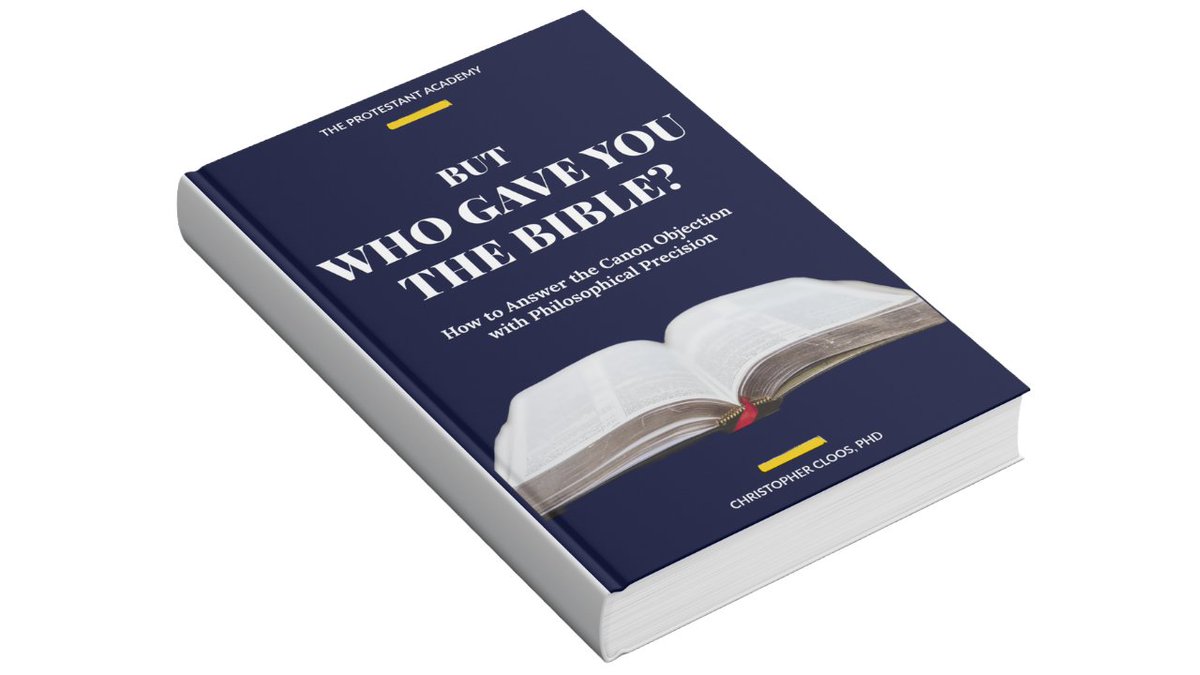
The Protestant Philosopher tweet media
English
16
8
70
7.1K
The Protestant Philosopher
The Protestant Philosopher@ProtPhilosopher·
Yes, and unfortunately, people will strip away the context of love that sandwiches the comment and turn it into a weapon to use against him, which is all the more reason we have to offer full context and applaud those trying to speak truth in love. It's not an easy balance. What's easy is to get cynical as a result of the bad actors one confronts as an apologist and devolve into returning like-for-like. I pray that I don't fall into that trap. As recent as today, I was tempted to.
English
1
0
1
14
Lee Monroe
Lee Monroe@LeeRMonroe·
I'm very glad he did it that way. Even with that, I still ran across a Catholic saying he was /attacking/ Catholics in his comment section. I'm not saying that justifies saying whatever you want however you want. It doesn't. We need to be salt and light even when others aren't. However, it just goes to show that you can deliver a critique as nice as possible and people will still act as if you're a bad person.
English
1
0
1
20
The Protestant Philosopher retweetledi
The Protestant Philosopher
The Protestant Philosopher@ProtPhilosopher·
It isn't just what Wes says that's a model for us Protestant apologists. It's also how he says it. He speaks truth in love. As an example, here's what he says near the end of the video: "What I'm about to say, I don't say out of malice or bitterness because I genuinely care for and love those within the church of Rome. Being a biblically based faithful Christian will make you a bad Roman Catholic and vice versa. There will come a time for the mature believer to have to leave Rome as they realize the incongruity within its doctrines and dogmas with that of the true faith of biblical Christianity. I say that with love. I say that with care. I don't say that lightly, but I think that is true." Wes offers a hard truth wrapped in love. That's being Christ-like with our speech. Lord, grant me the strength and wisdom to speak more truth in love. I pray that for you as well.
English
2
2
8
142
The Protestant Philosopher
The Protestant Philosopher@ProtPhilosopher·
Good, then you've conceded the point. You agree that no divine perfection failed. This means you agree God was sufficient to preserve John's text to the degree needed. That was my positive point, and you just granted it. Your next question seems to assume that transmitting a text means vouching for it. But, it doesn't. The copists weren't certifying it with their doctrinal authority. They were copying it in tons of independent communities. That's why the text is reliable. No one person's errors could rewrite John without that showing up against the wealth of manuscripts. Also, you're pointing to "men who teach falsely" and asking me to trust them. I don't and that's my position. The fact that people erred in the chain is why the norm is the text they couldn't corrupt with their errors. It wasn't the institution that produced them. So, you've just made both my case for the Attribute Inscripturation Thesis (AIT) with your earlier concession, and now you've made my case for sola scriptura. Let me request an answer to this one last time. How does the Church know it has the right copy of John, without appealing to the Spirit's guidance of the Church or to its own say so? You've granted God preserved the text. He did it through a tradition broad enough that no one's error could control it. That's what I've been saying.
English
0
1
23
947
The Protestant Philosopher
The Protestant Philosopher@ProtPhilosopher·
It appears you equate "public" with "printed in a critical edition." That's not what "public and verifiable" means if we're talking about the manuscript tradition. It means it was out in many hands checkable against each other. And now you're veering into sarcasm and condescension, which, ironically, is starting to make my point in the OP. I'll end at this point, as I've enjoyed our exchange, and I'll wait on an answer to the last question about a non-circular answer to how your Church acts a certifying authority of the veracity of John.
English
1
0
4
72
Ben Briggs
Ben Briggs@realbenbriggs·
@ProtPhilosopher Wow! You do know more than me! I totally missed this public inspection of scripture that happened between 100 and 200 AD. Where can I learn more about that?
English
1
0
1
112
Ben Briggs
Ben Briggs@realbenbriggs·
@ProtPhilosopher I see your question now. Which divine perfection failed? None. That would be impossible. God can’t fail at anything. I believe in an all powerful God. Would love to hear about how men who teach falsely about how to pray taught correctly about what John says.
English
1
0
0
124
The Protestant Philosopher
The Protestant Philosopher@ProtPhilosopher·
Sure, John is attested by a continuous, overlapping body of evidence starting in the second century. It was in the hands of many independent people in many places, which is what "public and checkable" means. Widely distributed, independent copying contrats with a single authority vouching for the text. That's why it's verifiable. No one community could alter it without the change showing up against everyone else's copies.
English
1
0
4
73
Ben Briggs
Ben Briggs@realbenbriggs·
@ProtPhilosopher This wealth of evidence, when was the first time it was available for public inspection? Like a date would be ideal, years or decades is plenty of detail.
English
1
0
3
86
The Protestant Philosopher
The Protestant Philosopher@ProtPhilosopher·
I said, "We have a wealth of Greek manuscripts and tons of other evidence that act as a public, verifiable evidence base." That's not the book confirming itself. That's public evidence attesting to the reliability of the text we have. The further question I asked you is the grounding question. If you say we can't know we have the right book without the Church, then the grounding question kicks in. Assuming you believe God is the author of Scripture, and he has all the essential perfections your text says he has, then... Now that the strawman is out of the way, I'd love to hear your answer to the question I asked you.
English
3
0
10
241
Ben Briggs
Ben Briggs@realbenbriggs·
@JohnnyWatson3 @ProtPhilosopher I haven’t said a single thing about my position. I’m willing to answer a question about my position, but only after somebody at least makes an attempt to answer the question I posed.
English
1
0
0
26
The Protestant Philosopher
The Protestant Philosopher@ProtPhilosopher·
I know I have the right copy of John based on the manuscript evidence. It's a very well-attested ancient text. I don't need a private nudge from the Spirit to believe it. We have a wealth of Greek manuscripts and tons of other evidence that act as a public, verifiable evidence base. The text is recoverable to a high degree of confidence. And the small remaining disputes don't change core doctrines. Now let me ask a question in return. Which divine perfection failed? If God is the primary author of a theopneustos text, and God is perfectly truthful, wise, and good, as well as providential and sovereign, then the preservation of that text to the degree needed to recover it follows from the same grounding as its original properties. A God sufficient to breathe out the text is sufficient to preserve it. Why would such a God author a text of saving import and then allow it to be corrupted beyond usefulness? That's incoherent on a high doctrine of inspiration and providence, which I know EO hold. In reply you might say that such providence includes God working through the Church. But, then you need to know you have the right Church in order to know you have the right Gospel of John. Then, I can ask how you know the Church received the right copy? How can you know that without appealing to the Spirit's guidance of the Church or the Chuch's say so? Those are the two moves you ruled out for Protestants. We both look at the same texts. You just add an authority to sort them, and that authority has to authenticate itself by the same means you said I couldn't use.
English
2
2
19
562
Ben Briggs
Ben Briggs@realbenbriggs·
@ProtPhilosopher Can you tell me how you know you have the right copy of John without saying “i believe because i believe” or appealing to your subjective experience of the Holy Spirit?
English
4
0
8
393
The Protestant Philosopher
The Protestant Philosopher@ProtPhilosopher·
This is an interesting suggestion, Tyler. If I'm tracking there's two attitudes toward the same proposition. One is a deep dispositional certainty that p, and the other is a surface occurrent doubt that p. The first involves implicit faith. The second is explicit faith. My worry is that this sets up self-deception concerns. Take a case where the surface doubt is the output of honest inquiry, and the deep certainty is sustained by a prior communion commitment. If this is a case of self-deception, the motivated layer can be the one she avows and the evidentially responsive layer is the one she discounts. The evidence tracking layer is the one suppressed while the motivated layer is the one she avows and acts on. So it seems the way of cashing this out can lead to self-deception in certain cases. That leads me to a question. Does the habit warrant the deep certainty independent of evidence? This would be like an appeal to grace as an infused habit. The worry then is that you'd need a bridge principle indicating the Church infallibly proposed this proposition as revealed, and that's where the evidential inquiry kicks in to challenge that. I'm wondering how you'd address that. And I'm imagining the case is non-culpable with no culpable ignorance in the chain such that a tracing condition is satisfied.
English
0
0
0
51
Tyler McNabb (Tý)🇻🇦
Good stuff here. One strategy is to argue that while your explicit faith commitment is less than certain your implicit faith disposition which is more fundamental is still certain. But what do you mean if one doubts a dogma? Like culpably or non culpably? If you mean that the person is full of knowledge of the truth and freedom, etc. but questions the proposition anyway, that's very different than someone who isn't culpable and wondering whether the doctrine is true. As for the Innocent reference, it's not entirely obvious to me that the condemnation is actually relating to the case mentioned by you.
English
3
0
4
253
Anglican Aesthetics
Anglican Aesthetics@AngAesthetics·
@TylerDMcNabb as a professional philosopher and a rigorous Roman Catholic, is it true that the moment someone starts to think they might some proposition of Revelation might be wrong, they no longer have divine faith and so lose saving faith under the Roman paradigm? The trads are out there saying stuff like this so....
Michael Corleone@DoorDashThomist

I can’t believe that this has to be explained to Protestants in the big 2026, but if you believe that the propositions that you assent to could be wrong, you merely have a human faith in these doctrines.

English
4
1
9
1.3K
Anglican Aesthetics
Anglican Aesthetics@AngAesthetics·
Lord give me the strength to accept the things I cannot change Courage to know what I can And wisdom to be like @javierperd2604 who does not get distracted from the task of synthesizing existential Thomists with Lutheran epistemology by X debates and various media streams
English
4
3
41
1.4K
The Protestant Philosopher retweetledi
The Protestant Philosopher
The Protestant Philosopher@ProtPhilosopher·
Thanks for your reply. You say I've shifted from normativity to epistemology and committed a category error, but that's not quite right. In fact, I'd argue the shoe is on the other foot. My reply to Perry involves a distinction within normative theory. It's one his argument relies on but doesn't make. It's between source normativity and access normativity. Both are normative categories. The first asks what grounds an obligation. The second asks what conditions must obtain for an obligation to bear on the agent. Perry's move conflates these. And if you look at my article I spend the bulk of my time undermining this move. Further, the tables turn because your move and Perry's move requires treating the conditions of cognitive uptake as if it settles the question of constitutive grounding. Look at section 4 where I press the transparency of belief argument. Belief is constitutively truth-aimed. The "this is how belief works" move isn't an avoidance of normativity. Rather, it's what shows Perry's view of normativity to be incoherent. You raise a decent worry with the "controls access" argument. Fully responding would require almost an essay in itself. But, let me say that when you redescribe the necessary condition as "effective authority that controls access," there's an equivocation on 'effective authority'. There's access-effective, which is trivially true. My cognitive uptake is causally necessary for any normative claim to take hold of me as an agent. Fair enough. This reading doesn't cut ice against SS. Then there's constitution-effective, which says that my judgment that p is what makes the obligation to believe that p exist. This is the claim Perry needs and my article shows can't be true given the transparency of belief. You seem to shift between these readings. The phrase "effective authority that controls access" sounds like 'effective authority' but the cash value ends up in 'controls access', which is the trivial access-effective disambiguation. Once I separate the readings, your move either proves nothing or assumes what it needs to prove (which I've applied pressure to show can't hold). I'll briefly reply to your other two points. The defeasibility dilemma you raise involves a false dilemma. You ask, "can an authority be indefinitely defeasible at the individual level and still be binding?" That's a good question, which I answer in Part 8. But it smuggles in the dilemma that the authority is either indefeasible such that it binds no matter what or it's not a real authority, namely it's mere advice. The third option is the one I argue for. It's defeasible authority as real and binding. It's the normative sort of epistemic authority that creates duties to inquire, presumptions, burdens of proof, while remaining overridable by sufficient counter evidence. You finish by throwing down the gauntlet, "your response doesn't answer where the locus of your normativity is, nor does it say why the individual isn't the final functioning authority." Well, let me say it plainly. The locus is Scripture and it's grounded in divine authorship. I have a whole thesis that does that work elsewhere on the grounding front. My Attribute Inscripturation Thesis (AIT) does that work. But, I responded to Perry before I had worked the AIT out, and I don't need it anyway. The key point here is just that Scripture's authority is constituted by God's speech. It's not constituted not by the conscience's reception of it. Why isn't the individual the final functioning authority? Because "final functioning authority" equivocates as my article explains. If it means "the agent whose cognitive states determine what they in fact come to believe," then yes, trivially, on every view. This sense doesn't distinguish SS from anything else. So it can't ground Perry's collapse argument. If it means "the source of obligation," then no. The individual can judge wrongly and be culpable for it. Culpability presupposes a normative standard that exists independent of the individual's judgment. If the individual were the source, mistaken judgment would be impossible by definition. I note this in Part 5. It would be a reductio of Perry's view.
English
2
2
17
583