๐•ฝ๐–Š๐–‹๐–”๐–—๐–’๐–Š๐–‰ ๐•ฝ๐–Š๐–™๐–—๐–Ž๐–Š๐–›๐–†๐–‘ ๐Ÿ•Š๏ธ

18.6K posts

๐•ฝ๐–Š๐–‹๐–”๐–—๐–’๐–Š๐–‰ ๐•ฝ๐–Š๐–™๐–—๐–Ž๐–Š๐–›๐–†๐–‘ ๐Ÿ•Š๏ธ banner
๐•ฝ๐–Š๐–‹๐–”๐–—๐–’๐–Š๐–‰ ๐•ฝ๐–Š๐–™๐–—๐–Ž๐–Š๐–›๐–†๐–‘ ๐Ÿ•Š๏ธ

๐•ฝ๐–Š๐–‹๐–”๐–—๐–’๐–Š๐–‰ ๐•ฝ๐–Š๐–™๐–—๐–Ž๐–Š๐–›๐–†๐–‘ ๐Ÿ•Š๏ธ

@RefRetrieval

Predominantly focused in Reformed thought on providence, free will, election/reprobation, grace, the extent of the atonement and the well-meant offer.
ุงู†ุถู… Kasฤฑm 2023
286 ูŠุชุจุน3.1K ุงู„ู…ุชุงุจุนูˆู†
Refuge7
Refuge7@Refuge7ยท
@RefRetrieval @its_noav Iโ€™m only just learning about HU so I just wanted to confirm that is what you were talking about (vs the high Calvinism you referenced earlier). The various soils sounds like it makes more sense in the HU framework than high Calvinism to me but I need to read more. Suggestions?
English
1
0
0
29
NOAV (stream โ€œAll of my praiseโ€)
If he sincerely desires the repentance and salvation of all men, why does he then, according to Calvinism, give irresistible grace to only the elect, knowing that without it, no one can receive the gospel? Sounds like a contradiction to me.
๐•ฝ๐–Š๐–‹๐–”๐–—๐–’๐–Š๐–‰ ๐•ฝ๐–Š๐–™๐–—๐–Ž๐–Š๐–›๐–†๐–‘ ๐Ÿ•Š๏ธ@RefRetrieval

English
1
1
6
1.4K
Refuge7
Refuge7@Refuge7ยท
@RefRetrieval @its_noav So this view still results with only the elect persevering to the end while the others who respond to grace through the gospel โ€œbelieveโ€œ for only a time (the seed among the various types of soil, except the good soil)? Is this a variant of hypothetical universalism ?
English
1
0
0
31
๐•ฝ๐–Š๐–‹๐–”๐–—๐–’๐–Š๐–‰ ๐•ฝ๐–Š๐–™๐–—๐–Ž๐–Š๐–›๐–†๐–‘ ๐Ÿ•Š๏ธ
Objection. 1. If Christ died for all men, then all would believe; for Christ's death procures all graces, and in particular, faith; seeing then all men have not faith, either Christ did not die for them all, or else he loseth part of his purchase. I answer, that Christ's death is procurative of all graces, and particularly of faith, so far as it is a price; and it is a price so far, as it was paid down by Christ and accepted by God for that purpose; for in a price there must be, both sufficientia nuda [bare sufficeincy] , consisting in the intrinsical value of the thing: and sufficientia ordinata [ordained sufficiency], consisting in the intentional paying and receiving that thing as a price. Now Christ's death was paid down by him and accepted by God as a price with a double respect. As for all men it was paid and accepted as a price, so far forth, as to procure for them a ground for their faith, viz., that they might be saved on gospel terms. And as for the elect it was further paid and accepted as a price, so far as to procure the very grace of faith for them. Thus our Saviour Christ, who best knew both upon what terms he paid down the price, and upon what terms his Father received it, opens this mysterious dispensation; โ€œI came down from heaven, saith he, not to do my own will, but the will of him that sent me,โ€ (John 6:38), and what was that? As to all men, it was that every one that seeth the Son and believeth on him may have everlasting life, (v. 40); and as to the elect, it was that all those should by faith come unto him, (v. 37), and never be lost, (v. 39). Christ then died for all men, not so far forth as to procure the grace of faith, but so far forth as to procure salvation on gospel terms for them; therefore, albeit all do not believe, it follows not either that Christ did not at all die for them, or that he loseth part of his purchase; Christ's death is procurative of faith, not in reference to all, but to the elect.ย  โ€”Edward Polhill, The Divine Will Considered in its Eternal Decrees, and Holy Execution of Them (London: 1695), 298-300.
English
1
1
7
479
๐•ฝ๐–Š๐–‹๐–”๐–—๐–’๐–Š๐–‰ ๐•ฝ๐–Š๐–™๐–—๐–Ž๐–Š๐–›๐–†๐–‘ ๐Ÿ•Š๏ธ
@its_noav Btw, I appreciate your honesty and willing to concede that thereโ€™s no contradiction in our view, while still disagreeing with our view. Got into the same debate with my Arminian brother here and he would not do the same thing you have done.
Gospel Encounter ๐Ÿ•Š๏ธ@GospelRencontre

@RefRetrieval "Which is it?"ย  I never argued it must be absolute --- as I said, Arminianism solves the dilemma without needing it to be absolute--- but it remains a problem in Calvinism where you've limited the options to irresistibleย or unable. What I've argued is:

English
1
0
0
63
NOAV (stream โ€œAll of my praiseโ€)
@RefRetrieval Also, I apologise that this argument went this long. It wouldn't have if I have noticed that you already said this: "Through sufficient grace, which is given with the gospel, the condition can truly be met by any man if that grace is not resisted." Would love some references...
English
2
0
1
81
๐•ฝ๐–Š๐–‹๐–”๐–—๐–’๐–Š๐–‰ ๐•ฝ๐–Š๐–™๐–—๐–Ž๐–Š๐–›๐–†๐–‘ ๐Ÿ•Š๏ธ
@its_noav Its both. It says those who are called but never come to Christ in the beginning. Those called who never come have common operations of the Spirit. Which is out sufficient grace in that category. Iโ€™m not saying I think Westminster prescribes that but leaves room for it.
English
1
0
0
11
๐•ฝ๐–Š๐–‹๐–”๐–—๐–’๐–Š๐–‰ ๐•ฝ๐–Š๐–™๐–—๐–Ž๐–Š๐–›๐–†๐–‘ ๐Ÿ•Š๏ธ
Yeah, it really is unfortunately. Thereโ€™s nothing explicitly taught about this as thereโ€™s room for diversity of views but I put it under the common operations of the Spirit in Westminster โ€œOthers, not elected, although they may be called by the ministry of the Word (Mat. 22:14), and may have some common operations of the Spirit (Mat. 7:22; 13:20-21; Heb. 6:4-5), yet they never truly come unto Christ, and therefore cannot be saved (John 6:64-66; 8:24): much less can men, not professing the Christian religion, be saved in any other way whatsoeverโ€ฆโ€ WCF 10.4 Iโ€™d also hold that itโ€™s the most consistent with Dortโ€™s second head of doctrine, Article 8: โ€œAs many as are called by the gospel are unfeignedly called. For God hath most earnestly and truly declared in His Word what will be acceptable to Him; namely, that all who are called, should comply with the invitation. He, moreover, seriously promises eternal life and rest to as many as shall come to Him and believe on Him.๏ฟผโ€
English
1
0
0
18
NOAV (stream โ€œAll of my praiseโ€)
@RefRetrieval Wowwww. This is so different from what he hear from โ€œmodernโ€ Calvinists these days. Thank you for these references. Also, one more question; do you have any reference from the 3FUs / WCF?
English
1
0
0
22
๐•ฝ๐–Š๐–‹๐–”๐–—๐–’๐–Š๐–‰ ๐•ฝ๐–Š๐–™๐–—๐–Ž๐–Š๐–›๐–†๐–‘ ๐Ÿ•Š๏ธ
@its_noav It also seems like Owen agrees because he explicitly references the British theologians of Dort in this work below.
๐•ฝ๐–Š๐–‹๐–”๐–—๐–’๐–Š๐–‰ ๐•ฝ๐–Š๐–™๐–—๐–Ž๐–Š๐–›๐–†๐–‘ ๐Ÿ•Š๏ธ@RefRetrieval

The Spiritโ€™s work of illumination is not regeneration. โ€œThe Spirit's work of illumination makes the word clear to the mind (2 Pet. 2:21). The gospel is understood, not only as true, but as God's way of righteousness (Rom. 1:17; 10:3, 4). Illumination helps the mind to agree to the truth (Acts 8:13; John 2:23; 12:42). Illumination brings a momentary joy (Luke 8:13; John 5:35). Along with illumination the person may receive some spiritual gifts (Matt. 7:22). Illumination is not regeneration, nor does regeneration infallibly take place after illumination. When light is shone on God's saving grace, then the soul sees clearly what is being offered. So illumination prepares the soul for regeneration. The second thing that happens is that the Holy Spirit brings conviction of sin. This is also brought about by the preaching of the word (1 Cor. 14:24, 25). The soul begins to feel a disturbing sense of its guilt as it is brought to face the righteous demands of God's law. It begins to feel a sense of sorrow or grief for the sins it has done (2 Cor. 7:10). They are now past and can no longer be put right (Rom. 8:15).This leads the soul to feel humbled for its sinfulness (1 Kings 21:29). Now, unless the soul is swallowed up in despair, it begins to look for a way out of its present state of misery (Acts 2:37; 16:30). Often the person begins to reform his life and a great change of attitude follows (Matt. 13:20; 2 Pet. 2:20; Matt. 12:44). Some neglect this light and conviction or seek to stifle it. Some are overwhelmed by the power and strength of their lusts, the love of sin and the power of temptations. Some think that being enlightened is quite enough and that this is all that God intends to do with them.โ€ โ€”John Owen, โ€˜The Holy Spiritโ€™

English
1
0
0
45
Gizmo
Gizmo@gizmorazaarยท
@theo_bruv @RefRetrieval Why the Spurgeon pfp if you don't like Calvinism then?
English
1
0
0
32
๐•ฝ๐–Š๐–‹๐–”๐–—๐–’๐–Š๐–‰ ๐•ฝ๐–Š๐–™๐–—๐–Ž๐–Š๐–›๐–†๐–‘ ๐Ÿ•Š๏ธ
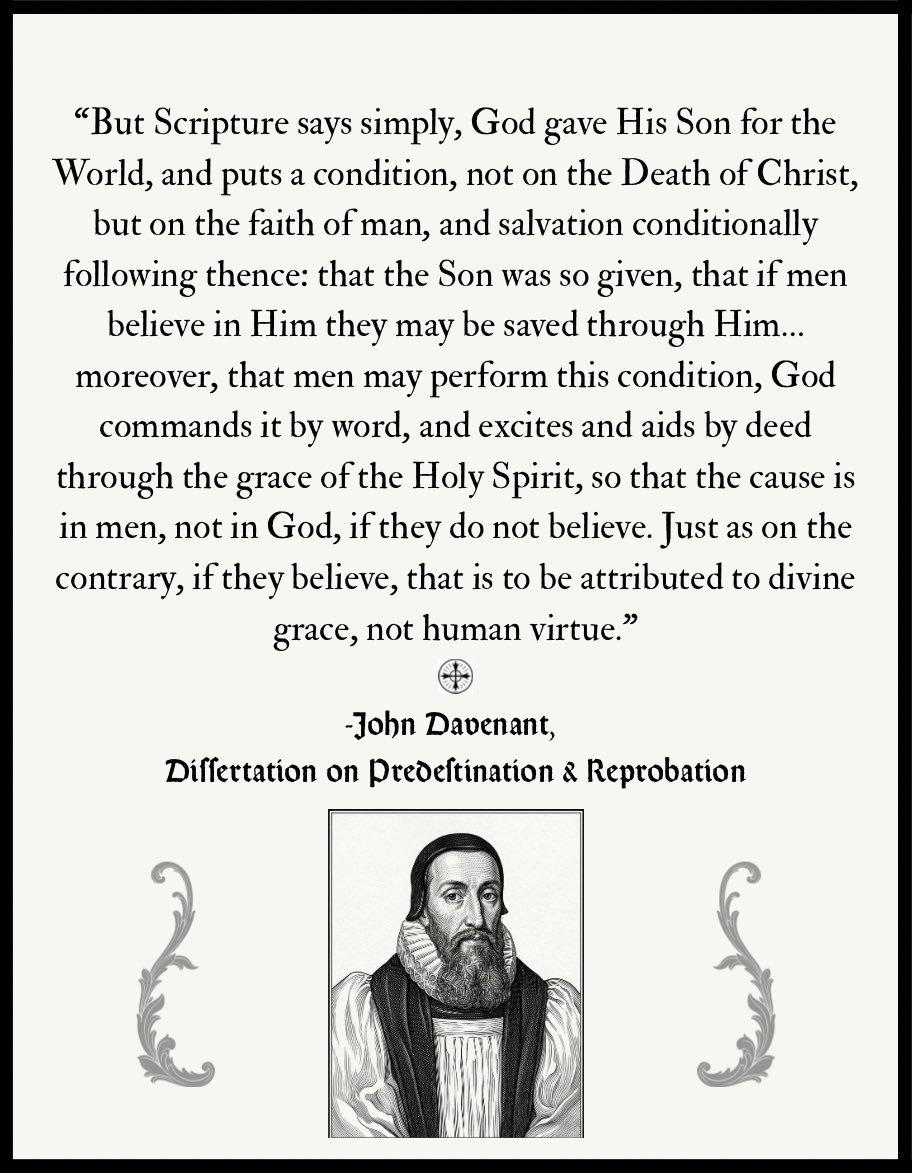
Arminians: โ€œElection in Christ means God chooses those foreseen as believers and thus already considered in Christ. God does not elect someone in Christ who is not first in Christ.โ€ Davenant: โ€œBut as to what they assert for the confirmation of the Major, That God cannot elect him in Christ who is not in Christ: But those only are in Christ, who are considered by God as engrafted in Christ through faith: therefore solely believers are elected: this argumentation relies entirely on a false exposition of those Apostolic words, He chose us in Christ. For those words, in Christ, are to be referred not to the state of the elect man, but to the act of God electing. The Arminians expound thus: He chose us in Christ, that is, Us existing in Christ, or us considered and foreseen as believers in Christ, and engrafted into Him through faith, God subsequently elected. But this formula of speaking, In Christ, as often as it is conjoined with any Divine act, does not always imply that the subject into which that act tends is considered as existing in Christ antecedently. For example, Eph. 1:3: God blessed us with every spiritual blessing in Christ. But among spiritual blessings is the very first donation of faith and repentance, which are not given to those existing in Christ, but to those alien from Christ, that they may be brought to Christ, and engrafted in Him. Thus God is said to have reconciled the world to Himself in Christ, 2 Cor. 5:19; to have created us in Christ for good works, Eph. 2:10. Finally the Remonstrants themselves teach that God regenerates men in Christ, Coll. page 9. In all these places those words, in Christ, cannot be expounded except most absurdly, existing in Christ antecedently. Therefore to elect in Christ is nothing else than in electing to respect Christ the Mediator and Head of the Church, and to destine members to be conjoined to Him and glorified by His grace. But as to what Arminius urges, God loves no one to eternal life unless in Christ, that is, as he interprets, unless considered as faithful and already engrafted in Christ, and consequently elects no one unless as faithful; that is true concerning the introduction to eternal life itself, but false concerning predestination. For God loves all those to eternal life in this sense whom He decreed to give to Christ to be vivified and saved before the foundations of the world were laid. But these who are given to be vivified, are not considered by God as vivified and faithful, but as dead in sins and still unbelieving. To absolve in a word; God is said to have elected us in Christ, not because He considered us as existing in Christ through our faith before He elected, but because He predestines however many He predestines to eternal life with a regard to Christ the Mediator.โ€
๐•ฝ๐–Š๐–‹๐–”๐–—๐–’๐–Š๐–‰ ๐•ฝ๐–Š๐–™๐–—๐–Ž๐–Š๐–›๐–†๐–‘ ๐Ÿ•Š๏ธ tweet media
English
4
1
24
1.2K
๐•ฝ๐–Š๐–‹๐–”๐–—๐–’๐–Š๐–‰ ๐•ฝ๐–Š๐–™๐–—๐–Ž๐–Š๐–›๐–†๐–‘ ๐Ÿ•Š๏ธ
All Calvinists (excluding hypers who arenโ€™t really Calvinists) affirm the former according to His revealed will. I affirm Christ died for the sins of all men, like the British and Bremen delegates at the Synod of Dort and some of the English delegates at the Westminster Assembly.
English
0
0
0
5
Colin C^2 Causey
Colin C^2 Causey@TheColinCauseyยท
@RefRetrieval @rootcausesleuth @CherylSchatz So, you recognize a distinction between sufficient and efficacious grace, maintaining that the former is resistable? In that case, do you also affirm God's universal salvific will and an unlimited atonement? With the aforementioned distinction in place, I see no reason not to.
English
1
0
0
15
Cheryl Schatz ๐Ÿฉธ
Cheryl Schatz ๐Ÿฉธ@CherylSchatzยท
For those who believe in predetermined election before the world began, what is the purpose of that election and what actually distinguishes the elect from the non-elect in any meaningful way?
English
21
0
13
1.7K