

Robot Wars World
10 posts




Michael’s one of the rarest specimens in research: unbridled curiosity, get-shit-done grindset, technical generalist, but above all a kind soul.
Excited to see the next chapter! 🚀
Michael Elabd@MichaelElabd
I am leaving the Foundational Research team at DeepMind! I just wanted to take the time to reflect on this truly amazing journey. It was such an intense and fulling ride that I will always cherish. Two efforts shaped me in particular: the reasoning work and building the continual learning infrastructure for robotics. They taught me what it takes to turn ambitious ideas into real systems. Here are some of my biggest takeways: 1. Iteration speed, iteration speed, iteration speed: the teams that win arent neccessarily the smartest but the ones able to execute on a thousand ideas in the time their competitors excute on five. This became way more obvious when we were working on reasoning for humanoids where the iteration contains hardware in the loop. You have to really deeply think about what it takes to test your hypothesis and how to greatly simplify the iteration loop to move faster. 2. Building scalable infrastructure from day 1: Researchers sometimes think that moving fast means building unscalable infrastructure. My time at DeepMind taught me that there is always one more experiment that requires refactoring the entire repo, as those come up, we should figure out how to better build the stack from the ground up to support more and more wacky experiments. 3. Having fun is probably the most important thing at work: When you truly enjoy your colleagues’ company and you are motivated by the success of the larger team, the late nights become memorable, not exhausting. I never truly understood this until the 1am nights at work all huddled near one of our humanoids trying to figure out why its behaving this way. I’m especially gratefJ to my mentors @sippeyxp , Jie Tan, @Kanishka_Rao, and @carolina_parada for constantly finding harder challenges for me and pushing me to grow. Peter Pastor, @keerthanpg, and Stefani Karp thank you for the late-night hacking sessions and the PEAK dinners. Those are some of my most treasured memories! @claudiofantacci, Alex Lee, @Sumeet_Robotics, and Ken Caluwaerts thank you for teaching me how to build scalable infrastructure, from building the new inference stack to scaling experiments. @Stacormed, @xiao_ted, @ColinearDevin, and Giulia Vezzani I learned so much from you. Thank you for entertaining all my hypotheses (especially the weird ones) and helping me learn through them. I can go on and on.. I just can’t thank each one of you enough. Truly thankful for the time we spent together! Will share more soon 👀
English


We're very serious people at Tesla. Join the fun, we're hiring folks interested in solving embodied AI across Robotaxi and Optimus.
Elon Musk@elonmusk
Tesla Optimus learning Kung Fu
English

Español

If we lose low Earth orbit - and we could - Nobody seems to be thinking about it.
@scarlett_koller. She's building the space radar dishes that don't exist yet at Mithril Technologies.
The full thesis is on Deployed Episode 5. Listen now!

English


Mark:
1/ First milestone: the Physical Turing Test.
You literally can’t tell if a human or robot is doing the task.
2/ Next: Physical API.
A fleet of robots, configured like software via APIs & CLI.
3/ Final stop: Physical Auto Research.
Robots design, improve, and build the next generation of themselves--far beyond human capability.
--
If you believe in robotics, robotics will believe in you.
Jim Fan@DrJimFan
I promise this will be the best 20 min you spend today! Robotics: Endgame, the sequel to my last year's Sequoia AI Ascent talk, "Physical Turing Test". I laid out the roadmap for solving Physical AGI as a simple parallel to the LLM success story. Be a good scientist, copy homework ;) And stay till the end, more easter eggs and predictions for your polymarket! 00:30 DGX-1 origin story at OpenAI, I was there in 2016 signing with Jensen and Elon. Heading to the Computer History Museum! 01:42 The Great Parallel 03:31 Robotics, the Endgame 03:39 Why VLAs fall short 04:32 Video world models as the 2nd pretraining paradigm 06:09 World Action Models (WAM) 07:46 Strategies for robot data collection and the FSD equivalent to physical data flywheel for robot manipulation 11:06 EgoScale and the Dexterity Scaling Law we discovered recently 14:00 Physical RL: bridging the last mile 15:39 DreamDojo: an end-to-end neural physics engine for scaling RL in silico 17:00 Civilizational Technology Tree and my predictions for the near future. Spoiler: it's closer than you think. Thanks to my friends at Sequoia for inviting me back to AI Ascent this year! I had a blast! Last year's talk is attached in the thread if you missed it.
English

fwiw I’ve never sold any of my figure stock and did not participate in the employee tender 💎 🙌
Doug Bielecki@dbielecki
@adcock_brett @Figure_robot Curious how much you’ve liquidated yourself @adcock_brett ? Corporate buyback or secondary?
English
USA or China ?
Krystian Kazyszka@KKazyszka
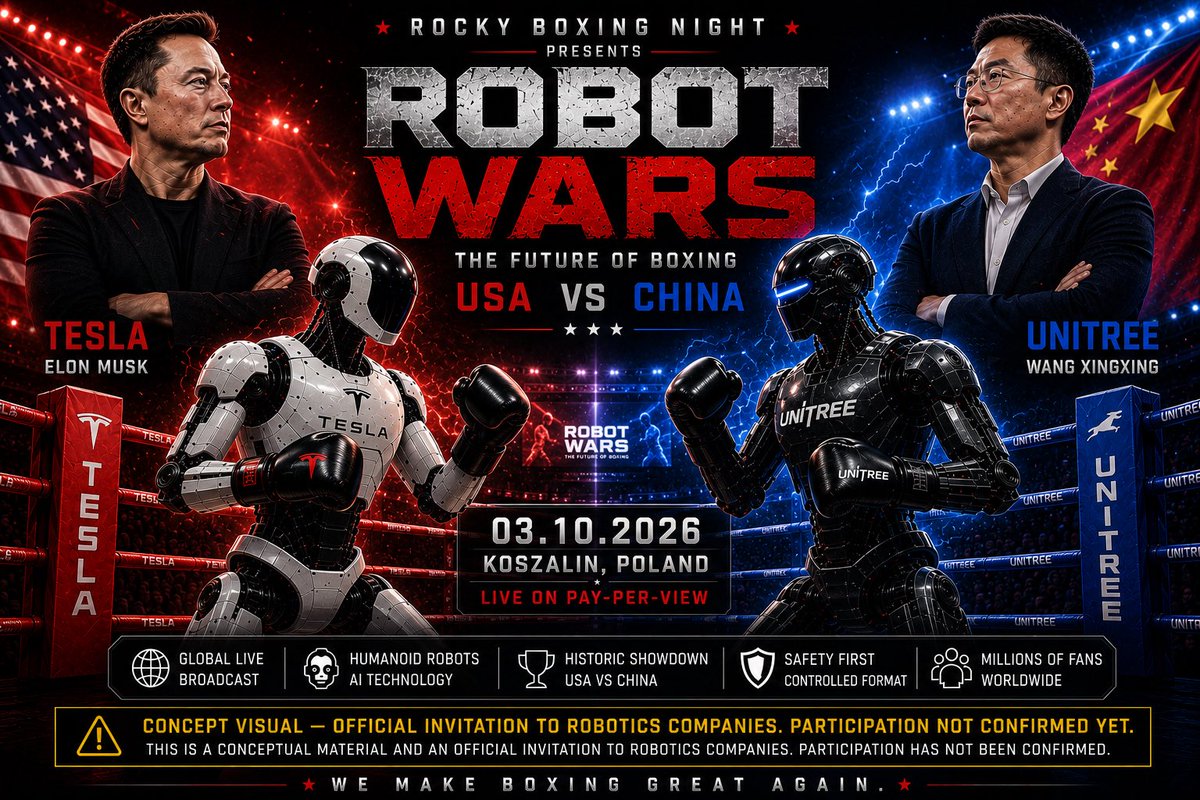
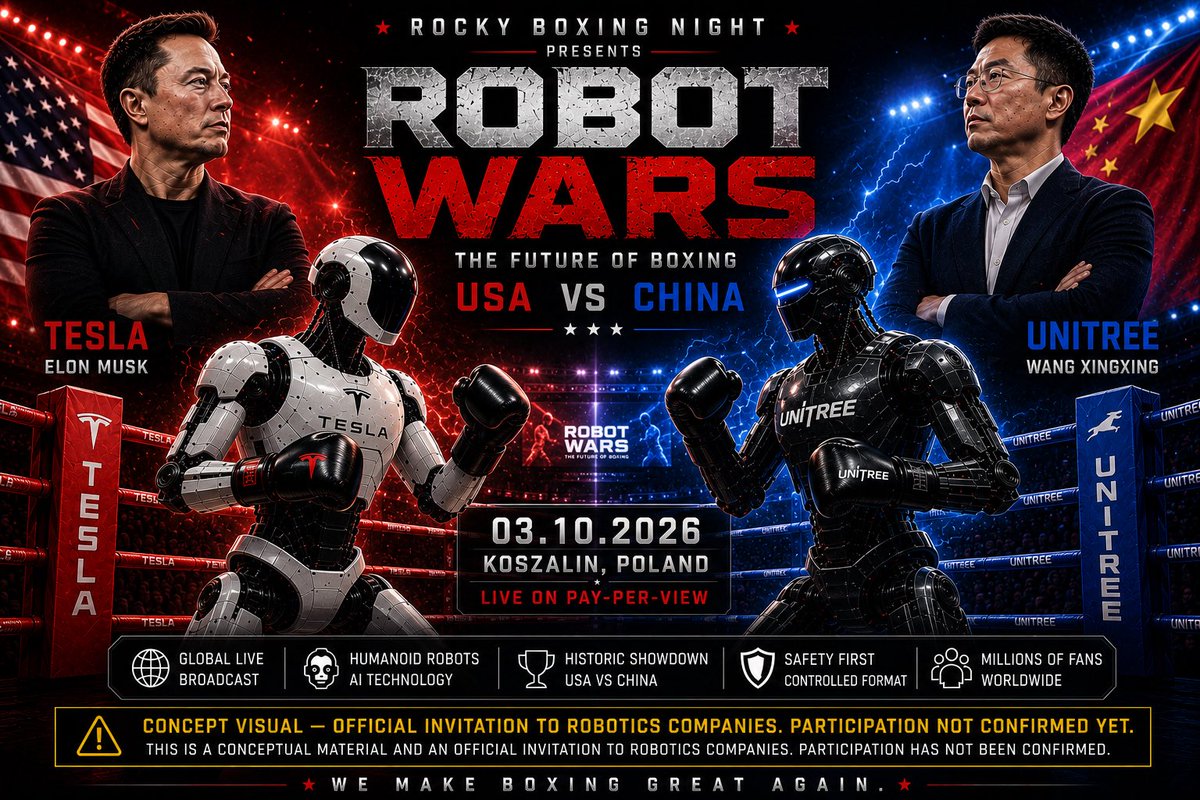
🥊🤖🇺🇸 USA vs CHINA 🇨🇳 ? Official invitations have been sent. Tesla Optimus 🇺🇸 vs Unitree 🇨🇳 03.10.2026 Poland The world's first Humanoid Robot Boxing Show. We provide the arena. You bring the future. @elonmusk @Tesla @UnitreeRobotics #RobotWars #USAvsChina #Tesla #Unitree #AI #Robot @RobotWarsWorld
Español

Krystian Kazyszka@KKazyszka
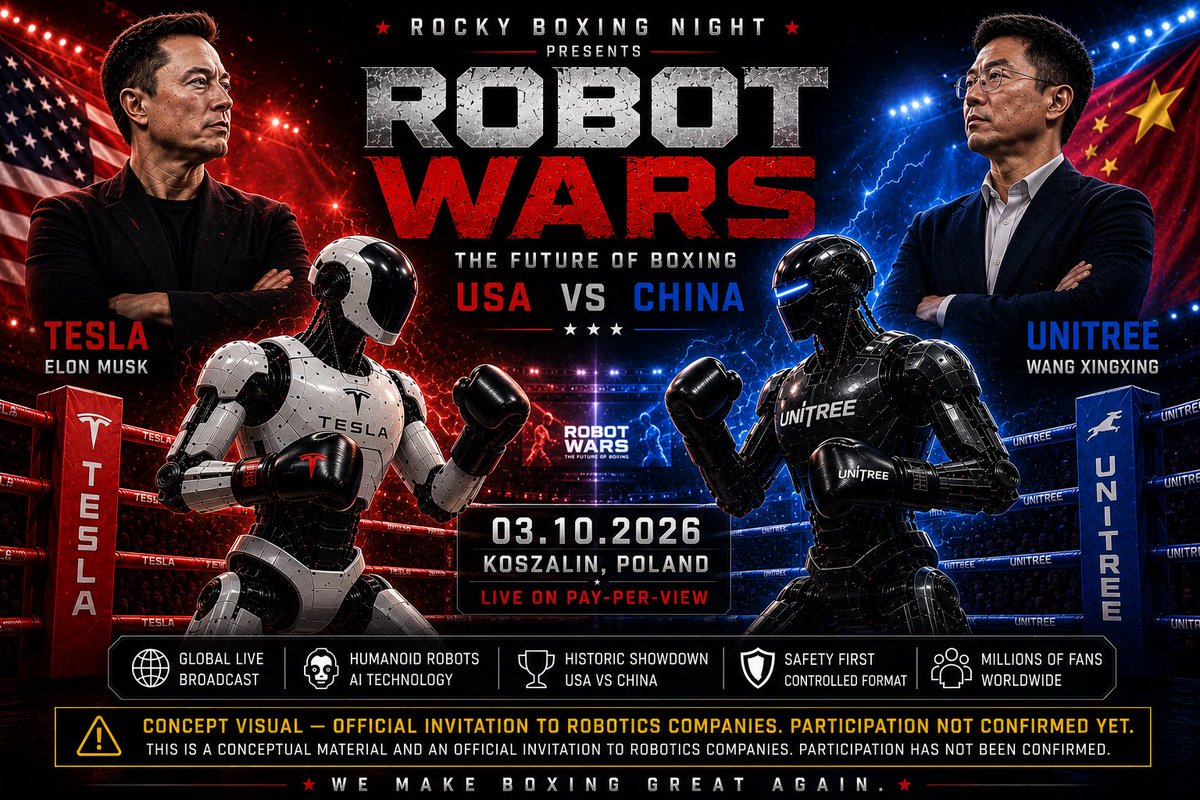
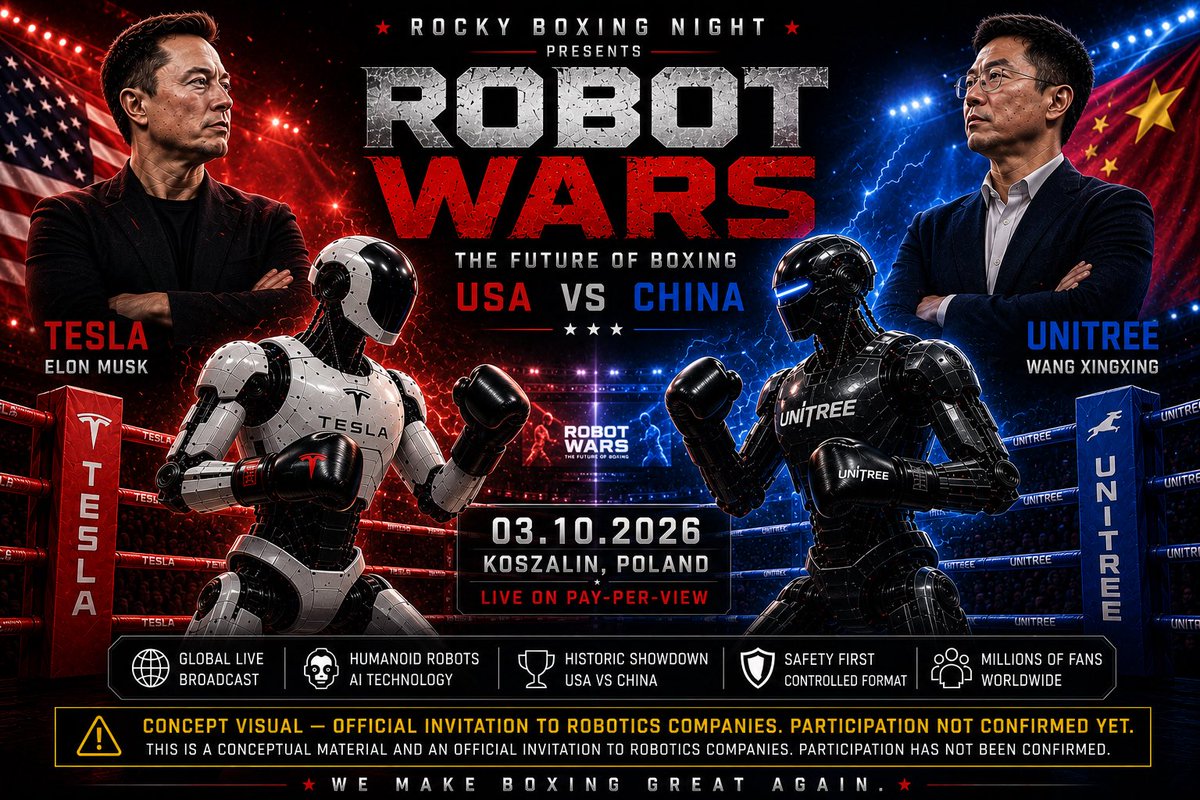
🥊🤖🇺🇸 USA vs CHINA 🇨🇳 ? Official invitations have been sent. Tesla Optimus 🇺🇸 vs Unitree 🇨🇳 03.10.2026 Poland The world's first Humanoid Robot Boxing Show. We provide the arena. You bring the future. @elonmusk @Tesla @UnitreeRobotics #RobotWars #USAvsChina #Tesla #Unitree #AI #Robot @RobotWarsWorld
QME

Michael is one of the best people I have had the fortune to work with at Deepmind.
He carries an infectious energy, lots of optimism, codes like a machine and more importantly, makes work so fun! He’s the type of guy you want in the trenches with you.
I’ll miss our conversations and 1am by the robot debugging sessions. Excited to see what you’ll do at Trajectory!
Michael Elabd@MichaelElabd
I am leaving the Foundational Research team at DeepMind! I just wanted to take the time to reflect on this truly amazing journey. It was such an intense and fulling ride that I will always cherish. Two efforts shaped me in particular: the reasoning work and building the continual learning infrastructure for robotics. They taught me what it takes to turn ambitious ideas into real systems. Here are some of my biggest takeways: 1. Iteration speed, iteration speed, iteration speed: the teams that win arent neccessarily the smartest but the ones able to execute on a thousand ideas in the time their competitors excute on five. This became way more obvious when we were working on reasoning for humanoids where the iteration contains hardware in the loop. You have to really deeply think about what it takes to test your hypothesis and how to greatly simplify the iteration loop to move faster. 2. Building scalable infrastructure from day 1: Researchers sometimes think that moving fast means building unscalable infrastructure. My time at DeepMind taught me that there is always one more experiment that requires refactoring the entire repo, as those come up, we should figure out how to better build the stack from the ground up to support more and more wacky experiments. 3. Having fun is probably the most important thing at work: When you truly enjoy your colleagues’ company and you are motivated by the success of the larger team, the late nights become memorable, not exhausting. I never truly understood this until the 1am nights at work all huddled near one of our humanoids trying to figure out why its behaving this way. I’m especially gratefJ to my mentors @sippeyxp , Jie Tan, @Kanishka_Rao, and @carolina_parada for constantly finding harder challenges for me and pushing me to grow. Peter Pastor, @keerthanpg, and Stefani Karp thank you for the late-night hacking sessions and the PEAK dinners. Those are some of my most treasured memories! @claudiofantacci, Alex Lee, @Sumeet_Robotics, and Ken Caluwaerts thank you for teaching me how to build scalable infrastructure, from building the new inference stack to scaling experiments. @Stacormed, @xiao_ted, @ColinearDevin, and Giulia Vezzani I learned so much from you. Thank you for entertaining all my hypotheses (especially the weird ones) and helping me learn through them. I can go on and on.. I just can’t thank each one of you enough. Truly thankful for the time we spent together! Will share more soon 👀
English

Lots of updates to come in the coming months!
Sunday@sundayrobotics
1,709 → 72,000 sq. ft. in two years Welcome to Sunday’s new HQ.
English