You literally didnt deny anything I said though. Thats textbook bad faith and you seemingly targeted me for some reason. Scholasticism doesnt win people back, action does. Orthodoxy is the only place where the talk is talked and the walk is walked. Reflect on Vatican II and the 4th crusade.
@Ortho_Patrick That's not my church so you are making false accusations again. Since you are sadly not telling the truth you seem to be of bad will. Hopefully you convert and become a true Christian: youtube.com/watch?v=pH9nVo…
Hugh of Saint-Cher Uses “Without” With “Or” To Teach Both Are Required
Along the lines of our most recent video, “These Latin Passages Illuminate The Truth About A Controversial Issue”, this is an interesting passage from Hugh of Saint-Cher. Hugh of Saint-Cher (c. 1190–1263) was a French Dominican friar, cardinal, and an important biblical scholar of the 13th century. In his Commentary On Luke 10:27, he writes:
Commentary on Luke 10:27
Diliges Dominum Deum tuum ex totis viribus totius cordis ex totis viribus totius anime ex totis viribus totius mentis…
“You shall love the Lord your God with all the powers of your whole heart, with all the powers of your whole soul, and with all the powers of your whole mind.
… {d} Ex tota mente id est memoria sine difficultate, vel sine oblivione. Hec non possunt impleri in via.
“With the whole mind, that is, with the memory without difficulty, or without forgetfulness. These things cannot be fulfilled on the way [i.e., in this present life / on the road of earthly existence]."
Here Hugh of Saint-Cher uses the Latin word “sine”, followed by a noun in the ablative case, followed by the word “or”, followed again by the word “sine”, and then followed by another noun in the ablative case. He does not employ that language to teach that only one of the two (i.e. the absence of difficulty or the absence of forgetfulness) is required to love God perfectly. Rather, he employs that construction to teach that, in his view, love of God with the whole mind would require the absence of both difficulty and forgetfulness, not just one without the other. Hugh of Saint-Cher thus uses the Latin word “sine”, followed by a noun in the ablative case, followed by the word “or”, followed again by the word “sine” to teach that both are necessary.
The examples covered in our video sufficiently prove our point, but this was an interesting additional example that served to directly refute another errant comment made by a “BOD” supporter. He falsely claimed that one could never repeat the “without” (sine) after “or” to teach that two things are required. He doesn’t know what he’s talking about, and they really just pile one error and false claim upon another.
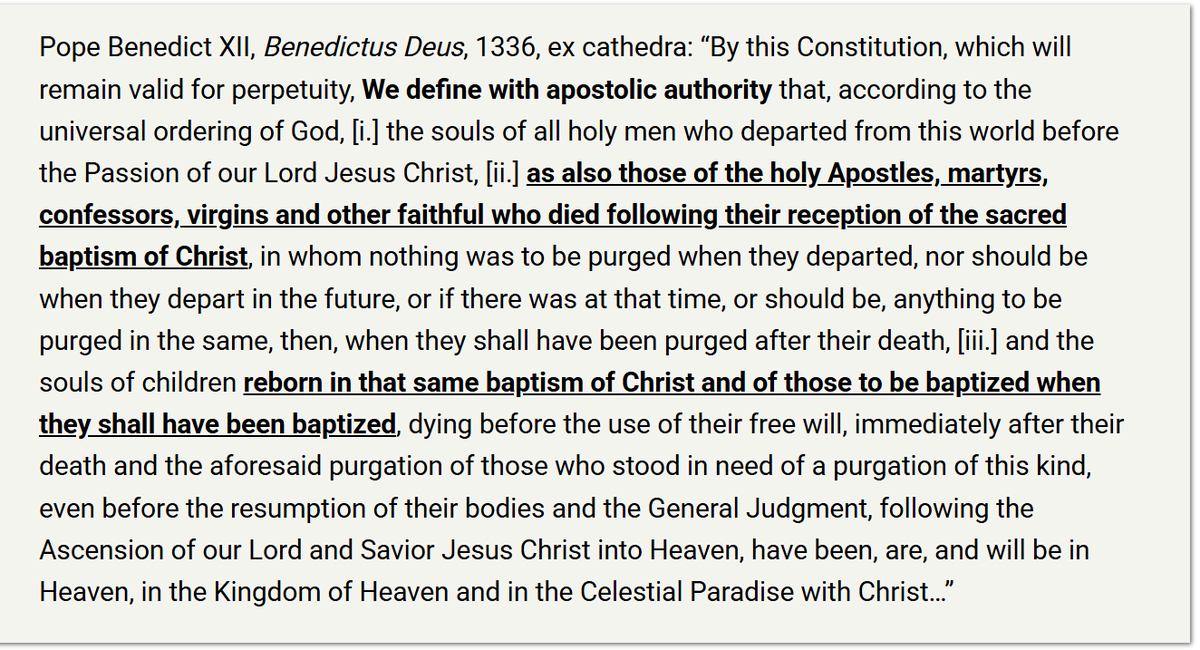
All the martyrs (as well as all the confessors, virgins, and other faithful) who are in Heaven RECEIVED SACRED BAPTISM (a term for the Sacrament of Baptism) BEFORE DEATH, the same baptism received by infants. This was infallibly defined by Pope Benedict XII. Those who teach that a martyr (or anyone else) is in Heaven without having first received sacred baptism are defying infallible Catholic teaching. Also, Pope Benedict XII made no exceptions for salvation without baptism in his dogmatic definition, even though he easily could have made exceptions if they existed. He didn't make any exceptions because none exist (see John 3:5). However, he was careful to qualify other things that he defined about people being purged in Purgatory because he made sure that his definition was precise, exact and completely accurate.
The intensity with which certain false traditionalists attack and condemn "Feeneyites" (which is an inaccurate term), while they accept the blatant heresy that non-Christians can be saved (and tolerate many other false doctrines), is another clear indication that they (and the illicit priests who guide them) are dominated by an evil and anti-Christ spirit. They are anti-Christs. Those false traditionalist, anti-baptism, John 3:5 mocking sects (even though divided among themselves) also represent a Counter Church and a deception that opposes the true Catholic Church today. Also, none of those heretical priests would actually have a debate because their heretical and contradictory position would be exposed. They simply repeat the same false arguments and lies that have been refuted while they ignore everything that contradicts and refutes their position. They have no supernatural faith or real commitment to infallible Catholic teaching. They are a plague and the very kind of people who led to the Vatican II apostasy.
Pope Eugene IV, The Council of Florence, Exultate Deo, Nov. 22, 1439: “Holy baptism, which is the gateway to the spiritual life, holds the first place among all the sacraments; through it we are made members of Christ and of the body of the Church. And since death entered the universe through the first man, ‘unless we are born again of water and the Spirit, we cannot,’ as the Truth says, ‘enter into the kingdom of heaven’ [John 3:5]. The matter of this sacrament is real and natural water.”
@Ortho_Patrick I don't accept Vatican 2 so your reply was irrelevant. But whatever problems you have with it, I can find Orthodox bishops espousing the same heresies. Watch the video on Nicaea II and learn some facts instead of just making baseless assumptions.
@catholicsede I dont know who the hell you are or anything.
Vatican II is blasphemous.
Try smoking up the tree of the old covenant to someone else.
Your religion is fully captured by globalist interests. The Vatican has been reduced to a political entity.
@opnjmj Yea can you link to a specific section of that article that you think makes your case? John Salza has been refuted many times before: vaticancatholic.com/john-salza-ref…
@catholicsede Please read the rest of St Bellarmine instead of posting quotes out of context, he does not support the erroneous notion Sedes have of loss of office. trueorfalsepope.com/p/the-true-mea…
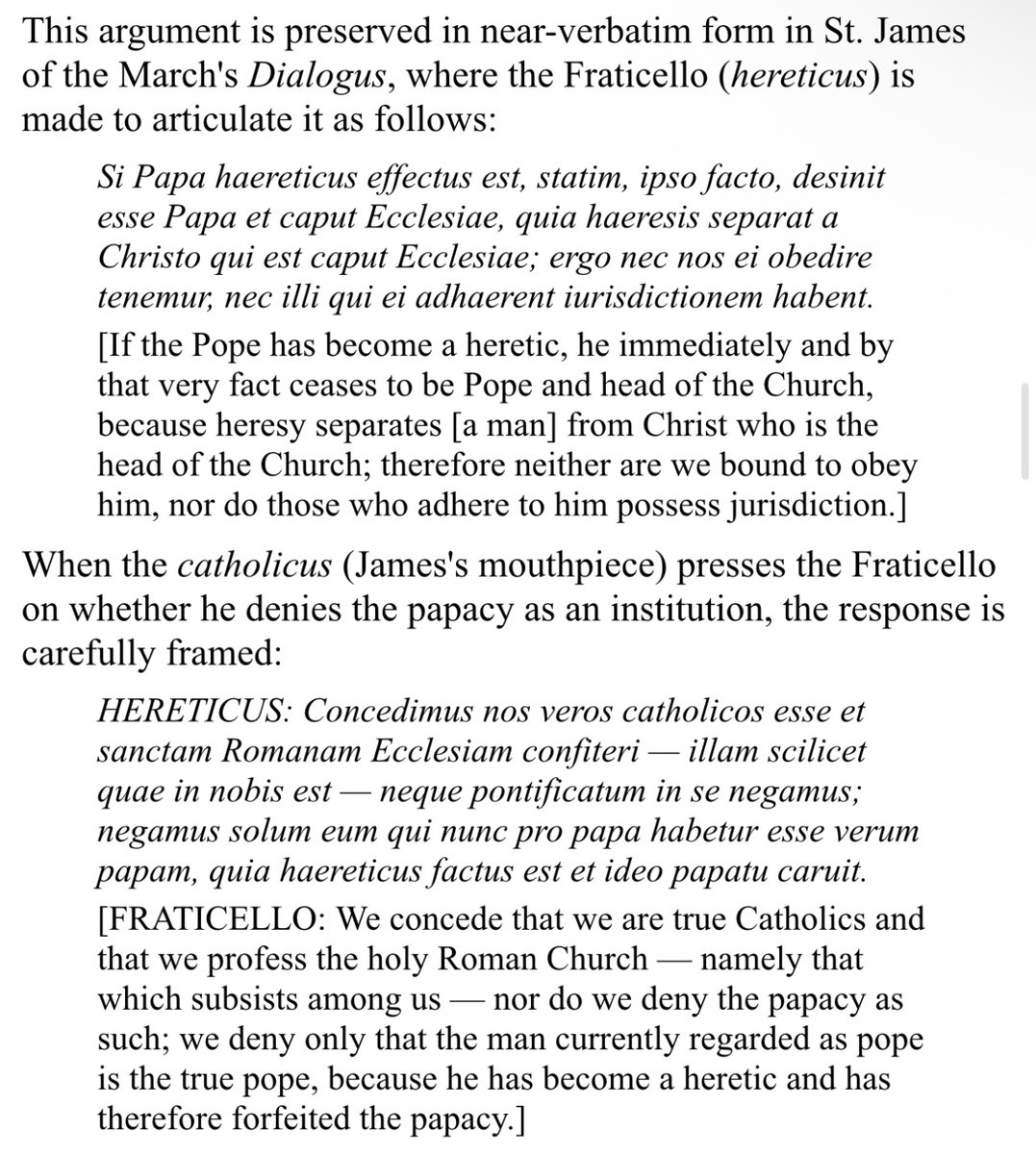
Sedevacantism has been condemned by the Church since the 14th century. The ‘Fraticello’ sect claimed Popes had lost the papacy due to heresy, and that they alone preserved the ‘true’ traditional faith. St James of the Marches was the inquisitor fighting against them: