تغريدة مثبتة
Cheapskate Value
1.2K posts

Cheapskate Value
@cheapskatevalue
**CAGR Since Inception** Cheapskate: 28.4% SPXTR: 13.8% Safety of principal and a satisfactory return — in that order. Catalysts are kinda overrated.

انضم Aralık 2020
463 يتبع662 المتابعون

@financialsamura That growth was unknowable in advance. And for most upper middle class people, that is a whopper of a mortgage.
English

Here’s a fun example for those who think real estate is terrible investment.
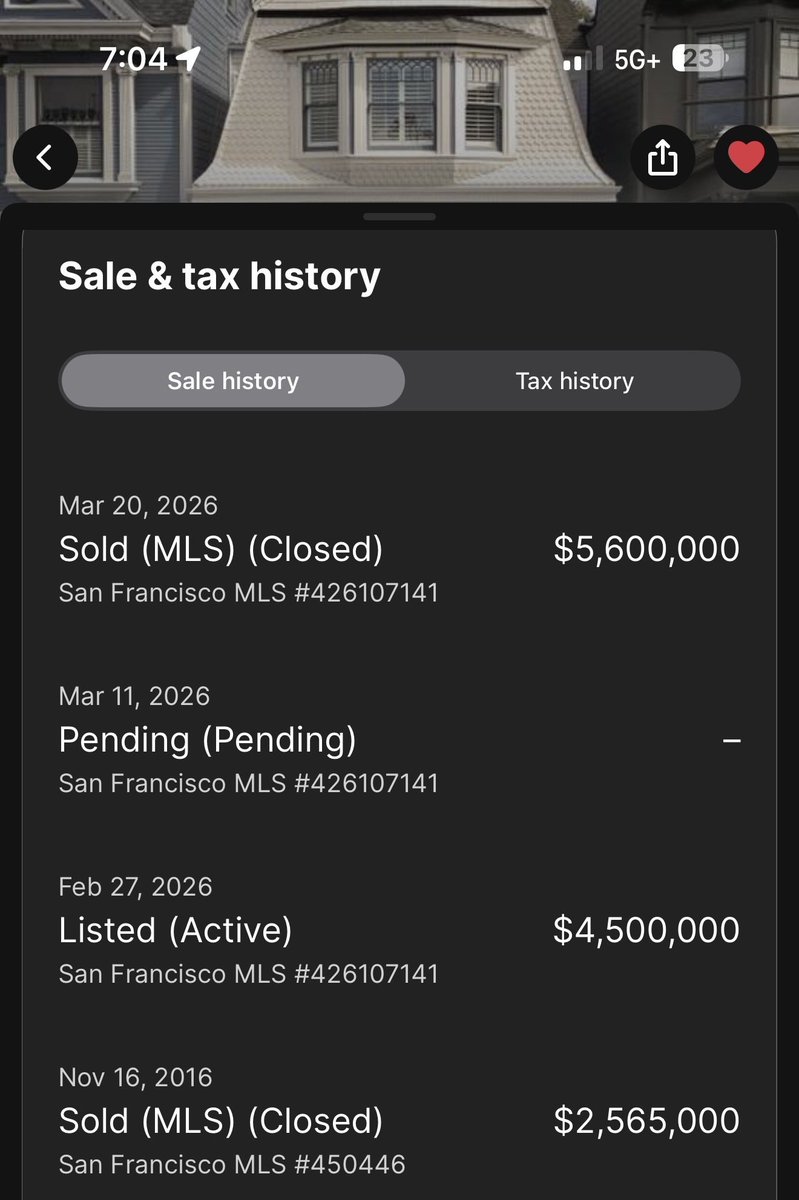
You buy this San Francisco for $2,565,000 in 2016 with 20% down.
You spend $300,000 to remodel and open up the downstairs and create a 1/4 bathroom upstairs. I checked it out in person and it’s nice.
Total invested: $813,000
10 years later, you sell for $5,600,000. After commissions and transfer fees, and paying off the remaining mortgage, you walk away with ~$3,600,000 pre-tax.
That’s a 16% IRR and 4.43X multiple. The cost to own was negated by the cost to rent the house. There’s also $500,000 in tax-free profits you can take if married.
So not only did you live comfortably for free for 10 years, raise your children and create wonderful memories, you also made millions.
How is that a bad thing? Sure, on paper, you could have made more with the $813,000 investing in $VCX pre-listing, but let’s not get greedy or delusional now. You wouldn’t have had the guts to invest that much.
Homeownership is one of the few ways you actually get to enjoy your wealth. Stocks, crypto, etc? No utility. It’s all just funny money on a screen until you sell and spend it.
Anti real-estate crusaders, feel free to poke holes at my argument!


English
Cheapskate Value أُعيد تغريده

@waterboystocks This is extremely uninteresting.
This dispersion probably hugs pretty closely to the average of any random selection of 12 month s and p returns.
English

S&P 500 12-Month Returns Post-U.S. Military Action
Korean War (June 1950): +23.7%
Lebanon Intervention (July 1958): +31.4%
Bay of Pigs Invasion (April 1961): +0.5%
Dominican Republic Intervention (April 1965): +10.1%
Grenada Invasion (Oct 1983): +6.3%
Libya Bombing (April 1986): +5.2%
Panama Invasion (Dec 1989): −3.1%
Gulf War (Jan 1991): +26.0%
Somalia Intervention (Dec 1992): +10.1%
Haiti Intervention (Sept 1994): +37.6%
Kosovo/NATO Bombing (March 1999): +21.0%
Afghanistan War (Oct 2001): -22.1%
Iraq War (March 2003): +26.7%
Libya Intervention (March 2011): +2.1%
Syria/ISIS Airstrikes (Sept 2014): +13.7%
English

@Investor_NICK_ I think the spitznagel tail risk hedge thing can work for more sophisticated folks with training in derivatives. Makes it so that cash appears in your pocket at the moment when stocks are cratering, and it’s most valuable.
English

Have to agree with David Tepper here. Have tried hedging various times the last few years and cash is overall a much better hedge for majority of retail investors. Cash is terrible to hold long term but it no doubt is king in the short term when everyone is getting carried out.
waterboy@waterboystocks
David Tepper at Carnegie Mellon University (Nov. 12, 2007)
English
Cheapskate Value أُعيد تغريده

Comparing what is now happening with what has happened in analogous historical situations and triangulating my thinking with smart, well-informed leaders and experts has always helped me make better decisions. I have found that most wars are filled with big disagreements about what is likely to happen and big surprises.
However, in the case of this Iran war, it is obvious, and there is near-universal agreement, that it all comes down to who controls the Strait of Hormuz. I hear from those who run governments, geopolitical experts, and people all over the world that if Iran is left with control over who can pass through the Strait of Hormuz, or is even left with the power to negotiate, there are four (4) key implications. I wrote about these consequences in my latest article.
I want to emphasize that I am not political; I am just a practical person who has to bet on what will happen and has studied history to draw lessons that help me do that well, and I am now passing along my principles and thoughts that might help others navigate these tumultuous times.
I remain ready, willing, and able to explore these things with you if you’d like to ask me questions in the comments.
x.com/RayDalio/statu…
English
Cheapskate Value أُعيد تغريده

One of the things I've been spending a lot of time on is how private equity consolidation of more sensitive industries (pet care, healthcare, funeral services) can really hurt consumers, especially at their most vulnerable.
We've all seen the research about what PE involvement does to hospitals.
I think at some point a lot of finance professionals need to have a talk to God moment about what type of businesses they want to be a part of or invest in. I certainly have.
It's certainly become clear to me there's some pockets PE/corporate consolidators shouldn't be involved in and I think consumers don't want corporate/PE ownership in their backyard for everything.
That tide is here and it's going to be advancing further.
Obviously, the below needs to be included as a risk factor, but if it doesn't make you feel anything then that's not a great sign of the type of character you have?
If you want to call me names or whatever, or do forest in the trees type stuff like this, please do so, but I'm going to be spending the rest of my life on this.
My mission is building a big resource hub that shows which businesses are PE/Corp backed so locals can steer towards more care-oriented mom-and-pop options.
And I would never monetize it. It's a public good resource.
I'll include it below to show where we're at so far.
Covfefe Anon@CovfefeAnon
"I'll pretend to be retarded so I can pretend to be OUTRAGED" Decreasing deaths in the future does indeed result in less revenue for funeral home services

English

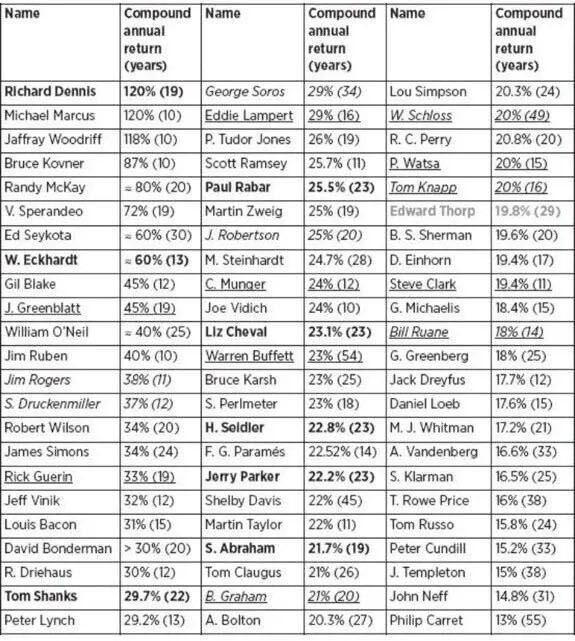
If Warren Buffett is truly the greatest investor of all time how do you explain these numbers?
Michael Marcus: 120% CAGR over 10 years
Richard Dennis: 120% CAGR for 19 years
Bruce Kovner: 87% CAGR over a decade
Ed Seykota: 60% CAGR for 30 years
William O'Neil: 40% CAGR for 25 years
Maybe the real question isn’t who’s the greatest
it’s what strategy truly wins

English

@InvestSpecial Also, that sales tax liability is almost certainly going to get negotiated down, substantially. I wouldn’t take it at book value.
English

Few things I’d add:
- they’ve hired bankers, and it seems probable they are running a process
- SilverCape has done take- privates in Japan, so while they’re a new name in US public markets, they are serious. They also own private businesses on west coast.
- chewy pays $120 per customer acquisition. PETS has something close to 2M active customers. Discount that number heavily — there’s clearly some value there still.
- the licenses and operations in 50 states are worth something.
- cash burn can be contained.
English

$PETS is down about 30% since January.
Not a surprise, it looked far too risky at those prices, and management did not seem particularly eager to sell.
Operations seem to be deteriorating quarter after quarter. In Q3 (Dec ’25 end), revenue declined 22% YoY, while gross profit fell by nearly 50%.
Cash burn has accelerated significantly and is now running at roughly $10m/q.
Remaining cash is $26m, plus roughly $40–50m in real estate value vs $50m mcap. Given the cash burn, the runway is just a few quarters here.
Even if the deal closes, it will likely be renegotiated at a lower price.
Dalius - Special Sits@InvestSpecial
Potential $PETS buyout smells off - Two bidders at $4–4.25/shr, both with shaky or no public mkt track records. - The spread sits at 14–20%, but PETS is performing terribly and isn’t current on filings. - Downside nearly 50%. If the spread narrows, this is a great short.
English

@InvestSpecial Ballpark, I'm curious what you would set as a floor on the share price if deal breaks?
English

That is the logical path forward, and the probability of that outcome seems to be increasing.
However, I disagree that $40m is a hard floor. Real estate is a hard asset and takes time to monetize. If $PETS does not sell the opco or move toward liquidation, the company will continue burning significant cash. In that scenario, the stock should trade at a meaningful discount to the real estate value.
Risk/reward is not particularly attractive, in my view. However, the odds of a deal closing at a lower price may be rising.
English

Agreed, but this really should be qualified by noting that… since oil is an input into just about everything… protracted oil supply shocks drive up costs across supply chains and are highly likely to trigger broader inflation… which, is a “hidden tax windfall” for the government, but f**ks over the average American big time. And makes it much harder for business owners to make successful investment decisions. So they’re inclined to reduce investment altogether.
I think the focus on energy / oil as a share of discretionary income misses the more pressing issue…
Lower income households still spend 20+% of their income on food.
If food prices double like they did in the 1970s, there would be an absurd amount of economic pain.
English

Higher oil prices hurt America less than you've been told
Energy Headline News@OilHeadlineNews
America Depends Less on Oil Than Ever - NYT
English

@JibbyCap It’s a risk, but one I can live with. Esp since they’ve been bolstering their higher value, longer term contractor projects.
English

I'm not deep in the weeds on the stock, so excuse the lazy question. But isn't it possible that most of the demand is from simple tasks like translation work, data entry, simple graphic design, simple programming tasks? I.e. already 100% replaceable by AI?
If that is even 50% of demand, then that ~4x FCF multiple is deceptive. And having used Fiverr many times personally, and thus being familiar with what is advertised there, this 50% figure does not seem excessive.
The 'cheap foreign freelancer' business makes sense only for low-cost, low-complexity tasks. Seems to me like you're basically waiting for Fiverr users to find out that Claude can do for $0.01 what their Bangladeshi graphic designer had been doing for $15. And you don't have to deal with the language barriers/back-and-forth with your freelancers anymore.
I could be wrong but paying 4x FCF when revenue is liable to drop off a cliff seems neither uncomplicated nor cheap to me.
English

The thesis on $FVVR needn't be made complicated.
-Last year they generated $2.78 free cash flow per share. Stock trades at just above $10 right now.
-Business has negative cash conversion cycle and effectively infinite return on capital. Great, simple marketplace model.
-AI will make their taskers more efficient; but entrepreneurs still will use it to outsource many tasks. I'm not bullish on the growth, but at these prices, if it's a shrinking ice cube you should still make some good money.
- They spent $90M on R&D last year; yet you can buy the company right now for an enterprise value of $110M
- $100M buyback authorization.
- Heavy insider ownership.
English

@DiscountedTr You really need to make these into a compilation one day. The book will sell like hotcakes.
English

> Scarecrow build and dead shark eyes, looks like he survives on WhatsApp screenshots and Saudi wire transfers
> Failed to disclose 100 foreign contacts on his security clearance forms like a fucking amateur spy
> Got into Harvard after daddy donated $2.5 million, classic mediocre rich kid move
> Received $2 billion from Saudi PIF six months after leaving office with zero investment experience
> His slumlord empire filed thousands of eviction cases against Baltimore tenants while charging illegal fees
> That skeletal frame drowning in expensive suits that somehow look like polyester bargain rack
> Qatar mysteriously bailed out his hemorrhaging 666 Fifth Avenue building after the blockade ended
> Crown Prince was sliding into his WhatsApp DMs while he pushed $110 billion in Saudi arms deals
> Daddy Charles went to prison for hiring prostitutes to honeytrap family members and filming it
> Used EB-5 visa scams to lure Chinese investors with green card promises through Kushner Companies
> From evicting poor families to managing Saudi blood money, the nepo baby trajectory is complete

English