
gphummer.eth

2.1K posts

gphummer.eth banner
gphummer.eth

gphummer.eth

@gphummer

Disintermediate the Leviathan @etherealize_io

San Francisco, CA انضم Ağustos 2014
1.5K يتبع7.4K المتابعون
تغريدة مثبتة
gphummer.eth
gphummer.eth@gphummer·
Thrilled to announce I’m part of @etherealize_io as the final cofounder! I’m also the first cofounder. Does that sound a bit confusing? Let me explain… ETHEREALIZE’S ORIGIN STORY I’ve been involved in Ethereum for a decade. I believe in it deeply - it’s the only real shot the world has at putting civilizational infrastructure on fair, transparent rails. July 23rd, 2024: the Ethereum ETFs launched. It was the day I’d been waiting for all year - Wall Street would finally wake up to Ethereum’s potential as the new operating system for global finance and further cement its position as the premier smart contract blockchain. The ETF launch fell short of my hopes, prompting me to dig deeper. I soon realized that the level of education and knowledge about ETH on Wall Street was still extremely low. While Bitcoin benefits from a clear “digital gold” storyline, Ethereum’s complexity makes its value harder to communicate—and no one was bridging that gap. Compounding the issue, competing layer-1 blockchains were—and still are—spreading relentless lies and gaslighting to chip away at Ethereum’s market share. The solution became obvious: Ethereum needed evangelization. It required a dedicated marketing and business development effort aimed squarely at Wall Street institutions. Together with my good friend @jamesfickel, an early ETH investor and Etherealize advisor, we dug deep into the Ethereum community for the right person to spearhead this effort. That’s when we met Vivek Raman. Vivek is a rare talent—a true unicorn. He’s brilliant, tirelessly hardworking, emotionally grounded, and perfectly suited for the role, with over a decade of experience on Wall Street and five years in Ethereum. We reached out to Vitalik Buterin and the Ethereum Foundation with our idea. They not only endorsed it but provided a grant to kick things off. When Vivek saw Vitalik’s support, he committed fully to Etherealize, and we hit the ground running! Soon, though, we discovered that sparking Wall Street’s interest in Ethereum meant more than talk—it meant action. We needed to build products and software to seamlessly integrate Ethereum into their systems. Enter Zach Obront. Vivek brought in his friend Zach to develop prototype applications. Zach delivered an extraordinary suite of tools in record time—an entire production-ready prototype in just weeks. Having met thousands of developers and working for years as a software developer myself, I can say I’ve never seen anyone ship high-quality code that fast. As Etherealize’s ambitious mission to bring Ethereum into the real world crystallized, Zach joined as a cofounder. Meanwhile, we’d been discussing our plans with Danny Ryan, an Ethereum legend who played a major role in driving critical improvements to the Ethereum protocol between 2018-2024. Danny was considering returning to the EF, or doing something new. We shared Etherealize’s vision with him, and he grasped it instantly. He became excited about the prospect of contributing to real-world adoption and dealing closely with important users, which could feed back into protocol R&D. After an intense weightlifting session with Vivek, Danny was on board—the rest is history. After ideating Etherealize and mostly operating behind the scenes, I’ll now be taking on the role of Chief Strategy Officer. I will work to position Etherealize in the Ethereum ecosystem and drive the highest impact ways we can accelerate our mission of bringing Ethereum to the real world. As we stand on the cusp of a transformative era, Ethereum’s moment to triumph is here. The Ethereum Foundation has appointed two exceptional co-Executive Directors, and we look forward to collaborating closely with them. Etherealize is partnering with the entire ecosystem to bridge innovation and real-world adoption. We’re here to energize Ethereum, elevate its narrative, and enable its potential to reshape the world. This is the moment we’ve all been waiting for—Etherealize is ready to help Ethereum not just succeed, but soar. Ethereum is open for business.
English

346
161
1.4K
157.2K
gphummer.eth أُعيد تغريده
Raoul Pal
Raoul Pal@RaoulGMI·
Wall Street is moving onchain. The question isn't if. It's which infrastructure wins. I sat down with @VivekVentures and @dannyryan from Etherealize to talk about Ethereum's role in tokenization, stablecoins, AI agents, and the regulatory path ahead. As ever, please enjoy!
English
120
167
1.4K
379.8K
gphummer.eth أُعيد تغريده
Etherealize
Etherealize@Etherealize_io·
Standard Chartered’s Geoffrey Kendrick explains his $40,000 ETH price target by 2030 “I think a lot of [tradfi activity] happens on Ethereum Layer 1. I think about how BlackRock rolled out BUIDL, for example — all on layer 1 Ethereum… which I think is a more logical playbook for how tradfi will approach this buildout in the next year. And if you assume that more activity equals higher token price — which I think is correct (today I find the best measure is fees paid on the applications or protocols built on the Ethereum network) — I think that means ETH outperforms now and for the foreseeable.” Geoffrey Kendrick is the Global Head of Digital Assets Research at Standard Chartered and former Head of Asia FX & Rates Strategy at Morgan Stanley. He believes the ETH/BTC ratio will go from 0.03 today to 0.04 by the end of 2026, which is a $4,000 price target for ETH at $100,000 BTC. “My long-term forecast is $500,000 BTC by 2030 and $40,000 Ethereum by 2030… roughly 20x [for Ethereum], but a huge outperformance [versus Bitcoin] as well. And it’s because all the use cases we’ve been talking about, will almost all happen on Ethereum.” Source: @MilkRoad @MilkRoadMacro @StanChart
English
21
90
463
95.7K
gphummer.eth أُعيد تغريده
fishbiscuit (LinkedIn Arc) @🇭🇰
first off, Ethereum is ALIVE just shipped an @ethereum events globe 🔹160 mapped over 52 countries 🔹browsable event calendar 🔹find your city & event! Made possible with @ethereumfndn 's curation with the ethereum community page Link 🔽 thank you @gabrielchua, I feel the AGI
English
20
28
196
19.5K
gphummer.eth أُعيد تغريده
Milk Road
Milk Road@MilkRoad·
The ETH valuation debate: @RaoulGMI: "People say we should value Ethereum based on its fees. That doesn't get what it is." "This is not a company that earns revenues. This is a network that enables an entire group of businesses to build upon it"
English
24
38
348
36.5K
gphummer.eth أُعيد تغريده
Etherealize
Etherealize@Etherealize_io·
Coinbase Institutional Research: "ETH is increasingly being moved into low-turnover ownership buckets"
Etherealize tweet media
English
11
39
336
12.2K
gphummer.eth أُعيد تغريده
Justin Drake
Justin Drake@drakefjustin·
Today is a monumentous day for quantum computing and cryptography. Two breakthrough papers just landed (links in next tweet). Both papers improve Shor's algorithm, infamous for cracking RSA and elliptic curve cryptography. The two results compound, optimising separate layers of the quantum stack. The results are shocking. I expect a narrative shift and a further R&D boost toward post-quantum cryptography. The first paper is by Google Quantum AI. They tackle the (logical) Shor algorithm, tailoring it to crack Bitcoin and Ethereum signatures. The algorithm runs on ~1K logical qubits for the 256-bit elliptic curve secp256k1. Due to the low circuit depth, a fast superconducting computer would recover private keys in minutes. I'm grateful to have joined as a late paper co-author, in large part for the chance to interact with experts and the alpha gleaned from internal discussions. The second paper is by a stealthy startup called Oratomic, with ex-Google and prominent Caltech faculty. Their starting point is Google's improvements to the logical quantum circuit. They then apply improvements at the physical layer, with tricks specific to neutral atom quantum computers. The result estimates that 26,000 atomic qubits are sufficient to break 256-bit elliptic curve signatures. This would be roughly a 40x improvement in physical qubit count over previous state-of-the-art. On the flip side, a single Shor run would take ~10 days due to the relatively slow speed of neutral atoms. Below are my key takeaways. As a disclaimer, I am not a quantum expert. Time is needed for the results to be properly vetted. Based on my interactions with the team, I have faith the Google Quantum AI results are conservative. The Oratomic paper is much harder for me to assess, especially because of the use of more exotic qLDPC codes. I will take it with a grain of salt until the dust settles. → q-day: My confidence in q-day by 2032 has shot up significantly. IMO there's at least a 10% chance that by 2032 a quantum computer recovers a secp256k1 ECDSA private key from an exposed public key. While a cryptographically-relevant quantum computer (CRQC) before 2030 still feels unlikely, now is undoubtedly the time to start preparing. → censorship: The Google paper uses a zero-knowledge (ZK) proof to demonstrate the algorithm's existence without leaking actual optimisations. From now on, assume state-of-the-art algorithms will be censored. There may be self-censorship for moral or commercial reasons, or because of government pressure. A blackout in academic publications would be a tell-tale sign. → cracking time: A superconducting quantum computer, the type Google is building, could crack keys in minutes. This is because the optimised quantum circuit is just 100M Toffoli gates, which is surprisingly shallow. (Toffoli gates are hard because they require production of so-called "magic states".) Toffoli gates would consume ~10 microseconds on a superconducting platform, totalling ~1,000 sec of Shor runtime. → latency optimisations: Two latency optimisations bring key cracking time to single-digit minutes. The first parallelises computation across quantum devices. The second involves feeding the pubkey to the quantum computer mid-flight, after a generic setup phase. → fast- and slow-clock: At first approximation there are two families of quantum computers. The fast-clock flavour, which includes superconducting and photonic architectures, runs at roughly 100 kHz. The slow-clock flavour, which includes trapped ion and neutral atom architectures, runs roughly 1,000x slower (~100 Hz, or ~1 week to crack a single key). → qubit count: The size-optimised variant of the algorithm runs on 1,200 logical qubits. On a superconducting computer with surface code error correction that's roughly 500K physical qubits, a 400:1 physical-to-logical ratio. The surface code is conservative, assuming only four-way nearest-neighbour grid connectivity. It was demonstrated last year by Google on a real quantum computer. → future gains: Low-hanging fruit is still being picked, with at least one of the Google optimisations resulting from a surprisingly simple observation. Interestingly, AI was not (yet!) tasked to find optimisations. This was also the first time authors such as Craig Gidney attacked elliptic curves (as opposed to RSA). Shor logical qubit count could plausibly go under 1K soonish. → error correction: The physical-to-logical ratio for superconducting computers could go under 100:1. For superconducting computers that would be mean ~100K physical qubits for a CRQC, two orders of magnitude away from state of the art. Neutral atoms quantum computers are amenable to error correcting codes other than the surface code. While much slower to run, they can bring down the physical to logical qubit ratio closer to 10:1. → Bitcoin PoW: Commercially-viable Bitcoin PoW via Grover's algorithm is not happening any time soon. We're talking decades, possibly centuries away. This observation should help focus the discussion on ECDSA and Schnorr. (Side note: as unofficial Bitcoin security researcher, I still believe Bitcoin PoW is cooked due to the dwindling security budget.) → team quality: The folks at Google Quantum AI are the real deal. Craig Gidney (@CraigGidney) is arguably the world's top quantum circuit optimisooor. Just last year he squeezed 10x out of Shor for RSA, bringing the physical qubit count down from 10M to 1M. Special thanks to the Google team for patiently answering all my newb questions with detailed, fact-based answers. I was expecting some hype, but found none.
English
332
1.2K
5.8K
1.5M
gphummer.eth أُعيد تغريده
RYAN SΞAN ADAMS - rsa.eth 🦄
In early 2024 it was becoming obvious Ethereum L2 roadmap had a fatal flaw. No shared liquidity. Each L2 was a separate nation - with its own borders and economics - rather than the United Chains of Ethereum we'd envisioned in 2021 and 2022. To be blunt: the L2 roadmap was a bit of a let down. At DevCon 18 months ago many hoped for an "Ethereum 3.0" plan that would unify our rollups. Instead, we got Justin Drake's 5 year long early Lean Ethereum journey. (Which has since solidified into a brilliant execution plan to scale & strengthen Ethereum, but at the time was received with disappointment.) We wanted a plan to unite the chains. @koeppelmann's presented an early form of that plan - he called them Native Rollups. These would be rollups that share liquidity, composability, and validators with Ethereum's L1. Rather than L2s as a loose alliance of chains that opt-in to shared security (the NATO model) we'd get a strongly coordinated yet federated economic union of chains (the U.S. model). No hard forks required. I hadn't seen much movement on this vision until now. But @etheconomiczone appears to be a serious attempt at a United Chains of Ethereum. ZK is the tech unlock and we get the zk genius of @jbaylina leading this. The engineering ability of @gnosis_ gives credibility this will ship. And the support of @ethereum foundation makes me optimistic this will remain open and credibly neutral. If Ethereum pulls this off - if it unites its chains into an integrated economic zone - while shipping quantum upgrades and L1 scaling of Lean Ethereum in parallel... Ethereum will gain an unstoppable network effect. It will finally deliver on its core promise Ethereum = world ledger. ETH = world reserve asset.
Sebastian Bürgel@SCBuergel

The "Ethereum 3.0 vision" is what @RyanSAdams called it That vision is now a mission and it's called "Ethereum Economic Zones" Incredibly proud to be team Gnosis ☺️

English
30
48
409
76.2K
gphummer.eth أُعيد تغريده
Etherealize
Etherealize@Etherealize_io·
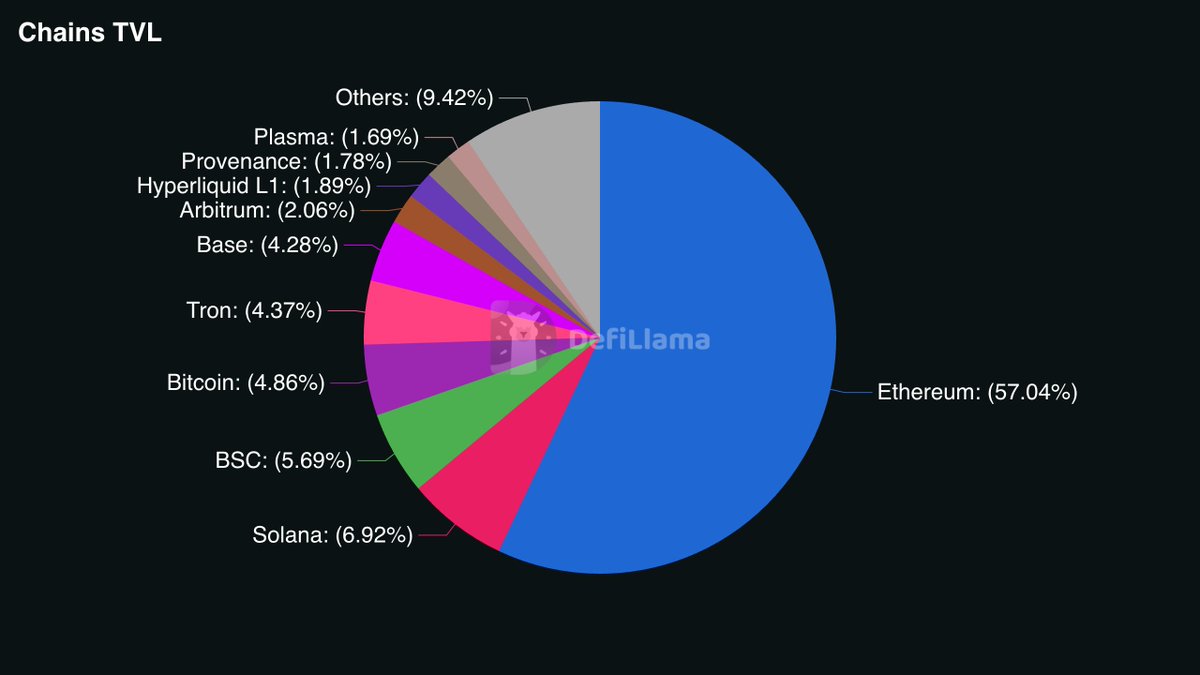
"ETH is still the king" 57% of DeFi TVL lives on Ethereum Source: @DefiLlama
Etherealize tweet media
Etherealize@Etherealize_io

Erik Vorhees: “ETH is still the king, and I don’t see it being dethroned" The founder of ShapeShift and Venice AI is asked if Ethereum was a “sustainable ecosystem.” He replies: “I think [Ethereum] is more than sustainable. I think it is the clear winner of the smart contract innovation. It actually wasn’t the first mover in smart contracts, but it was the first one to achieve any sort of scale with smart contracts. What’s most important about Ethereum isn’t so much the first-mover advantage as much as it is the network effect it has had since it was released.” Erik continues: “I think both Bitcoin and Ethereum have achieved a network effect that is close to unassailable. People have gotten distracted with some of these other L1s, but if you look at metrics like where the developers are and where stablecoin volumes are, these are hard to fake metrics that are very important. They’ve always been predominantly on Ethereum. It’s not even close. I’m glad that other people tried to build L1s. The process of innovation and competition is really important. But ETH is still the king, and I don’t see it being dethroned. It has had various scaling challenges — the patchwork of L2s and the UX problems between them sucks. But I have a suspicion that Base is going to end up becoming the predominant L2 on top of the predominant L1 of ETH and that vertical is going to be very powerful and very strong. So yes, I’m always bullish on ETH in the same way I’m always bullish on Bitcoin.” However, Erik warns that if Base loses its permissionlessness it “will flounder and deserves to die”: “Base has designed things very well. It has gotten a lot of adoption and very quickly became the major L2 even though it was not the first mover. I think it’s gaining a network effect pretty quickly. It obviously has a very powerful corporate ally in Coinbase, and to the degree that Coinbase does not abuse that privilege, that’s a very good privilege. Abuse here means: if Coinbase tries to exert control over base such that it loses its permissionlessness, then it will flounder and deserves to die. But Coinbase has been a very good actor in this regard, and they deserve a lot of credit for demonstrating the principles of decentralization and permissionless innovation in several parts of what they do. Obviously the centralized exchange is not that, but it’s not trying to be either.” Source: @CoinDesk (Dec 2025)

English
24
57
436
23.6K
gphummer.eth
gphummer.eth@gphummer·
The case for a crypto-asset store of value (bearer asset, seizure resistant, transportable anywhere in seconds, etc.) is stronger than it’s ever been. *Something* is going to displace gold. Everyone assumed BTC was the natural winner in this race. What if…?
John Galt@lurkaroundfind

Bitcoin is facing three major problems which Ethereum has already solved. Quantum upgrade: Bitcoin has no central entity to coordinate the quantum upgrade. Moreover, Bitcoin's culture is extremely conservative, which means big changes are socially very difficult. Inaccessible coins: When the quantum upgrade happens, all BTC will need to be moved to new quantum-proof addresses. But there are about 1.7M BTC that are presumed inaccessible, and which are therefore vulnerable to quantum hacking. This creates a dilemma: either miners freeze the coins or quantum hackers will take them. This dilemma will cause huge divisions within the Bitcoin community, similar to the block size war. Economic security problem: As the block subsidy runs out, Bitcoin will become less and less secure. Transaction fees will never replace the subsidy. There are no good solutions to this problem. Fortunately, Ethereum has already solved all these problems. Ethereum Foundation will easily coordinate the quantum upgrade; relative to Bitcoin, there are very few inaccessible ETH quantum hackers will eventually be able to take; and the economic security problem is solved with PoS and effective tail emissions. Culturally speaking, as the years go by Bitcoin is becoming more centralized while Ethereum is becoming more cypherpunk and ossified. On the one hand, look at what Saylor has done to Bitcoin culture. On the other hand, read the recent Ethereum Foundation manifesto. Due to Bitcoin's three major problems and the slowly changing cultures of Bitcoin and Ethereum, I expect ETH to gain a lot of ground against BTC in the coming years. Considering relative market caps, buying ETH today is like buying BTC at $12,200.

English
7
3
48
3.4K
gphummer.eth أُعيد تغريده
nic carter
nic carter@nic_carter·
Elliptic curve cryptography is on the brink of obsolescence. Whether it’s 3 or 10 years; it’s over and we need to accept that The only thing that matters is how quickly blockchain developers recognize that they need to bake in cryptographic mutability into their networks This of course requires an entire reimagining of how these systems work. Today the crypto is hardcoded in. That will have to change ETH people have already figured this out. Everyone else seems to be petrified in fear. Unless something changes quickly ETHBTC will start to reflect the divergence in prioritisation
English
114
104
1.1K
264.9K
gphummer.eth أُعيد تغريده
Etherealize
Etherealize@Etherealize_io·
"Yesterday, the Ethereum Foundation Enterprise team ran the Institutional Ethereum Forum in New York City... BlackRock. Western Union. Robinhood. Moody's. Baillie Gifford. Securitize. All on panels. Not as guests. As participants building on Ethereum."
James | Snapcrackle@Snapcrackle

Fair warning. This post is bullish on Ethereum. Yesterday, the Ethereum Foundation Enterprise team ran the Institutional Ethereum Forum in New York City. Broad Adoption Activated. Invitation only. 100's of Banks, asset managers, and infrastructure providers representing around $250 trillion in assets under management. feedback so far "Absolute banger tbh." "People won't stop talking and networking and the content has all been great." "Your institutional team did an amazing job. I was there. Kudos." BlackRock. Western Union. Robinhood. Moody's. Baillie Gifford. Securitize. All on panels. Not as guests. As participants building on Ethereum. This is what adoption actually looks like. EF also presents its post-quantum security strategy and launches pq.ethereum.org. EF also presented its post-quantum security strategy and launched pq.ethereum.org. This is not just leading blockchain. No major technology platform has a published, open-source post-quantum migration roadmap at this level of detail. Ethereum is doing it before it is required, not after. Proud of the Enterprise team for putting this together. Choose Ethereum.

English
12
33
213
13.1K
gphummer.eth أُعيد تغريده
joshrudolf.eth
joshrudolf.eth@rudolf6_·
1/ How L1 and L2s can build the strongest possible Ethereum tldr: we should continue to lean into the unique capabilities of each layer, and make sure all users have a clear path to securely and seamlessly benefit from the core properties of Ethereum
joshrudolf.eth tweet media
English
61
80
342
119.5K
gphummer.eth أُعيد تغريده
Etherealize
Etherealize@Etherealize_io·
On Monday in NYC: Etherealize will join 150+ executives from major US institutions at the Institutional Ethereum Forum, hosted by @ethereumfndn. $250+ trillion in assets represented in one room to discuss Ethereum's role as infrastructure for the future of finance.
English
48
103
748
255.3K
gphummer.eth أُعيد تغريده
Etherealize
Etherealize@Etherealize_io·
ETH investor Stanley Druckenmiller: “Our whole payment system will be stablecoins in 10-15 years” BitMine (BMNR), the ETH treasury company chaired by Tom Lee, holds more than $10 billion of ETH. Legendary investor Stanley Druckenmiller is listed among key backers like ARK and Bill Miller. This aligns with his recent bullish comments on stablecoins and blockchain payments: “Blockchain and the use of stablecoins — if you want to throw crypto and tokens into that — are incredibly useful in terms of productivity. I assume our whole payment system will be stablecoins in 10-15 years. Efficient. Quicker. Cheaper.” Source: @MorganStanley (Mar 2026)
English
18
64
422
29.5K
gphummer.eth أُعيد تغريده
Etherealize
Etherealize@Etherealize_io·
Erik Vorhees: “ETH is still the king, and I don’t see it being dethroned" The founder of ShapeShift and Venice AI is asked if Ethereum was a “sustainable ecosystem.” He replies: “I think [Ethereum] is more than sustainable. I think it is the clear winner of the smart contract innovation. It actually wasn’t the first mover in smart contracts, but it was the first one to achieve any sort of scale with smart contracts. What’s most important about Ethereum isn’t so much the first-mover advantage as much as it is the network effect it has had since it was released.” Erik continues: “I think both Bitcoin and Ethereum have achieved a network effect that is close to unassailable. People have gotten distracted with some of these other L1s, but if you look at metrics like where the developers are and where stablecoin volumes are, these are hard to fake metrics that are very important. They’ve always been predominantly on Ethereum. It’s not even close. I’m glad that other people tried to build L1s. The process of innovation and competition is really important. But ETH is still the king, and I don’t see it being dethroned. It has had various scaling challenges — the patchwork of L2s and the UX problems between them sucks. But I have a suspicion that Base is going to end up becoming the predominant L2 on top of the predominant L1 of ETH and that vertical is going to be very powerful and very strong. So yes, I’m always bullish on ETH in the same way I’m always bullish on Bitcoin.” However, Erik warns that if Base loses its permissionlessness it “will flounder and deserves to die”: “Base has designed things very well. It has gotten a lot of adoption and very quickly became the major L2 even though it was not the first mover. I think it’s gaining a network effect pretty quickly. It obviously has a very powerful corporate ally in Coinbase, and to the degree that Coinbase does not abuse that privilege, that’s a very good privilege. Abuse here means: if Coinbase tries to exert control over base such that it loses its permissionlessness, then it will flounder and deserves to die. But Coinbase has been a very good actor in this regard, and they deserve a lot of credit for demonstrating the principles of decentralization and permissionless innovation in several parts of what they do. Obviously the centralized exchange is not that, but it’s not trying to be either.” Source: @CoinDesk (Dec 2025)
English
48
97
832
133.1K
gphummer.eth أُعيد تغريده
dannyryan
dannyryan@dannyryan·
fastconfirm.it The fast confirmation rule is incredible So many years in the making. Super excited to see it finally ship!
English
37
111
579
98.3K
gphummer.eth أُعيد تغريده
⟠
@ryanberckmans·
I read a crazy thing this week about America's retirement, health, and needy family benefits. According to the Penn Wharton economist Kent Smetters, America's federal debt-to-gdp ratio would rise from 125% to 300% if the federal pay-as-you-go programs, including social security and medicaid, were fully funded as accruals. What does that mean? The US federal government will spend $4.6 trillion this year on pay-as-you-go programs, or 2/3rds of the whole federal budget. Pay-as-you-go means the programs are funded year to year without consideration for future years. Ie. zero lookahead to match future expected cost growth with a piggy bank of money. For example, military retirement is not pay-as-you-go because it's funded continuously into a pension trust. The trust is designed and expected to cover all future obligations. For social security and other major programs (66% of federal budget), they are funded for this year only. If social security costs are expected to rise next year/decade- and they are majorly- that is next year's/decade's problem. No additional money is saved to ensure these programs remain affordable. Many people already know that - the US fed govt is $39 trillion in debt. - the interest expense on the debt is $1 trillion per year rn. - the debt-to-gdp ratio is a high 125%. - the federal debt is growing by $1.7 trillion per year rn. - programs like social security have a structural shortfall in long term funding. But a mind-blowing fact is just how huge this structural shortfall is. According to Penn Wharton economist Kent Smetters: - if you take the long run shortfall for the current $4.6 trillion annual fed spend on pay-as-you-go programs (eg. from an aging population) - then you pretend the shortfall is fully funded already, not pay-as-you-go - then you pretend that fully amount was funded today using federal debt - result is the debt-to-gdp would go 2.4x from 125% to 300% (!!) These numbers are so huge that extreme political instability and significant real inflation are virtually unavoidable for America. But when? Ray Dalio said "1 to 5 years" last September. Other estimates put social security's heart attack date in early 2030s. Nothing ever happens. Until it does. Personally, I prefer the positive sum reasons to hold ETH. It's the future of the global financial system. But it's also going to be a schelling haven for crazy instability.
English
5
3
26
2.3K
gphummer.eth أُعيد تغريده
RYAN SΞAN ADAMS - rsa.eth 🦄
A truth bomb for you. ETH will never earn fees. Ok, never is a strong word - let me rephrase - ETH won't earn fees anytime soon or in sustained amounts necessary to justify a centa-billion dollar asset. The reason is written in the roadmap. Ethereum intends to massively increase blockspace supply in the coming years. If we get to Justin Drake's gigagas in 5 years, that's a 200x increase in blockspace supply. ETH only generates fees when demand exceeds supply - demand won't outstrip supply during this rapid expansion era, that means low fees. So if your reason for holding ETH is fee generation, sell now - send it to zero. Or...re-consider how to value ETH. Consider what the market is already telling you. What assets don't earn fees but are worth trillions? Gold. Silver. Oil. Bitcoin. Together worth $170 trillion in value. Commodity money and store of value assets aren't priced on their ability to generate fees. They're priced on consumptive usage, and store of value demand relative to their scarcity. ETH is scarce. Lower annual issuance than gold or bitcoin. ETH has store of value demand. A censorship resistant digital money, a cyberpunk money, native to AI and the internet, economic bandwidth for DeFi. You can try to value ETH as a fee generating DCF asset and continue to be confused or you can value it as the market already does. ETH is an emerging commodity money.
RYAN SΞAN ADAMS - rsa.eth 🦄@RyanSAdams

@MikeIppolito_ > However, if ETH is going to go up, it must earn fees. Send it to zero then. It ain't earning fees.

English
109
64
608
109.1K
gphummer.eth أُعيد تغريده
dannyryan
dannyryan@dannyryan·
you go deep, we'll go broad I respect and appreciate the EF clarifying its focus and mandate so that others know what gaps to fill and which alternative threads to follow so we make maximal impact as a collective At @Etherealize_io we'll stay the course and focus on rearchitecting institutional finance from the inside out We are one piece of the diverse machine that will make the deepest and broadest impact possible
Ethereum Foundation@ethereumfndn

Today, the Foundation’s Board released the EF Mandate. This document, which was first intended for EF members, reaffirms the promise of Ethereum, and the role of EF within this ecosystem.

English
65
91
569
159K