Jim Bergquist (httprover2)

16.6K posts

Jim Bergquist (httprover2)

Jim Bergquist (httprover2)

@httprover2

Science and news junkie.

California, USA انضم Aralık 2019
325 يتبع242 المتابعون
Fox News
Fox News@FoxNews·
“The founders fell terribly short of the Declaration’s promise.” Former President Barack Obama took aim at America’s founders during the opening of his presidential center, arguing they left slavery intact and limited political rights despite laying the groundwork for the nation. The remarks come just days before the United States marks its 250th anniversary, as Obama urged Americans to continue the work of building a “more perfect” union.
Fox News tweet media
English
2K
302
1.1K
358.8K
Science Magazine
Science Magazine@ScienceMagazine·
"The goal is not just more capable AI, but AI that is more intelligible, accountable, and aligned with human aims. The window for achieving that future is narrowing," argue Eric Horvitz and Robert West in a new #ScienceEditorial. scim.ag/4ukSMYo
Science Magazine tweet media
English
8
14
37
14.7K
Physics In History
Physics In History@PhysInHistory·
“People like us who believe in physics know that the distinction between past, present, and future is only a stubbornly persistent illusion. Time, in other words, he said, is an illusion.” — A. Einstein (1879-1955)
Physics In History tweet media
English
58
105
539
16.4K
Jim Bergquist (httprover2) أُعيد تغريده
Astronomy Magazine
Astronomy Magazine@AstronomyMag·
Sky Today: June 15 Mercury lines up with Venus, Jupiter, and the Moon in the evening as the small planet also reaches greatest eastern elongation from the Sun. Image credit: Stellarium/USGS/Celestia/Clementine Read more: vist.ly/57rth
Astronomy Magazine tweet media
English
1
19
56
2.7K
Jim Bergquist (httprover2)
@PhysInHistory What is the nature of the vacuum thermodynamically? One would expect energetic particles to be unlikely. But we need to consider what exists in the vacuum and what passes through it. There are energetic photons and subatomic particles. Does binding energy have a temperature?
English
0
0
0
6
Physics In History
Physics In History@PhysInHistory·
The very fabric of space-time at the smallest scales is thought to be extremely turbulent and chaotic, described as a frothy sea called quantum foam. This concept, stemming from quantum mechanics and general relativity, suggests that the very nature of space-time is bubbling with tiny wormholes and fluctuations that appear and disappear within fractions of a second. 📷by Johann Rosario
English
49
88
626
51.1K
Jim Bergquist (httprover2)
@PhysInHistory In physical systems subject to thermal noise how much effort does it take to maintain a given data set of stored information? If memory degrades over time, one would have to oppose the potential changes. In a noisy communications channel, wouldn't any message degrade over time?
English
0
0
0
4
Jim Bergquist (httprover2)
@PhysInHistory Information is stored in physical systems and one might ask what the signal to noise ratio (S/N) is for information. How much work does it take to change each bit of information? More than thermal energy ST where S=k_B ln2, the Boltzmann entropy. Is this like an ideal gas law?
English
1
0
0
99
Physics In History
Physics In History@PhysInHistory·
Erasing one bit of information has a hard physical energy cost. Landauer argued in 1961 that deleting a single bit must dissipate at least kT ln 2 of heat — about 2.9 × 10⁻²¹ J, or 0.018 eV, at room temperature. It went unverified for half a century until a French–German collaboration (ENS Lyon with Kaiserslautern and Augsburg) showed, using a single colloidal particle in a double-well trap, that the dissipated heat saturates exactly at this bound for slow erasures. Information is physical, and forgetting it costs energy. — Bérut et al., Nature 483, 187 (2012).
GIF
English
12
38
174
17.2K
Jim Bergquist (httprover2) أُعيد تغريده
SCOTUS Wire
SCOTUS Wire@scotus_wire·
🚨 The Wisconsin Supreme Court struck down the state's Minority Undergraduate Retention Grant Program, ruling that grants reserved for specified racial and ethnic groups violate the Equal Protection Clause.
SCOTUS Wire tweet media
English
39
628
2.9K
107.3K
Jim Bergquist (httprover2)
@PhilosophyOfPhy Followed by, Hamilton (Apr 1834) On a General Method in Dynamics; By Which the Study of the Motions of All Free Systems of Attracting or Repelling Points is Reduced to the Search and Differentiation of One Central Relation, or Characteristic Function archive.org/details/ongene…
English
0
0
0
9
Jim Bergquist (httprover2)
@PhilosophyOfPhy The 1830 paper gave a characteristic function for geometrical optics. In was soon applied to dynamics. Hamilton (Nov 1833) On a general Method of expressing the Paths of Light, and of the Planets, by the Coefficients of a Characteristic Function #v=onepage&q&f=false" target="_blank" rel="nofollow noopener">books.google.fr/books?id=--44A…
English
1
0
0
10
Philosophy Of Physics
Philosophy Of Physics@PhilosophyOfPhy·
In 1833, a fiercely eccentric Irish mathematician locked himself inside a chaotic observatory in Dublin, quietly plotting a structural revolution against the greatest scientific legacy in human history. Armed only with a fountain pen and a brilliant obsession with optics, he spent his nights under the dim flicker of an oil lamp, single-handedly inventing a radical mathematical engine that would eventually decode the subatomic universe. His name was William Rowan Hamilton. The story of how he completely overhauled the foundations of classical physics is a masterclass in why rigid traditional formulas fail where fluid structural intuition succeeds. In the early 19th century, scientists were trying to calculate the complex movements of multiple gravity-bound planets. But they had a crippling bottleneck: Isaac Newton's standard formulas required calculating massive, individual forces and vectors for every single object. The equations quickly became a tangled, unreadable mess of calculus. The elite professors at Oxford and Paris said the solution was simple: just grind through the brutal paperwork and brute-force the calculations. It didn't work. The mathematical systems routinely collapsed under their own weight. Hamilton looked at the data from his isolated perspective and realized the establishment was blind. They were focusing entirely on the physical forces pushing and pulling the objects. He figured out that motion isn’t a battle of violent forces; it is a ball rolling smoothly through a landscape of total energy. He introduced a bizarre mathematical shortcut now known as the Hamiltonian. Instead of tracking separate forces, he combined a system's total kinetic and potential energy into a single, elegant geometric equation. Suddenly, calculating the path of a planet or a thousand particles, was reduced to tracking a single point moving across a smooth surface of energy. The establishment called his math an unnecessary, abstract detour. They couldn't accept throwing away Newton's familiar formulas for a purely theoretical framework. Hamilton didn't care. He knew that viewing the universe through energy instead of force was a cleaner, more absolute truth. The old guard ignored his framework for decades as a mere novelty. But when the quantum revolution exploded in the 20th century, physicists realized that Newton's formulas were useless at the atomic scale but Hamilton's energy equations mapped the quantum world perfectly. Hamilton did the heavy structural lifting, but later physicists got the textbook fame. The lesson Hamilton left behind is a philosophical blueprint for navigating a complex world: The people who memorize the proper formulas are excellent at solving textbook problems. But they are entirely dependent on the system staying simple. The people who understand the underlying system don't care about the rules. They change the metric from force to energy to find what actually works. Most of us approach our life's problems like the 19th-century scientific establishment. When our careers or projects get complicated, we try to battle every single external force pushing against us. We try harder at a exhausting, brute-force method. But sometimes, the problem isn't that you aren't trying hard enough to fight the forces. The problem is that you need to stop focusing on individual conflicts and start looking at the total energy landscape of your environment. What is a complicated battle in your career right now where you keep trying to fight every opposing force manually? What happens if you stop trying to follow the textbook formula and start shifting your strategy toward the path of least resistance?
Philosophy Of Physics tweet media
English
12
32
147
6.2K
Jim Bergquist (httprover2)
@PhysInHistory Is the madman's mind hyperactive, uncritical, ecstatic with dreams feeding off of dreams? Is he too focused on himself and not burdened by what is evident?
English
1
0
0
10
Physics In History
Physics In History@PhysInHistory·
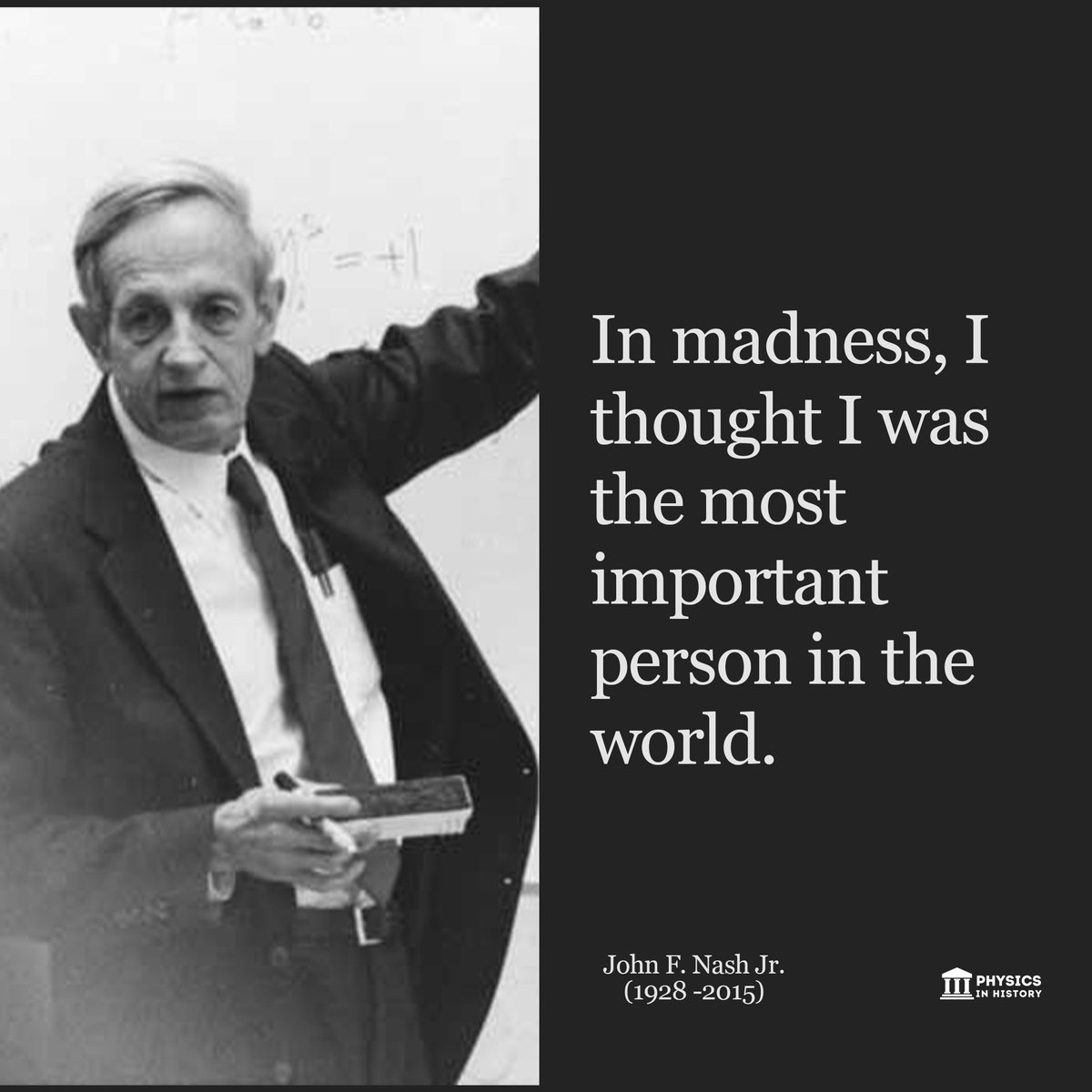
Mathematics and madness 🧠 I think madness can be an escape. If things are not so good, you maybe want to imagine something better. In madness, I thought I was the most important person in the world. I would not dare to say that there is a direct relation between mathematics and madness, but there is no doubt that great mathematicians suffer from maniacal characteristics, delirium and symptoms of schizophrenia. -- John F. Nash (1928-2015)
Physics In History tweet media
English
22
45
314
15.8K
Physics In History
Physics In History@PhysInHistory·
Richard Feynman's definition of a paradox.
Physics In History tweet media
English
16
54
292
14.4K