Kevin O'Connell
57 posts
Kevin O'Connell
@kkoconnell
attorney + coder, building git for lawyers (YC W21)
انضم Ekim 2009
1.2K يتبع88 المتابعون

Yesterday on the Saturday of Saint Lazarus i was baptized in the Eastern Orthodox Church. Glory to God!!!☦️




milk drinker 3.0@milkisgood4you_
Im going to be baptized in the Orthodox church next Saturday :)
English

Some personal news: I’m joining @harvey to lead product. Building an AI-native law firm taught me what lawyers actually need from these tools — turns out that’s a rare skill set. Incredibly excited to work alongside the team to shape what’s next. More soon. 🚀🚀🚀
English
@zackbshapiro @harvey LMAO - you had me there for a second - hilarious!
English

Most of the people who think that AI will replace developers are:
- Managers who don’t code
- Investors and startup founders selling it
- People outside tech
Developers: "It's helpful."
English

A bespoke software revolution? I don't buy it.
It'll exist. It already exists. Small consultants and big consulting firms have made custom software for years. It almost always sucks. It’s bloated, confusing, and because the client pays, it’s built wrong in all the ways.
Who’s excited about bespoke software? Software makers! Of course they're excited about building bespoke software — that's what they do. X is full of them. Your feed is full of people who love making software talking about making software. Of course they’re excited about the revolution. Echo, echo, echo...
Most people don’t like computers. Nobody in tech wants to say that out loud. People tolerate computers. They use them because they have to. Given the choice, most would rather not think about them at all.
So when someone suggests that AI means everyone will build their own custom tools, ask who "everyone" is. The three-person accounting firm drowning in client paperwork? They want the paperwork gone, not a new system to maintain. The regional logistics company with 40 trucks? They want the routes optimized, not Joe spouting off about this new system he’s been messing around with. The law firm billing 70-hour weeks? They want leverage on their time, not a software project to design.
They don’t hate technology. But building and maintaining their own critical systems isn’t their wheelhouse, regardless of how much faster and easier it’s become. It's another job on top of the job.
Will these people use AI? Absolutely, for all sorts of things. Will some outliers go deep and build real custom systems? Sure, but they're almost always people who already had some pull toward software. The curiosity was already there. They were dabblers before.
Giving everyone access to software building tools doesn't mean everyone becomes a builder. A powerful excavator doesn't turn a homeowner into a contractor. Most people just want the hole dug by someone else. They don’t want the responsibility either.
English

We often hold Ancient Egypt to be the pinnacle of the ancient world… but a strange reality is that a Minoan commoner would almost certainly NOT trade places with a common Egyptian.
The Minoan people likely had the wealthiest & highest quality of life anywhere in the ancient world (at least during their time).
It’s shocking that most people don’t even know who the Minoans (2000-1450 BC) were…


English


@RobertBlaszczak @alex_prompter I just think it will evolve. The billable hour survived Word and email. LegalZoom started 24 years ago. CooleyGo offers phenomenal templates for free. Lawyers still get paid to solve problems for their clients.
English

@alex_prompter Thought-provoking and requiring deeper reflection from legal practitioners. There will be a need to interpret and apply AI-generated findings and to establish new laws as the world evolves, but the pricing models won’t withstand the economic reality.
English

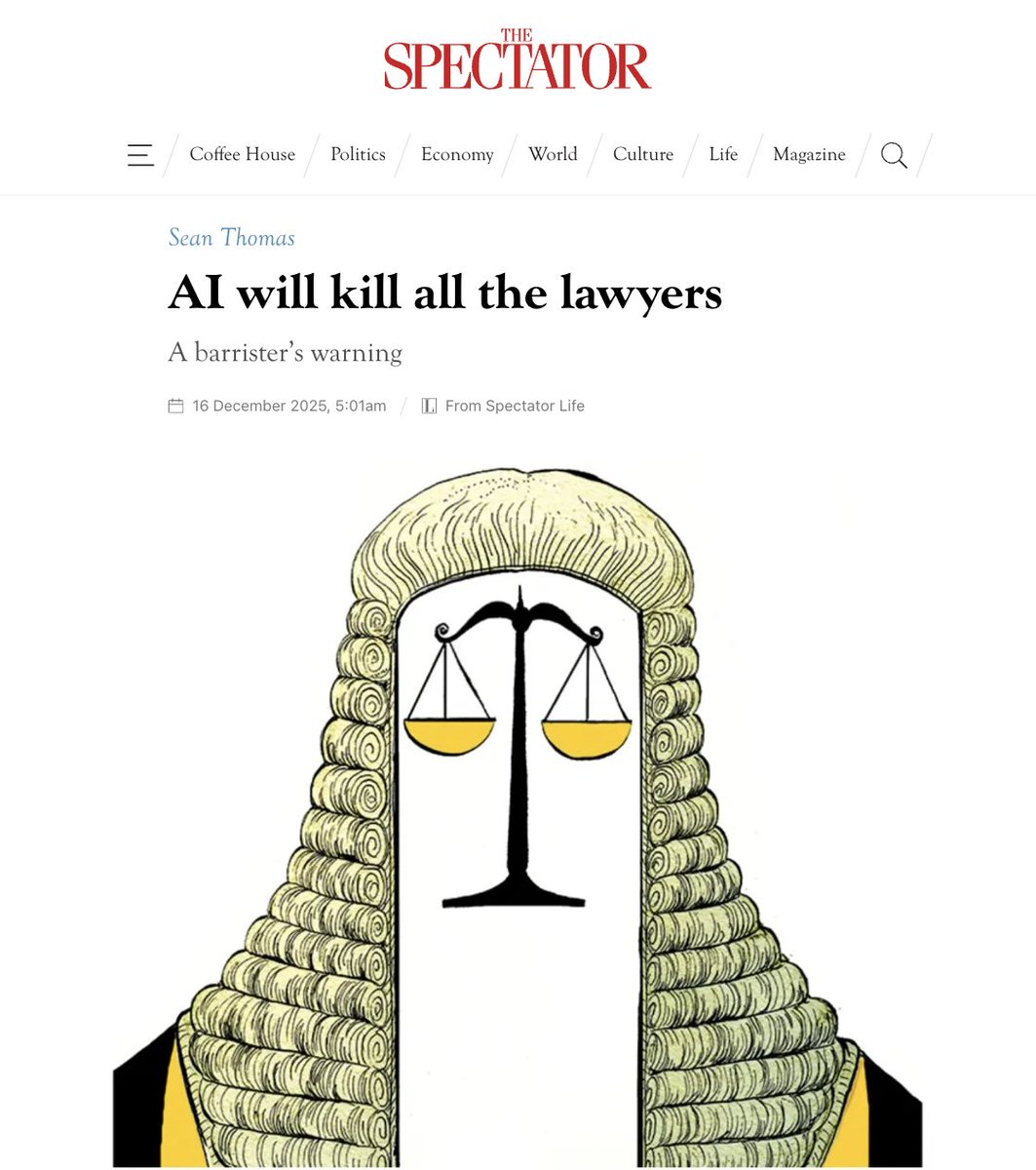
This Spectator piece reads like gossip until you realize it’s actually a warning.
A senior English barrister takes a real appeal he spent a day and a half writing, feeds it to an AI model, and gets back something better in 30 seconds. It matched the standard of the very best barristers, and it did it instantly, for pennies.
That’s the moment the illusion breaks.
Law has always sold itself as irreplaceable because it’s complex, nuanced, and human. But most of the value in modern legal work isn’t wisdom. It’s pattern recognition, structure, precedent matching, argument assembly, and risk framing. That’s exactly the territory AI eats first.
The scary part isn’t that AI can draft contracts or scan case law. That’s already obvious. The scary part is that once the output quality crosses a threshold, the pricing logic collapses. Clients don’t care how many years it took you to become a barrister if the document they receive is objectively worse than something generated in seconds.
So the profession reaches for comfort stories.
“AI is just a tool.”
“There will always be a human in the loop.”
“Judges and clients want a human face.”
Those are emotional arguments, not economic ones. And economics always wins.
The barrister in the piece understands something most of his peers don’t want to admit. Law isn’t protected by status or tradition. It’s protected by cost and friction. Once those disappear, so does the moat.
The first to go are process lawyers. Then drafting specialists. Then advisory roles with no client relationship. Eventually people start asking why they’re paying six figures for a human to read out arguments an AI already wrote better.
What makes this explosive isn’t just unemployment. It’s who lawyers are in society. They sit at the top of institutions. They write rules. They shape policy. They’re used to being indispensable. Replacing them doesn’t just disrupt jobs. It destabilizes power.
That’s why the resistance will be fierce. There will be calls to ban AI. To regulate it out of courtrooms. To slow it down. But you can’t regulate away a cost advantage that large.
The most honest line in the whole piece is the advice to his niece. Don’t take on decades of debt for a career whose core value has already been automated. Not in twenty years. Now.
This isn’t anti law. It’s anti denial.
AI isn’t coming for lawyers because it hates them. It’s coming because much of what they do turned out to be legible, compressible, and cheap.
And once that happens, respect doesn’t save you. Only reality does.
English
@alex_prompter The article relates an anonymous story about documents we don’t get to see. I’m a lawyer / coder and I use LLMs for almost everything. The value comes from many hours of dialectical work with the LLM through many iterations of prompt, output, revision, prompt.
English

Nothing says "I went to law school" quite like spending 45 minutes trying to fix the spacing between paragraphs 17.2(a)(iii) and 17.2(a)(iv), only to accidentally delete your entire table of authorities.
English


@hnwmemes I met him on the subway once in NYC. He said, “You can either have a lot of fun or you can make money.”
English
@GRDecter I’m confused. Earlier in the thread you said they’ve been working on it for 7 years…
English

ChatGPT has now gone viral and reached 1 million users in just 5 days. For context, here’s how long it took other products to reach 1 million users:
Netflix - 41 months
Twitter - 24 months
Facebook - 10 months
Instagram - 2.5 months
English
ChatGPT launched just 5 days ago and already crossed 1 million users.
Here’s what you should know about one of the most disruptive technologies ever created.
🧵👇
English
With artificial intelligence in the news, I asked computer scientists whether lawyers should worry about being replaced by AI.
Should lawyers fear AI? The answer, as with anything involving law and lawyers, is that it depends.
Read more: versionstory.com/blog/should-la…

English
English
I’m excited to share that @jobryan205 and I have been invited to present at the first Legal Tech Fund Summit!
We'll show hundreds of law firms and investors how Version Story makes it easy to compare, track, and merge documents.
See you in Miami 😎
tltfsummit.com/startups
English
@sama the interesting problems these days are harder to solve
experience helps you solve hard problems
English

surprising trend: for years it felt like a substantial fraction of the most impressive tech founders were under 28 or so. in the past few years, very few of them are.
what changed?
English
@the_transit_guy The US passenger rail system looked pretty good up until the 1950s
English

@the_transit_guy Didn’t it used to be run by a for-profit company?
English