mac

1.2K posts

mac banner
mac

mac

@macflapd

community @swellnetworkio | @layer2roundup

aus انضم Nisan 2022
236 يتبع449 المتابعون
mac أُعيد تغريده
Ethereum Foundation
Ethereum Foundation@ethereumfndn·
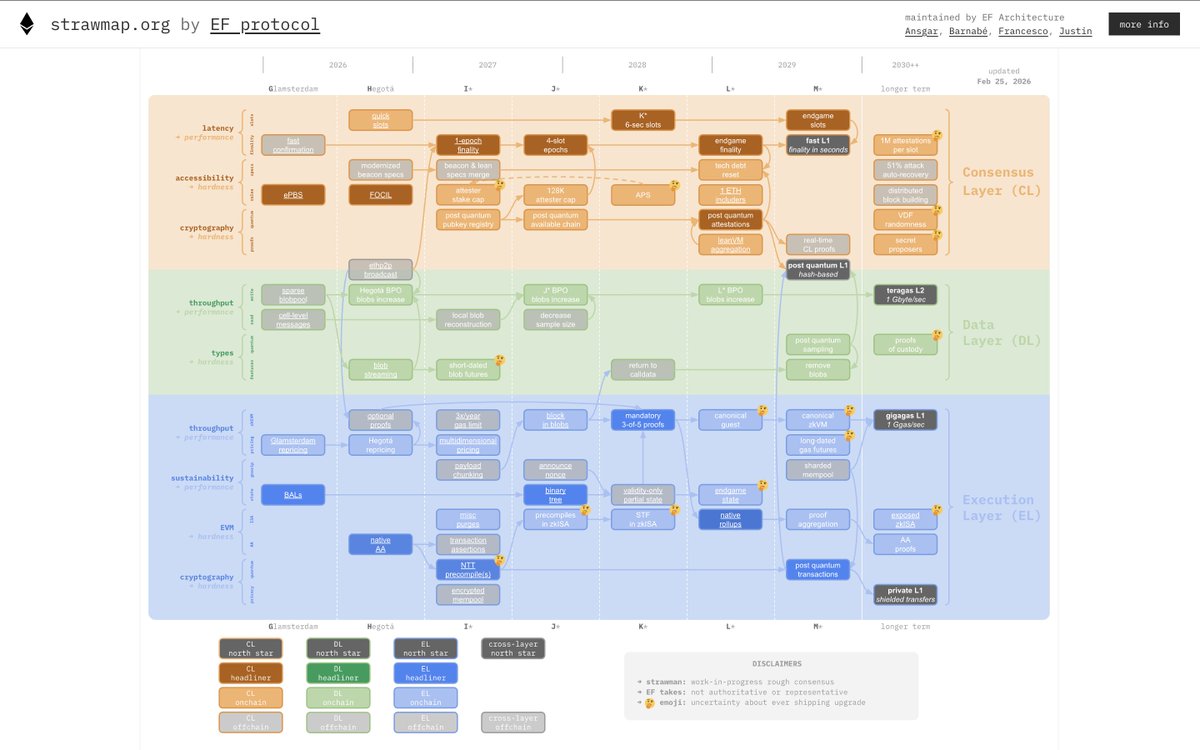
Today, several teams at the EF are launching pq.ethereum.org, a dedicated resource for Ethereum's post-quantum security effort. What started with early STARK-based signature aggregation research in 2018 has grown into a coordinated, multi-team effort, all open source. The Post-Quantum team and Cryptography teams, with help from the Protocol Architecture and Protocol Coordination teams, have been working on this body of work for 8+ years. At pq.ethereum.org you'll find: - How PQ impacts each protocol layer - The full PQ roadmap (strawmap.org) - Open resources: repos, specs, papers, EIPs - FAQ: 14 questions across 5 categories, written by the PQ team - A 6-part lean Ethereum interview series (@zeroknowledgefm) - Interest form for the 2nd Annual PQ Research Retreat (Cambridge, UK, Oct 2026) - 10+ client teams are already building and shipping devnets weekly through PQ Interop. All the work is public and all of it is open. pq.ethereum.org
English
86
243
969
83.8K
mac أُعيد تغريده
Ethereum
Ethereum@ethereum·
From private payments to tokenized funds and AI standards, Ethereum builders kept shipping. Here are 25 things the ecosystem delivered this month. 0/ @payy_link announced Payy Network, a privacy-first Ethereum enabled EVM L2. It features default private token transfers and a cheaper way to build privacy-preserving applications, strengthening Ethereum’s privacy ecosystem. 1/ @RobinhoodApp launched the public testnet for Robinhood Chain, an Ethereum L2 powered by @arbitrum. Institutional settlement on Ethereum rollups continues to bridge traditional finance and public infrastructure. 2/ The @ethereumfndn Protocol Cluster published its 2026 priorities: Scale, Improve UX, and Harden the L1. Ethereum continues coordinating long-term technical upgrades in public to help steward the protocol forward. 3/ @l2beat launched L2BEAT Interop, a dashboard tracking cross-chain connectivity,value, and highlighting interoperability risks, helping the ecosystem stay connected to interoperability progress. 4/ @drakefjustin introduced Strawmap, a roadmap of proposed L1 protocol upgrades. It acts as a technical resource for researchers, developers, and participants in Ethereum governance. 5/ @Starknet integrated Nightfall, bringing confidential institutional DeFi to the Starknet stack. ZK privacy continues advancing Ethereum’s institutional use cases. 6/ @hinkal_protocol enabled private ETH and stablecoin payments on @arbitrum, demonstrating how private transactions are expanding across Ethereum L2s. 7/ @StartaleGroup introduced JPYSC, the first trust bank–backed JPY stablecoin. 8/ The One Trillion Dollar Security Dashboard was released by the @ethereumfndn. It is a comprehensive view of Ethereum’s security across the ecosystem. 9/ @builders_garden introduced Sign In With Agent (SIWA), a trustless identity standard for AI agents. 10/ @blockscout launched a Tor-native onion service: a privacy-first way to observe and verify Ethereum state. Blockscout’s .onion domain for Ethereum provides a way to view blocks, transactions and accounts. 11/ @MetaLeX_Labs launched cyberSign, letting users sign any legal agreement with @ethereum / @base. 12/ @Rocket_Pool activated Saturn One, introducing 4 ETH megapool validators. Improved capital efficiency strengthens Ethereum’s decentralized staking layer. 13/ @BNPParibas launched a euro-denominated money market fund on Ethereum. Tokenized funds on public blockchain infrastructure signal growing institutional confidence in Ethereum. 14/ Tokenized RWAs on Ethereum mainnet surpassed $15B in market cap. 15/ @aave crossed $1 trillion in all-time loans. 16/ @OndoFinance tokenized stocks (SPYon, QQQon) went live as DeFi collateral on @Morpho. Tokenized equities are now usable inside onchain credit markets. 17/ @eulerfinance enabled tokenized equities as collateral, built with @OndoFinance, @SentoraHQ, and @chainlink. Traditional financial exposure is now composable inside Ethereum-native lending markets. 18/ @Uniswap integrated with @Securitize to make @BlackRock’s BUIDL fund tradable via UniswapX. 19/ @LineaBuild sustained 100+ mGas/s throughput, peaking at 218 mGas/s, showing how rollups are scaling Ethereum in practice. 20/ @Starknet released Starkzap, an open-source SDK that turns apps into onchain consumer apps. 21/ @base announced @YCombinator startups can now get funded in USDC on Base. 22/ @Optimism shipped Upgrade 18 setting the foundation for a more performant, customizable, and operationally efficient OP Stack. 23/ @ether_fi released its Android app. Native mobile access lowers the barrier to staking and DeFi participation. 24/ The next Ethereum Community Hub is launching in Rome, hosted by @urbeEth. Local builder ecosystems continue expanding globally.
English
128
235
1.1K
122.7K
mac أُعيد تغريده
L2BEAT 💗
L2BEAT 💗@l2beat·
L2BEAT Monthly Updates are here again! Here’s what defined the ecosystem in February 👇
L2BEAT 💗 tweet media
English
1
4
25
1.8K
mac أُعيد تغريده
vitalik.eth
vitalik.eth@VitalikButerin·
Now, the quantum resistance roadmap. Today, four things in Ethereum are quantum-vulnerable: * consensus-layer BLS signatures * data availability (KZG commitments+proofs) * EOA signatures (ECDSA) * Application-layer ZK proofs (KZG or groth16) We can tackle these step by step: ## Consensus-layer signatures Lean consensus includes fully replacing BLS signatures with hash-based signatures (some variant of Winternitz), and using STARKs to do aggregation. Before lean finality, we stand a good chance of getting the Lean available chain. This also involves hash-based signatures, but there are much fewer signatures (eg. 256-1024 per slot), so we do not need STARKs for aggregation. One important thing upstream of this is choosing the hash function. This may be "Ethereum's last hash function", so it's important to choose wisely. Conventional hashes are too slow, and the most aggressive forms of Poseidon have taken hits on their security analysis recently. Likely options are: * Poseidon2 plus extra rounds, potentially non-arithmetic layers (eg. Monolith) mixed in * Poseidon1 (the older version of Poseidon, not vulnerable to any of the recent attacks on Poseidon2, but 2x slower) * BLAKE3 or similar (take the most efficient conventional hash we know) ## Data availability Today, we rely pretty heavily on KZG for erasure coding. We could move to STARKs, but this has two problems: 1. If we want to do 2D DAS, then our current setup for this relies on the "linearity" property of KZG commitments; with STARKs we don't have that. However, our current thinking is that it should be sufficient given our scale targets to just max out 1D DAS (ie. PeerDAS). Ethereum is taking a more conservative posture, it's not trying to be a high-scale data layer for the world. 2. We need proofs that erasure coded blobs are correctly constructed. KZG does this "for free". STARKs can substitute, but a STARK is ... bigger than a blob. So you need recursive starks (though there's also alternative techniques, that have their own tradeoffs). This is okay, but the logistics of this get harder if you want to support distributed blob selection. Summary: it's manageable, but there's a lot of engineering work to do. ## EOA signatures Here, the answer is clear: we add native AA (see eips.ethereum.org/EIPS/eip-8141 ), so that we get first-class accounts that can use any signature algorithm. However, to make this work, we also need quantum-resistant signature algorithms to actually be viable. ECDSA signature verification costs 3000 gas. Quantum-resistant signatures are ... much much larger and heavier to verify. We know of quantum-resistant hash-based signatures that are in the ~200k gas range to verify. We also know of lattice-based quantum-resistant signatures. Today, these are extremely inefficient to verify. However, there is work on vectorized math precompiles, that let you perform operations (+, *, %, dot product, also NTT / butterfly permutations) that are at the core of lattice math, and also STARKs. This could greatly reduce the gas cost of lattice-based signatures to a similar range, and potentially go even lower. The long-term fix is protocol-layer recursive signature and proof aggregation, which could reduce these gas overheads to near-zero. ## Proofs Today, a ZK-SNARK costs ~300-500k gas. A quantum-resistant STARK is more like 10m gas. The latter is unacceptable for privacy protocols, L2s, and other users of proofs. The solution again is protocol-layer recursive signature and proof aggregation. So let's talk about what this is. In EIP-8141, transactions have the ability to include a "validation frame", during which signature verifications and similar operations are supposed to happen. Validation frames cannot access the outside world, they can only look at their calldata and return a value, and nothing else can look at their calldata. This is designed so that it's possible to replace any validation frame (and its calldata) with a STARK that verifies it (potentially a single STARK for all the validation frames in a block). This way, a block could "contain" a thousand validation frames, each of which contains either a 3 kB signature or even a 256 kB proof, but that 3-256 MB (and the computation needed to verify it) would never come onchain. Instead, it would all get replaced by a proof verifying that the computation is correct. Potentially, this proving does not even need to be done by the block builder. Instead, I envision that it happens at mempool layer: every 500ms, each node could pass along the new valid transactions that it has seen, along with a proof verifying that they are all valid (including having validation frames that match their stated effects). The overhead is static: only one proof per 500ms. Here's a post where I talk about this: ethresear.ch/t/recursive-st… firefly.social/post/farcaster…
English
803
1K
5.7K
903.7K
mac أُعيد تغريده
Justin Drake
Justin Drake@drakefjustin·
Introducing strawmap, a strawman roadmap by EF Protocol. Believe in something. Believe in an Ethereum strawmap. Who is this for? The document, available at strawmap[.]org, is intended for advanced readers. It is a dense and technical resource primarily for researchers, developers, and participants in Ethereum governance. Visit ethereum[.]org/roadmap for more introductory material. Accessible explainers unpacking the strawmap will follow soon™. What is the strawmap? The strawmap is an invitation to view L1 protocol upgrades through a holistic lens. By placing proposals on a single visual it provides a unified perspective on Ethereum L1 ambitions. The time horizon spans years, extending beyond the immediate focus of All Core Devs (ACD) and forkcast[.]org which typically cover only the next couple of forks. What are some of the highlights? The strawmap features five simple north stars, presented as black boxes on the right: → fast L1: fast UX, via short slots and finality in seconds → gigagas L1: 1 gigagas/sec (10K TPS), via zkEVMs and real-time proving → teragas L2: 1 gigabyte/sec (10M TPS), via data availability sampling → post quantum L1: durable cryptography, via hash-based schemes → private L1: first-class privacy, via shielded ETH transfers What is the origin story? The strawman roadmap originated as a discussion starter at an EF workshop in Jan 2026, partly motivated by a desire to integrate lean Ethereum with shorter-term initiatives. Upgrade dependencies and fork constraints became particularly effective at surfacing valuable discussion topics. The strawman is now shared publicly in a spirit of proactive transparency and accelerationism. Why the "strawmap" name? "Strawmap" is a portmanteau of "strawman" and "roadmap". The strawman qualifier is deliberate for two reasons: 1. It acknowledges the limits of drafting a roadmap in a highly decentralized ecosystem. An "official" roadmap reflecting all Ethereum stakeholders is effectively impossible. Rough consensus is fundamentally an emergent, continuous, and inherent uncertain process. 2. It underscores the document's status as a work-in-progress. Although it originated within the EF Protocol cluster, there are competing views held among its 100 members, not to mention a rich diversity of non-EFer views. The strawmap is not a prediction. It is an accelerationist coordination tool, sketching one reasonably coherent path among millions of possible outcomes. What is the strawmap time frame? The strawmap focuses on forks extending through the end of the decade. It outlines seven forks by 2029 based on a rough cadence of one fork every six months. While grounded in current expectations, these timelines should be treated with healthy skepticism. The current draft assumes human-first development. AI-driven development and formal verification could significantly compress schedules. What do the letters on top represent? The strawmap is organized as a timeline, with forks progressing from left to right. Consensus layer forks follow a star-based naming scheme with incrementing first letters: Altair, Bellatrix, Capella, Deneb, Electra, Fulu, etc. Upcoming forks such as Glamsterdam and Hegotá have finalized names. Other forks, like I* and J*, have placeholder names (with I* pronounced "I star"). What do the colors and arrows represent? Upgrades are grouped into three color-coded horizontal layers: consensus (CL), data (DL), execution (EL). Dark boxes denote headliners (see below), grey boxes indicate offchain upgrades, and black boxes represent north stars. An explanatory legend appears at the bottom. Within each layer, upgrades are further organized by theme and sub-theme. Arrows signal hard technical dependencies or natural upgrade progressions. Underlined text in boxes links to relevant EIPs and write-ups. What are headliners? Headliners are particularly prominent and ambitious upgrades. To maintain a fast fork cadence, the modern ACD process limits itself to one consensus and one execution headliner per fork. For example, in Glamsterdam, these headliners are ePBS and BALs, respectively. (L* is an exceptional fork, displaying two headliners tied to the bigger lean consensus fork. Lean consensus landing in L* would be a fateful coincidence.) Will the strawmap evolve? Yes, the strawmap is a living and malleable document. It will evolve alongside community feedback, R&D advancements, and governance. Expect at least quarterly updates, with the latest revision date noted on the document. Can I share feedback? Yes, feedback is actively encouraged. The EF Protocol strawmap is maintained by the EF Architecture team: @adietrichs, @barnabemonnot, @fradamt, @drakefjustin. Each has open DMs and can be reached at first.name@ethereum[.]org. General inquiries can be sent to strawmap@ethereum[.]org.
Justin Drake tweet media
English
205
414
1.6K
600.8K
mac
mac@macflapd·
30% of the ETH supply is now staked, and this number is only expected to rise. Why? Because protocols like @Obol_Collective and @Rocket_Pool are prioritising decentralisation and technology that is ready for broader adoption. Bullish.
English
1
1
9
275
mac أُعيد تغريده
liam
liam@daddysether·
ETH is superior to BTC when it comes to usability. As an asset, it's natively productive, and unlike BTC mining where the barrier to entry is astronomically high, participating in ETH staking is accessible to anyone with any amount of ETH. Native ETH yield is for everyone.
English
25
17
193
8.7K
mac أُعيد تغريده
mac أُعيد تغريده
Layer 2 Roundup
Layer 2 Roundup@Layer2Roundup·
🔮 Today in Layer 2 Ethereum 🔮 - @Starknet integrate Nightfall 🌃 - @base batch round 003 is open for builders 🛠️ - @GenLayer launches the Court of the Internet on @base 🔥 - And much more! 👇
English
2
3
8
709